One Property, Several Exposures
Asking whether limestone or basalt is better for the Turks and Caicos Islands is the wrong question, because a single Grace Bay villa contains four or five different exposures within a hundred yards of each other. The beach frontage, the pool deck, the shaded courtyard, the driveway and the service yard all face different loads. Choosing one material for all of them guarantees that some zones get the wrong stone.
A better approach is to map the exposures first, then assign a material and a thickness to each one.
How the Two Stones Differ
Both are sound choices in a salt-air climate when the grade is right. They simply behave differently, and the differences are predictable.
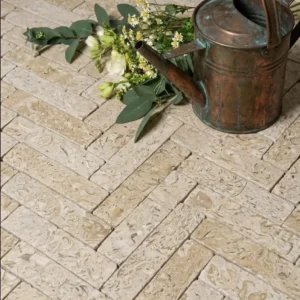
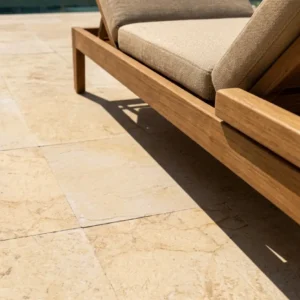
- Limestone is pale, calm and cooler underfoot, which matters where people walk barefoot.
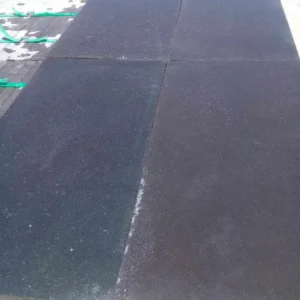
- Basalt is dark, dense and volcanic, and it takes concentrated wheel loads without complaint.
- Pale stone hides salt bloom and dust; dark stone hides oil, tire marks and general grime.
- Basalt stores heat and holds it into the evening, which is welcome on a terrace and punishing at a pool.
- Both should be specified by documented absorption and density, not by material name alone.
Beach Frontage and Full Spray
The most exposed zone on any island property is the one facing open water. Salt arrives constantly, dries fast in the sun and works into whatever pore structure it finds. Here the deciding factor is not color at all; it is how tight the material is and how the units are bedded. A dense basalt and a low-absorption limestone both perform, and both fail if laid dry on an exposed frontage where surge can get underneath.
What actually decides this zone is the fixings and the build-up. Stainless only, no cast zinc alloys, bonded and restrained rather than loose, and drainage sized for a storm rather than a shower. The building codes across these islands were strengthened after Hurricane Ike in 2008, and the performance seen through Hurricane Irma in 2017 suggested that was money well spent. Paving deserves the same seriousness as the roof, because an exposed terrace is the first thing surge reaches.
Pool Decks and Barefoot Zones
This is where limestone earns its place decisively, and it is worth being blunt about why.
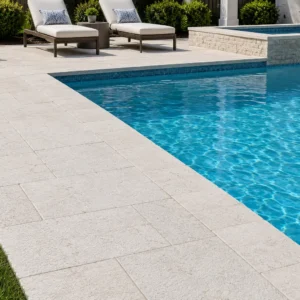
- Pale tone reflects more sunlight and runs cooler on a surface crossed by bare feet all day.
- Dark basalt in the same position stores heat and stays uncomfortable long into the evening.
- A brushed or bush-hammered limestone face gives grip without the harshness of a rough texture.
- Pale stone reads better against turquoise water and bright sand, which matters commercially.
The limestone units sized for terraces we carry are listed by format and finish so a deck and a coping detail can be planned together.
Driveways, Turning Areas and Service Yards
The zones walked in shoes and driven on are where basalt makes the strongest case. Turning circles concentrate load at specific points, delivery vehicles and construction traffic are harder on paving than any owner is, and dark stone forgives the marks that lighter surfaces broadcast.
- Increase thickness before increasing unit size wherever vehicles turn rather than roll straight.
- Give the field a proper restrained edge, because loose perimeters fail first under turning loads.
- Keep the darkest tones away from any route people cross barefoot between water and building.
- Match the bedding to the traffic, since a paver rated for cars still needs a base rated for them.
Where the load is genuinely heavy, dark basalt for driveways and turning areas is the straightforward answer.
Courtyards, Shade and Interiors
Enclosed courtyards and covered loggias change the calculation again. Direct sun is limited, so the heat argument weakens and tone becomes a design decision rather than a comfort one. Basalt reads well in a shaded courtyard, where its depth of color makes planting and water features stand out. Limestone keeps enclosed spaces feeling open and bright, which is usually the intent in a villa with small windows on the leeward side.
Interiors follow the same logic with one addition: whatever goes inside should relate to what runs outside the door, so thresholds do not read as a hard stop. A common and successful arrangement runs one pale limestone from the living space out onto the terrace in the same format, then switches to basalt at the point where the surface starts taking wheels. The eye accepts that change because it lines up with a change of use.
Mixing Them Without a Patchwork
Using both materials on one property is normal and looks deliberate when handled with discipline.
- Change material at a real boundary such as a gate, a step or a planting bed, never mid-run.
- Keep the module consistent so joints line through where the two surfaces meet.
- Use one of the two as a border or banding to tie the scheme together.
- Hold the finish family constant, since mixing a honed and a heavily textured face reads as an accident.
Zoning the Plan Before You Order
Freight into these islands is expensive and slow enough that ordering twice is a serious setback, so do the zoning exercise on paper before anything is confirmed. Mark each area with its exposure, its traffic and its bare-foot status, then assign material, finish and thickness. Order Providenciales delivered, and price any outer-island leg separately as its own barge movement. Choose the stone for the zone rather than the property, and both materials will do exactly what they are good at.