Ground That Falls Away
Most building plots in the Territory sit on a slope. The British Virgin Islands are hilly to mountainous across the majority of the islands, and housing is dispersed along those hillsides rather than gathered on flat coastal land. That one condition shapes every hardscape decision on Tortola and Virgin Gorda. Paving here is rarely a tidy rectangle behind a house; it is a run of terraces, ramps, landings and turning spaces stitched into a grade, and each element meets the next at an awkward angle.
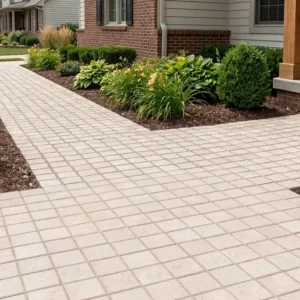
Small units answer that geometry better than large ones. A cobble sett can be rotated, tilted a fraction and coursed around a change in level without a single saw cut. Where a wide slab would rock on a hollow or demand a thick bedding wedge, a sett takes the fall and keeps going.
Read the Fall Before You Order
Quantities set from a floor plan alone come up short on sloping ground, because the finished surface is longer than its plan shadow. Walk the site with a level and a tape first, and write down five things.
- Total fall across the paved area, corner to corner, in feet.
- Every point where the fall changes direction, since setts course across a break far more easily than they bridge one.
- Finished levels already fixed by doors, gates, steps and pool coping.
- The narrowest point a loaded truck has to pass on the approach road.
- Where terrace water is meant to go once it leaves the paving.
Bedding and Restraint on a Grade
On a slope, gravity works on paving quietly every day and violently in a storm. Setts laid loose on sand creep downhill: joints open at the head of the run, close at the foot, and the courses look tired inside a season. Above a gentle fall, bedded construction on a properly formed base with positive restraint at every free edge is the only method worth paying for. Restraint means a buried curb, a concrete haunch or a structural edge that the lowest course pushes against and cannot pass. We size graded setts for steep plots around that detail rather than treating the edge as an afterthought, because the edge decides how the whole field behaves.
Joints, Water and the Cistern
More than nine in ten households in the Virgin Islands harvest rainwater, collected off roofs into cisterns usually built into the foundation of the house. Desalination carries the rest, with five plants on Tortola and the first installed in 1988. In a place that stores what falls on it, paving belongs to the water system rather than sitting outside it.
- Fall terraces toward a clean collection line, not blindly toward the downhill boundary.
- Keep jointing stable so fines are not washed into a channel that feeds storage.
- Separate catchment surfaces from areas that carry vehicles and their drips.
- Give steps and landings enough cross fall that water leaves before it sheets over a nosing.
What Irma Left Behind
Hurricane Irma crossed the British Virgin Islands directly on 6 September 2017 as a Category 5 storm, with sustained winds reaching 185 mph. Around 85 percent of the housing stock, roughly 4,200 homes, was damaged or destroyed, and Hurricane Maria passed to the south as a Category 5 only two weeks later. Damage was estimated at 3.6 billion US dollars and power returned slowly. Buildings put up to current codes performed markedly better than older stock, and roofing structures were the clearest weakness. Hardscape carries the same lesson in miniature: anything light, loose or unrestrained can become a projectile, so unit weight, bedding and edge detail are safety questions on exposed hillside ground.
Getting Stone to a Hillside Site
Access is the cost nobody prices until it bites. Cargo from the mainland lands at Port Purcell in Road Town, and the villa roads above it are steep, narrow and full of switchbacks.
- Tropical Shipping sails a direct service from Palm Beach, Florida to Tortola, leaving Fridays and arriving Thursdays on a six-day transit.
- No transshipment is required for cargo of US origin, which keeps handling damage low.
- Loads for Virgin Gorda, Anegada or Jost Van Dyke take an onward inter-island leg from Tortola.
- Traffic keeps left, yet most trucks are left-hand drive and imported from the United States, so US pallet handling practice applies at the gate.
Tell the Virgin Islands supply desk the turning radius at your gate before the crate list is fixed, and pack sizes can be built to suit the last hundred feet.
Formats That Suit Falling Ground
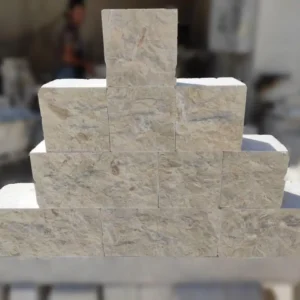
Sett formats do not all behave the same way on a grade. Depth and face size trade against one another.
- Deeper units resist rocking and rotation where a ramp meets a landing.
- Smaller faces follow a warped surface with less lipping between neighbors.
- Textured faces give grip where an occasional downpour sheets across a slope.
- Sorted, consistent depths cut bedding labor, which matters when material is carried by hand up a bank.
Who Signs the Drawings
Development in the Virgin Islands runs under the Physical Planning Act, 2004. The Town and Country Planning Department reviews an application and carries out a field visit, and the Planning Authority makes the decision. A locally registered architect or surveyor has to file the application, which means an overseas owner is never the only voice in a specification. That local professional is the person who will carry your sett depths, bedding notes and edge details into the drawing set, so send the technical sheet early rather than after the crates land. Slope work rewards the team that settles the edge detail before the first course is bedded.