
Large granite block sizes and weight aren’t uniform across the industry — there’s no single “standard” block, and that gap between expectation and reality is where most project delays happen. Specifiers who build a materials schedule around generic dimensions and then discover their actual blocks run heavier or longer than assumed end up with under-engineered bases, delivery access conflicts, and setting crews that can’t maneuver units safely. The breakdown below gives you the real dimensional and mass variables that govern granite block specification, so your project schedule and structural design reflect what’s actually arriving on site.
What Defines a Granite Block?
Granite, governed by ASTM C615 (Standard Specification for Granite Dimension Stone), is a coarse-grained igneous rock quarried in large primary masses and then sawn or split into usable forms. The Natural Stone Institute granite specifications outline the classification criteria, but dimensional tolerances in the field are set at the quarry level and vary between sources. That means two blocks labeled the same nominal size can differ meaningfully in finished dimension — a detail worth confirming on your shop drawings before fabrication.
Granite’s density is what drives its mass per unit volume. The stone’s mineralogy — predominantly quartz, feldspar, and mica — produces a dense, low-porosity structure, and that density is consistent enough across a single quarry run that you can build a reliable weight estimate once you know the block’s finished dimensions. Where you get into trouble is assuming a standard density without confirming it against the actual source material.
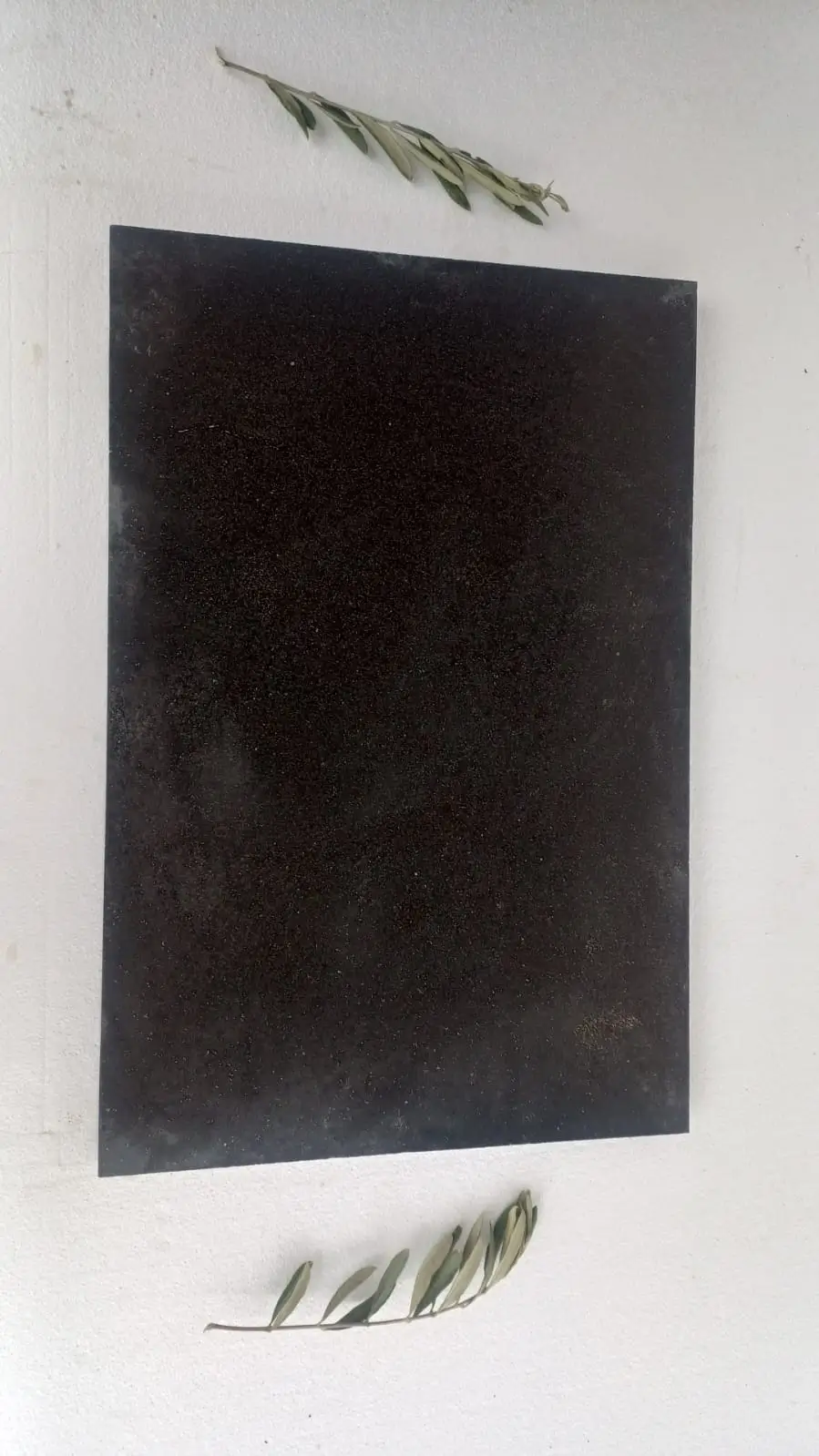
Common Dimensions for Large Granite Blocks
Large granite block sizes span a wide range of formats, and the category you’re working with determines how you calculate weight and plan your base. Here are the dimensional families you’ll encounter most often in commercial and landscape work:
- Quarry blocks (primary extraction): typically 60 × 36 × 24 in (roughly 1500 × 900 × 600 mm) up to 120 × 60 × 48 in (3000 × 1500 × 1200 mm) — these are raw blocks sawn for further processing
- Retaining wall blocks: commonly 24 × 12 × 12 in (600 × 300 × 300 mm) or 36 × 18 × 18 in (900 × 450 × 450 mm), though custom-cut blocks run to 48 in (1200 mm) in length on large commercial retaining projects
- Landscape feature blocks: 24 × 24 × 24 in (600 × 600 × 600 mm) cubic forms are a standard request for seating ledges, edge markers, and water feature bases
- Stepping and bridge blocks: 48–72 in long × 18–24 in wide × 6–8 in thick (1200–1800 mm × 450–600 mm × 150–200 mm) — the span governs the thickness here, not just aesthetics
- Curbstone and edging blocks: 24–48 in long × 6–8 in wide × 6–10 in deep (600–1200 mm × 150–200 mm × 150–250 mm)
Your project drawings should specify finished dimensions with a stated tolerance — ±⅛ in (3 mm) is achievable on sawn faces; split faces carry a wider natural tolerance you need to account for in joint design. Never let nominal dimensions drive your structural calculations. Always use confirmed finished dimensions from the fabrication schedule.
How to Calculate Granite Block Weight
The calculation is straightforward once you have your confirmed dimensions and a density figure from your source material. Granite’s density varies by mineralogy and source quarry, so the approach below gives you a working method rather than a fixed number to plug in blindly.
Your weight estimate follows this sequence:
- Obtain the confirmed density of your specific granite from your supplier — request the value in pounds per cubic foot (lb/ft³) or kilograms per cubic meter (kg/m³) alongside the material specification
- Calculate block volume in cubic feet: (length in inches × width in inches × height in inches) ÷ 1,728
- Multiply volume (ft³) × density (lb/ft³) = weight in pounds
- For metric: volume in m³ × density in kg/m³ = weight in kg; convert to pounds by multiplying by 2.205 for US site use
- Add a contingency — sawn face tolerances and natural density variation within a quarry run can shift individual block weights by several percent from the nominal
To illustrate the method: a 24 × 12 × 12 in block at a density of 165 lb/ft³ works out to approximately 275 lbs. The same block at 170 lb/ft³ — still within the range for granite — comes in around 283 lbs. That’s a small difference per block, but across a 200-block retaining wall it compounds into a material tonnage figure your engineer needs to know. The USGS dimension stone production data documents how widely granite’s physical properties vary by source region, which is exactly why you confirm density with your supplier rather than defaulting to a textbook value.
Practical Weight Ranges by Block Format
These ranges reflect real project experience across a variety of granite sources and give your team a planning baseline. Treat them as a starting bracket for preliminary scheduling — not as confirmed weights for structural design.
- Retaining wall block (24 × 12 × 12 in): approximately 200–300 lbs per unit
- Retaining wall block (36 × 18 × 18 in): approximately 680–750 lbs per unit
- Cubic landscape block (24 × 24 × 24 in): approximately 800–950 lbs per unit
- Stepping block (60 × 24 × 8 in): approximately 820–960 lbs per unit
- Bridge or feature block (72 × 24 × 10 in): approximately 1,250–1,450 lbs per unit
- Quarry primary block (60 × 36 × 24 in): approximately 3,500–4,200 lbs per unit
Blocks in the 800–1,000 lbs range represent the threshold where most standard telehandler attachments are operating near their rated lift capacity. Your lifting and setting plan needs to reflect actual confirmed weights, not the lower end of a planning range. Brief your setting crew on the confirmed weight per block before work begins — it changes rigging hardware selection, lift angle limits, and working-radius calculations.
Delivery, Site Access, and Offloading Considerations
Large granite block sizes and weight create logistical constraints that run from the access road all the way to the final placement point. Truck access is the first variable to resolve — a fully loaded delivery carrying a quantity of large retaining wall blocks or cubic landscape blocks can reach a gross vehicle weight that restricts access to routes rated for that load class. Your project’s access constraints should be communicated to the supplier when you confirm dimensions and delivery scheduling, so offloading arrangements are planned before the delivery date rather than improvised on arrival.
Key site-access factors to resolve early:
- Bridge and culvert load ratings on your access route — verify these with your local authority before the delivery date
- Turning radius for the delivery vehicle at your site entry — large-format block deliveries typically arrive on flatbed or step-deck equipment that requires a wider sweep than a standard rigid vehicle
- Offloading zone — confirm a level, compacted area that can support the combined weight of the vehicle and its load; soft ground or slopes create tipping hazards during crane-off or forklift operations
- Crane or forklift capacity on site — confirm rated lift capacity against the heaviest single block in your order
- Staging proximity — blocks set down in the wrong sequence create double-handling; agree a stacking layout before the delivery arrives
Lead times are quoted with the order and depend on your block specifications, quarry run schedule, and delivery routing. Citadel Stone cuts blocks to order at our selected quarries, so confirmed dimensions and confirmed delivery access details both need to be in hand before production begins.
Granite Block Formats and Landscape Design Integration
Block size selection isn’t purely a structural decision — the dimensional proportions of your granite units shape the visual character of the finished landscape in ways that matter to architects and landscape designers as much as to engineers. A 36 × 18 × 18 in retaining wall block reads as a bold, monolithic horizontal course; a 24 × 12 × 12 in block laid in a running bond introduces more visual rhythm and suits smaller-scale residential settings. These are real design variables, not secondary concerns.
Landscape design styles influence block format choices in specific ways:
- Modern minimalist schemes — where clean lines and strong geometric shadow gaps define the aesthetic — typically specify larger-format blocks with tight-tolerance sawn faces; a uniform gray or black granite in a bush-hammered finish reads as intentionally architectural rather than naturalistic
- Desert and xeriscaping compositions benefit from warmer granite tones and rougher split-face textures that echo the natural rock outcrops of the surrounding landscape; here, block size variation within a retaining feature can read as an intentional design move rather than inconsistency
- Traditional colonial or formal estate landscapes often call for dressed blocks in consistent coursing — a 24 × 12 in face dimension with a chiseled edge gives the regularity those schemes require without looking machine-made
- Tropical or lush garden settings use large stepping blocks and cubic seat blocks as counterpoint to dense planting; a single 60 × 24 × 10 in stepping block embedded in a planted grade reads as a found-object element, and the mass reinforces permanence
For wall cladding and feature block applications in landscape design, consider how your finish interacts with the block’s dimensional proportions. A split-face finish on a large block exaggerates depth and shadow; a bush-hammered finish on the same block reads more uniformly and suits contemporary schemes. Finish choice belongs in the design brief alongside dimensional choice — not as an afterthought.
For projects where the same granite material is being used in modular formats alongside larger feature blocks, Granite Bricks from Citadel Stone offer a compatible smaller-format option that ties in naturally with large block coursework.
Basalt Blocks as an Alternative Format
Not every project brief that calls for large stone block work is committed to granite by material specification. Basalt — a fine-grained extrusive volcanic rock formed by rapid cooling of lava — produces dense, visually uniform blocks that work in many of the same landscape and structural applications. The USGS overview of igneous rocks explains how rapid surface cooling keeps basalt’s crystal structure fine and even, which is what gives a basalt block its consistent face texture across a wall or paving run.
Citadel Stone’s Black Basalt Belgian Block is a format worth reviewing when your project calls for a compact, heavy-duty unit with a consistent dark face. The Black Basalt Split-Face Belgian Block introduces a natural texture plane that works well in retaining features and feature walls where the split profile creates depth and shadow. For applications where surface texture and water management are both relevant — ramp entries, hardscape borders, public plaza edging — the Black Basalt Bush-Hammered Stone delivers a mechanically worked face in the same dense basalt material. These are distinct product formats, not finishes applied to the same unit, so confirm the correct product against your specification before ordering.
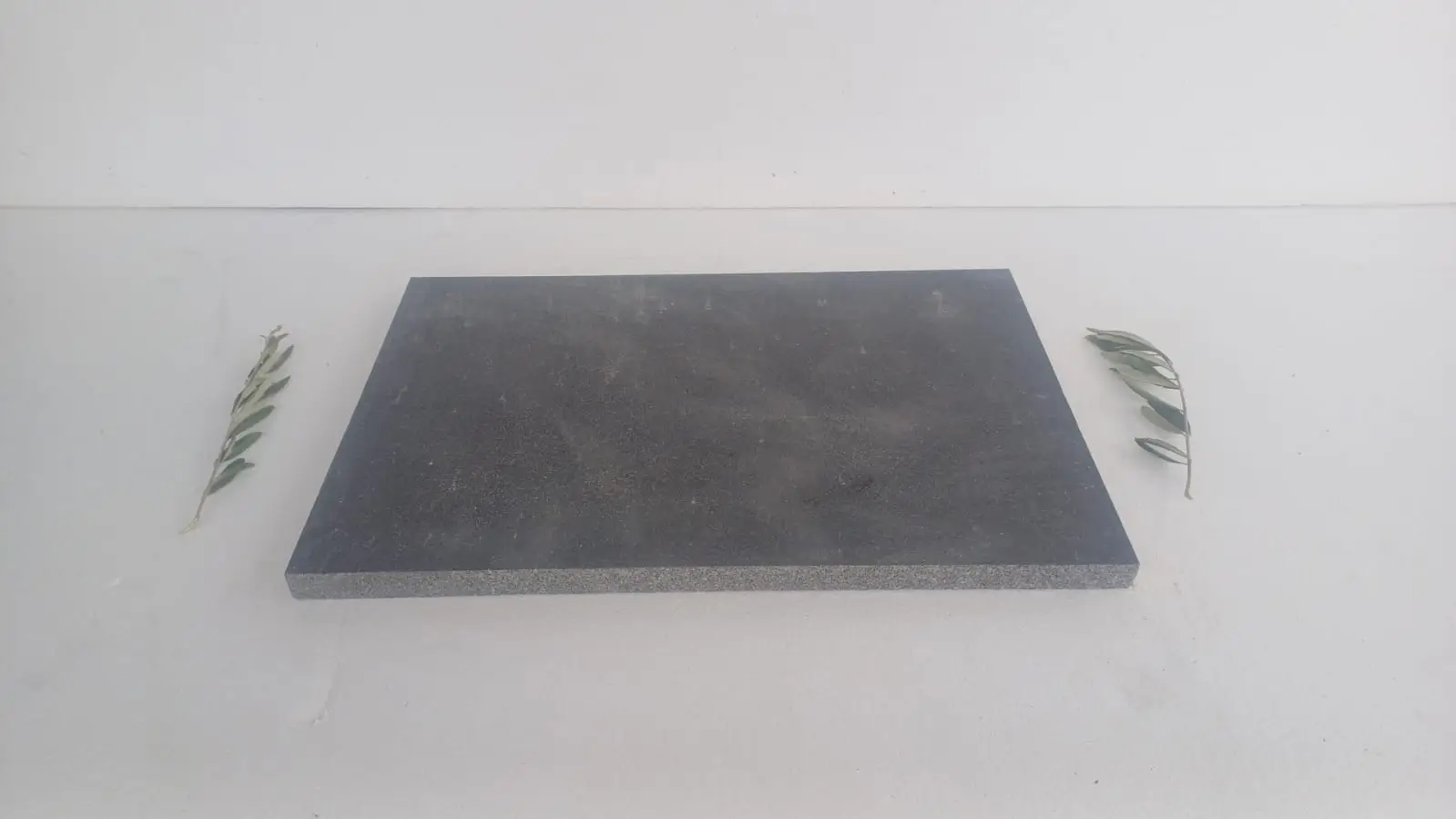
Base Preparation for Large Granite Blocks
Base preparation requirements scale with block weight, and this is where large granite block weight has a direct structural consequence that many residential landscape contractors underestimate. A 24 × 24 × 24 in cubic block approaching 900 lbs concentrates significant point load at its contact area. The bearing capacity of your compacted base needs to be engineered for that load, not assumed adequate because the block looks stable once placed.
Your base specification should account for:
- Existing soil bearing capacity — have your geotechnical report or probe data in hand before you finalize base depth; clay-dominant soils compress under sustained point loads in ways that granular soils don’t
- Frost penetration depth in your region — retaining blocks and large landscape features set above the frost line in freeze-thaw regions will heave and settle cyclically; your base depth needs to extend below that line or your engineer needs to design for the movement explicitly
- Drainage geometry — water trapped under or behind large blocks accelerates joint deterioration and can build hydrostatic pressure behind retaining features; your drainage detail is as critical as your structural depth
- Compaction verification — large blocks placed on inadequately compacted base can tilt or settle differentially; get compaction confirmed at the specified depth before placement begins, not after blocks are in position
For retaining wall applications, your structural engineer governs the foundation and drainage specification — the block’s size and weight feeds into that calculation as an input, not as a standalone answer. Never assume that large granite block weight is itself the structural solution; it’s part of the design equation.
How to Specify Large Granite Blocks Correctly
When comparing large granite blocks for sale, ask each supplier to state finished dimensions, source density, and applicable tolerances in writing so you can evaluate offers on the same basis. Getting your specification right before you request pricing saves significant re-work downstream. A complete specification for large granite blocks covers more than finished dimensions — it includes finish, tolerancing, packing and stacking requirements, and the material standard the stone must conform to.
Your specification package should include:
- Finished dimensions with stated tolerances — distinguish between sawn-face tolerances (tighter) and split-face tolerances (wider natural variation)
- Material standard reference — ASTM C615 (Standard Specification for Granite Dimension Stone) is the governing standard for granite dimension stone in the US; include this in your spec
- Finish specification — sawn, bush-hammered, split face, or honed; specify each face independently if they differ (e.g., exposed face bush-hammered, bed and back sawn)
- Color and veining range — provide a physical sample or digital reference approved by the design team; color variation within a single quarry run is natural, but your spec should state acceptable limits
- Weight confirmation requirement — request confirmed block weight per unit from the supplier based on finished dimensions and actual source density; this feeds directly into your lifting plan and delivery scheduling
- Packing and stacking notes — large blocks delivered loose on a flatbed need dunnage between courses to prevent face damage during transit; confirm this with your supplier before dispatch
The ASTM C615 standard for granite dimension stone is the reference your engineer and specification writer should both have in hand — it governs the physical requirements that qualified granite must meet and provides the test methods by which those properties are verified. Never substitute a supplier’s verbal description for a standards-compliant specification on a commercial project.
Your Action Plan
Large granite block sizes and weight sit at the intersection of structural engineering, logistics planning, and landscape design — and all three threads need to be resolved before your first unit leaves the quarry. Start with confirmed finished dimensions from your fabrication schedule, then derive your weight estimates from confirmed source density rather than generic values. Brief your structural engineer on those confirmed weights before the foundation design is finalized, and resolve your site access and offloading logistics in parallel with your delivery scheduling.
Confirm your finish specification against the design intent early — finish choice affects both aesthetics and the dimensional tolerances you can hold, and changing a finish after fabrication begins carries real cost and schedule consequences. For retaining and feature-wall applications, your drainage and base compaction details deserve the same attention as your block selection. A well-specified granite block placed on a poorly prepared base won’t perform to its potential, regardless of how good the stone is. As your natural stone project evolves from granite blocks into other hardscape elements, it’s worth reviewing natural stone driveway paver maintenance for guidance on keeping related stone surfaces in long-term condition. Citadel Stone selects granite known for uniform grain structure, which helps maintain predictable block weight across a landscape project.