What Stacked Stone Selection Actually Involves
Knowing how to choose stacked stone before ordering prevents the most expensive mistakes in natural stone specification — and those mistakes almost always trace back to conflating three decisions that must be made separately: profile geometry, panel system type, and mineral composition. The geometry determines how light reads across the face; the panel system determines how the installation behaves over decades; the mineral composition determines everything from freeze-thaw performance to long-term maintenance demands. When you separate these three decisions clearly, you eliminate the most common ordering errors before they reach the job site.
Panel Systems: Dry-Stack vs. Mortared Construction
The panel system decision shapes every downstream specification — substrate prep, joint treatment, thermal movement accommodation, and long-term performance. Dry-stack panel systems interlock without mortar between courses, relying on mechanical engagement and gravity for stability. Mortared interlocking systems bond courses with type S or type N mortar depending on exposure, creating a rigid assembly that distributes point loads differently across the substrate.
Here’s what most specifiers miss at this stage: the choice between these two systems isn’t primarily aesthetic — it’s a structural and thermal engineering decision. Mortared assemblies create a continuous rigid plane across the wall face. In installations exposed to significant temperature swings between day and night, that rigid plane becomes a liability. Thermal expansion coefficients for natural stone typically run between 3.0 × 10⁻⁶ and 7.0 × 10⁻⁶ per °F depending on mineral composition, and a rigid mortared face bonded to a substrate with a different coefficient builds differential stress with every thermal cycle. Over five to ten years of freeze-thaw exposure, that differential stress produces spalling at mortar joints and face delamination — failures that look like installation errors but trace directly back to system selection.
- Dry-stack systems accommodate thermal movement through panel-to-panel slip, which makes them better suited for outdoor feature walls in climates with wide day-to-night temperature ranges
- Mortared systems deliver superior impact resistance and are preferable for high-traffic interior accent walls where thermal cycling is minimal
- Interlocking panel geometry varies by manufacturer — verify that corner panels, end caps, and field panels from a single product line share the same course height before ordering
- Substrate compatibility matters as much as system type — dry-stack panels on a substrate with flex (wood framing without rigid sheathing) can shift and crack at panel joints regardless of how well the panels interlock
According to Natural Stone Institute installation and wall stone guidance, proper substrate preparation and movement joint placement are among the most critical factors in long-term stone veneer performance — a standard that applies equally to panel-based stacked systems.
Mineral Composition and Long-Term Performance
Your selection of mineral type — limestone, quartzite, slate, or manufactured stone — drives the performance profile more than any other single variable. Natural stacked stone panels are quarried from sedimentary, metamorphic, or igneous rock, and each family behaves differently under the conditions your wall will actually face.
Limestone-based stacked stone panels deliver excellent thermal mass and a warm, varied colour palette, but their calcium carbonate matrix is susceptible to acid etching and requires sealing on exterior applications. Quartzite panels offer superior compressive strength — typically above 20,000 PSI — and better freeze-thaw resistance because their interlocking grain structure limits moisture ingress. Slate splits cleanly along cleavage planes, which gives it the distinctive laminar profile many designers specify, but thinner slate panels can delaminate in severe freeze-thaw environments where moisture penetrates the cleavage planes and expands on freezing. Understanding these differences before finalising your stacked stone panel selection is the difference between a 25-year wall and a 12-year repair project.
- Limestone: good thermal mass, warm palette, requires sealing, vulnerable to acid rain in heavily polluted environments
- Quartzite: highest freeze-thaw resistance in the natural stone category, harder to cut on site, limited colour range compared to limestone
- Slate: distinctive laminar aesthetic, excellent compressive strength, risk of delamination if moisture content at installation exceeds 2%
- Manufactured stacked stone panels: consistent geometry, no moisture ingress risk in the stone itself, but substrate bonding failure remains the primary long-term risk
Profile Geometry and Visual Depth
The profile geometry of a stacked stone panel controls how shadow lines read across the face, and this has practical implications beyond aesthetics. Deep-relief panels — those with face projections exceeding 3 inches — create strong shadow patterns that visually texture a wall surface. They also create more surface area for water to pond and freeze in cold environments, which accelerates joint deterioration in freeze-thaw regions if the panel system isn’t designed with drainage relief.
Shallow-relief panels with face projections under 1.5 inches read as more uniform at distance and shed water more efficiently. For exterior applications in regions where temperatures regularly cycle below and above freezing, shallow-relief profiles combined with dry-stack systems represent the most durable pairing. The thermal expansion stress on individual panels is lower because the contact geometry between panel faces is more consistent, distributing movement load across a larger bonded area.
- Deep-relief profiles: maximum visual impact, higher surface area, requires more attention to drainage detail on exterior applications
- Shallow-relief profiles: cleaner water management, lower freeze-thaw stress on panel faces, reads more uniform at distance
- Ledgestone profiles: horizontal coursing with varied individual stone lengths, creates natural-looking irregular bonding pattern
- Castle-cut profiles: tighter dimensional tolerancing, more contemporary look, easier to install at corners without profile mismatch
What to Ask Stacked Stone Manufacturers Before You Order
Sourcing decisions made before your panels leave the warehouse determine whether your installation proceeds on schedule and within specification. When evaluating stacked stone manufacturers, your first question should be about batch consistency — specifically, whether panels from a single order are cut from the same quarry run. Colour and texture variation between quarry runs is normal in natural stone, but variation within a single project installation is the source of the callbacks that cost contractors time and credibility.
At Citadel Stone, we source panels directly from vetted quarry operations and conduct warehouse-level quality checks that verify thickness tolerancing, course height consistency, and colour batch uniformity before any order ships. That hands-on review process is what allows us to offer technical consultation on panel selection — not just product listings. Stack stone manufacturers who ship directly from quarry without an intermediate quality verification step carry higher risk of batch inconsistency, particularly in natural stone products where quarry-face colour can shift over a single extraction campaign. Working with decorative stone manufacturers who maintain dedicated warehouse inventory and quality review protocols is the most reliable safeguard against mid-project colour drift.
- Ask whether panels are batch-coded to a specific quarry run — this is your protection against mid-project colour shifts
- Verify that corner panels and field panels share the same course height — mismatches here cause visible stepping at corners
- Confirm warehouse stock levels before scheduling your installation crew — backordered panels on a mid-project reorder extend timelines by 4–6 weeks in most cases
- Request a physical sample, not a digital swatch — natural stone colour renders differently on screen than in field lighting conditions
You can browse the Citadel Stone stacked stone collections to assess current panel options across mineral types, profiles, and system configurations before finalising your specification.
Freeze-Thaw and Thermal Cycling: The Hidden Performance Driver
Temperature cycling is the primary long-term stressor for exterior stacked stone installations, and it’s consistently underestimated in project specifications. The failure mode isn’t simply freeze damage — it’s the cumulative fatigue that develops through hundreds of thermal cycles annually. Even in climates without hard winter freezes, wide day-to-night temperature swings of 30–50°F create repeated expansion and contraction cycles that work against every joint interface in the assembly.
Thermal expansion in natural stone creates linear movement in a 10-foot wall section ranging from approximately 0.018 to 0.042 inches per 50°F temperature swing, depending on mineral type. That sounds small — but across 20 years of daily cycling, it accumulates into significant cumulative displacement at every bonded joint. For mortared stacked stone installations exposed to daily temperature ranges exceeding 30°F, movement joints at 8-to-10-foot intervals are a specification requirement, not an option. The Masonry Society natural stone wall construction standards provide detailed guidance on movement joint placement for exterior stone assemblies — requirements that apply directly to stacked stone panel installations on exterior feature walls.
- Calculate expected linear thermal movement using your panel’s published expansion coefficient before finalising joint spacing
- In freeze-thaw regions, specify panels with water absorption rates below 0.75% — this limits the volume of water available to freeze and expand within the stone matrix
- Daily temperature swings of 30°F or more require movement joints even in climates without hard freeze exposure
- Seal all panel faces and joints on exterior applications using a breathable penetrating sealer — film-forming sealers trap moisture and accelerate spalling in thermal cycling environments
Thickness Specifications and Structural Considerations
Panel thickness isn’t purely a structural specification — it directly affects thermal mass, installation method, and the load your substrate must carry. Standard stacked stone panel systems run between 1 inch and 3.5 inches in overall assembly thickness. Thicker panels deliver more thermal mass, which moderates surface temperature swings and reduces the daily thermal cycling stress discussed above. The trade-off is substrate load: a 3-inch natural quartzite panel assembly runs approximately 25–35 lbs per square foot, which exceeds the capacity of standard wood-framed walls without structural reinforcement.
Your substrate assessment should precede panel selection, not follow it. Concrete masonry unit and CMU block substrates handle high panel weight without modification. Wood-framed substrates require blocking between studs at panel heights exceeding 4 feet, and the fastening system for the substrate membrane must be rated for the combined panel weight plus wind load. The IBC Chapter 21 masonry and veneer building code requirements specify maximum veneer weights for various substrate types — verify compliance before ordering panels in the upper thickness range.
- 1.0–1.5 inch panels: suitable for most wood-framed substrates without reinforcement, lower thermal mass, lighter truck delivery weight per pallet
- 1.5–2.5 inch panels: the most common range for exterior feature walls, balances weight and thermal mass
- 2.5–3.5 inch panels: maximum thermal mass and visual depth, requires structural substrate assessment before specification
- Panel weight per pallet affects truck delivery logistics — verify site access and unloading equipment availability before scheduling delivery
Surface Preparation: The Variable That Decides Longevity
Surface preparation is where stacked stone installations succeed or fail, and it’s the section of the specification that gets compressed when project timelines tighten. For dry-stack panel systems, the substrate surface flatness tolerance is typically ±3/8 inch over 10 feet — tighter than most contractors assume, and critical for consistent panel engagement across the full installation height.
For mortared stacked stone systems, substrate surface preparation includes a scratch coat of type S mortar applied at 3/8 inch nominal thickness and allowed to cure for a minimum of 72 hours before panel installation begins. Rushing the scratch coat cure cycle is the single most common cause of panel bond failure in the first two to five years of service. On exterior applications in environments with wide thermal cycling ranges, the scratch coat also acts as the primary thermal buffer layer — its cure quality directly affects how well the assembly accommodates movement across the full temperature range the wall will experience.
- Apply a bonding agent to any substrate with surface contamination — oil, form release agents, or curing compounds will prevent adequate mortar bond regardless of substrate type
- Use alkali-resistant mesh embedded in the scratch coat when installing over exterior foam insulation — foam substrates have high thermal movement and require mesh reinforcement to prevent scratch coat cracking
- Allow scratch coat to achieve 70–80% of compressive strength before panel installation — this typically means 48–72 hours at 70°F, longer in cooler or humid conditions
- Check substrate plumb before installation begins — a wall that’s out of plumb by more than 1/4 inch over 8 feet will produce visible coursing irregularities that can’t be corrected with panel adjustments
Ordering, Logistics, and Project Planning
Your ordering timeline should work backward from your installation start date with realistic buffers built in. Natural stacked stone panels sourced through a national supplier with warehouse inventory typically ship within 5–10 business days. Custom or less common mineral types may require 4–8 weeks if panels need to be quarried and processed to order. Build your project schedule around the realistic lead time for your specific panel selection, not the fastest available option.
Order quantity calculation for stacked stone should include a 10–12% overage above your measured coverage area. The overage accounts for cuts at corners and openings, panels rejected during installation for colour variation or damage, and future repair stock. Storing overage panels from the same batch in a dry warehouse environment protects against future colour-match issues on repairs — panels from a different quarry run will rarely match exactly, even from the same supplier and product line. Reputable decorative stone manufacturers will confirm batch coding on overage stock so you can match future repairs reliably.
- Measure all openings, corners, and irregular features separately — corner panels consume coverage area at a different rate than field panels
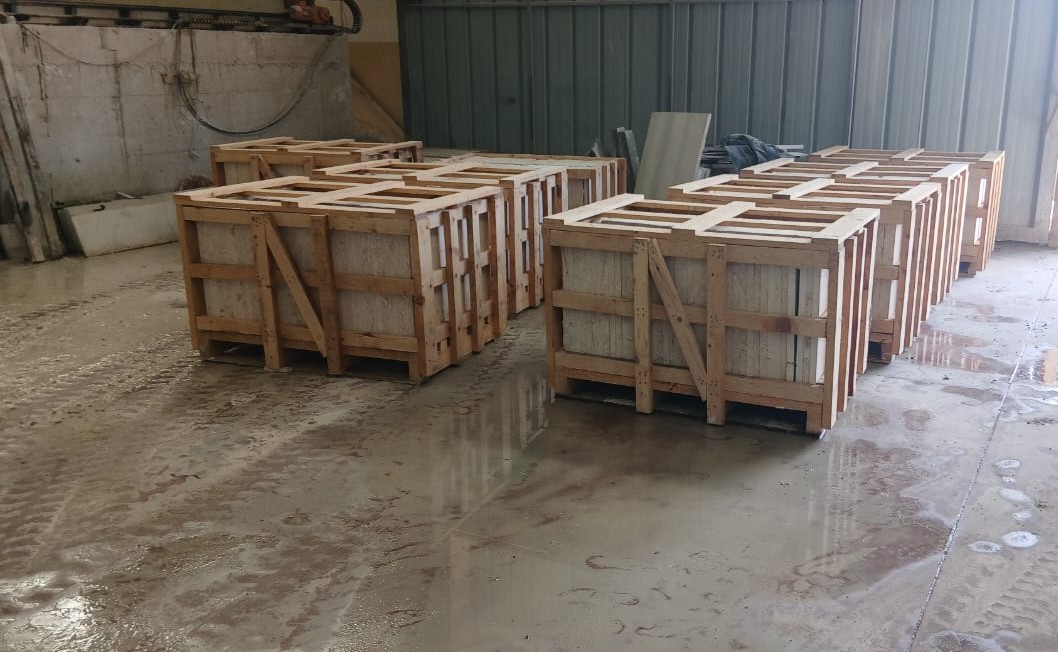
- Confirm truck access to your delivery site before finalising the order — palletised stone panels require a flatbed or liftgate truck, and tight residential sites may require a crane or hand-carry from the street
- Request a delivery date confirmation at least one week before your scheduled installation crew arrival — delays in transit can push installation starts by days or weeks
- Inspect all panels at delivery before signing the delivery receipt — damage claims submitted after the truck leaves the site are significantly harder to resolve
Getting Stacked Stone Specifications Right
Getting stacked stone right means resolving the panel system, mineral composition, profile geometry, and thermal performance requirements before a single panel leaves the warehouse. These decisions interact — a choice made in one category constrains your options in another, and the projects that end up with callbacks or premature failure almost always trace back to selections made without understanding those interactions. Your substrate type limits your panel weight range; your thermal environment limits your system type; your mineral selection drives your long-term maintenance protocol. Work through these in sequence, not in parallel.
Knowing how to choose stacked stone systematically — rather than defaulting to aesthetics first — is what separates durable, low-maintenance installations from ones that require costly remediation within a decade. As you plan your project, related cladding applications can inform your broader material decisions. If your project includes adjacent wall surfaces or building envelope details beyond the feature wall, choosing stone veneer siding for facades covers how Citadel Stone materials perform across a related but distinct wall cladding context. Knowing the difference between dry-stack and mortared interlocking systems before ordering helps Citadel Stone clients avoid installation failures on outdoor feature walls.
Related reading: manufactured stone veneer exterior · engineered stone manufacturers · sintered stone vs quartz.