Wet Stone Is a Different Material
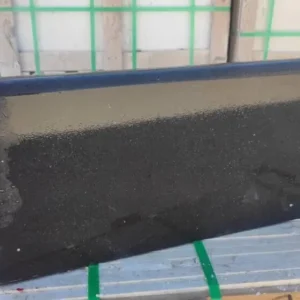
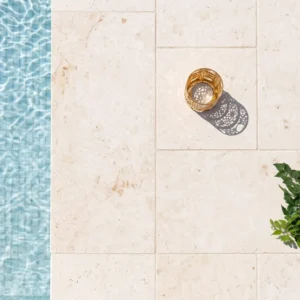
Walk a pool surround dry and you learn nothing at all. Every finish feels secure under a dry foot, which is why showroom decisions about poolside stone are so often reversed on site. The test is the same surface with a film of water on it, a wet sole, and somebody moving faster than they should be. Grip comes from texture at a scale you can feel but barely see: peaks that break through the water film and let skin make contact with stone. A polished face offers none of that. A properly worked face offers plenty, and still stays comfortable to sit on and easy to sweep.
The Zones That Actually Get Wet
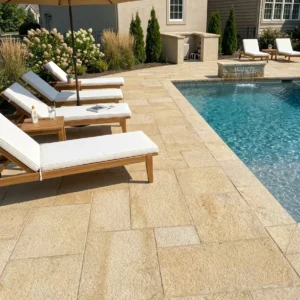
Before choosing any finish, mark the wet zones on the plan. They are rarely where clients expect them.
- The coping itself, wet almost continuously in use and carrying the most barefoot traffic on the property.
- The splash apron, roughly a stride and a half beyond the coping, damp for hours after swimming stops.
- Steps and thresholds, where a slip has the worst consequences and where falls concentrate rain runoff.
- Outdoor showers, foot rinses and the shaded path back to the house, which dry long after the terrace does.
Finish Families and What They Do
The vocabulary is worth getting right, because these are genuinely different processes with different results.
- Honed: smooth and matte, easy underfoot, best kept back from the water’s edge.
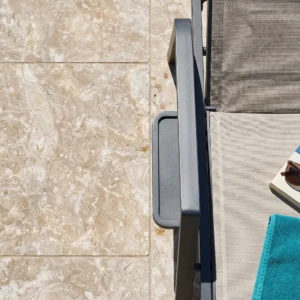
- Brushed: mechanically softened with abrasive brushes, a gentle texture that suits barefoot zones well.
- Bush-hammered: struck to a fine even pitting, strong grip, still comfortable when the pitting is controlled.
- Sandblasted: an open, uniformly abraded face with reliable grip once wet.
- Flamed: thermal shock applied to a dense stone, giving the most aggressive texture of the group.
Texture Depth Against Volcanic Ash
Here is where Saint Vincent and the Grenadines diverges from every other island brief. Fine gray ash from La Soufriere, which erupted in April 2021, has to be washed off paving rather than left to weather. A very deep, very open texture grips beautifully and then holds that ash in its hollows, where a brush cannot easily reach. The workable answer is a medium texture on a dense, low-absorption stone, which is the balance we look for in paving around Bequia pool decks. Grip you can feel, hollows shallow enough to flush. That single constraint rules out several finishes that would be perfectly sensible on a Mediterranean poolside, and it is the reason a specification copied from another market often disappoints here.
Comfort and Grip Pull in Opposite Directions
Every increase in texture buys grip and costs comfort, and no finish escapes that trade. The job is to find the point where a wet foot still feels planted and a dry one does not object, then stop there rather than pushing for more texture on principle.
- Test any candidate with a wet bare foot, not with a shoe and not with a dry hand.
- Sit on the coping for a minute, because a texture that is fine underfoot can be unpleasant to sit on.
- Check how a towel and a swimsuit behave on it, since a coarse face catches fabric.
- Try it on a hot afternoon, as heat and texture are always felt together rather than separately.
Detailing Does Half the Work
Finish is one lever. Water management is the other, and it is usually the cheaper of the two.
- Set falls away from the pool so water leaves the walking surface instead of standing on it.
- Choose a coping profile with a drip edge, keeping the vertical face and the wall behind it dry.
- Keep joints narrow, consistent and flushable, since a joint that traps grit becomes the slippery part.
- Fix edge restraint properly at the perimeter, a detail that matters wherever wind exposure is high.
The Cleaning Regime Is Part of the Specification
A grip finish only performs while it is clean. Biofilm in a shaded corner will beat any texture ever cut into stone. Plan for regular flushing with water and a stiff brush, more often after an ash fall, and choose a stone dense enough to take that treatment without dulling or staining. Shaded corners and the north side of a wall need attention first, because they stay damp longest and grow the film that costs you grip. Write the cleaning routine into the handover pack alongside the paving schedule, so whoever maintains the villa knows the surface was chosen on the assumption it would be washed. Comparing finish textures that shed water side by side is the quickest way to see which ones will still be gripping in five years.
Sample It Wet, On Site
Order small samples of two or three finishes and test them where the pool will actually be, in the light and heat of that exact spot. Wet them from a hose. Stand on them. Let the client stand on them, and watch what they do. Nothing in a photograph or a specification sheet substitutes for those thirty seconds. If two finishes feel equally secure, take the one that is easier to clean, because that is the one still performing in five years. Choose the finish that feels safe wet and kind hot, and the rest follows.