What the Granite Countertop Fabrication Process Actually Involves
The granite countertop fabrication process is far more sequenced and precision-dependent than most homeowners or contractors anticipate — and the decisions made in the first hour of templating directly shape every cut that follows. Most projects that fail dimensionally don’t fail at installation; they fail at the point where measurements were taken too casually or substrate irregularities were ignored. Understanding what fabrication actually demands, from slab selection through final polishing, gives you a meaningful advantage when specifying, scheduling, or supervising the work.
Slab Selection and Quality Assessment
Your countertop project starts long before any cutting machine is switched on. Slab selection is a judgment call that blends structural assessment with aesthetic intent, and experienced fabricators evaluate both simultaneously. You’re looking at veining continuity, thickness consistency across the slab face, and the presence of fissures or voids that could compromise cut edges or sink cutouts.
According to Natural Stone Institute granite durability and application specifications, granite’s interlocking crystalline structure gives it compressive strength that can exceed 19,000 PSI — but that rating assumes sound material without pre-existing fracture planes. Slabs with visible fissures running perpendicular to planned cutout edges are higher risk and should be templated to route those lines away from stress-concentration points. This is exactly the kind of field assessment that separates a competent fabrication shop from an order-processing operation.
- Check thickness variation across the slab — more than 3mm of deviation creates complications during setting and leveling
- Assess veining direction relative to your planned layout — matching grain across seams requires deliberate slab orientation
- Flag pits or voids near sink and cooktop locations before committing to a layout
- Verify color consistency under consistent lighting — warehouse fluorescents can mask tonal shifts that become visible in natural light
Templating: The Step That Defines Everything Downstream
Templating is where the granite countertop fabrication process transitions from planning to precision. Your template captures the exact geometry of the substrate — every irregular wall angle, out-of-square corner, and cabinet inconsistency gets documented in hard reference material. Digital templating systems use laser measurement to build CAD models with sub-millimeter accuracy, which then drive CNC cutting paths directly. Traditional physical templates use rigid stock cut to exact profile, transferred to the shop for manual cutting.
The practical reality is that most residential spaces have at least one wall that’s off-square by 1.5 to 3 degrees — a deviation that’s invisible to the eye but catastrophically obvious in a countertop that doesn’t seat flush. Your fabricator should walk every wall run with a digital angle finder, not just eyeball it. Backsplash height, window sill projections, and appliance clearances all become fixed variables the moment the template is finalized. Changes after this stage cost time and material.
Cutting and CNC Machining
Once the template data is confirmed, fabrication moves to the cutting floor. CNC waterjet or bridge saw systems translate the digital template into actual stone cuts, running diamond-tipped blades or high-pressure abrasive streams along programmed paths. The precision here is what allows complex edge profiles, tight miter joints, and curved cutouts to be executed repeatably.
What matters most at this stage is understanding the difference between straight cuts and profiled edge work. Straight cuts are fast and highly accurate. Edge profiling — whether you’re specifying an ogee, a waterfall edge, or a double-bevel — adds significant time because the stone passes through multiple polishing heads at progressively finer grits. Your project timeline needs to account for this. A simple eased edge might add 20 minutes per linear foot; a full ogee profile can triple that figure.
- CNC bridge saw cuts require water cooling at the blade to prevent thermal cracking — inadequate cooling is a common quality shortcut to watch for
- Sink cutouts are among the highest-risk cuts in the process — proper clamping and slow feed rates prevent breakout at the corners
- Mitered edge joints require matching slab sections with complementary veining, which affects your material yield calculation
- Cooktop cutouts need reinforcement strips bonded to the underside before cutting to prevent slab flex during use
As confirmed by ASTM C615 granite dimension stone quality standards, dimensional tolerances for cut granite in countertop applications are typically held to ±1.6mm for length and width — a threshold that requires calibrated equipment and consistent operator technique to maintain across a full production run.
Seam Placement and Structural Considerations
Seam placement is one of the most consequential decisions in the granite countertop fabrication process, and it’s one that too many projects leave entirely to the fabricator without meaningful input from the specifier or homeowner. You should be involved in this discussion before templating is finalized, not after cuts are made.
The guiding principle is structural: seams must always land over cabinet support, never over open spans or appliance cutouts. Beyond structure, aesthetics drive placement in a secondary role — you want seams positioned where the eye doesn’t naturally travel, typically away from high-visibility centerlines. In L-shaped or U-shaped layouts, the inside corner is almost always a seam location, and that joint needs an epoxy-filled rodded reinforcement on the underside to handle the stress concentration at that geometry. Skipping this step is a common cost-cutting measure that leads to seam separation within two to three years of normal use.
Edge Profiling and Finish Selection
Your edge profile choice has both an aesthetic and a functional dimension, and the two don’t always point in the same direction. A polished full bullnose looks elegant on a kitchen island but creates a harder impact zone for anyone who catches it with a hip. An eased or beveled edge is more forgiving physically and easier to maintain because it doesn’t collect buildup in tight radius curves the way an ogee does.
The fabrication of granite countertops with specialty profiles requires diamond polishing wheels run at progressively finer grits — typically starting at 50-grit for shaping and finishing through 3,000-grit for final gloss. The edge finish should match the face finish of the slab. A honed face with a polished edge creates a visual inconsistency that’s difficult to explain to clients. Confirm the finish specification in writing before the slab hits the polishing line. At Citadel Stone, we recommend specifying both face finish and edge profile simultaneously so the fabrication team can sequence the two processes efficiently without rework.
- Eased edge: lowest cost, most durable for high-traffic kitchens
- Beveled edge: classic profile, good for traditional and transitional design styles
- Ogee: complex profile requiring multiple wheel passes, higher cost, suited to formal or period-style interiors
- Waterfall edge: flat vertical face, requires precision mitering, popular in contemporary and minimalist design schemes
- Full bullnose: high visual weight, requires careful thickness matching across miter joints
Surface Finish and Aesthetic Integration
Surface finish is where the granite countertop fabrication process intersects directly with the broader design vision for a space. A polished finish maximizes color depth and veining contrast, making it the dominant choice for kitchens where the stone is meant to be a focal element. Honed finishes read as softer and more matte, which integrates cleanly with design schemes that prioritize restraint — think modern minimalist interiors, neutral palettes, or spaces where the cabinetry carries the visual weight and the countertop is meant to recede.
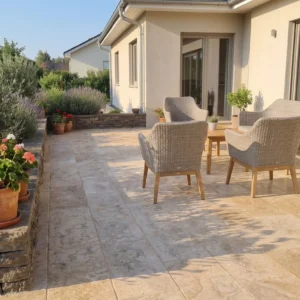
Leathered or brushed finishes occupy a middle position: they retain some of the color saturation of polished stone while introducing texture that reads naturally against warm wood cabinetry or organic landscape-inspired interiors. For projects where the countertop connects to outdoor entertaining areas — a kitchen adjacent to a courtyard with natural stone hardscape, for example — a leathered finish often bridges interior and exterior material languages more convincingly than a high-polish surface would. The finish isn’t just aesthetic; it also affects maintenance demands, with polished granite requiring more frequent attention to fingerprints and water spots than its honed or leathered counterparts.
For more on our granite countertop fabrication capabilities and finish options, the technical resources on that page detail the full range of profile and surface combinations available through Citadel Stone’s production team.
Polishing and Quality Control
Final polishing is the stage where the fabrication and installation of granite countertops most directly exposes quality shortcuts. A properly polished slab face progresses through a minimum of seven to eight abrasive grits, from aggressive diamond pads that remove machine marks down to the resin pads that produce the final reflective surface. Shops that skip grit stages to save time produce surfaces that look acceptable in artificial light but show swirl patterns and inconsistent gloss under directional natural light.
You can test for this during shop inspection by bringing a portable LED spotlight and raking it across the polished surface at a low angle — about 15 to 20 degrees from horizontal. Any skipped grit stages show up immediately as circular or directional haze patterns. This inspection step takes five minutes and can save a significant reinstallation cost. According to USGS granite production and construction use statistics, granite remains the most widely specified natural stone in North American countertop applications — which means fabrication capacity is high and quality variation between shops is correspondingly wide.
What Is Countertop Fabrication: The Full Scope
What is countertop fabrication in its complete sense? It’s the conversion of a raw quarried slab into a dimensionally precise, finished component ready for installation — encompassing templating, digital or physical layout, CNC cutting, edge profiling, surface finishing, seam preparation, and final quality inspection. Each step is dependent on the accuracy of the one before it, which is why the process is better understood as a sequential system than a collection of independent tasks.
Fabrication shops range from large-format CNC operations capable of running 50-plus slabs per day to smaller custom shops where a single craftsperson handles each piece from template to polish. Neither model is inherently superior — the right choice depends on your project’s complexity, timeline, and tolerance for variation. Custom shops typically offer tighter communication and more flexibility on unusual profiles; high-volume operations offer faster turnaround on standard configurations. Citadel Stone works with fabrication services across both models and can advise you on which approach suits your specific project scope.
- Standard residential countertop fabrication typically takes 3 to 7 business days from templating to delivery readiness
- Complex commercial projects with multiple seams, specialty edge profiles, and large-format sections may require 10 to 14 days
- Truck delivery and logistics scheduling should be confirmed before the fabrication start date — narrow site access or upper-floor installations require specialized handling equipment that needs advance coordination
- Warehouse lead times on specialty slabs can add 5 to 10 business days if your chosen material is not in stock domestically
Installation Readiness and Site Preparation
The fabrication and installation of granite countertops depends as much on the receiving site as it does on shop precision. Cabinet boxes must be level within 3mm across their full run — any deviation beyond that creates a shimming situation that risks point-loading the slab at the shim rather than distributing weight across the cabinet rails. This is one of the most common causes of cracking in the first year after installation, and it’s entirely preventable with proper substrate leveling before the fabricator templates.
Your plumber and electrician need to have roughed in all penetrations before templating, not before installation. Waiting until after the template to move a drain or add a dishwasher circuit means a remeasure and potential slab recut. Coordinating these trades in the correct sequence is a project management detail that saves real money. The Natural Stone Institute outlines fabrication standards and certification requirements that quality fabrication shops follow — asking your fabricator about their NSI certification status is a fast way to assess their commitment to consistent standards.
Getting Granite Countertop Specifications Right
The granite countertop fabrication process rewards careful specification and disciplined sequencing at every stage. Your involvement doesn’t end when you choose a slab — it extends through template review, seam placement approval, edge profile confirmation, and pre-installation substrate verification. Each of those touchpoints is an opportunity to catch a problem before it becomes a costly repair. If you’re evaluating stone options beyond granite, it’s worth understanding how different materials behave through fabrication — how marble and granite compare in fabrication covers the key performance and process differences that affect specification decisions. The more precisely you can communicate your requirements through every phase, the more consistently the finished countertop will match the original design intent. Accurate templating is among the most critical steps in the process, and Citadel Stone fabricators treat it as the foundation that every subsequent cut depends on.