Flagstone edging options fail most often not because of material weakness but because of lateral load paths that nobody accounts for at the design stage. You’re dealing with a surface that experiences differential settlement, thermal cycling, and foot-traffic shear simultaneously — and whichever flagstone edging option you choose has to resist all three without transferring stress back into the field stone. The edging method you select ultimately governs whether your flagstone installation holds its geometry for two decades or starts migrating inside five years.
Why Flagstone Edges Shift in the First Place
The movement you see at flagstone perimeters is almost always a base problem, not a surface problem. Sub-base material that compacts unevenly under live loads creates micro-voids at the perimeter first, because that’s where lateral confinement is lowest. Once a single edge piece loses its bearing surface, the adjacent field stones lose their restraint and the migration accelerates.
Freeze-thaw regions accelerate this process dramatically. Moisture infiltrating the joint between the edging and the field stone expands on freezing, widening the gap incrementally each cycle. According to flagstone sedimentary rock characteristics and paving use, the porous nature of sedimentary flagstone means moisture absorption at joints is a persistent performance variable that specifiers need to plan around from day one. Your base prep and drainage design carry more weight than the edging material itself.
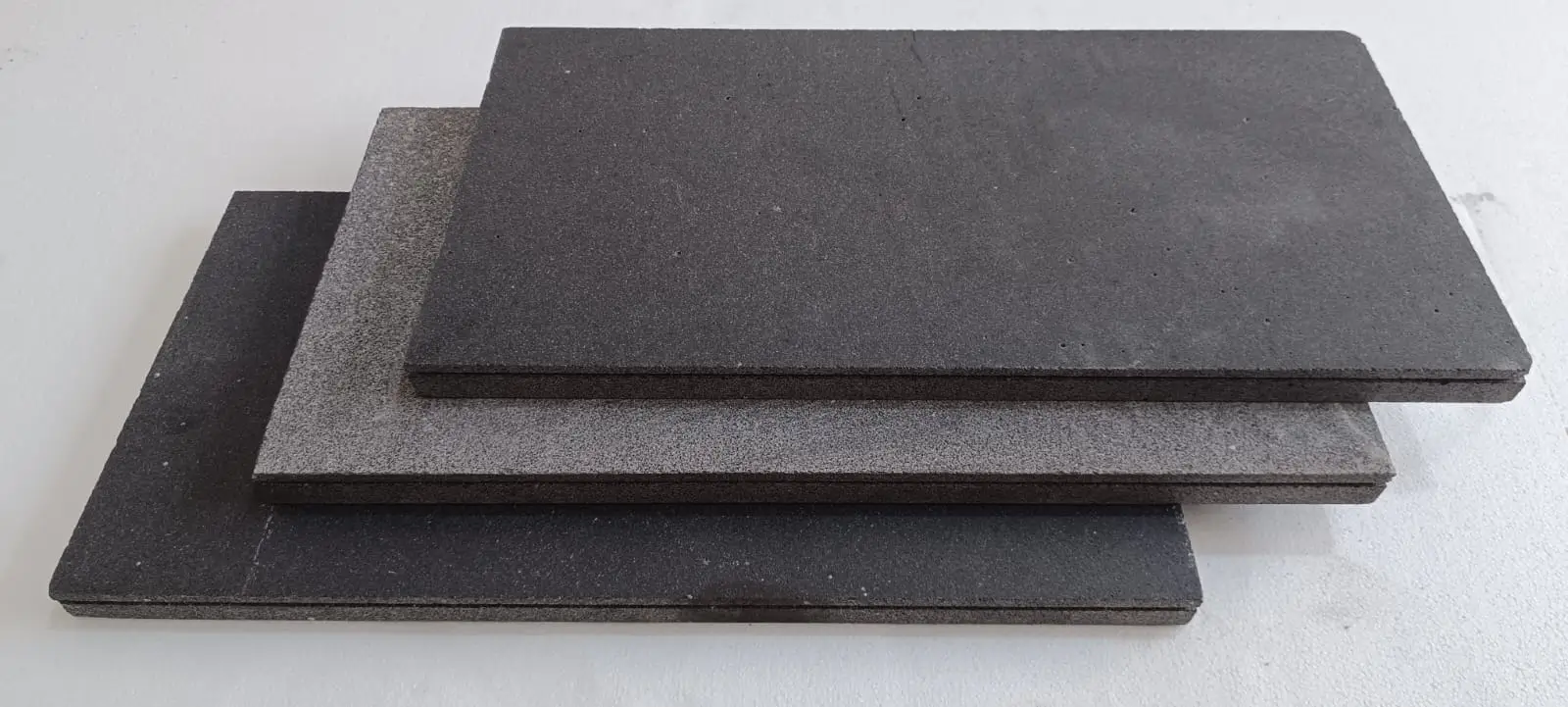
Steel Edging for Flagstone: Precision With a Trade-Off
Steel edging — specifically 14-gauge or heavier rolled steel bender board — delivers the tightest dimensional control of any flagstone edging option available. You drive steel stakes every 18 to 24 inches, and the continuous barrier prevents lateral migration effectively across straight runs and gentle curves. For irregular flagstone formats with highly variable joint widths, steel’s rigidity is actually its weakness: it doesn’t conform to the organic perimeter geometry that natural stone creates.
- Use 14-gauge or heavier steel — lighter gauges bow under soil pressure within two to three seasons
- Set the top of the edging flush with the finished flagstone surface, not above it, to avoid a trip hazard
- Apply a rust-inhibiting primer or specify galvanized steel in humid or wet climates to prevent surface staining of adjacent stone
- Drive stakes on the outward face of the edging, not inward — inward stakes reduce the working face that restrains the stone
- Allow a 1/8-inch expansion gap at steel joints to prevent buckling in hot, dry climates where surface temperatures can exceed 140°F
Steel edging works best when using flagstone in landscaping applications with defined geometric beds — rectangular patios, formal walkways, and pool surrounds where a clean line is part of the design intent. For naturalistic flagstone patios ideas where the perimeter undulates organically, you’ll spend more labor fitting steel to the curve than the restraint value justifies.
Concrete Edging: The Highest Lateral Strength Option
Poured concrete edging, sometimes called a concrete haunch or toe, is the workhorse of high-load flagstone installations — driveways, heavy-traffic patio surrounds, and any area where vehicular loads approach the perimeter. You pour a 4-inch wide by 6-inch deep continuous concrete footing directly against the outside face of the perimeter flagstone, keying it into a compacted gravel base. This creates a monolithic restraint that steel and stone edge options cannot match.
The honest limitation of concrete edging is that it’s invisible in the finished installation — which is fine for most applications but unacceptable when the edge itself is a design feature. You also need to account for the concrete’s own thermal expansion, which runs at roughly 5.5 × 10⁻⁶ per °F — slightly higher than most sedimentary flagstone types. Without a bond breaker or expansion joint at the concrete-to-stone interface, differential thermal movement will crack the adjacent field stone within a few seasons in climates with wide temperature swings.
- Score expansion joints in poured concrete edging every 10 feet maximum — this is non-negotiable for long perimeter runs
- Install a 30-mil polyethylene bond breaker between the concrete haunch and the flagstone face to isolate their differential movement
- Cure the concrete for a minimum of 7 days before backfilling against it — premature backfill pressure compromises edge geometry
- Use a minimum 3,000 PSI mix for residential applications; 4,000 PSI for any area with vehicle overhang potential
Natural Stone Border Edging: Aesthetic and Structural Integration
Natural stone border edging — using dimensional flagstone pieces, cobbles, or cut limestone set vertically or in a soldier course — is the premium flagstone edging option for projects where the perimeter needs to perform structurally and read as part of the design. Vertical-set flagstone creates a defined edge with genuine mass; a 3-inch thick flagstone set 4 to 6 inches deep in a sand-and-cement mortar bed develops meaningful passive resistance to lateral thrust from the field stones.
For projects considering edging for flagstone with natural stone borders, the sourcing decision carries real budget implications. Freight distance is a primary cost driver — natural stone border pieces shipped across multiple freight zones can add $2 to $4 per linear foot in logistics cost before installation labor is even counted. At Citadel Stone, we source flagstone border stock directly from quarries, which allows us to reduce that freight premium on large orders and maintain consistent sizing across the run — something that becomes critical when you’re fitting irregular border pieces to an organic perimeter. Exploring Citadel Stone flagstone border solutions before finalizing your material budget can help you understand realistic delivered costs for your project scale.
- Set natural stone border pieces in a 1:3 Portland-sand mortar bed for permanent installations — dry-set stone edging migrates faster than it restrains
- Select border pieces in the 2.5- to 3-inch thickness range — thinner pieces fracture under the lateral load cycles of high-traffic areas
- Match the stone species of your border to your field stone where possible — differential porosity between two different stone types at a shared joint creates a moisture trap that accelerates freeze-thaw damage
- Tamp border stone into position before mortar sets to eliminate voids under the bearing surface
Plastic and Composite Edging: When and Why to Use It
Plastic bender board and composite edging products occupy a specific niche in flagstone installations — they’re appropriate for informal garden paths and low-traffic flagstone patios ideas where the primary goal is weed suppression and visual separation rather than structural restraint. What they don’t do is meaningfully resist lateral migration of flagstone pieces under foot traffic, particularly at perimeter corners where load concentration is highest.
The performance ceiling for plastic edging sits at approximately 200 pounds of lateral force per linear foot before visible deflection occurs. Compare that to a properly installed concrete haunch, which resists upward of 2,000 pounds per linear foot. For casual garden path flagstone, that gap is irrelevant. For a patio serving regular entertaining traffic, it’s the difference between an installation that holds for a decade and one you’re resetting in three years.
- Stake plastic edging every 12 inches maximum — the standard 18-inch spacing that works for steel is too loose for flexible plastic materials
- Avoid plastic edging in climates with sustained surface temperatures above 120°F — UV degradation accelerates brittleness and the edging cracks at stake points within two to three seasons
- Use composite edging over pure plastic when the budget allows — the fibre reinforcement adds meaningful lateral stiffness at minimal cost premium
Cost Factors That Shape Your Edging Decision
Material cost is rarely the decisive number in flagstone edging options selection — labor-to-material ratio is. Steel edging runs $1 to $3 per linear foot in material, but installation is fast: an experienced crew installs 150 to 200 linear feet of steel edging per day. Natural stone border edging might run $8 to $20 per linear foot in material depending on stone type and freight zone, but installation slows to 40 to 60 linear feet per day when fitting irregular pieces to an organic perimeter. Your total installed cost ratio can flip dramatically based on labor market conditions in your area.
Concrete haunch edging sits in an interesting middle ground. The material cost is the lowest of any option — essentially the cost of mix design and formwork — but it requires a separate mobilization, a cure period, and a skilled pour to achieve consistent geometry. On projects in markets with high concrete labor rates, a concrete haunch sometimes costs more installed than natural stone border edging sourced from a national supplier with warehouse stock ready to ship. Verify truck access to your site early in the planning process; a 15-ton stone delivery requires adequate turning radius and surface bearing capacity, and restricted access can add $300 to $800 in re-handling costs that no budget initially accounts for.
The USGS flagstone and dimension stone paving data provides a useful baseline for understanding how regional material availability affects pricing nationally — market pricing for dimension stone edging stock varies by as much as 35% between freight-advantaged and freight-disadvantaged markets. Building that variability into your budget contingency before committing to a material is straightforward planning discipline that prevents scope reductions mid-project.
Base Preparation and Its Direct Effect on Edging Performance
No edging option performs at its rated capacity on a poorly prepared base. The most common field failure pattern involves contractors who install technically correct edging on a base that hasn’t reached 95% modified Proctor compaction — the standard for hardscape sub-bases under the ASLA natural stone and flagstone outdoor paving guidance. The edging holds initially, but the base consolidates under load and the flagstone drops 3/8 to 1/2 inch relative to the edge, creating a differential height that initiates the rocking and migration cycle.
Your base preparation sequence directly determines whether flagstone edging options function as designed. A 4-inch compacted gravel base is the minimum for residential foot-traffic applications; 6 inches is appropriate for heavier use, and anything near vehicle overhang potential demands 8 inches minimum with a geotextile separation layer beneath the aggregate.
- Compact your base in 2-inch lifts — single-pass compaction of a 4-inch base leaves the lower 2 inches under-compacted regardless of equipment size
- Crown the base 1/4 inch per foot toward the perimeter to encourage drainage away from the edging interface
- Install edging before laying field stone — setting edging against an already-laid surface forces you to work around finished material and compromises stake alignment
- Allow 48 hours after edging installation before beginning field stone placement in mortar applications — early loading deflects edging geometry before the mortar achieves adequate strength
Matching Flagstone Format to the Right Edging Type
The format of your flagstone — irregular, semi-irregular, or cut square — should drive your edging selection as much as load requirements or aesthetics. Irregular flagstone with its organic, varied-length perimeter pieces creates a saw-tooth edge profile that steel edging bridges across without full contact. Those contact gaps are where edge pieces rock and migrate first under repeated loading.
Cut and semi-cut flagstone pavers in rectangular or square formats create a straight, continuous bearing surface against edging — which is exactly what steel, concrete, and prefabricated stone borders are designed to contact. Using flagstone in landscaping applications with cut stone at the perimeter and irregular stone in the field is a well-established hybrid approach that delivers the organic aesthetic of irregular flagstone with the dimensional stability of a defined, straight edge interface. Citadel Stone’s warehouse stock includes both irregular field stone and precision-cut border pieces that are sized to work together, which eliminates the dimensional mismatch that creates problems at the field-to-edge transition.
- Irregular flagstone at perimeters: use natural stone or concrete edging — both accommodate variable contact profiles better than rigid steel
- Cut flagstone pavers at perimeters: steel, concrete, or prefabricated stone border all perform well with consistent contact surface
- Thin flagstone (3/4 to 1 inch): avoid vertical-set stone border edging — the mass differential between thin field stone and thick border creates a differential settlement risk that accelerates perimeter movement
- Thick flagstone (1.5 to 2.5 inches): natural stone borders set vertically create a visually balanced and structurally appropriate edge for most residential applications
Selecting the Right Flagstone Edging for Your Project
Choosing among flagstone edging options is fundamentally a decision about load path engineering rather than aesthetic preference. The edging type that looks best in a catalogue image may deliver the worst field performance for your specific flagstone format, base type, and use pattern — so sequence the decision correctly: base design first, flagstone format second, edging selection third. Your surface protection decisions extend to sealers as well; once your edging is set and your flagstone is placed, protecting the surface is the next specification milestone. For guidance on how to approach that process, flagstone sealing methods and timing covers the variables worth understanding before your first application.
The edging market has more options than most projects need, and the tendency to over-engineer the edge while under-engineering the base is the single most consistent failure pattern in residential flagstone work. Get the compaction right, match the edging to your stone format, and your flagstone installation will hold its geometry through years of seasonal movement and traffic loading. Steel, stone, and concrete edging each restrain lateral movement differently, and Citadel Stone can help buyers match the edging method to their flagstone format and base type.
Related reading: flagstone vs bluestone paving · cost to lay flagstone patio · what is flagstone stone.