There Is No Sheltered Inland Here
On most islands you can draw a line and call one side coastal. Anguilla does not offer that comfort. The island is roughly 16 miles long and 3 miles wide, it is flat, and Crocus Hill at 240 feet is the highest ground on it, so trade-wind salt aerosol has very little to stop it crossing the whole landmass. It is more honest to treat every plot as salt-exposed and then grade the exposure by degree than to assume a site set back from the water is protected. That single assumption separates paving that still reads well years later from paving that does not.
Grading the Exposure
Zoning a plot takes ten minutes on site and saves an argument later, and it is what turns units picked for windward frontage into a decision rather than a guess. Most Anguillian projects contain three or four of these zones at once.
- Front line: open frontage at Meads Bay, Rendezvous Bay, Shoal Bay or Barnes Bay, taking direct spray and wind-driven sand.
- Second line: behind a dune, wall or planting, still in salt-laden air but out of direct spray.
- Cliff top and headland, as above Little Bay, where wind dominates and updraft carries salt higher than people expect.
- Enclosed courtyard: sheltered from wind, but salt still lands and, without rain to wash it, it simply stays.
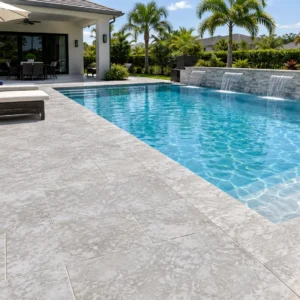
- Pool surround, which layers its own water chemistry on top of everything else.
The Rain Pattern Inverts the Brief
Anguilla receives the least rainfall of the Lesser Antilles, precisely because it has no mountains to trap cloud: roughly 900 to 1,000 mm, about 35 to 40 inches a year, and highly erratic. February and March are the driest months, September and October the wettest, and there are no rivers at all. The drainage brief is therefore inverted compared with a wet-tropics island. Paving is not fighting chronic saturation. It has to shed one intense burst after weeks of nothing, then go back to being dry.
Paving as Catchment, Not Just Surface
Water on this island comes from rainwater catchment, aquifer wells and desalination, which makes any hard surface part of a supply conversation rather than only a puddle conversation. Detailing choices that look like landscape decisions elsewhere are water decisions here.
- Fall every surface to a defined outlet, not to a random low spot at the perimeter.
- Decide where run-off actually goes: to planting, to a routed overflow, or to ground that can take it.
- Choose between permeable joints and a sealed field deliberately, because the two send water to different places.
- Provide silt and sand traps, since a long dry spell leaves a dusty surface that the first downpour mobilizes.
- Keep pool surround run-off away from planting and away from anything feeding a catchment route.
Salt Cycling in the Dry Months
The durability stress here is not frost. It is salt. Aerosol lands on a dry surface, the moisture evaporates, crystals form and grow inside the pore structure, and weeks later a downpour dissolves and redeposits them somewhere slightly different. Run that cycle through February and March, year after year, and a porous stone with an open structure will show it in the surface long before a dense one does. That is why the specification here starts with low absorption and high density and only then moves on to how the stone looks.
Finish and the Sudden Wetting Problem
The dangerous moment here is not a rainy afternoon. It is a dry, salt-dusted surface hit by the first heavy shower, or a wave of pool water across a hot deck. The finish has to hold grip in exactly that transition. Comparing texture options for salt-dusted decks side by side is the fastest way to see which textures keep their bite when a dry surface is suddenly wet.
- Prefer a texture with real depth over a polished or lightly honed face on any outdoor field.
- Keep the pool coping and the first course beyond it in the same slip category, not just the same stone.
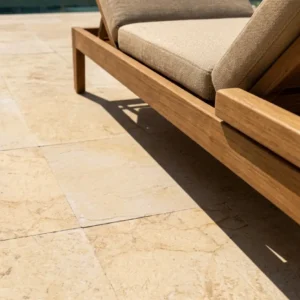
- Watch tone as well as texture, because a pale surface stays usable under bare feet in the dry months.
- Test a sample wet, dusted and dry rather than judging a finish from a clean, dry showroom piece.
Storm-Season Detailing That Holds
Hurricane season runs July to November, and on this island Irma, on 6 September 2017, is the reference event behind every construction conversation. Nobody here needs the drama; they need the details.
- Positive restraint at every free edge, because an unrestrained perimeter is where wind-driven water starts lifting units.
- Outlets, channels and gullies cleared before the season, not after the first warning.
- Bonded rather than loose-laid detailing where a surface sits high, open and directly wind-exposed.
- Loose site items, planters and furniture given a storage plan that does not involve the new terrace.
- Spare units from the same lot kept on site, so a localized repair does not turn into a tone-matching exercise.
Built to the Code, Detailed for the Island
Construction here is designed to the Anguilla Building Code, which incorporates the Caribbean Uniform Building Code, and your engineer works to it. We do not publish design wind figures; a number lifted from a secondary source has no business inside anyone’s calculation. What a stone supplier can properly own is the material and the detail: density, absorption, finish, gauge, restraint and drainage. Call the result hurricane-resilient and specified for post-Irma rebuilding standards, and never call it anything stronger than that.
On Anguilla, exposure is the specification, and the stone is only as good as the edge you restrain it with.