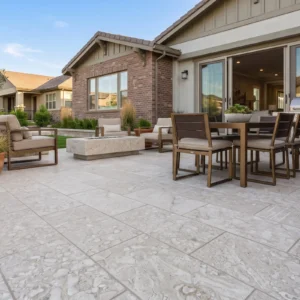
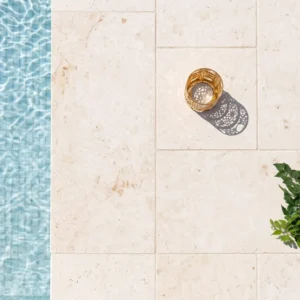
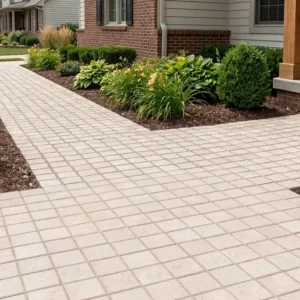
Driveway limestone specs look simple on paper until you’re standing on a job site with a 40-ton delivery, a compacted base that’s three inches too shallow, and a homeowner expecting the kind of finish they saw in a design magazine. The grade of limestone you specify and the depth of material you order are two decisions that don’t forgive errors — and most project overruns trace back to getting one of them wrong before the truck ever shows up. This guide covers stone type, grade selection, thickness, base requirements, and the cost factors that determine whether your limestone driveway project lands on budget or blows past it.
Understanding Limestone Grades and Stone Types
Not all driveway limestone comes out of the quarry ready for the same job. The industry broadly separates material into crushed aggregate, compacted base grades, and dimensional surface stone — and confusing these three categories is the most expensive mistake you can make at the ordering stage. Crushed limestone used as a base course has a completely different compaction coefficient, fines content, and load-bearing profile than the dimensional pavers that sit on top of it.
For driveways, you’re typically working across two material tiers simultaneously: a structural base layer and a surface layer. The base layer runs from #610 crusher run (a blend of crushed stone and fines that compacts tightly) down to a clean #57 or #67 aggregate for drainage correction beneath clay soils. Surface-layer limestone for a finished driveway — dimensional pavers, slab cuts, or large-format flags — needs a minimum compressive strength of 7,500 PSI to handle repeated vehicle loads without surface spalling or edge fracture over time.
- Crusher run (#610): dense-graded blend with fines — ideal structural base, compacts to near-rigid substrate
- #57 clean aggregate: open-graded, no fines — used where drainage correction is the priority, not compaction
- #4 or #5 crushed: transition layer in multi-depth base builds for heavy vehicle access
- Dimensional limestone pavers: surface material, typically 2–4 inches thick depending on load class
- Flagstone cuts: irregular surface stone, typically 1.5–2.5 inches, suitable for lighter residential traffic
According to Natural Stone Institute limestone specifications, dimensional limestone for exterior paving applications should meet minimum absorption rates below 7.5% and a modulus of rupture above 900 PSI — figures worth confirming with your supplier before accepting delivery on large orders.
Choosing the Right Surface Finish for Driveways
Surface finish on driveway limestone does more than affect aesthetics — it directly determines traction performance, long-term maintenance intervals, and how the stone weathers under tire abrasion and surface water. Honed finishes look clean in photos, but in practice, a lightly textured or sawn surface holds up better under repetitive vehicle contact without showing polish wear in wheel-track zones.
Here’s what most specifiers miss: the finish you select affects your sealer compatibility as much as your slip resistance. A high-polish or honed limestone surface has lower porosity at the surface layer, which changes how penetrating sealers bond — you’ll need a densifier-based sealer rather than a standard impregnating sealer for reliable protection on honed stone in a driveway application.
- Sawn finish: flat cut surface, moderate texture — best general-purpose driveway finish for residential loads
- Bush-hammered: mechanical texture applied post-cut, excellent traction, slightly rougher hand feel
- Tumbled: rounded edges, antique character — better suited to lower-speed decorative entries than main drive lanes
- Honed: smooth, consistent surface — aesthetically refined but requires densifier sealing for durability
- Natural cleft (flagstone): irregular, split surface — highest traction coefficient, lowest maintenance, least predictable aesthetic
For main driveway lanes that take daily vehicle traffic, a sawn or bush-hammered finish gives you the best performance-to-maintenance ratio. Tumbled limestone rock for driveway borders and edging details works beautifully, but it shouldn’t be your primary surface material where tires contact the stone regularly.
Thickness Requirements and Load Capacity
Dimensional limestone for a standard passenger-vehicle driveway should spec at a minimum of 2 inches nominal thickness — and that assumes a properly compacted aggregate base beneath it. The moment you’re designing for SUVs, trucks, or any vehicle over 6,000 lbs GVW, you need to move to 3-inch nominal or thicker, and your base depth needs to increase accordingly.
The load distribution math is straightforward: a 2-inch limestone paver concentrates point load at its edges, and if the base beneath compresses unevenly, you’ll see cracking propagate from corner joints inward. Speccing 3-inch material adds enough mass and cross-section to bridge minor base irregularities without cracking — which is why installation teams that work high-end residential projects almost always default to 3-inch on primary drive lanes, even when the spec sheet allows 2-inch.
- 2-inch nominal: suitable for passenger vehicles under 6,000 lbs, requires superior base preparation
- 3-inch nominal: standard for SUV and light truck access, recommended default for most residential projects
- 4-inch or greater: required for RV pads, commercial access lanes, or any repeated heavy vehicle use
- Base depth: minimum 6 inches compacted crusher run for 2-inch surface; 8–10 inches for 3-inch surface on standard soils
- Clay soils: add 2–4 inches of drainage aggregate below the crusher run base to prevent heave-driven surface displacement
Your geotechnical conditions should be assessed before you finalize thickness — expansive clay soils in particular will cause uplift damage regardless of surface stone thickness if the base design doesn’t account for soil movement.
How to Use a Limestone Driveway Calculator
A limestone driveway calculator gives you a starting tonnage figure, but it’s a planning tool, not an order confirmation. The standard formula — (length × width × depth in feet) ÷ 27 × stone density — works for rectangular drives, but real driveways have curves, apron flares, turnaround areas, and side setbacks that add material requirements most online calculators undercount by 10–15%.
The density variable is where most estimates go wrong. Crushed limestone aggregate runs approximately 2,700 lbs per cubic yard compacted, but dimensional paver stone calculates differently because you’re working in square footage covered rather than volume filled. For surface pavers, convert your square footage to tonnage using the thickness: a 2-inch limestone paver at approximately 150 lbs per cubic foot gives you roughly 25 lbs per square foot of surface coverage. Run your limestone driveway calculator at that rate, then add 8% for cuts, breakage, and edge waste.
- Measure total driveway area including apron, turnaround, and any side extensions
- Calculate base tonnage separately from surface paver tonnage — they’re ordered differently
- Add 8–10% overage for cut waste on driveways with curves or angled entries
- Account for compaction factor on crusher run base: crushed material loses 15–20% of loose volume after compaction
- Verify weight limits on your delivery access — gravel driveways and soft shoulders may restrict truck access
Once your quantities are confirmed, you can review our limestone rock driveway supply to match your calculated tonnage and paver dimensions to available stock before finalizing your project timeline.
Base Preparation: Where Driveway Projects Succeed or Fail
The surface limestone gets all the attention at the design stage, but base preparation is where driveway projects actually succeed or fail. A well-laid limestone surface over a poorly compacted base will show joint displacement and edge cracking within two to three freeze-thaw seasons — sometimes sooner in high-clay soils where moisture retention drives heave pressure upward through the base profile.
Proper subgrade preparation starts with stripping topsoil completely — not grading over it, stripping it — down to stable mineral soil. Consistent bearing capacity across the full drive width is required before the first layer of aggregate goes down. Any soft spots, organic pockets, or disturbed fill zones need to be excavated and replaced with compacted select fill before base aggregate is placed. This adds time and sometimes unexpected cost, but skipping it creates a ticking clock on your installation.
- Strip topsoil to stable mineral subgrade — minimum 6 inches below finished surface elevation
- Proof-roll subgrade: any deflection under a loaded truck indicates soft zones requiring remediation
- Place geotextile fabric over subgrade in clay soils to prevent base contamination over time
- Compact base in 3–4 inch lifts — never place the full base depth in a single layer
- Check for uniform 95% Proctor density before placing setting bed
- Maintain 2% cross-slope minimum on finished base for positive drainage
According to USGS limestone composition data, limestone’s inherent density and load-transfer characteristics make it an excellent driveway material — but those characteristics only perform as specified when the substrate beneath them is equally engineered.
Cost Factors, Freight, and Sourcing Decisions
Your material cost per ton is only one line item in the real cost equation for a limestone driveway project. Freight distance from the warehouse or distribution point to your site has an outsized effect on final project cost — particularly for bulk aggregate orders where the stone-to-freight cost ratio can flip entirely depending on how far the material travels. In markets where limestone is locally quarried, delivered crusher run base material may run $35–50 per ton. In markets served primarily by long-haul freight, that same material can run $80–120 per ton delivered before a single paver is placed.
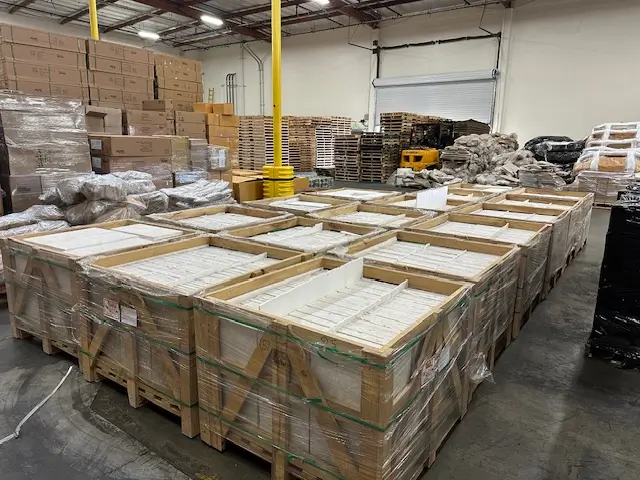
Dimensional limestone pavers are a different freight calculation. Because they ship in palletized, strapped loads rather than bulk aggregate trucks, the per-unit freight cost is more predictable — but the delivery access requirements become more specific. Most pallet deliveries require a truck with liftgate or a forklift on-site to offload, and if your driveway project is in a constrained access location, you need to factor in the labor cost of hand-offloading or repositioning materials from the drop point to the installation zone.
- Compare delivered price, not just material price — a lower per-ton cost can still be more expensive after freight
- Order base aggregate and surface pavers on separate deliveries if your site can’t receive both at once without damage to material staging
- Ask about warehouse stock availability before committing to a project start date — back-ordered stone can delay a project 4–8 weeks
- Consider the material-to-labor cost ratio: on larger driveways, saving 10% on stone while paying for an extra day of crew time rarely produces net savings
- Installation rates vary significantly across different markets — a $15/sq ft rate in one area can be $28/sq ft in another
At Citadel Stone, we ship driveway limestone nationwide in graded, palletized loads from centrally located warehouse inventory, which typically keeps lead times tighter than sourcing through regional distributors who depend on import cycles. Confirming warehouse stock levels before your project mobilizes is always worth a call — it prevents the common scenario of breaking ground with base material in place but surface stone still weeks away.
Sealing, Joint Sand, and Long-Term Maintenance
Limestone’s open crystalline structure makes it more porous than granite or basalt, which directly affects your sealing protocol on a driveway application. Driveways expose stone to petroleum-based fluids — motor oil, transmission fluid, driveway sealers from adjacent asphalt — that penetrate porous limestone within minutes of contact and stain permanently if the stone isn’t protected with an appropriate impregnating sealer before the surface goes into service.
The sealing schedule for driveway limestone should begin within 30 days of installation — before any vehicle traffic — and repeat every 2–3 years depending on use intensity and UV exposure. You’ll know the sealer has reached end-of-life when water no longer beads on the surface and instead absorbs quickly. At that point, oil contamination risk increases significantly.
- Apply a penetrating impregnating sealer rated for exterior limestone — not a topcoat or film-forming product
- First application: two coats within 30 days of installation, before any vehicle access
- Maintenance resealing: every 2–3 years for standard residential use, annually for heavy-use driveways
- Joint sand: maintain polymeric sand at 90–95% joint fill depth — low joint sand is the primary entry point for weed establishment and joint displacement
- Edge restraints: concrete curb or steel edging prevents lateral paver migration on high-traffic driveway edges
- Clean oil stains within 24 hours using a poultice draw-out method — delayed cleaning on unsealed limestone typically results in permanent staining
Driveway limestone maintained with correct sealing and joint sand management consistently delivers 20–30 year surface life in residential applications. The installations that fall short of that range almost always show one of two failure patterns: no sealing program, or joint sand allowed to deplete to below 50% fill depth, which triggers progressive edge rocking and surface cracking at joints.

Performance Across Conditions and Climate Zones
Limestone performs well across a wide range of conditions, but its durability profile shifts depending on the specific variety and density. Dense, low-absorption limestone — below 3% water absorption by weight — handles freeze-thaw cycling effectively and is the specification choice for regions with hard winters. Higher-absorption varieties in the 5–7% range are better suited to dry climates where freeze-thaw stress is minimal, and they deliver excellent surface life in those conditions without the premium cost of ultra-dense alternatives.
Surface temperature is one performance factor worth noting for driveway applications specifically. Lighter-colored limestone reflects more solar radiation than dark stone varieties — a meaningful difference in hot, dry climates where dark asphalt surfaces can reach 150°F+ in peak summer. A mid-toned or light-colored driveway limestone typically stays 30–40°F cooler at the surface under the same solar conditions, which reduces thermal expansion stress at joints and extends the life of polymeric joint sand before UV degradation requires replacement.
- Freeze-thaw zones: specify limestone with water absorption below 3% and compressive strength above 10,000 PSI
- Hot, dry climates: higher-absorption varieties acceptable; lighter surface color reduces thermal stress at joints
- High-rainfall areas: ensure positive drainage grade on base design and use a closed-graded setting bed, not open aggregate
- Coastal environments: confirm limestone variety is tested for salt spray resistance — some varieties exhibit surface scaling under prolonged salt exposure
The ASLA driveway paving material guidance also highlights the environmental performance advantages of natural stone driveways over highly resistant surfaces — dimensional limestone installations with open joint systems can contribute to site stormwater management in jurisdictions where permeable paving credits apply toward local stormwater compliance requirements.
Ordering, Delivery, and Project Logistics
Getting your ordering sequence right prevents the most common project delay in limestone driveway installations: receiving surface pavers before the base is ready, then having material sit on-site exposed to construction traffic and weather. The correct sequence is base aggregate delivery and installation first, setting bed preparation second, and surface paver delivery timed to arrive when the crew is ready to lay stone.
Coordinate your truck delivery windows with your site access conditions. Fully loaded pallet deliveries on a standard flatbed typically require a minimum 12-foot wide access lane and a stable turning radius at the delivery point. Soft or unprepared driveways can create a problem where the delivery truck damages the existing surface or becomes stuck — communicate your access conditions to the supplier at the time of ordering so the right delivery configuration is arranged from the warehouse.
- Order base aggregate 1–2 weeks before project start to allow for supplier lead time
- Schedule surface paver delivery for day 2 or 3 of installation — after base is compacted and inspected
- Confirm warehouse stock availability on specific paver sizes and finishes before project mobilization
- Request delivery tickets showing weight and quantity — verify against your order before signing
- Inspect paver pallets on delivery for edge damage, lippage, or tone variation before offloading — rejecting damaged material at delivery is far easier than after installation
- Store uninstalled pallets on stable, level ground away from active vehicle traffic zones
Citadel Stone’s nationwide distribution network means your driveway limestone order isn’t dependent on a single regional quarry’s production schedule — warehouse inventory is maintained across product lines so stock availability doesn’t hold up your project start date the way single-source import orders frequently do.
Limestone Road and Heavy-Access Applications
Beyond residential driveways, driveway limestone in its crushed and graded forms serves as the primary surfacing material for limestone road construction on private access roads, rural properties, and agricultural access lanes. The limestone road application is essentially a high-volume version of the same base specification used under dimensional pavers — just without the surface paver layer on top, relying instead on the compacted stone itself as the wearing surface.
For a gravel-surface limestone road, the standard specification runs a 6–8 inch compacted base of #610 crusher run topped with a 3–4 inch wearing course of #8 or #9 crushed limestone. The fines content in #8 and #9 aggregate provides a self-binding characteristic when compacted — particularly in humid conditions — that produces a stable, driveable surface without the cost of dimensional stone. The trade-off is periodic re-grading and top-dressing every 2–3 years as fines migrate and surface material redistributes under traffic.
- Minimum specification for passenger-vehicle limestone road: 6-inch compacted #610 base, 3-inch #8 or #9 wearing course
- Heavy vehicle access: increase base to 10–12 inches, add geotextile at subgrade
- Maintenance cycle: re-grade surface annually, top-dress with 1–2 inches of fresh material every 2–3 years
- Crown road surface at 3–4% cross-slope minimum to prevent water ponding and surface deterioration
Getting Driveway Limestone Specifications Right
Selecting the right grade, thickness, and finish for your driveway limestone project is the decision that defines everything that comes after — installation speed, maintenance intervals, long-term performance, and total project cost. The specifications that consistently produce 20-plus year installations all share the same foundation: properly graded material matched to load class, base depth engineered to soil conditions, and a sealing program that starts before the first vehicle rolls over the finished surface. Cutting corners on any of those three elements rarely saves money in the long run and almost always shows up as a costly repair within the first five to ten years. If you’re exploring the full range of natural stone options for your project and want to compare how other dark-stone materials perform in similar hardscape applications, our related guide on black rock driveway performance and heat covers a complementary set of material considerations worth reviewing before finalizing your specification. Sourced direct from quarries in Turkey, the Mediterranean, and beyond, our driveway limestone ships nationwide in graded loads.
Related reading: crushed limestone driveway pros and cons · crushed limestone driveway cost · driveway limestone size.