The Apron Works Harder Than the Drive
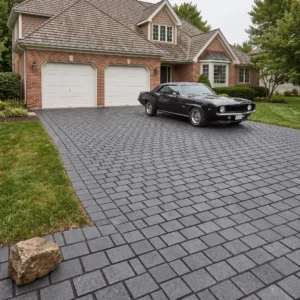
The apron is the short stretch where a private driveway meets the public road. It is a small area and it absorbs a wildly disproportionate share of everything the plot will ever suffer: full lock turns, delivery trucks reversing, service vans mounting the edge, and water sheeting off the road in a squall. On villa and resort work around St John’s, Jolly Harbour and the south coast, the apron is usually the first surface to look tired and the last one anyone budgeted honestly. Getting it right starts with accepting that it is a different piece of engineering from the drive behind it, with a heavier build-up, a stronger edge and, quite often, a deeper unit. Treat it as an extension of the road rather than as the beginning of the garden and most of the decisions make themselves.
What Turning Actually Does to Paving
Straight-line traffic is easy. Turning traffic is not, and that difference explains most of the apron failures you will see on the island.
- A steered wheel scrubs sideways, dragging the surface rather than rolling over it
- Point loads concentrate at the tire contact patch instead of spreading across a panel
- Braking and pulling away add a shear force pointing straight along the drive
- Delivery vehicles turn in the same three or four spots every single week
- Wide units resist that scrub with one joint line, small units with hundreds of them
Why Small Units Win at the Gate
A sett is a deep block with a small face. Under a turning wheel it behaves like a piece of masonry in compression rather than a lid over a void, passing load into the bed and into its neighbors instead of trying to span. A cracked slab is a repair job; a moved sett is an afternoon of lifting and relaying. That maintenance arithmetic is why the format has survived on aprons for two centuries, and why it still suits a country that imports its wearing surfaces and repairs whatever it can. It also means a damaged apron never has to be closed off while a replacement panel is sourced and shipped. Our apron setts laid on concrete guidance sets out the working sizes.
Your Base Course, Our Wearing Surface
Antigua and Barbuda quarries its own stone, and the honest division of labor on an apron runs like this.
- Burma Quarry produces subbase and base material used widely across the island
- Bendals Quarry produces crushed stone for road finished surfaces
- Local aggregate builds the base course under your apron, and importing it makes no sense
- The calibrated wearing surface laid over that base is what arrives by sea
- No imported paver rescues a poor base, so sequence and inspect the two properly
Build-Up for an Apron That Lasts
An apron is not a patio with cars parked on it. Specify it as a trafficked pavement and it will behave like one for decades.
- A rigid base under the sett field rather than a compacted granular bed alone
- Bedding and jointing chosen together as a system, so both work under shear
- A restrained edge on all four sides, including the side facing the road
- Deeper units in the turning zone than in the parking bays sitting behind it
Edges, Curbs and the Road Interface
The weakest line on any apron is where it stops. Vehicles find that line, mount it, and lever units out of the field one at a time. A haunched curb or a heavy edge course changes the failure mode completely, because the row taking the abuse becomes a single restrained element rather than a loose end. Set the edge before the field, keep the joint between them tight, and take your levels off the road rather than off the house so runoff never backs up against the threshold. Where the apron meets an existing concrete road edge, the joint between the two materials should be detailed deliberately rather than left to the mason on the day. Depths and finishes for edge and field units appear on our sett sizes and edge details page.
Salt, Storms and Fixings
Freeze-thaw performance means nothing in this climate, so ignore it and spend the attention where it counts. Salt aerosol travels a long way inland on the exposed north and west coasts, and anything ferrous set into an apron will bleed rust and split its surround, so use non-ferrous or stainless fixings throughout. Storm exposure is the other governing case. Hurricane Irma crossed on 6 September 2017 and left around 95% of Barbuda’s structures damaged or destroyed, with the whole population evacuated to Antigua until the order was lifted about three weeks later. Loose units become projectiles in that kind of event.
Landing the Order and Clearing It
Aprons are small areas, which tempts buyers into small orders. Resist that, because freight and clearance costs scale badly downward.
- Ship with the rest of the hardscape wherever the build program allows it
- Expect to appoint a broker, since Customs requires one above six lines or EC$5,000
- Budget CARICOM common external tariff duty on CIF and 17% ABST charged on top of duty
- Confirm the Revenue Recovery Charge and levy rates with your broker before ordering
- Price any Barbuda delivery separately as a small-vessel leg into River Wharf
An apron built as a pavement rather than as a patio pays for itself the first time a truck turns on it.