Where a Saint Lucian Driveway Fails
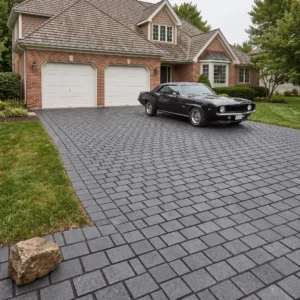
Walk any older drive in Gros Islet or Castries and the damage tells the same story. The middle of the run is usually fine. The failure is at the entrance, in the arc where vehicles swing off the road, and again at the turning head near the house. Those are the two places where wheels are not just rolling but twisting, and where rainwater from the road arrives with momentum. A drive built to a single specification from gate to garage is a drive that has quietly overbuilt the easy sections and underbuilt the hard ones. Fixing that imbalance costs nothing at the design stage and a great deal three years later.
The Apron Is a Different Job
Treat the apron as its own piece of engineering rather than the first few rows of the driveway. It has different loads, a different water regime and a different owner at the boundary.
- It carries delivery trucks and service vehicles the rest of the drive never sees.
- It is where road runoff crosses onto private ground, often at speed.
- It must tie into a road surface that was not built to your levels.
- It is the one stretch that cannot be closed for a week without arguments.
What Turning Does That Driving Does Not
Rolling traffic pushes down. Turning traffic pushes sideways, and sideways is what pulls a paved surface apart. A tire scrubbing through a slow arc drags at every joint it crosses, and it does that in the same footprint thousands of times a year.
- Joints lose their fill first, then the units start to rotate.
- Braking and pulling away add repeated shear on top of the turning drag.
- Point loads from a loaded truck concentrate on individual units, not on a slab field.
- Heat and rain cycle the joint material between soft and washed-out.
- Once one unit sits low, every wheel afterward hammers it further down.
Base and Bedding for Vehicle Duty
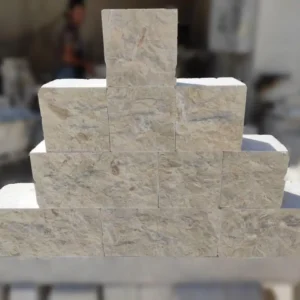
The honest answer is that nothing you choose from a stone list will rescue a thin base. Vehicle-duty sett paving depends on a properly formed and compacted sub-base, a bedding layer chosen so it will not pump under wheel loads, and a joint that is genuinely full rather than brushed in and forgotten. Saint Lucia’s local quarry operators supply exactly the crushed rock and filter stone that layer needs, and that is the right division of work: local aggregate underneath, imported stone as the wearing course. Our deeper sett units for aprons are the format to ask about once the base is settled, because depth is what buys you tolerance against point loading.
The Road Interface and the Edge
Every apron ends at a line you do not control. The road may be asphalt, it may be patched, and it will move at a different rate than your paving does. A defined, deep edge unit at that boundary does three things at once: it stops the sett field from creeping under turning load, it gives the mason a straight datum to lay to, and it takes the abuse from wheels that clip the corner. Choosing edge restraint that resists scour matters even more where road runoff crosses the apron, because water finds an unsupported edge long before it finds the middle of a field.
When the Drive Becomes a Stream
In a Saint Lucian downpour a sloping drive is a watercourse. Hurricane Tomas made the point at national scale in 2010, when rainfall of up to 668 mm in around 23 hours triggered the landslides that did most of the damage. On a private site the same physics scours a poorly detailed apron.
- Intercept road water before it reaches your paving, not halfway down it.
- Give the apron a cross-fall that sheds sideways rather than straight at the gate.
- Keep any channel accessible, because leaf litter and grit block it within a season.
- Never discharge a drive over the crest of a cut slope.
Gates, Gradients and the First Few Feet
The first stretch inside the gate is where most drives get their steepest change of grade, and where vehicles stop, wait and pull away under load. On a hillside plot at Cap Estate or Marigot Bay that transition can be brutally short, so it deserves the same treatment as the apron itself rather than being tidied up at the end of the job.
- Allow a level landing at the gate so a car is not braking on the transition.
- Watch the vertical curve, since long wheelbase vehicles ground out on abrupt changes.
- Keep gate posts and their foundations clear of the paving edge restraint.
- Plan where a delivery truck will actually stand when it drops your pallets.
Ordering for a Drive
Order the apron and the turning head as one item with its own depth, and the lighter runs as another. Split that way, most clients spend less overall than they would specifying one heavy format everywhere. Add a sensible allowance for cuts at the radius, and keep a small reserve of matching units in a corner of the property, because a repair made three years later with a different batch always shows. Send us a sketch with the gradient, the widest vehicle and the boundary condition, and we will come back with formats, depths and a landed figure. The apron is the cheapest place to overspend and the most expensive place to save.