The Three Yards That Take the Beating
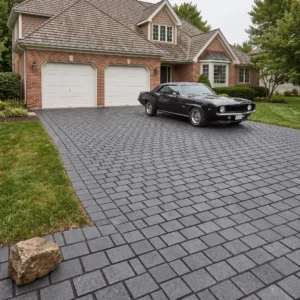
Look at any driveway on the island that has aged badly and the damage is almost never spread evenly. It sits in three places: the apron where the drive meets the road, the turning ground where a vehicle swings to reverse, and the short strip by the gate where wheels stop and start every single day. Everything between those points has an easy life. Those three areas carry the twist, the braking and the point loads, and they are where paving decisions are actually tested.
An apron takes more punishment in a month than the middle of a drive takes in a year. It deserves to be specified separately, and on Barbadian plots it is usually the strongest argument for small setts.
What Actually Fails in an Apron
Failures follow a predictable script, whatever the material, and once you have watched a few aprons lifted the list gets very short.
- Corners chip where a tire clips a raised edge on the turn in from the road.
- Units rock, then crack, because a wheel loads one corner while the opposite corner sits unsupported.
- Bedding migrates downhill under repeated braking, leaving a hollow that fills with water.
- Joints open at the road transition, grit washes in, and the whole edge starts to unravel.
- Oil and fuel drips mark a wide, open surface far more visibly than a busy jointed one.
Why a Large Slab Struggles Here
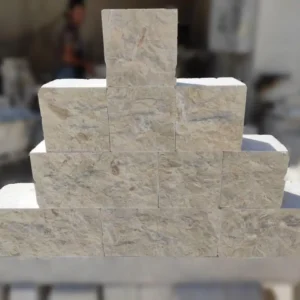
A slab has to carry a wheel load across its full span. Support the middle and lose a corner, and the unit becomes a lever working against itself; the crack that follows runs the full width and there is no quiet repair available. A sett does not face that problem, because it is smaller than the tire patch pressing on it. The load transfers into the joints and the bed instead of into a bending plate. That is why setts have survived on working entrances for centuries while fashionable large formats arrive and disappear.
There is a bedding argument underneath the structural one. A large unit needs a bed compacted evenly across its whole footprint, which is genuinely hard to achieve where a drive has been cut into sloping ground and backfilled near the road edge. Setts forgive small variations, because every block finds its own level under the mason’s hammer rather than depending on the block beside it.
Edge Restraint Is Most of the Job
Nothing matters more in an apron than whatever stops the field from spreading sideways. A sett surface works in compression, and that compression only exists while the perimeter holds.
- A haunched, restrained perimeter should be built before the field is laid, never added once movement appears.
- The road transition needs the most robust detail on the whole job, since traffic meets it at an angle.
- Where the apron meets a soft verge, use a heavier edge unit rather than more of the same sett.
- Allow the restraint to be repaired independently, because it will be the first thing a delivery truck finds.
Turning Grounds and Tight Entrances
Barbadian parish roads offer very little room to hesitate. Many drives are entered on a turn, sometimes uphill, and a car scrubs its front tires across the surface rather than rolling cleanly over it. That scrubbing action is what shreds thin surfaces and lifts poorly restrained units. A small, deep unit resists it, and when a block finally does give up it can be replaced in an afternoon without a saw cut running across the whole entrance. Contractors specifying sett paving for turning grounds are usually buying repairability as much as raw strength.
Bedding Choices on a Rainwater Catchment
Most homes here store rain on the lot, so what runs off a drive is never an abstract question. It ends up somewhere on the property, and usually somewhere you care about.
- Keep vehicle-area runoff out of any path that feeds a storage tank.
- Prefer open, free-draining joints over sealed ones so water leaves the surface quickly.
- Avoid heavy coatings and solvent sealers on a catchment lot altogether.
- Give the apron a defined low point with somewhere for water to go before it reaches the road.
Ordering and Landing the Stone
The logistics here are simpler than on most islands in the region, which is worth remembering whenever a supplier quotes freight vaguely.
- Bridgetown is a deep-water port, so ocean freight from the US East Coast arrives directly with no transshipment leg.
- A local customs broker files the entry; CET duty at the dimension-stone line, VAT and environmental levies all apply.
- Ask for those charges itemized in the quote rather than folded into a single tidy number.
- Confirm inland haul separately, since a narrow parish lane may need a smaller vehicle for the final run.
A Surface That Can Be Repaired
The honest case for setts on an apron is not that they never move. It is that when they do, a mason lifts six blocks, corrects the bed and puts the same six back, and nobody can tell afterward. Pair the field with curbstones that hold an edge and the entrance will still look composed in fifteen years. A driveway that can be repaired quietly is worth far more than one that was merely perfect on day one.