What the Numbers Reveal About Decomposed Granite vs Solid Granite
Decomposed granite vs solid granite isn’t a debate about which material is “better” in the abstract — it’s a structural and performance question that hinges on load classification, drainage geometry, and long-term maintenance cycles. Solid granite delivers compressive strengths that regularly exceed 19,000 PSI under ASTM C615 testing, while decomposed granite (DG) compacts to a surface that behaves more like a bound granular base than a structural paving element. That gap defines where each material belongs in a well-specified project.
Your application dictates the answer before you ever open a product catalogue. A pedestrian garden path and a vehicle-rated driveway apron sit at opposite ends of the performance envelope — and choosing DG for the latter isn’t a cost saving, it’s a specification error you’ll be correcting within three to five years.
Material Composition and Formation: What Each Actually Is
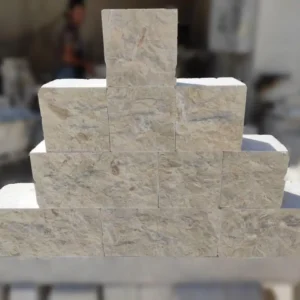
Solid granite is an intrusive igneous rock — formed under high pressure deep in the earth’s crust and composed primarily of quartz, feldspar, and mica. That crystalline interlocking structure is what gives it exceptional hardness (6 to 7 on the Mohs scale) and its characteristic resistance to abrasion, freeze-thaw cycling, and chemical attack. According to Natural Stone Institute granite durability and application specifications, granite’s mineral density and low absorption rates make it one of the most stable dimension stone options for exterior use.
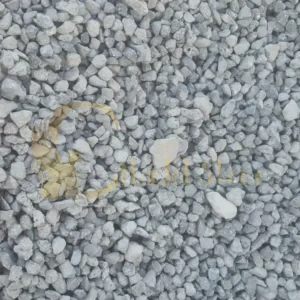
Decomposed granite is the same parent rock — but broken down by weathering into a granular mix of gravel, sand, and silt-sized particles. It retains some of the quartz and feldspar minerals from its origin, which is why it compacts reasonably well and holds its reddish or buff color. Three forms exist: raw DG (loose fill), DG with stabilizer (a polymer binder is mixed in), and DG with resin (a harder, more cohesive surface). Each behaves quite differently under traffic and moisture exposure.
- Raw DG displaces under foot traffic and erodes in heavy rain without edge restraint and frequent regrading
- Stabilized DG holds compaction better but still degrades under repeated vehicle loads above 3,000 lbs per axle
- Resin-bound DG approaches semi-rigid surface behavior but remains vulnerable to frost heave in freeze-thaw regions
- Solid granite pavers maintain structural integrity under vehicular loads and decades of UV, thermal, and moisture cycling
Load-Bearing Capacity and Building Code Requirements
Here’s where specifiers most commonly underestimate the gap between these two materials. Many residential and commercial jurisdictions reference International Building Code (IBC) provisions and local amendments for paved surface load classification — and loose or stabilized DG rarely meets the threshold for driveways, emergency vehicle access lanes, or commercial pedestrian zones that require a rigid or semi-rigid surface.
Your jurisdiction may also specify minimum base depth requirements that differ significantly depending on frost line depth. In regions where frost lines reach 36 to 48 inches, a compacted aggregate base beneath solid granite pavers needs to extend below the frost line or incorporate proper drainage layers to prevent heave. DG surfaces, lacking edge restraint and rigid binding, are inherently more susceptible to frost displacement — making code compliance for freeze-thaw regions an important factor in your material choice. ASTM C615 granite dimension stone quality standards provide the benchmark specifications your engineer or inspector will reference when evaluating solid granite paver installations.
- Solid granite pavers on a compacted aggregate and sand-set base can satisfy rigid paving requirements in most code jurisdictions
- DG installations require clearly defined edge restraint systems (steel, aluminum, or concrete curb) to prevent lateral spread under code review
- Seismic zones in certain parts of the country add requirements for flexible jointing and base stability that DG alone cannot meet for rated surfaces
- Emergency vehicle access paths — common in residential subdivisions under fire code requirements — typically mandate surfaces rated for 75,000 lb gross vehicle weight, which eliminates DG entirely
Drainage Performance Compared
Drainage is one area where the comparison requires nuance rather than a simple winner. Raw and stabilized DG is permeable by nature — water infiltrates through the granular matrix rather than sheeting off. For projects where stormwater management, site permeability ratios, or low-impact development credits are design objectives, dg decomposed granite has a genuine advantage over highly resistant solid paving.
Solid granite paving can also achieve drainage performance when installed with open joints (typically 3mm to 10mm) over a permeable aggregate base — a detail that satisfies both drainage goals and structural requirements simultaneously. The decision isn’t DG for drainage vs. granite for strength; you can have both with correct solid granite detailing. At Citadel Stone, we consistently recommend open-joint granite installations for clients who need to meet stormwater retention ratios without sacrificing surface durability.
The failure mode to avoid with DG is surface rutting caused by channeled water flow. Without adequate cross-slope (minimum 2% grade), water concentrates in low points, undermines compaction, and creates erosion channels that worsen with each rain event. This is a maintenance cycle that never fully resolves without regrading.
Surface Stability and Maintenance Cycles
Surface stability over time is where the decomposed granite vs solid granite question becomes a total-cost-of-ownership conversation rather than a material-cost comparison. DG requires regrading every one to three years depending on traffic volume, rainfall intensity, and whether a stabilizer was used. Stabilized DG reduces this cycle but doesn’t eliminate it — and reapplication of stabilizer adds material and labor cost at each service interval.
Solid granite pavers, correctly installed on a compacted base with proper jointing sand, realistically deliver 30 to 50 years of service with minimal intervention. The primary maintenance tasks are occasional joint sand replenishment and periodic cleaning — neither of which involves regrading or resurfacing. According to USGS granite production and construction use statistics, granite remains one of the most widely used dimension stone materials in long-service exterior applications precisely because of its low lifecycle maintenance profile.
- DG annual maintenance: regrading, weed suppression, edge restraint inspection, possible stabilizer reapplication
- Solid granite annual maintenance: joint sand check, surface cleaning, inspection for any settled units
- DG weed intrusion is persistent — seeds germinate readily in the granular surface without pre-emergent treatment
- Solid granite with polymeric sand jointing significantly limits weed establishment at joint lines
- Pet and children’s play areas on raw DG track material onto surrounding surfaces — a practical nuisance most project briefs don’t address until after installation
Aesthetic Applications and Design Fit
Both materials carry genuine aesthetic appeal — but they suit fundamentally different design vocabularies. DG creates a naturalistic, informal surface texture that complements xeriscaping, informal garden paths, trail systems, and rustic landscape settings. Its warm mineral tones integrate well with plantings and organic design forms. For projects aiming at a relaxed, naturalistic character, dg decomposed granite’s matte granular surface reads authentically.
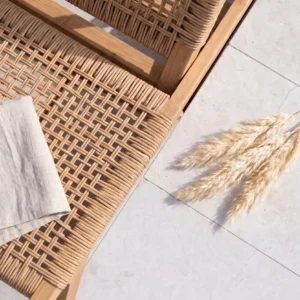
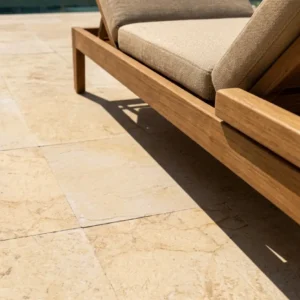
Solid granite brings precision and permanence. Whether you’re specifying flamed granite setts for a formal driveway, honed granite tiles for a courtyard, or sawn granite pavers for a commercial plaza, the material communicates architectural intention in a way that DG simply cannot replicate. The surface can be finished to spec — from thermal (flamed) for high-grip outdoor use, to polished for interior applications, to bush-hammered for mid-range slip resistance on wet surfaces.
Consider the visual consistency question as well. DG color can shift between supplier batches, and weathering creates gradual tonal variation across a surface. Solid granite maintains consistent color and texture across its service life, which matters for formal settings where visual uniformity is part of the design intent. Exploring the range of granite options at Citadel Stone gives you a clear picture of the tonal range available for your project’s palette.
Installation Requirements and Base Preparation
The installation process for each material reflects their fundamental difference in structural character. DG installation begins with subgrade preparation — typically 3 to 4 inches of compacted base DG below the finish surface layer — followed by compaction with a plate compactor. Edge restraint installation is non-negotiable; without it, the surface migrates laterally within the first season. Finished DG surface thickness typically runs 3 to 4 inches for pedestrian applications.
Solid granite paver installation follows a more demanding sequence that delivers proportionally better results. Base preparation should include 6 to 8 inches of compacted crushed aggregate (deeper in frost-active regions or clay-bearing subgrades), a 1-inch bedding sand layer, the granite paver unit, and jointing sand. Paver thickness selection depends on application: 1.25-inch for pedestrian, 2.375-inch (60mm) for residential vehicular, and 3.15-inch (80mm) for commercial or heavy vehicular use.
- DG base: compact native subgrade, add 3-4 inches of base DG, compact, apply 2-3 inch finish DG layer with optional stabilizer
- Granite paver base: compact subgrade to 95% Proctor density, 6-8 inch crushed aggregate base, 1-inch bedding sand, granite units, polymeric joint sand
- Edge restraint for DG: steel or aluminum bender board, or concrete curb — installed before any DG placement
- Edge restraint for granite pavers: concrete or plastic paver restraint spiked at 12-inch intervals
- Slope requirement for both: minimum 2% cross-slope for drainage — non-negotiable regardless of material
Cost Analysis and Project Budgeting
Material cost comparisons between DG and solid granite are frequently misleading when presented as simple per-square-foot figures. DG runs significantly lower at the point of purchase — typically $0.50 to $3.00 per square foot for raw or stabilized material, versus $8 to $20+ per square foot for solid granite pavers depending on thickness, finish, and format. That cost gap narrows substantially when you account for lifecycle maintenance.
Project planning should also factor in delivery logistics. DG is typically delivered by truck in bulk loads — cubic yards or tonnage — which requires good site access for a dump truck and adequate staging area. Solid granite pavers arrive on pallets, which is more manageable for restricted access sites, though you’ll need to verify warehouse availability before committing to project timelines. Citadel Stone maintains nationwide inventory across multiple distribution points, which typically compresses lead times to one to two weeks rather than the six to eight weeks common with import-only suppliers.
- DG installed cost (materials + labor + edge restraint): $4 to $9 per square foot for stabilized applications
- Granite paver installed cost (materials + base + labor): $18 to $40 per square foot depending on specification
- DG re-grading at 3-year intervals adds $1.50 to $4.00 per square foot per cycle over the project’s life
- Solid granite paver lifecycle cost over 30 years is typically lower than three DG resurfacing cycles over the same period
- Truck delivery access for bulk DG requires a minimum 12-foot clear gate width and firm ground approach
Stone Dust vs Decomposed Granite: A Practical Distinction
The comparison between stone dust vs decomposed granite comes up frequently in base preparation discussions, and it’s worth clarifying the distinction because the two materials are often confused at the point of ordering. Stone dust (also called crusher dust or stone screenings) is a manufactured by-product of crushing operations — it’s angular, fine, and typically composed of a single parent rock type such as limestone or granite. DG is a naturally weathered material with a broader particle size distribution and rounded particle morphology from natural abrasion.
Stone dust compacts well and is commonly used as a bedding layer under rigid paving units — but it does not drain freely once compacted, which makes it a poor choice where permeability is a priority. DG, particularly the raw or stabilized variety, retains some permeability after compaction. For a solid granite paver installation, your bedding layer specification should call for coarse washed concrete sand (ASTM C33), not stone dust and not DG — this is the detail that most field errors trace back to when early settlement occurs. The stone dust vs decomposed granite distinction matters most at this stage of the specification process, where a single substitution error can compromise the entire base system.
Where Each Material Genuinely Excels
Specifying either material correctly means being honest about what each does well — and where the other is the better call. DG performs best in low-traffic pedestrian applications, informal garden and trail settings, and projects where permeability and naturalistic aesthetics are primary criteria. It’s a legitimate material in its right context, and forcing solid granite into every application doesn’t serve the project or the budget.
Solid granite is the correct specification for any application where structural integrity, long service life, vehicular load rating, or architectural precision is required. Driveways, public plazas, pool surrounds, formal garden paths, and commercial outdoor areas all sit firmly in solid granite territory. The dg decomposed granite category has a place in landscape architecture — but that place is carefully bounded by application type and traffic classification.
- DG excels: informal garden paths, native plant areas, trail systems, low-traffic residential side yards, natural playground surfaces
- Solid granite excels: driveways, vehicle courts, pool decking, formal garden design, commercial plazas, high-traffic pedestrian zones
- DG with stabilizer: acceptable for moderate pedestrian areas, municipal trail connections, low-speed parking areas with edge restraint
- Solid granite in thin formats (1.25 inch): suitable for pedestrian patios and walkways with correct sand-set base
- Neither material suits applications without adequate drainage provision — standing water degrades both, though by different mechanisms
Making the Specification Decision That Serves Your Project
The decomposed granite vs solid granite decision resolves cleanly once you run your application against three filters: required load rating, target service life, and maintenance tolerance. If your project requires a rated surface, a service life beyond ten years, or low maintenance burden, solid granite is the answer — and the specification process should focus on thickness, finish, and base design rather than reconsidering the material category.
Our technical team at Citadel Stone reviews project specifications regularly and finds that the most common errors occur when DG is selected on budget grounds for applications that will require solid paving within five years — at which point the project is paying twice. Getting the specification right the first time is always the lower-cost path when total lifecycle cost is the measure. As you consider the full scope of your natural stone project, you may also find value in exploring complementary material decisions — how to select green marble for interior use covers another dimension of natural stone specification worth reviewing alongside your exterior material choices.
For projects where drainage and surface stability are both priorities, Citadel Stone offers solid granite formats that complement or replace loose-fill decomposed alternatives.