The breeze cools the house; the floor holds the cool
A Barbadian house built the traditional way is a machine for moving air. Louvers face the windward wall, jalousies bleed the leeward rooms, a deep veranda shades the openings, and the doors stand open from first light until the evening damp arrives. The trade winds do the cooling. What the floor decides is whether the cool the house gathered overnight is still underfoot at two in the afternoon.
That is a different question from the one a sealed, air-conditioned room asks. In a sealed room the floor is scenery. In a cross-ventilated room the floor is working equipment, and dense stone is unusually good at the work.
What actually makes a stone floor feel cool
Two separate properties get credit for the same sensation, and pulling them apart helps you specify better.
- Thermal mass: dense stone takes on heat slowly and gives it back slowly, so its surface lags behind the swing of the air instead of tracking it hour by hour.
- Conductivity: stone draws warmth away from a bare sole faster than timber or vinyl, so it reads as cool to the foot even at the same measured temperature.
- Night flushing: air crossing the house after sunset strips stored heat out of the floor, so each morning starts with the mass already discharged.
- Reflectance: pale limestone throws back more of the light landing on it, so less of the sun that reaches the floor turns into heat you have to live with.
Where the sun actually lands in your plan
General rules matter less than the geometry of your own house. Walk the rooms with a notepad across a full day and mark what you find, because the pattern is rarely what people assume.
- West coast rooms: a deep veranda holds sun off the floor for most of the day, then surrenders it completely for the last hour before sunset, exactly when those rooms fill up.
- South coast rooms: low light crosses terraces at a shallow angle and reaches much further inside than owners expect.
- Sheltered interiors: rarely take a direct beam at all, so tone can be chosen for looks rather than for heat.
- Courtyards and light wells: overhead sun lands hard on a small area for a short, intense window each day.
Carrying the floor from veranda to interior
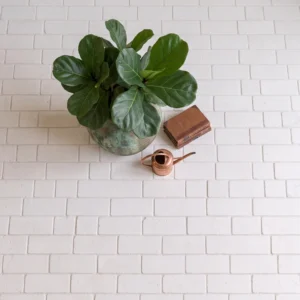
Houses here are not read room by room. You see straight through them, gallery to drawing room to the water beyond, and a change of material at every threshold chops that view into pieces. Running one stone family from the shaded veranda through the interior keeps the sightline whole, and it lets the shaded outer bay work as a cool reservoir for the rooms behind it. Choosing cool limestone floor tiles in the same color family as the outdoor paving is the simplest way to get that continuity without matching every surface exactly.
Coral stone is the island’s own; imported stone complements it
Barbados has quarried and built with its own coral limestone for more than three centuries: great houses, parish churches, boundary walls, and the Bridgetown and Garrison streets now inscribed as a UNESCO World Heritage property. Nothing shipped in replaces that, and no serious supplier should suggest otherwise. What imported limestone adds is a different set of calibrated formats, thicknesses and finishes to sit alongside the local material, plus batch volumes that suit one long interior floor.
Two coasts, two specifications
An island this compact still holds two very different exposures, and a floor drawn for one is wrong for the other.
- The Atlantic east coast around Bathsheba: constant salt-laden wind carrying airborne sand, an abrasive pairing that leaves salt as a permanent film on anything facing it.
- The sheltered west and south coasts: gentler air, where comfort underfoot and the look of the finish can lead the decision.
- Ridge and hillside plots: these catch wind coming over the high ground and behave more like the east than their address suggests.
- Interiors behind deep verandas: protected on every coast, and the right place to spend on a finish you actually want to look at.
Specifying a floor for a ventilated plan
A handful of decisions carry most of the outcome.
- Keep interior tone pale, and reserve deeper tones for shaded bays and thresholds that never bake.
- Ask for tiles drawn from one production batch so tone drift does not show across a long open run.
- Choose a surface with enough tooth for wet feet but not so much texture that tracked-in sand grinds into it.
- Set thresholds low and level so air, water and people all move through without a lip to catch.
Where the shaded veranda continues into the garden, limestone pavers for shaded terraces in a related tone finish the run without forcing an exact match to the interior tile.
Landing the order in Bridgetown
Bridgetown is a deep-water port, so ocean freight from the US East Coast arrives directly with no transshipment leg to add weeks and handling damage. What follows is local. A customs broker files the entry, Common External Tariff duty applies at the dimension-stone line, VAT is charged at 17.5 percent, and environmental levies sit on top; ask for all of it itemized in the quote rather than discovered at clearance. Onward road delivery deserves its own conversation, because parish roads narrow fast and a hillside plot may need a staging point and a smaller truck for the last leg.
Stand a sample on your own floor, in your own light, before a single crate is booked.