The apron works harder than the rest of the drive
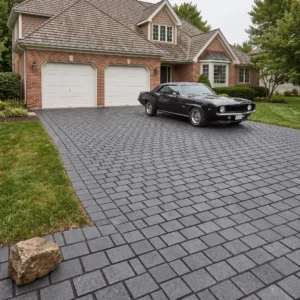
The apron is the strip where the property meets the road: the first few feet inside the gate, the flare at the sidewalk, the pad where a vehicle stops, swings and straightens up. It carries more work per square foot than anything else on the site. Every car that enters brakes on it, every delivery truck pivots on it, and on a Jamaican property it also takes the first hit of road grit, storm runoff and the occasional overloaded flatbed. If a drive fails, it fails here, usually within two or three rainy seasons rather than at the end of a design life.
What actually breaks an apron
The failures repeat with depressing regularity, and almost none of them are the fault of the stone.
- Bedding laid too thick, so the surface consolidates unevenly under repeated wheel paths
- No edge restraint at the road line, letting the outer course creep outward and open the joints
- A base built for foot traffic and then asked to carry a loaded truck
- Joints left unfilled, or filled with material that washes out in the first heavy downpour
- Falls set toward the gate, so every storm pushes road water into the yard
Turning loads are not rolling loads
A wheel rolling straight pushes a paving unit down. A wheel turning while stationary, or nearly stationary, twists it sideways, and that horizontal shear is what lifts units out of a field. Aprons see more of it than any other area, because drivers steer as they enter. Small units help, because the load spreads across many joints instead of levering one large slab, but only where the joints are properly filled and the perimeter is locked. Setts bring a second advantage at the road interface: they dress into an uneven existing tie-in without a long saw cut across a full slab.
Build depth where vehicles turn
Specify the apron as a vehicular area from the start rather than extending a terrace detail out to the gate and hoping.
- Choose a deeper sett than you would use on a terrace and keep that depth across the whole field
- Build a compacted, well graded base sized against the vehicles the property really receives
- Bind the joints, and consider a bound bed anywhere a truck brakes or pivots
- Restrain every free edge, including the joint against the concrete gate threshold
- Set the surface to shed water sideways into a channel rather than along the wheel path
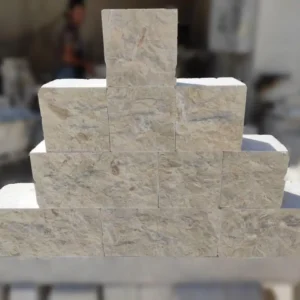
Depth consistency is a supply question as much as a workmanship question. Our cobble paving stock for Jamaica is cut to controlled thickness bands, so a crew can build one bedding depth for the entire apron instead of chasing tolerance with sand.
Storms, wind and storm water
Jamaica designs against weather it has actually lived through. Hurricane Gilbert in 1988 remains the national reference point, and design wind speed used in Jamaican practice was lifted from 120 mph to 150 mph after it. Beryl came ashore on the south coast in July 2024 as a reminder that the exposure is current rather than historic. Wind is not the direct enemy of paving; the rainfall traveling with it is. An apron that cannot pass water quickly becomes a channel, and a channel scours joints. Size outlets for a real tropical downpour, not an average month.
Resort service yards and delivery cycles
The heaviest sett aprons we specify for Jamaica are not private driveways at all. They are hotel service entries along the north coast around Montego Bay, Rose Hall, Ocho Rios and Negril, where linen trucks, food deliveries and staff vehicles trace the same arc a dozen times a day, all year.
- Assume a vehicular build-up across the whole yard, not only under the wheel tracks
- Bind the joints where refuse vehicles reverse and pivot
- Keep spare stone on site from the original shipment for local repairs
- Plan on lifting and relaying small areas rather than resurfacing the yard
That is the quiet advantage of setts on a working property: a damaged patch lifts and relays in a morning without leaving a visible scar.
Ordering, clearance and landed cost
Material lands at Kingston for the capital and the south, or at Montego Bay for the resort belt. Budget the clearance stack honestly, and confirm current figures with your broker before committing a price to a client.
- Import duty commonly around 20 percent for many goods under the CARICOM common external tariff
- General Consumption Tax at 15 percent
- An environmental levy of 0.5 percent on CIF value
- A standards compliance fee of 0.3 percent, collected by Jamaica Customs for the Bureau of Standards Jamaica
- A customs administrative fee, with the whole calculation running on CIF rather than invoice value alone
Format choice moves the freight line too, since deeper units mean fewer square feet in the box. Compare depths and plan sizes across our cobble setts in stock formats before the quantity is fixed.
Where Jamaican quarries fit
Limestone underlies about two thirds of Jamaica, and the Mines and Geology Division regulates quarrying under the Mining Act and the Quarries Control Act, with marble sitting on the non-metallic list beside limestone, marl, silica sand and clay. Local operations feed the island its aggregate, base course, marl and block, and an apron built here still depends on that material below the surface. What is not produced locally is calibrated dimension setts of consistent depth with documented absorption, and that is the part we ship in. Send us the vehicle schedule and the gate dimensions and we will spec the apron depth around them.