The Dutch side runs the northeastern Caribbean’s night shift: casinos from Philipsburg to Simpson Bay dealing to cruise crowds and stay-over players, show lounges and clubs stacking the entertainment offer, and a nightlife economy that makes SXM the islands’ late-hours capital. Gaming premises are hospitality’s most demanding indoor-outdoor genre — theater, security and stamina in one envelope — and their ground craft runs around the clock. Here is the casino coast’s guide.
The arrival theater
Casino economics begin at the curb: porte-cochère and forecourt ground on the flagship-threshold register at showtime polish, valet and taxi choreography on surge-duty surfaces timed to ship schedules and show breaks, facade lighting on ground that carries the glow — the night-register craft at full production values — and the first-impression arithmetic the luxury-threshold principle shares: the player judges the house by the approach, and the approach is stone before it is anything.
Twenty-four-hour duty
Gaming floors never close, and their thresholds never rest: entry ground cycling smokers, players and shows all night on the double-shift discipline without the dawn pause, terrace and courtyard gaming — the tropical genre’s outdoor tables — on all-weather stone, service circulation on the working-grade law at three-shift tempo, and maintenance choreographed into the quiet hours that barely exist: the no-looking-tired standard with no overnight to hide the work in.
- A cleaning window measured in hours, not overnight shifts
- Surfaces that recover with water and a neutral cleaner, not acid
- Sealed transitions so mop water never reaches a bedding layer
- Replacement units held on site so a damaged piece leaves before opening
Entertainment-district ecology
The casinos anchor wider nights: show lounges and clubs clustering on the entertainment-district craft at resort polish, restaurant rows feeding the pre-show economy on the flagship-dining standard, the Maho corridor running its sunset-to-slots evening arc, and district ground carrying the ecology — shared parking, lit walks between venues, taxi ranks on honest aprons — with the late-night safety layer built in: sightlines, lighting and surfaces that serve the walk home as seriously as the walk in.
Security in the ground plan
Gaming premises carry security as architecture: cash-route circulation separated on its own thresholds, camera-served sightlines shaping court and entrance geometry, vehicle standoff managed in forecourt design — bollard and planter lines on the institutional-perimeter craft dressed as landscape — and the regulatory layer the documentation culture governs: licensed premises audit their fabric, and the ground plan answers to inspectors as well as guests.
- Sight lines kept open by low planters and level changes rather than walls
- Bollard and barrier fixings designed into the slab from the start
- Lighting conduits routed under joints that can be lifted without cutting
- Camera positions agreed before the paving pattern is set out
Storm nights and comeback seasons
The night economy took Irma with the island: the dense-rebuild chapter returning the casinos in waves, insurance-era upgrades hardening the estates, the reopen-fast arithmetic at entertainment stakes — the house that lights first books the season’s players — and the two-speed wisdom in every renewed forecourt: engineered permanence underfoot, renewable spectacle above. The show must go on is a specification here; the ground is how it does.
Specifying the night shift
Casino-coast work blends flagship polish, fortress logic and industrial stamina: showtime thresholds, surge-duty forecourts, all-weather gaming terraces, security-served geometry and no-pause maintainability — landed on the hub supply line and served by the island supply guide at the night shift’s standard. The house lights climb at dusk, the tables run till dawn, the forecourt resets by breakfast — and the stone under the islands’ late-hours capital plays the longest session on the coast, and never shows its cards.
Daylight at the house: the casino before dark
The casino coast’s daylight hours run a quieter economy the night’s glamour hides: the morning’s deep maintenance — floors, plant and the no-pause fabric serviced in the only window the schedule offers; the afternoon’s soft trade — the sports book’s matinee crowd, the slots’ daytime regulars, the tour groups routed through on the cruise-day circuits; and the operational day — deliveries, cash logistics, staff training and the compliance calendar — running through premises designed for around-the-clock life. The daylight audit is the fabric’s honest hour: what the night’s lighting flatters, the afternoon sun cross-examines — worn thresholds, tired surfaces, the forecourt’s stains — and the flagship houses schedule their standards inspections accordingly, walking the estate at noon precisely because the evening’s theater hides nothing then.
The premises’ daylight duties extend outdoors: forecourts doubling as the district’s daytime parking resource, terraces serving the lunch trade the restaurant economy shares, and the corridor’s family afternoon traffic passing frontages that must read respectable at three o’clock and thrilling at nine — the double register the entertainment coast’s stone was specified to hold. The transition hour is the daily performance: lighting cycles rehearsed, terraces re-set from lunch to evening, valet choreography scaling up as the district’s pulse quickens.
The operational lesson is continuity’s: the twenty-four-hour house has no closed sign to hide behind, its fabric is always on duty in one register or another, and the specification that survives is the one chosen for daylight’s scrutiny as much as midnight’s forgiveness. The night makes the money; the day makes the standards; and the stone underfoot works both shifts without a costume change.
The smoking terrace: the outdoor room regulation built
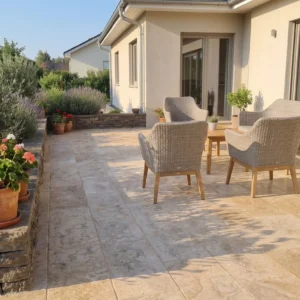
Modern gaming regulation moved the smokers outdoors, and the casino coast answered with a premises type all its own: the smoking terrace — the outdoor gaming and lounge room where the house’s hospitality continues under open sky, and whose design carries real revenue weight. The specification blends the estate’s registers: gaming-grade surveillance sightlines and cash-handling adjacency, hospitality comfort — shade, fans, the wind screening the trades demand — and the all-weather stone ground that takes cigarette traffic, spilled drinks and twenty-four-hour service without carrying yesterday’s evidence into tonight. Ventilation strategy is placement: terraces sited so the prevailing breeze clears them without delivering the plume to the main entrance or the neighboring hotel’s balconies — the acoustic courtesies applying to smoke as much as sound. Ashtray-and-cleaning logistics run on the reset discipline; furniture and finishes choose the burn-indifferent end of every range; and the terrace’s lighting holds the house’s warmth so the outdoor room reads as amenity rather than exile. The regulation wrote the requirement; good design converted it into some of the coast’s most profitable square meters — open-air, stone-floored, and busy at every hour the tables are.
What the ground absorbs between midnight and dawn
A night venue asks something unusual of a floor: it is busiest when nobody is looking at it closely, and it is judged in daylight the following morning. Spilled drinks, citrus, coffee, cigarette ash and cleaning chemistry all land on the same surface within a few hours. Absorption is therefore the number to interrogate first, because a stone that takes liquid in will keep a record of every busy night. The Natural Stone Institute overview of limestone is a useful starting point precisely because it shows how widely density and porosity range inside one commercial name, which is why a sample and a test result matter more than a label.
- Low-absorption stone anywhere drinks are carried or served
- Consistent honed or textured finishes that hide wear rather than polish unevenly
- Joint materials chosen for cleaning chemistry, not only for color
- A written cleaning method issued to the night team, not improvised
Grip when the surface is never quite dry
Between the valet drop, the terrace and the entrance, most of the ground plane at a late-night venue spends part of every evening wet. Guests arrive in smooth-soled shoes, often in rain, and the transition from open sky to covered entrance is where the risk concentrates. Guidance on testing frictional properties of natural stone walking surfaces makes the case for quoting wet values on the delivered finish, which is the only figure that describes the condition a doorman actually manages.
- Wet-tested finishes at the forecourt, threshold and every step
- No change of texture across the covered and uncovered halves of a terrace
- Falls that clear standing water fast rather than holding a sheen
- Step nosings detailed for grip and mechanically restrained
Choosing casino terrace stone that reads well at both hours
The specification worth writing here is one that performs at two in the morning and photographs at ten. That means a dense stone with a stable color under artificial light, a finish that resists both staining and slipping, and a build-up that lets a single damaged unit be replaced before the doors open again.
- Color checked under the venue lighting, not only in daylight
- Units laid so any piece can be lifted without disturbing its neighbors
- Edge restraint continuous around valet and drop-off traffic
- Attic stock ordered with the main delivery and stored dry on site
Our Sint Maarten stone supply guide sets out the formats, finishes and lead times that suit this island. A venue that trades until dawn cannot afford a floor that needs the morning off.