What Border Specifications Reveal About Black Stone Supplier Quality
Reputable black stone suppliers differentiate themselves long before material lands on your project site — the gap shows up in how they communicate color consistency, thickness tolerances, and batch control across multiple pallet orders. Borders are unforgiving: a 2mm variation in thickness between adjacent pieces creates a lippage problem you can’t grind out without destroying the profile, and a color shift between the first and third delivery turns a crisp border line into a patchwork edge. Understanding how to evaluate black stone suppliers on these technical dimensions protects your specification from the most common border failures seen in the field.
Material Types You Should Evaluate for Border Applications
Your first decision point when approaching black stone suppliers is material type, and the category matters enormously for border performance. Black basalt, black limestone, black granite, and dark slate each bring a distinct combination of hardness, porosity, and thermal behavior — and each performs differently when used as a linear border element exposed on multiple faces.
- Black basalt delivers exceptional hardness — typically 6 to 7 on the Mohs scale — making it highly resistant to edge chipping along exposed border profiles
- Black limestone offers a softer cutting profile that suits curved border layouts, but its porosity demands sealing before installation in high-moisture zones
- Black granite maintains dimensional stability under load, making it the preferred choice for driveway border applications where vehicle overhang causes cyclic edge stress
- Dark slate cleaves naturally along parallel planes, which gives it a layered aesthetic but limits the thickness consistency you need for flush-set border work
- Sintered dark stone provides near-zero absorption, though it presents different bonding challenges than natural material when set into mortar beds
The Natural Stone Institute technical specifications confirm that igneous stones like basalt and granite outperform sedimentary options in freeze-thaw regions due to lower absorption coefficients — a useful benchmark when evaluating supplier material data sheets against your project conditions. According to NSI stone variety specifications, absorption and density values vary significantly across natural stone families, making supplier-provided test data an essential part of the selection process.
Thickness Tolerances and Batch Control: Where Suppliers Separate
Here’s what most specifiers miss when comparing black stone suppliers: the published nominal thickness is almost irrelevant — what matters is the tolerance range the supplier actually controls to, and whether that tolerance is maintained across batches. A supplier quoting ±3mm tolerances on a 30mm nominal border piece is telling you to expect lippage. A supplier who controls to ±1mm and backs it with caliper records from their warehouse intake process is telling you something completely different.
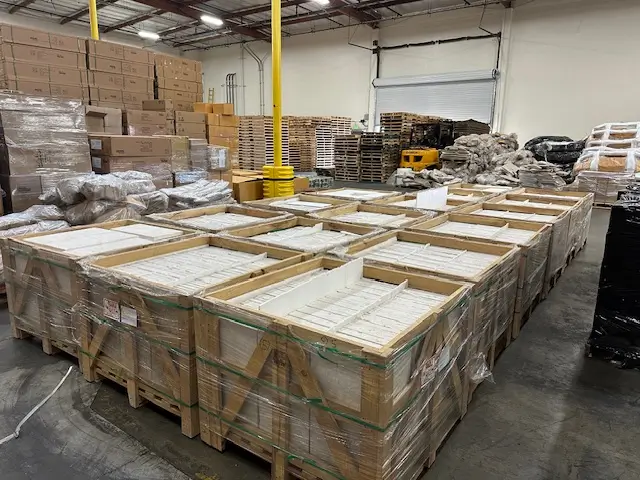
Your specification should require that all border pieces from a single order come from the same quarry run and the same saw calibration batch. This is the only way to guarantee that the fourth pallet delivered matches the first. Suppliers who can’t provide lot traceability documentation — or who won’t commit to it — are telling you their warehouse and logistics operation isn’t set up to support precision border work. At Citadel Stone, we sort and batch our dark stone border inventory by quarry lot before it leaves our warehouse, so color and thickness consistency is managed before delivery rather than sorted on site.
Edge Profiles and Finish Options Your Supplier Should Offer
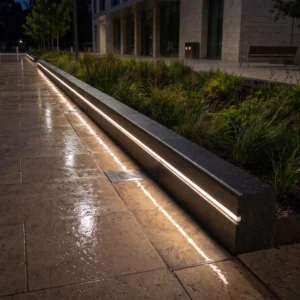
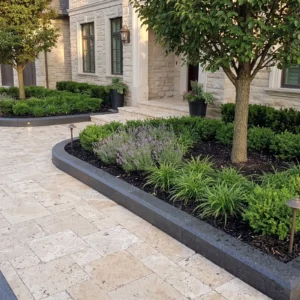
Border applications expose edges that field cuts and patio field stone never reveal, which means your black stone suppliers need fabrication capability beyond standard slab supply. The finish on the face is only half the specification — the exposed border edge carries equal visual weight in a completed installation.
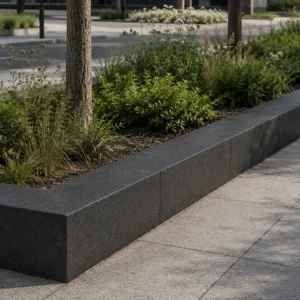
- Sawn edge: clean, geometric, and consistent — the standard for contemporary landscape border work where straight lines define the design intent
- Sandblasted edge: adds texture that reduces the visual sharpness of straight cuts and improves grip on vertical or angled border faces
- Tumbled edge: creates a naturally aged profile that integrates with informal garden settings; requires supplier-level tumbling, not field improvisation
- Bullnose profile: rounds the top corner of the border piece, eliminating the sharp arriss that creates a trip hazard on raised border edges adjacent to turf or gravel
- Chamfered edge: a 45-degree bevel that defines border transitions without the visual softness of bullnose, often specified for formal driveway edging
Suppliers who manufacture to your specified edge profile — rather than offering only stock profiles — reduce the site fabrication burden significantly. Every field cut you eliminate is a potential crack point removed from the finished border, which matters particularly for harder stones like basalt where field grinding risks micro-fractures along cut lines.
Evaluating Color Consistency in Dark Stone Orders
Color consistency in dark stone is more complex than it appears at the specification stage. Black limestone ranges from near-charcoal to a warm dark grey depending on calcium carbonate distribution, and what reads as uniform in a single sample can show significant variation across a pallet. Your evaluation of black stone suppliers should include a specific request for a full-range sample set — not a curated single piece — that shows the natural variation within a typical lot.
The benchmark most experienced specifiers use is the mid-point-to-extremes range: the lightest and darkest pieces in a pallet should still read as the same material at 3 meters distance. Suppliers who can demonstrate this through physical lot samples — or through calibrated digital color matching from their warehouse stock — provide a fundamentally more reliable supply chain than those who offer only catalogue photography. According to USGS dimension stone production data, natural color variation is inherent to quarried stone, which makes supplier-level sorting and documentation the only reliable control mechanism available to specifiers.
For projects requiring coordinated material across multiple zones — say, a perimeter border that transitions from a driveway entry to a garden bed and then a pool surround — source all border material from a single coordinated lot. Splitting orders across multiple runs from the same supplier introduces color drift that compounds as the project progresses. The Citadel Stone dark edging range is stocked and sorted specifically to support this kind of coordinated multi-zone specification.
Cost Factors and Sourcing Decisions That Affect Your Total Budget
Freight distance from the supplier’s warehouse to your project site is the variable most project budgets underestimate when sourcing dark border stone. The material cost difference between a mid-grade and premium black stone supplier often narrows to 8–12% per linear meter, but freight adds a flat cost per pallet that scales with distance — not with material value. A supplier positioned closer to your project can offset a higher material unit cost entirely through reduced delivery charges, particularly on large border quantities where multiple truck deliveries are required.
- Calculate your total delivered cost, not just the per-piece or per-linear-meter material price — freight and handling can represent 20–35% of total material cost on heavy stone deliveries
- Ask suppliers about minimum order quantities per truck load — orders that don’t fill a truck typically carry a premium freight rate that disappears at full-load thresholds
- Verify warehouse lead times before committing to a project timeline — suppliers with deep warehouse inventory of dark border stone typically offer 5–10 day lead times versus 6–8 weeks for direct import orders
- Evaluate material-to-labor cost ratios: premium stone with better thickness tolerance reduces installation labor time, which can offset a higher material price on labor-intensive border layouts
- Regional market conditions affect quarry pricing seasonally — suppliers with established quarry relationships often absorb price fluctuations more effectively than spot-buy distributors
Value engineering on border projects rarely benefits from downgrading material quality. The labor cost of rehandling off-spec pieces, managing thickness variations, or replacing cracked edges in service consistently exceeds the initial material saving. The more productive value engineering move is to optimize your supplier’s truck scheduling — coordinating delivery windows to minimize site holding costs and reduce the number of separate delivery charges across the project duration.
Installation Requirements Your Supplier Should Help You Plan
The performance of dark border stone in service depends as much on base preparation as material selection — and reputable black stone suppliers will engage with your installation specification, not just sell you material. Borders experience a different load pattern than field pavers: they receive lateral soil pressure from one side, point loads from mowers or foot traffic on the top face, and cyclic wet-dry cycling at the soil interface on their buried faces.
Your base preparation spec for border applications should typically call for a compacted aggregate sub-base of 100–150mm depth, with a concrete haunch on the back face of the border piece when it’s retaining a grade change of 50mm or more. Suppliers who understand this application will ask about your site conditions rather than just processing a quantity order. Field performance data consistently shows that border failures trace back to inadequate back haunching, not material weakness — a detail that doesn’t show in the supplier’s specification sheet but should come up in a technical conversation before you commit to an order.
Dark stone border pieces should be evaluated at 30–50mm thickness for standard landscape edging, stepping up to 60–80mm for driveway or vehicular border applications. The compressive strength requirements differ significantly: ASTM standards for dimensional stone used in vehicular zones set minimums that thinner decorative pieces don’t always meet, making supplier material certification documentation a non-negotiable part of your pre-order checklist. Refer to ASTM dimensional stone testing standards for the specific compressive strength and absorption thresholds relevant to your application category.
Sealing Protocols and Long-Term Maintenance for Dark Borders
Dark stone borders present a specific maintenance challenge that lighter materials don’t: efflorescence reads more visibly against a dark background, and calcium deposits from mortar haunch work can create persistent white streaking that compromises the border’s visual impact. Your sealing protocol needs to address this before the installation is complete, not after the first season.
- Apply a penetrating impregnating sealer to all exposed faces — top, side, and any cut ends — before the border pieces go into position; sealing after installation leaves the mortar contact zones unprotected
- Allow at least 28 days for mortar haunching to fully cure before applying a final topcoat sealer; premature sealing traps moisture migration from fresh mortar and causes seal failure
- Re-seal dark border stone every 2–3 years in moderate conditions, annually in high-UV or freeze-thaw environments where thermal cycling accelerates sealer breakdown
- Clean efflorescence deposits with a diluted acid wash — typically 10:1 water to muriatic acid — applied to pre-wetted stone; dry application risks etching on limestone and some basalt finishes
- Inspect mortar haunch joints at each resealing interval for cracking; hairline haunch cracks allow soil moisture intrusion that undermines the border’s lateral stability over time
Suppliers who provide material-specific sealing recommendations — rather than generic advice — are demonstrating product knowledge that goes beyond sourcing. This is particularly relevant for black limestone, where the sealer chemistry interacts with calcium carbonate in ways that can affect color depth and sheen level, sometimes darkening the material beyond the specified appearance.
Final Considerations for Specifying Black Stone Suppliers
Choosing the right black stone suppliers for border applications ultimately comes down to three interlocking factors: material traceability, fabrication precision, and logistical reliability. A supplier who can demonstrate quarry-lot documentation, controlled thickness tolerances, and confirmed warehouse stock levels before you commit gives you a fundamentally different project outcome than one who processes orders without these controls in place. The conversation you have with a supplier before the order is placed tells you almost everything you need to know about the conversation you’ll have if something goes wrong mid-project.
Your specification should lock in the material type, finish, edge profile, thickness tolerance, and lot batch requirements in writing before any delivery is scheduled. This protects your installation quality and gives your supplier clear parameters to meet — removing ambiguity from a supply chain where ambiguity always costs more to resolve than it would have to prevent. As you finalize your border specification, you may also find it useful to explore how different stone formats perform in adjacent hardscape applications — sintered versus natural stone edging is a comparison worth reviewing if your project scope includes non-natural alternatives alongside your border work. Sourced direct from quarries in Turkey, the Mediterranean, and beyond, our dark edging ships in coordinated lot batches for color consistency.
Related reading: natural granite suppliers · pebble edging ideas · marble edging care.