The territory’s beaches are its reputation. Magens Bay’s long protected curve on St. Thomas, Trunk Bay’s underwater snorkeling trail inside the national park on St. John, and Buck Island Reef off St. Croix — a national monument protecting an entire reef system — are as close to public infrastructure as sand gets. They carry enormous visitation, sit inside protective designations, and depend on ground craft that most visitors never notice. Here is the public-shore guide.
Managed beaches, real numbers
A cruise-day beach receives crowds that would strain a stadium, and the infrastructure answering them is deliberately modest: access paths that concentrate footfall away from dune vegetation, changing and restroom facilities built to survive salt and volume, shaded gathering ground, and vehicle staging for the taxi and safari-bus economy that delivers everyone. The public-duty specification applies at beach-park scale, and the famous-beach discipline governs the balance: serve thousands without privatizing a meter or paving what should stay sand.
Inside the park
St. John’s beaches sit within the national park, which sets the register firmly: minimal-intervention facilities, materials that read natural, interpretation rather than commerce, and construction manners that treat the surrounding ecology as the point rather than the backdrop. The protected-boundary craft this library wrote for Aruba applies here at higher visitation, and the underwater trail at Trunk Bay adds a genuinely unusual asset: interpretive infrastructure that lives offshore and is maintained by people in fins.
- Consultation with the managing agency before any design is fixed
- Works confined to existing disturbed ground wherever possible
- Materials and colors kept within the natural range of the shore
- Full reinstatement of every temporary access route
Reef stewardship as ground craft
What happens on land decides what survives underwater, and the territory’s reef designations make that explicit. Runoff carrying sediment and nutrients is the reef’s quiet enemy, which turns drainage design on shore-adjacent property into conservation work: permeable surfaces where they can be, planted margins that filter, sediment controls during construction that are actually maintained, and the habitat-margin manners at every waterline. Buck Island’s protections and the coral restoration work around the territory make this concrete rather than theoretical.
Turtle beaches and the dark shore
Several territory beaches host nesting turtles, and the lighting rules that follow are absolute during season: shielded, low, warm fixtures, nothing beach-visible, and the nesting-season discipline this library wrote for Aruba enforced here by federal protections. Shore-side properties inherit the duty and generally embrace it — a dark shoreline is also a better one to sit on, and the hatch nights are among the territory’s quiet privileges.
- Lighting kept low, warm and shielded from the water line
- No works during the most sensitive nesting periods
- Machinery kept off open sand entirely
- Debris and offcuts removed daily rather than at the end of a phase
The properties that adjoin
Living beside a famous beach carries the shared-treasure obligations this library keeps meeting: access preserved rather than obstructed, boundary treatments that never suggest the sand is private, lighting held to the park and turtle standards, and the discretion register governing what the beach sees looking back. The reward is straightforward — a permanently protected view, permanently maintained by somebody else — and the properties that behave well toward the shore are the ones the community defends when questions arise.
Specifying the shared shore
Public-shore work is modest, durable and heavily used: concentrated access paths, salt-and-volume facilities, shaded rest ground, filtration-minded drainage and dark-shore lighting — supplied through the territory supply page in the honest grades public infrastructure deserves. These beaches are why a great many people come to the territory at all; the ground serving them should be as carefully specified as any villa deck, and considerably less noticeable.
Cruise day at the beach: managing the pulse
The territory’s famous beaches meet their hardest test on the mornings several ships berth at once. Thousands of people arrive within a compressed window by taxi and safari bus, spend a few hours, and leave almost simultaneously — a pulse rather than a flow, and one that beach infrastructure either absorbs or visibly fails. The management response is unglamorous and effective: vehicle staging that keeps buses off the sand approach, arrival sequencing that spreads the load across entry points, facilities sized for peak rather than average, and staff presence at the hours that matter.
The ground carries the specifics. Access paths are the pressure point — concentrated footfall on a defined route protects the dune vegetation either side, and a path that erodes into a braided mess is a conservation failure as much as a maintenance one. Facilities buildings take volume no residential specification anticipates, which argues for the public-duty grades this library specifies for civic ground. Shade is infrastructure rather than amenity at these numbers. And the afternoon reset — sand raked, litter cleared, facilities cleaned — is what decides whether tomorrow’s arrivals see a treasured beach or a used one.
The balance the territory has largely struck is worth naming: these beaches carry enormous commercial visitation while remaining genuinely public, genuinely beautiful and, in the protected cases, genuinely conserved. That is not accidental — it is designation, management and daily maintenance working together. Properties nearby benefit from it entirely for free, which is a reasonable argument for behaving well toward the shore in return: preserved access, dark lighting, filtered runoff and the discretion that leaves the beach’s photographs uninterrupted.
The beach economies
Around the famous sand runs a small commercial ecosystem that most visitors treat as scenery: chair and umbrella concessions deploying at dawn, watersports operators at their marked stations, food and drink kiosks, and the taxi and safari drivers whose day is built around the ship schedule. These are licensed livelihoods, often family-held across generations, and their premises deserve the specification this library gives small commerce everywhere – hard-standing where equipment stages, wash-down surfaces at the food end, secure overnight storage so the operation is not rebuilt daily, and shade that makes a twelve-hour day survivable. The strip-economy craft from Puerto Rico reads directly across. Beaches that integrated these trades into their planning look ordered; beaches that treated them as an afterthought look improvised, and the difference is visible in every photograph a visitor takes home.
A reef with no equivalent in United States waters
The standard for shoreline work here is set by what sits just offshore. Buck Island Reef National Monument protects a coral reef ecosystem and the small island it encircles, described by the Park Service as one of the most pristine barrier reef systems in the Caribbean, with an elkhorn-coral barrier reef unique within United States waters and green sea turtles among the species it supports. Tens of thousands of visitors reach it every year. Nothing built on the adjacent shore can be allowed to send silt, fuel or wash water toward that.
- Silt control treated as a permanent condition, not a wet-season measure
- Cutting and washing stations located well back from the water line
- Slurry and fines collected rather than allowed to drain seaward
- Fuel and chemical storage bunded and sited away from open ground
Public land, public water, public expectation
The public interest here is unusually literal. Virgin Islands National Park holds 7,259 terrestrial acres and 5,650 submerged acres, so on St. John the land, the water and the seabed can all be in public hands at the same site. Add territorial law keeping beaches open to everyone and the result is a design brief with more stakeholders than a private terrace ever has.
- Design for year-round public use, including the busiest single day
- Accessible routes from parking to sand, not just to the facilities
- Durable, repairable surfaces that a public budget can maintain
- Signage and level changes legible to a first-time visitor
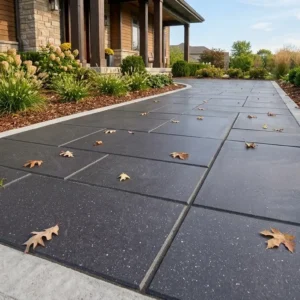
Choosing public shore stone for a shared beach
A public shore surface has to survive crowds, salt, sand abrasion and a maintenance budget that is never generous. The answer is nearly always modular, replaceable and plain.
- Units a two-person crew can lift and reset without plant
- One format and finish across the whole facility so repairs match
- Sand-tolerant textures that keep grip without trapping grit
- Spare stock held locally, because closures are what the public notices
Our US Virgin Islands stone supply guide sets out the formats, finishes and lead times that suit these islands. When the sand belongs to everyone, the surface leading to it has to work for everyone.