

The surface density of basalt versus brick pavers shapes a project’s outcome long before the first paver is set. Basalt is a fine-grained volcanic rock with a tight crystalline matrix, while brick is a kiln-fired clay product whose porosity and surface texture can vary widely between manufacturers. Understanding those structural differences — not just the aesthetics — is where a well-specified basalt vs brick pavers comparison has to begin.
What Each Material Actually Is
Basalt forms when low-silica lava cools rapidly, leaving very little time for large crystals to grow. The result is a dense, dark-grey to near-black stone with a uniform texture that reads the same way whether you’re looking at a single tile or a full paved courtyard. Its colour comes from iron and magnesium minerals locked into the matrix during cooling — which is why basalt pavers don’t fade the way pigmented materials do.
Brick is fundamentally different in origin. Clay is shaped and fired, and the final product’s density, absorption and surface hardness depend on firing temperature, clay blend and the manufacturer’s process controls. Traditional clay pavers — the kind specified for pedestrian and light-traffic paving — are a mature product with well-understood behaviour, but they vary considerably between production runs. You’ll notice that range most clearly in colour: bricks can shift from deep red to buff to almost orange, and that variation can show up within a single delivery.
- Basalt is igneous — volcanic in origin, homogeneous in texture, dark charcoal in colour palette
- Brick is manufactured from fired clay — colour, hardness and absorption depend on the production process
- Basalt’s crystalline structure means colour consistency across orders; brick’s fired-clay chemistry can shift batch to batch
- Both materials are available in a range of paving formats: rectangular units, setts, cobbles and cut-to-size slabs
Surface Appearance and Colour Over Time
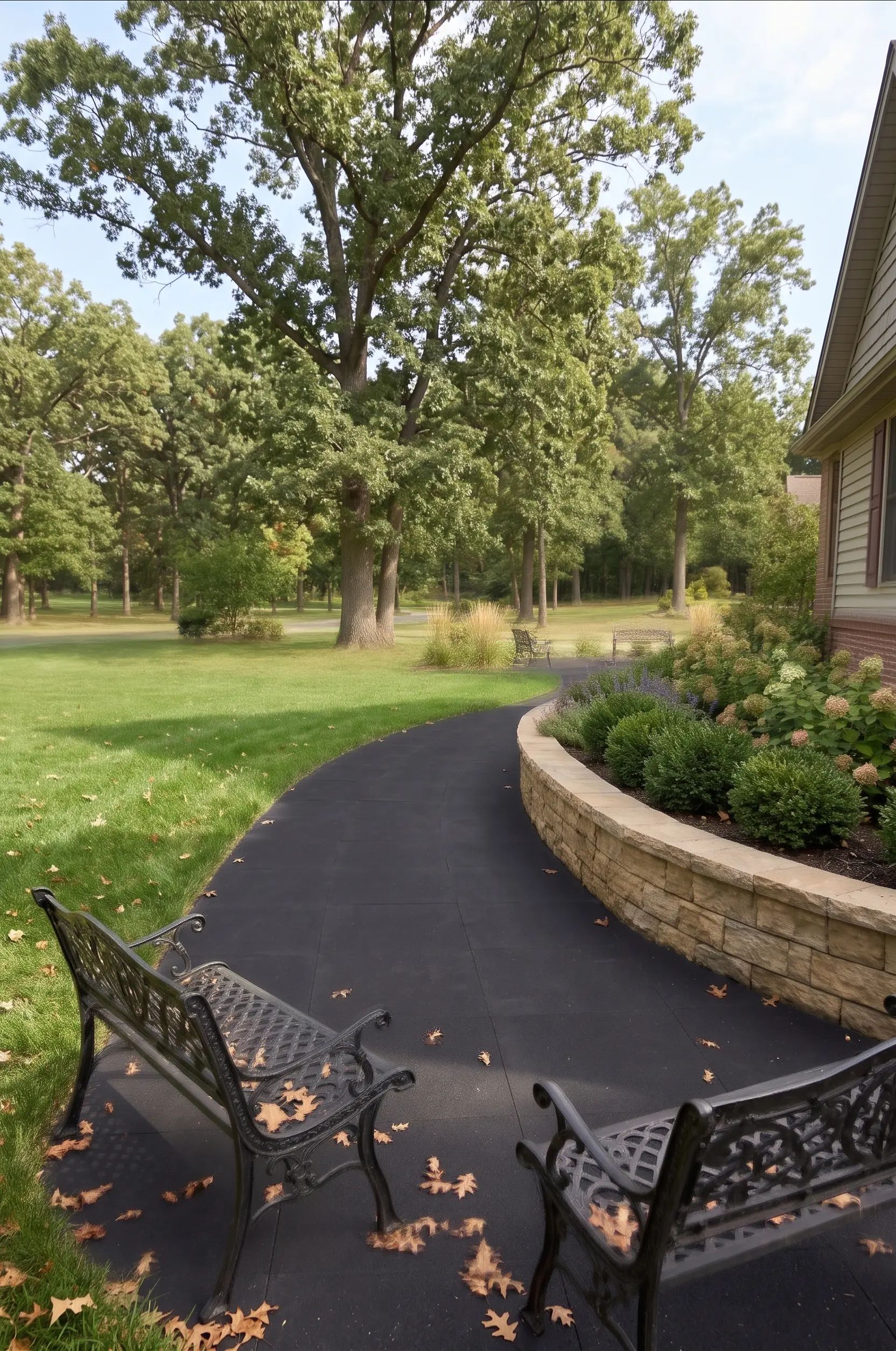
Your choice of paver dictates the visual language of the space for decades. Basalt’s dark charcoal surface works particularly well where you want contrast — against pale rendered walls, timber decking, or light-coloured landscaping. The stone’s uniform tone reads as intentional and precise, which is why it appears in contemporary residential and commercial projects that prize a clean, restrained palette.
Brick’s appeal is the opposite: warmth, variation and a handcrafted quality that reads as familiar and relaxed. The red-to-buff range in traditional clay pavers creates the kind of organic patterning that softens formal layouts. Over time, brick surfaces weather to a more mottled, characterful finish — which many owners find appealing, and others find difficult to maintain consistently.
According to basalt volcanic rock formation and construction properties, the stone’s mineral density and tight grain structure make it highly resistant to surface staining and UV bleaching — both relevant factors when you’re assessing long-term appearance. Basalt won’t lighten noticeably in the sun; brick can fade at the surface, particularly in sustained high-UV environments where clay pigments break down over a long service life.
- Basalt: dark charcoal, uniform, contemporary — colour consistent between orders from our selected quarries
- Brick: warm red to buff range, organic variation, traditional aesthetic character
- Basalt holds colour without UV fading; brick surface pigments can lighten over an extended outdoor exposure
- Both materials look better under a light surface wash than under pressure washing, which erodes mortar joints prematurely
Wear and Surface Durability
Surface wear in paving is governed by abrasion resistance — the material’s ability to maintain its texture under foot traffic, wheeled loads and cleaning cycles. For basalt, this is one of its strongest performance attributes. The tight crystalline matrix resists surface abrasion well, which is why honed and brushed basalt surfaces retain their texture even in busy pedestrian areas. The USGS basalt volcanic rock properties and composition data confirms basalt’s position as an exceptionally durable igneous material with low porosity and high mineral density — both factors that translate directly to wear performance in paving applications.
Clay brick pavers also perform well under pedestrian loads, but their abrasion resistance is more variable. Engineering brick — the dense, low-absorption variety specified for hard paving — outperforms standard-grade brick significantly. If you’re sourcing brick pavers, the grade specification matters far more than it does with basalt. Standard house brick repurposed as paving is a common field mistake; it tends to spall at the arris and absorb water into the body, shortening the surface life considerably.
You can review NSI igneous stone paving standards for the test methods used to assess abrasion resistance and surface hardness in natural stone — the relevant ASTM test methods for abrasion resistance are named there; ask your supplier for the test report rather than relying on a general description.
- Basalt: tight crystalline matrix, high abrasion resistance, retains surface texture under sustained foot traffic
- Brick: abrasion resistance depends on firing grade — engineering brick performs well; standard-grade brick spalls and absorbs moisture
- In a basalt vs brick pavers comparison for high-traffic pedestrian zones, basalt’s surface consistency gives it a measurable advantage
- Specify the relevant ASTM abrasion test and request the test report from your supplier before committing either material to a demanding application
Absorption, Drainage and Water Management
Here’s where the material differences become structural decisions rather than aesthetic preferences. Basalt’s low absorption rate means it takes on very little moisture through its body — an important factor in climates that experience heavy rainfall seasons, freeze-thaw cycles, or regions where water table fluctuations affect base conditions. In areas that receive intense seasonal rainfall, a paving material that doesn’t retain moisture in its body is easier to drain and less prone to efflorescence blooming at the surface.
Brick’s absorption behaviour depends on the product grade, but most clay pavers are more porous than dense basalt. In freeze-thaw regions, water absorbed into brick during wet months can expand during freezing and cause surface spalling. This is manageable with proper base drainage — but it means the base design matters significantly. A well-engineered permeable base that sheds water away from the paving body before temperatures drop is essential for brick longevity in cold-weather climates. The American Society of Landscape Architects provides guidance on permeable paving design and drainage material selection that applies directly to base specification decisions for both basalt and brick installations.
Your drainage design needs to account for the full rainfall profile of the site — not just peak events, but the cumulative moisture load across wet seasons. Basalt’s lower absorption simplifies that calculation because less water enters the paving body, reducing the moisture contribution to the base layer between rain events.
- Basalt: low absorption, moisture stays at the surface and drains rather than entering the paving body
- Brick: higher absorption (grade-dependent) — more moisture enters the body, which matters in freeze-thaw and high-rainfall climates
- Both materials require a base designed for positive drainage — the paver’s absorption rate informs how much drainage work the base must do
- In drought-cycle climates, basalt’s dimensional stability under wet-dry cycling is an advantage; clay brick can experience minor dimensional shift over long dry-wet cycles
- Specify permeable or free-draining aggregate base construction where surface runoff or ponding is a documented site risk
Finish Options and How They Affect Texture
Basalt’s finish range is one of the material’s practical strengths in specification. For outdoor pedestrian areas, paths and general paving, a Brushed 36 Grit or Brushed 80 Grit finish leaves a clean, open-grained surface texture without the rough edges that can make walking uncomfortable in bare feet. For pool decks, wet steps and slopes, the right selection is a bush-hammered finish — it leaves an open, textured matte surface that is distinctly different from the tight, reflective face you get with a polished or honed finish. Polished basalt stays reserved for dry indoor surfaces: floors, walls, countertops and fireplace surrounds where moisture isn’t a factor.
Brick pavers come in their own range of surface textures — smooth-faced, sand-faced, wire-cut and tumbled — but the range is narrower than what’s available in cut natural stone. The texture is also a product of the manufacturing process rather than a post-production finishing decision, which means you have less flexibility to specify different surfaces for different areas of the same project. You can explore our basalt paving stone to see the full finish range available and assess which surface texture best fits your project’s specific application zones.
- Basalt finishes for outdoor use: Brushed 36 Grit (patios, pool surrounds, indoor-outdoor), Brushed 80 Grit (barefoot pool decks, terraces), Bush-Hammered (pool decks, ramps, wet and public areas)
- Basalt for driveways and courtyards: Brushed 16 Grit or Split Face setts and cobbles at correct thickness on a compacted base
- Polished basalt: dry indoor surfaces only — floors, walls, countertops, fireplace surrounds and hearths
- Brick: surface texture is set during manufacturing — less flexibility to adapt finish by zone within a project
Thickness and Base Specification
The format you choose needs to match the application load — and this is where the basalt vs brick pavers comparison moves from aesthetics into structural specification. For pedestrian patios, paths and pool decks, basalt pavers at a minimum of 30 mm (approximately 1¼ in) work well when laid on a properly prepared aggregate base or mortar bed. For driveways, the specification changes: use setts or cobbles at least 3.5 in (4 in standard) thick on a compacted base, or pavers 2 in (5 cm) or thicker mortar-bonded to a reinforced concrete slab. Thin-format tiles and 3 cm pavers are not appropriate for vehicle loads and should not be specified for any driveway or vehicle access area.
Brick pavers for pedestrian paving are typically specified at 60–65 mm depth, though engineering-grade pavers specified for lightly loaded driveways may run thicker. The depth of a clay paver is part of its structural contribution in a dry-lay system — the weight and depth of the unit provide resistance to vertical displacement. In a mortar-bonded system, the bond to the concrete slab carries that load, so paver thickness requirements differ depending on the installation method.
- Pedestrian patios, pool decks, paths: basalt pavers at 30 mm (1¼ in) minimum on a prepared base
- Driveways: setts or cobbles at minimum 3.5 in (4 in standard) on a compacted base, or pavers at 2 in (5 cm) or thicker mortar-bonded to a reinforced concrete slab — no thinner format for any vehicle area
- Brick for pedestrian paving: typically 60–65 mm; driveway-grade brick or engineering pavers specified thicker
- Never interpret a compressive strength figure as confirmation that a thinner format suits vehicle loads — thickness and base preparation are the governing variables
Sealing and Ongoing Maintenance
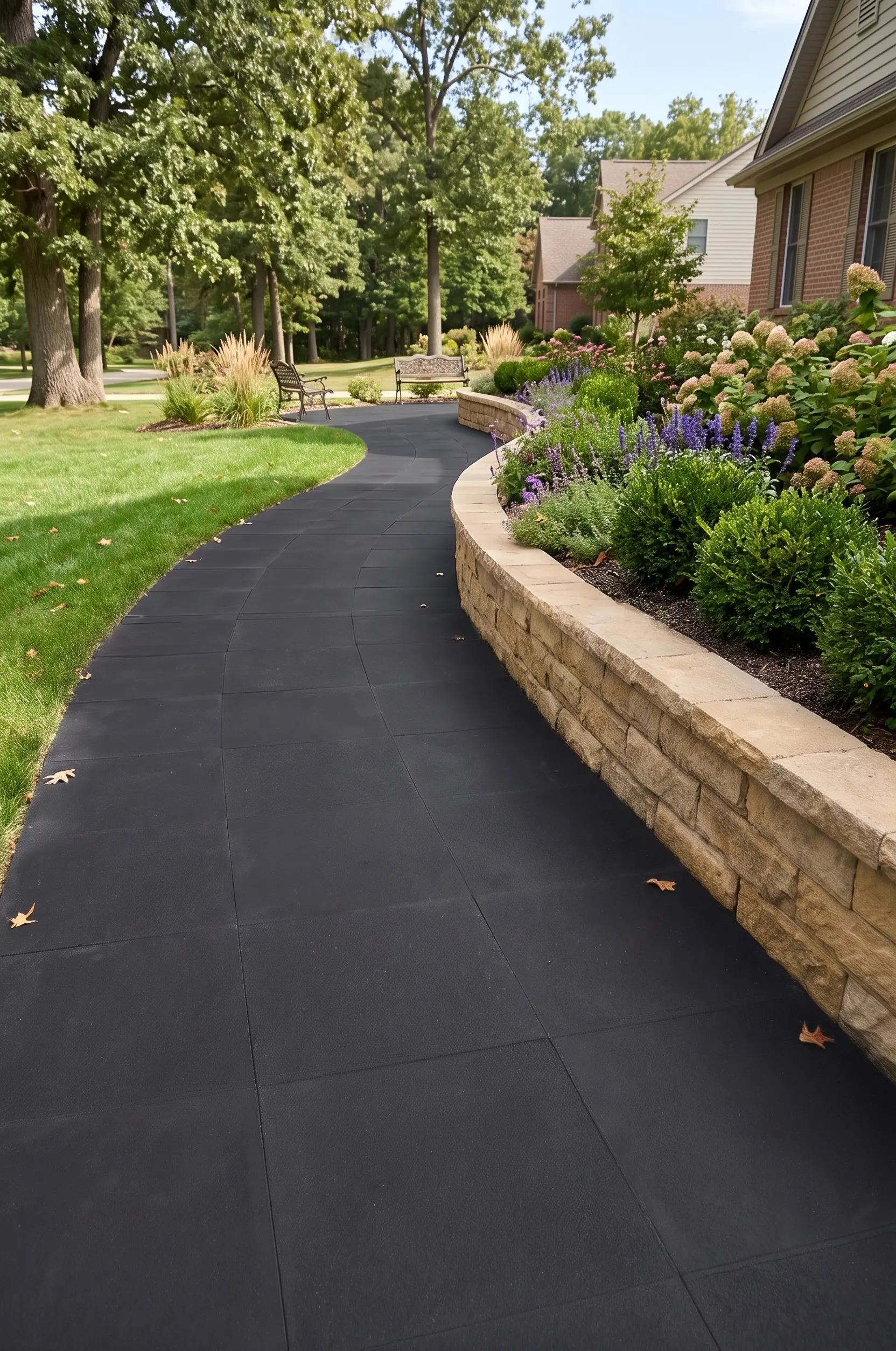
Basalt benefits from sealing in outdoor applications. A quality penetrating sealer reduces the surface’s ability to take on oil, organic staining and surface moisture, which is particularly relevant around pool decks and outdoor kitchen areas. The sealing interval depends entirely on the sealer manufacturer’s stated recommendation — there is no universal figure, and a sealer applied too infrequently will allow the surface to re-open before the next application takes effect. Plan your maintenance schedule around the product data sheet, not a general rule.
Brick maintenance centres on joint integrity rather than surface sealing. Sand-jointed brick paving needs regular joint refilling — particularly after the first wet season, when fine sand settles and joints open up enough to allow weed ingress and ant colonisation. Mortar-jointed brick needs inspection for cracked joints, which, left unrepaired, allow water into the base layer. For basalt compared with brick in terms of maintenance simplicity, basalt’s denser surface and lower absorption mean the maintenance cycle is less frequent once the sealer programme is established.
- Basalt: seal with a penetrating sealer on the manufacturer’s stated interval; clean with pH-neutral products to avoid surface etching
- Brick — sand joints: refill and re-compact after first wet season and annually; inspect for weed ingress and joint settlement
- Brick — mortar joints: inspect for cracking; repair early to prevent water ingress to the base
- Both materials benefit from prompt removal of iron-based stains, which can oxidise and discolour the surface if left to dwell
Cost and Project Logistics
Brick pavers are widely available domestically and tend to have shorter lead times for standard sizes and colours. If your project needs a fast procurement cycle, that availability can matter. Basalt is a natural volcanic stone quarried at our selected quarries, and delivery is arranged and confirmed with the order — lead times are quoted at order stage. For projects with a defined programme, the better approach is to specify the material early and confirm the delivery schedule before the base preparation phase begins.
Your project’s site access constraints will affect delivery planning for both materials. Large-format basalt pavers or bulk sett deliveries need a clear unloading area and a site contact available for offloading — those logistics are confirmed before delivery so there are no surprises on the day. Brick pallets are typically lighter and easier to handle in restricted access situations, but the logistics conversation is the same.
- Brick: often available through domestic supply; shorter lead times for standard products
- Basalt: quarried from our selected quarries; lead times and delivery quoted at order confirmation — plan procurement before base preparation starts
- Budget comparison should account for finish, thickness, base preparation, sealing and joint materials — the paver unit cost is only part of the total project figure
- Installation labour costs are broadly similar for both materials in a standard wet-lay or dry-lay system
Decision Points
The basalt vs brick pavers decision comes down to a clear set of trade-offs. Basalt gives you a consistent dark charcoal palette, tight crystalline density, a wide finish range and low ongoing maintenance — it’s the specification that holds its appearance and surface texture longer in demanding outdoor environments. Brick gives you warmth, organic variation and a traditional character that no manufactured or natural stone fully replicates, along with familiar procurement pathways and installation practices.
Your application zone determines the specification: pool decks and wet areas call for a bush-hammered or coarse-brushed basalt finish; driveways call for setts or cobbles at the correct thickness on a proper base; covered terraces and indoor-outdoor transitions suit a honed or double-brushed finish. Brick works best in traditional garden settings, heritage-compatible streetscapes and low-to-medium pedestrian traffic areas where its visual warmth is the defining value. For projects where basalt also extends to water features or pool surrounds, basalt pool coping options explores how the material performs in that specific context.
At Citadel Stone, we quarry, template, manufacture and handle each order at our selected quarries, cutting basalt pavers to the dimensions your project drawings require. That direct involvement from quarry face to delivery means the specification you write is the specification you receive. Citadel Stone basalt pavers offer a dark charcoal palette in contrast to red and buff brick, each order cut to size from our selected Middle East quarries.
Related reading: large format basalt pavers · basalt fire pit surround · Laying Basalt Pavers Over an Existing Concrete Patio.