

Specifying basalt pool coping comes down to dimensional precision before anything else — the wrong thickness or edge profile creates a condition at the pool rim that no amount of skilled installation can fully correct. Basalt pool coping has to reconcile structural load, water drainage, and a tight tolerance at the bond beam, and those three demands pull in different directions depending on your pool type and the coping format you choose. Getting the specification right from the start saves you from the costly exercise of pulling and resetting coping after the pool shell is finished.
Standard Sizes for Basalt Pool Coping
The coping format that works for your pool depends on the bond beam width and the overhang you want over the water face. Most residential pools use a bond beam between 6 and 8 inches wide, which makes a 12-inch-deep coping piece the practical minimum — it gives you full bond beam coverage plus a modest overhang. Wider coping at 16 or 18 inches is increasingly common on modern pools where the deck sits flush with the water line and a generous overhang improves the visual proportion.
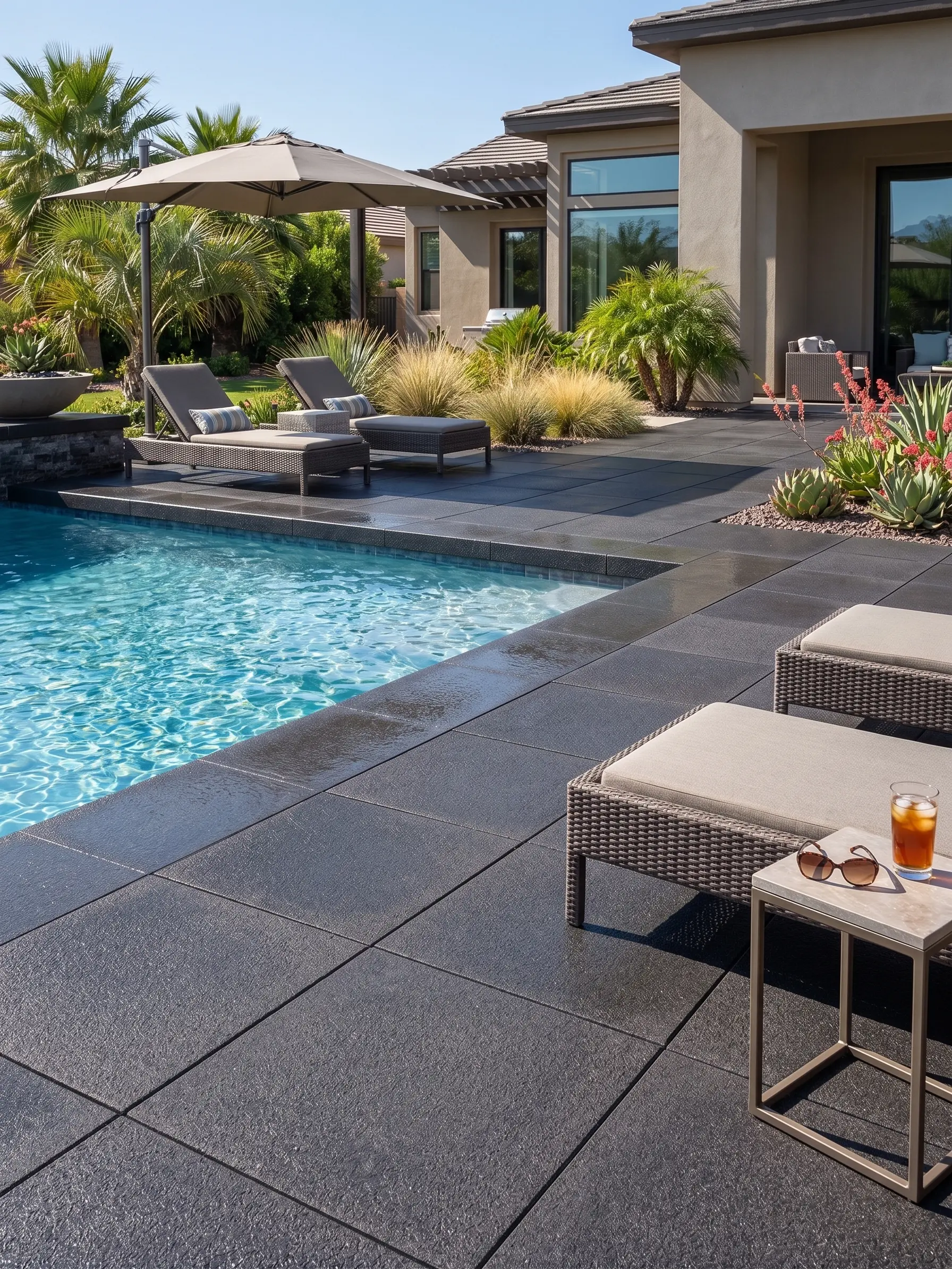
Length is the dimension that most directly affects your cut waste and your joint pattern. Standard field lengths for basalt coping run between 12 and 24 inches, with 12×24 being a widely used format for rectangular pools. Corner pieces require a mitered or returned edge, which adds lead time. For irregular pool shapes, random-length coping gives your installer more flexibility to manage the curve without excessive cutting. Citadel Stone cuts coping pieces to the lengths your drawings specify, which eliminates the field-cutting waste that comes with buying oversize stock and reducing on site.
- 12×12 in: compact format for narrow bond beams and spa copings
- 12×24 in: the most common residential format for rectangular pools
- 16×24 in and 18×24 in: wider formats for contemporary zero-edge designs
- Custom lengths: available cut to order for curved and freeform pools
- Corner pieces: specify mitered or returned — confirm the return depth matches your field piece width
Thickness Requirements for Pool Coping
Pool coping thickness drives the structural performance at the pool rim, and it’s a specification decision that needs to account for both the point load at the edge and the bond method you’re using. The dominant question is whether the coping is mortar-bedded over the bond beam or mechanically fixed with anchors — each method has a different minimum thickness requirement to avoid flexural failure under the loads a pool rim actually sees.
For mortar-bedded basalt pool coping over a concrete bond beam, a nominal 1¼-inch (30 mm) thickness is standard for residential applications. At that thickness, basalt carries the point loads from normal poolside foot traffic without stress concentration at the overhang. For larger-format coping pieces — especially anything over 18 inches in depth — stepping up to 1½ inches (40 mm) eliminates edge deflection risk when someone sits on the coping or leans against it. Thinner profiles below 1 inch are decorative tiles, not structural coping, and they don’t belong at the pool rim where the piece cantilevers over the water face. According to Natural Stone Institute igneous stone paving technical standards, igneous stone coping should be specified with adequate thickness for the span and the expected point loads at the edge — consult the technical data and request a test report from your supplier.
- 1¼ in (30 mm): standard for mortar-bedded residential coping up to 16 in deep
- 1½ in (40 mm): recommended for larger-format pieces and commercial pools
- 2 in (50 mm): appropriate for heavy-use commercial or resort pool rims
- Profiles below 1 in: decorative tile only — not suitable for structural pool coping
- Always confirm the thickness with your pool builder against the bond beam detail
Edge Profiles and What They Mean at the Rim
The edge profile is the specification decision that most directly affects the visual outcome and the drainage geometry at the pool rim. Two profiles dominate basalt pool coping: bullnose and square edge. Each has a specific structural and aesthetic logic, and choosing between them is not purely a design call — it affects how water moves off the coping surface and how the leading edge weathers over time.
A bullnose edge — where the top face rolls over in a radius to the side face — gives a softer visual transition and eliminates the sharp arris that a square-cut piece carries. The radius also distributes contact stress when someone presses against the edge, which is a practical advantage at pool rims where that contact happens repeatedly. A square or eased edge gives a cleaner architectural line and is increasingly specified on contemporary pools with linear profiles. The underside of the coping should always carry a drip kerf — a narrow channel routed into the underside of the overhang — to break the water bead and prevent water from tracking back under the piece and into the bond beam joint. Not every fabricator cuts this detail in automatically; it’s worth specifying explicitly. You can review our basalt pavers and coping for the edge and finish options available cut to order.
- Bullnose: radius profile on the water-face edge — softer visual, reduced edge stress
- Square edge: clean architectural line — specify an eased arris to reduce chipping risk
- Drip kerf: always specify on the underside of any overhang — prevents water tracking into the joint
- Double bullnose: required where both faces of the coping are exposed (spa walls, raised bond beam)
- Rock face or split face on the side drop: a textural option for raised pool walls
Finish Selection for Pool Coping
The finish you specify for basalt pool coping determines the texture at the walking surface, and the choice is straightforward once you understand what pool coping actually needs to do: shed water quickly, keep its appearance under sustained UV exposure, and tolerate a chlorinated pool environment without accelerated surface degradation. Under sustained sunlight, basalt’s dense volcanic structure holds up exceptionally well compared to more porous stone types, but the finish affects how the surface weathers visually over years of direct sun exposure.
For pool decks, wet steps and slopes, choose a bush-hammered finish. For other outdoor paths, bush-hammered or brushed in our coarsest grit both work; check a sample. A polished finish is for dry indoor surfaces only and has no place on pool coping — the combination of water, sun, and foot traffic will dull a polished face quickly, and the smooth surface is inappropriate for the poolside environment. A honed finish sits in a middle ground and works on coping that is primarily used as a decorative rim rather than a heavily trafficked walking edge, particularly when the pool is under a covered structure. The PHTA standards for pool deck stone and coping set the framework for surface finish decisions at pool rims — review the current edition for your project’s jurisdiction and confirm finish selection with your pool builder.
- Bush-hammered: open, matte texture — the preferred finish for actively trafficked pool coping
- Brushed 36 Grit: a coarser brushed surface suited to pool surrounds and outdoor coping details
- Brushed 80 Grit: a finer brushed surface — appropriate for barefoot pool decks and spa surrounds
- Honed: acceptable on covered or sheltered pool copings with lower wet-foot traffic
- Polished: dry indoor surfaces only — never on pool coping
UV Exposure and Long-Term Appearance
Basalt is one of the more UV-stable natural stones you can specify for an outdoor pool environment. Its dense, low-absorption volcanic matrix means it doesn’t carry the surface moisture that can accelerate color change on more porous stone. That said, sustained UV exposure does affect the surface of any stone over time, and basalt pool coping is no exception. The black and dark grey tones that make basalt so visually striking at installation can shift toward a lighter, more matte grey as the surface weathers — a process driven by oxidation of iron minerals at the stone’s surface rather than by fading in the conventional sense.
Sealing is the primary tool for managing this shift. A quality penetrating sealer reduces the rate at which atmospheric oxygen and pool water chemistry interact with the stone surface, preserving the richer dark tone for longer. Your sealer manufacturer’s stated reapplication interval is the schedule to follow — in a full-sun pool environment, that interval may be shorter than the label’s standard recommendation because UV degrades the sealer’s carrier chemistry faster. Plan for an initial application before the pool is filled, and factor reapplication into your pool’s annual maintenance schedule. According to USGS basalt volcanic rock properties, basalt’s dense silica-rich composition gives it strong resistance to surface weathering — an inherent advantage in pool coping applications exposed to UV and pool chemistry simultaneously.
- Expect gradual surface lightening over years of full UV exposure — this is a normal weathering pattern, not a defect
- Apply a penetrating sealer before pool fill and reapply on the sealer manufacturer’s stated schedule
- In full-sun environments, inspect the sealer annually rather than relying on a fixed multi-year interval
- Dark coping colors appear richest when the stone is sealed — dry, unsealed basalt reads several shades lighter
- Avoid surface sealers that form a film — they trap moisture and eventually peel in a pool environment
Joint Sizing and Movement at the Pool Rim
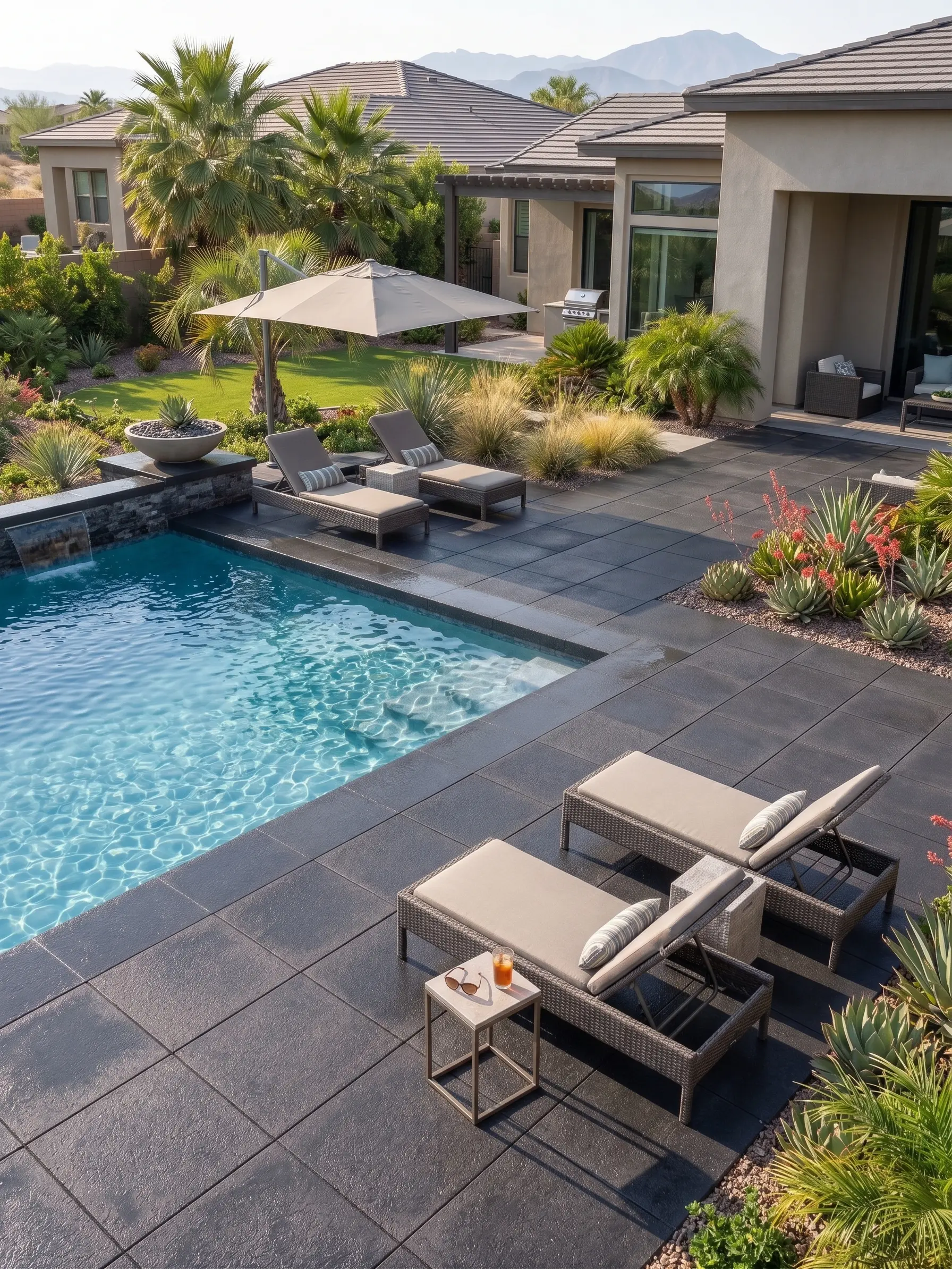
The pool rim is a demanding movement environment. The shell expands and contracts with water temperature changes, the surrounding concrete deck responds to its own thermal cycle, and the coping sits at the interface of both. A common specification error is treating pool coping joints like interior tile joints — tight and filled with rigid grout. That approach fails at the pool rim because the shell and the deck don’t move in sync, and a rigid joint has nowhere to go when differential movement occurs.
The joint between the coping and the pool deck — sometimes called the expansion joint or the coping-to-deck joint — needs a flexible sealant, not grout. The face joint between coping pieces in the run can be grouted, but the critical joint at the back of the coping where it meets the deck is the one that fails first under rigid fill. Your pool builder or waterproofing contractor should specify the sealant type and confirm compatibility with the pool’s waterproofing system. The joint sizing should come from the actual movement calculation for your pool shell type — steel, concrete, or vinyl-liner construction all have different movement characteristics. ASTM standards for stone specifications cover the testing methods that characterize stone for coping applications — request the test report from your supplier for any critical performance property.
- Coping-to-deck joint: flexible sealant only — never rigid grout
- Face joints between coping pieces: standard grout is acceptable here
- Joint width: derived from your pool’s movement calculation, not from a standard rule of thumb
- Sealant: confirm compatibility with the pool’s waterproofing membrane system
- Color-matched sealant is available — worth the minor cost premium for a consistent finished appearance
Ordering Logistics for Coping Cut to Size
Basalt pool coping is not a standard stock tile format — the pieces are cut to the dimensions your pool rim requires, and the lead time reflects that. Your ordering timeline needs to account for the pool shell cure schedule, because coping installation happens after the shell is set and the bond beam is ready. Ordering too early risks holding the material on site in conditions that aren’t ideal for a finished stone product; ordering too late pushes back the pool fill date.
For a typical residential pool, a lead time of several weeks from order confirmation to delivery is realistic. Confirm the actual lead time at the time of order — it varies with the complexity of the edge profile, the number of mitered corners, and the current production schedule at our selected quarries. Delivery is arranged and managed by Citadel Stone, and your project’s access constraints should be communicated when you confirm the order so that offloading arrangements can be confirmed before the delivery date. Basalt coping pieces at 1¼ to 1½ inch thickness and 12 to 24 inch lengths are manageable by two people, but full pallet deliveries require clear vehicle access to the pool area or a staging point within a short carry.
- Order after the bond beam dimensions are confirmed — not from the pool drawings alone
- Confirm lead time at the point of order — profile complexity and corner count affect production time
- Communicate access constraints early — pool areas often have restricted vehicle approach
- Stage material under cover if it arrives before the shell is ready for coping installation
- Count pieces against the cut sheet before the delivery vehicle departs
Your Action Plan
The specification decisions that matter most for basalt pool coping are thickness, edge profile, finish, and joint type — in that order. Get the thickness right for your coping format and bond method, confirm the edge profile against the pool builder’s bond beam detail, and specify the finish against the actual use conditions at your pool rim. Everything downstream of those decisions — sealing schedule, joint sealant, maintenance interval — follows logically from a specification that’s grounded in how the coping will actually perform in a full-sun, wet-environment installation. For projects that include basalt edging elements beyond the pool rim, the guidance on basalt sett and cobble installation covers the base preparation and bedding details that apply to surrounding hardscape elements.
Citadel Stone stocks basalt at our selected quarries and cuts coping pieces to your dimensions — including bullnose, square edge, and double bullnose profiles — so your order matches the pool drawing rather than requiring field modification. Confirm your bond beam dimensions, overhang depth, and corner count before you call through the order, and the cut sheet becomes a straightforward handoff to production. Citadel Stone cuts basalt coping to order at our selected Middle East quarries, with bullnose or square edges to suit the pool rim.
Related reading: large basalt pavers · Basalt Fire Pit Surrounds: Sizes, Finishes and Edging · basalt pavers over concrete.