

Sizing and finish choices for a basalt fire pit surround are decisions you lock in early — and they affect everything from how the stone weathers after the first rainy season to how comfortable the surface is underfoot on a barefoot summer evening. The geometry of the surround, the edge profile, and the finish grade all interact with each other in ways that are easy to underestimate when you’re working from a catalogue page alone. This article walks through each of those decisions in the sequence a specifier actually works through them.
Why Basalt Suits Fire Pit Surrounds
Basalt’s dense, fine-grained structure makes it a practical choice for an outdoor surround where the stone will be exposed to intense sun, seasonal rainfall, and the mechanical wear of furniture, foot traffic, and the occasional dragged chair. The stone holds its colour well under UV exposure — the dark, near-black tone doesn’t bleach the way lighter sedimentary stones can. Your local building code and the appliance manufacturer’s clearance requirements determine exactly how close any stone surface sits to the firebox; those clearances govern the layout, not the stone itself.
Porosity is lower in basalt than in most sedimentary alternatives, which matters when you’re choosing a surround that will sit through wet winters and dry summers. You can request the absorption test report from your supplier to confirm the figure for the specific stone you’re ordering — according to USGS basalt volcanic rock properties, basalt’s mineralogical density directly drives its low absorption characteristics. That lower absorption rate also means the sealer you apply works with less effort against water ingress, and the resealing interval tends to be longer.
Standard Sizes for a Basalt Fire Pit Surround
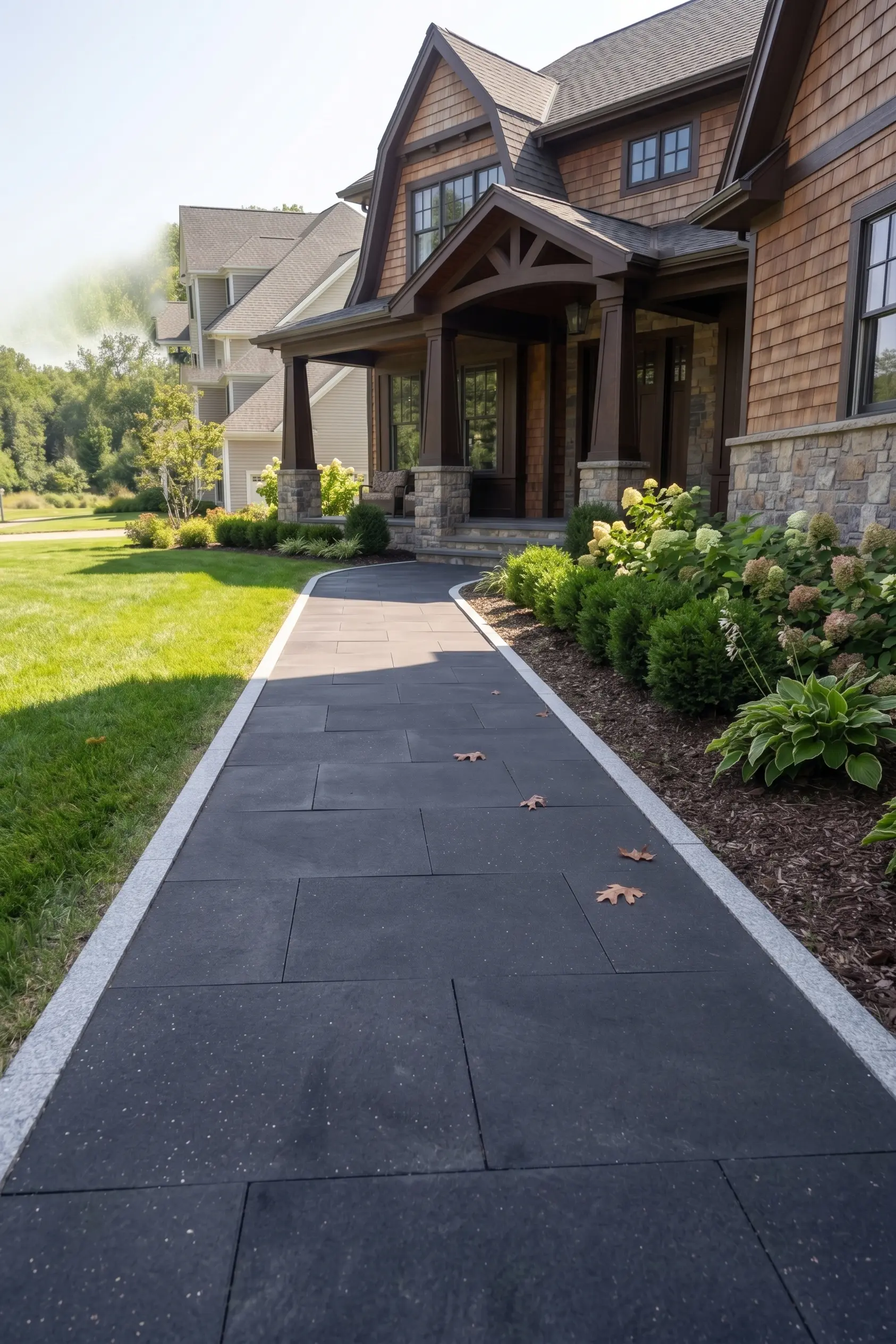
The size question usually starts with the fire pit’s outer diameter or footprint, then works outward to establish how wide a stone apron you need. A common approach is a minimum 600 mm (roughly 24 in) of paved surface around the pit edge — enough room for seating clearance and to keep loose materials away from the firebox. Larger surrounds in the 900 mm–1200 mm (36–48 in) range give you a more generous apron and make the layout proportional to bigger pit units.
- Pavers cut to 600 × 600 mm (24 × 24 in) are a practical module for surrounds — they tile cleanly around a circular or square pit with minimal cutting waste
- 300 × 600 mm (12 × 24 in) rectangles let you run a running-bond pattern that radiates outward from the pit, which draws the eye and can disguise the cut lines at the pit’s perimeter
- Slab formats — anything wider than 600 mm — need careful thickness specification; a 30 mm (1¼ in) thickness suits pedestrian-only areas, but confirm it against your base design and point-load expectations
- For surrounds that double as pathways or that sit in areas where heavy furniture is regularly moved, a 40 mm thickness adds margin without demanding major changes to the base build
- Citadel Stone cuts basalt pavers to your specified dimensions from quarry stock, so you’re not forced into a catalogue size that doesn’t suit your geometry
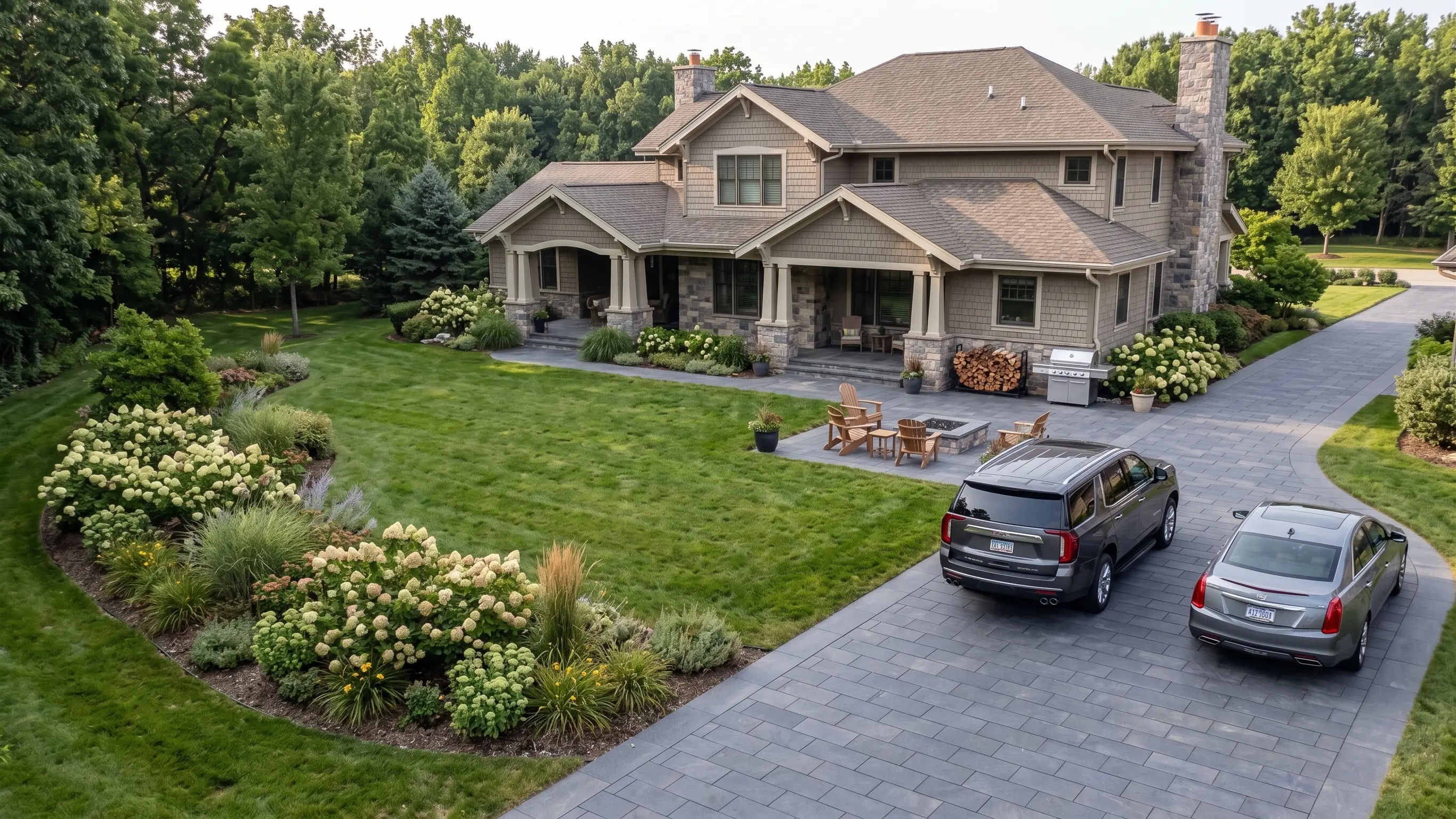
The module you choose also affects how you handle the transition from the surround into the wider patio or path. A 600 × 600 mm surround paver that matches your patio module creates a seamless visual plane. A contrasting size — say, 400 × 400 mm surrounds stepping out to 600 × 600 mm patio pavers — gives you a clear delineation zone that reads as a deliberate design decision rather than a mismatch.
Thickness and Base Preparation
For a pedestrian basalt fire pit surround — no vehicles, no heavy machinery — 30 mm (approximately 1¼ in) pavers on a properly prepared compacted aggregate base perform well. Your base depth needs to account for your local soil conditions; clay-heavy subgrades compress and move seasonally, and that movement telegraphs through a thin base into the stone joints. A deeper compacted aggregate layer — typically 100–150 mm (4–6 in) depending on soil type — absorbs that differential movement before it reaches the surface.
Here’s what most specifiers skip: the bedding layer between the base and the stone. A 25–40 mm (1–1½ in) screeded bedding layer of sharp sand or a semi-dry mortar blend gives you the fine adjustment you need to set each paver level without disturbing the compacted base below. If you bed directly onto compacted aggregate without a screeded layer, you’ll fight level inconsistencies across every joint. The Natural Stone Institute paving specifications address bedding and setting requirements for natural stone in detail — worth reviewing before you finalise your base design.
Finish Options for a Basalt Fire Pit Surround
The finish determines the surface texture, the maintenance interval, and how the stone reads visually in the landscape. For an outdoor surround, the finish choice is also where you manage wet-surface behaviour — and that decision belongs to ANSI A326.3, measured wet, with the specific test report available from your supplier. The finish is the variable in that assessment; no generic finish claim substitutes for a tested result on the specific stone and finish combination you’re specifying.
These are the finish options that work across fire pit surround applications:
- Bush-Hammered: an open, pocked texture that leaves a mechanical profile on the surface — suited to pool decks, ramps and any area that stays wet; the texture reads well against the dark basalt colour and weathers without looking abraded
- Brushed 36 Grit: a medium-texture brushed finish suited to patios and pool surrounds; the surface is smoother than bush-hammered but still carries a visible directional texture
- Brushed 80 Grit: a finer brushed finish appropriate for barefoot terraces and pool deck areas; the surface is comfortable underfoot while retaining enough texture to read as natural stone
- Split Face: a cleft, natural-break texture used for feature walls and raised-edge cladding around fire pit structures; not a walking surface, but appropriate for vertical elements in the surround design
- Honed 60 Grit: suited to covered patios and indoor-outdoor transitions; not recommended for surfaces that collect standing water from rainfall
- Polished: reserved for dry indoor surfaces only — a polished finish is not appropriate for any outdoor fire pit surround
For most open-air fire pit surrounds, the Bush-Hammered finish or Brushed 36 Grit gives you the texture profile that works across varied weather. For surrounds in covered outdoor living areas that stay relatively dry, Brushed 80 Grit or Double-Brushed 60 reads as a more refined surface finish.
Edging and Border Options
The edge detail at the perimeter of a basalt fire pit surround is where a lot of the visual quality of the installation lives — and it’s often the last decision made, when it should be one of the first. Your edge treatment affects how you specify the outer border pavers, whether you need a different cut thickness at the perimeter, and how you handle the transition to the surrounding ground plane.
These are the main edge approaches for a basalt surround:
- Bullnose edge: a rounded-top profile cut to the outer perimeter pavers; comfortable where people sit or place their feet against the edge, and reads cleanly in a contemporary landscape
- Sawn square edge: a clean, straight-cut edge with no rounding; suits contemporary and linear design schemes; needs a stable border or restraint system to prevent lateral movement
- Cobble or sett border: a ring of basalt cobbles or setts in a contrasting size laid around the outer perimeter of the paved surround; defines the zone clearly and provides a textural contrast to the flat paver field
- Recessed channel edge: a drain channel set at the surround perimeter that captures rainfall and runoff; the channel frame sets the visual edge and manages water at the same time
- Raised step edge: a single step up from the surrounding ground plane into the surround area; reads as a deliberate outdoor room delineation and gives you a sitting ledge around the fire pit
Explore our basalt stone selection to see how slab, tile and cobble formats can be combined in a fire pit surround and border layout. The range includes the formats that work for both the flat field and the edge detail in the same material, which keeps the overall palette coherent.
Drainage and Water Management for Outdoor Surrounds
Drainage design is the detail that separates a basalt fire pit surround that stays level and tight over the years from one that starts to rock, settle, and show joint gaps after a few wet seasons. Your site’s rainfall pattern determines how hard drainage works in this application. In regions that experience heavy rain seasons or occasional intense downpours, water needs a clear path off the surround and away from the fire pit base — standing water that has nowhere to go undermines the bedding layer and the compacted base below it.
A minimum 1.5–2% cross-fall across the paved surround surface is the standard starting point. That’s enough to move water to the edge without creating a slope you notice underfoot. In areas with pronounced wet seasons, a perimeter channel or linear drain at the outer edge of the surround gives you a defined collection point that keeps water off the paved field entirely. For designs where the surround is set into a grade — partially below the surrounding lawn or planting — you’ll need a drainage layer below the compacted aggregate base to prevent water from pooling at the subgrade.
- Set the finished surface level of the surround at or slightly above the surrounding grade to prevent ponding at the transition
- In freeze-thaw regions, the base depth needs to account for frost penetration — an under-prepared base in a cold climate will heave and settle repeatedly, which loosens joints and eventually rocks individual pavers
- In drought-cycle climates, expansive clay subgrades can shrink and crack during dry periods, then swell when rain returns; the compacted aggregate base needs to be deep enough to buffer that movement
- In coastal or high-humidity environments, the sealant regime matters more — moisture cycling through an unsealed or under-sealed joint accelerates the rate at which the bedding layer breaks down
The Britannica basalt geological properties reference confirms that basalt’s crystalline, low-void structure makes it highly resistant to water ingress at the stone body itself — but that doesn’t remove the need for sound drainage design at the base. The stone holds up; the base is what fails when drainage is ignored.
Sealing and Ongoing Maintenance
Basalt used in a fire pit surround benefits from sealing — not because the stone is porous by sedimentary standards, but because the joints and the surface together form a system that keeps debris, organic staining, and moisture from working their way into the bedding layer. A penetrating impregnator sealer rather than a surface film sealer is the right product category for an outdoor basalt surround; film sealers trap moisture below the surface if applied when the stone isn’t fully dry, and they can cloud or peel when exposed to direct sun.
Your sealer manufacturer’s reapplication interval governs your maintenance schedule — not a generic rule of thumb. Most penetrating sealers for dense igneous stone recommend a check at two to three years, with reapplication when the water-bead test shows the stone is starting to absorb rather than repel water. Ash, charcoal residue, and grease from cooking setups should be cleaned off promptly with a pH-neutral cleaner — acidic cleaners will etch the surface over time and dull the finish. Citadel Stone can advise on sealer type and application timing when your order is confirmed.
Ordering and Delivery Planning
Planning your order for a basalt fire pit surround starts with a dimensioned layout drawing, not a loose square-footage estimate. The layout drawing tells you exactly how many full pavers you need, how many need to be cut at the perimeter, and what edge-cut dimensions the border detail requires. Working from a layout rather than a surface area estimate reduces waste and means you aren’t ordering extra stone as a buffer against poorly specified cuts.
Delivery scheduling depends on your site’s access — narrow gates, soft ground, or low-clearance entries all affect how the stone is delivered and where it can be offloaded. Your delivery arrangements are confirmed with the order; lead times are quoted at that point rather than assumed. For surrounds that combine multiple formats — field pavers, cobble borders, and coping or edge pieces — a single coordinated order from one source keeps all the material on the same ticket and in the same shade and finish batch.
- Order a minimum 10% additional quantity on any cut-to-size format to allow for on-site cuts and the occasional breakage during installation
- Request that field pavers, edge pieces, and border cobbles be batch-matched at the quarry — colour variation between batches is harder to manage once material is on-site
- Confirm your access constraints with your installer before the delivery date is set, so offloading can be planned without a second movement
- If the surround is part of a larger basalt patio or path project, order everything in one batch; basalt colour can vary between production runs even from the same quarry source
Getting Your Basalt Fire Pit Surround Specification Right
A well-specified basalt fire pit surround comes down to a sequence of decisions that each depend on the one before: size module first, then thickness against your base design, then finish against your climate and use pattern, then edge detail against your design intent, and finally drainage and sealing as the long-term maintenance framework. Skipping any step in that sequence typically shows up later as a performance issue — a rocking paver, a stained joint, or an edge detail that looks finished in isolation but doesn’t tie back to the wider paving scheme. For projects that extend the fire pit area into a larger basalt patio or garden path, it’s worth reviewing planning large basalt paver layouts before you finalise your module and joint spacing decisions — the considerations overlap significantly. Basalt from Citadel Stone gives a fire pit area a dark, natural frame that ties into the rest of a basalt patio or path.
Related reading: how basalt is formed · basalt rock type explained · brushed basalt pavers.