

Specifying basalt rock type correctly is where most project decisions either hold together or start to unravel. The volcanic origin of basalt produces a dense, fine-grained matrix that behaves differently across product grades — and those differences compound when you factor in base conditions, application load, and finish selection. Understanding the basalt rock type landscape upfront saves you from costly mid-project corrections. This guide focuses on basalt as an igneous building stone — the grades, finishes, and site conditions that shape its use in paving, cladding, and hardscape specification.
What Makes Basalt Rock Type Different From Other Igneous Stone
Basalt forms when low-silica lava cools rapidly, either at the surface or in shallow submarine environments. That rapid cooling is what gives it an extremely fine-grained crystalline structure — the individual mineral grains are too small to see with the naked eye, which directly affects how the finished material cuts, finishes, and performs under load. You’re working with a material whose mechanical properties trace back to cooling rate and mineral chemistry, not to sedimentary layering or metamorphic pressure. The structural types themselves (dense, vesicular and columnar) are compared in our guide to basalt rock types for tiles.
The mineral composition — typically a blend of plagioclase feldspar, pyroxene, and olivine — produces a material that is highly resistant to surface abrasion and maintains dimensional stability across wide temperature swings. According to USGS volcanic rock composition data, basalt is the most abundant volcanic rock on the Earth’s surface, which explains why commercial grades vary considerably depending on the quarry source and flow sequence. Not all basalt behaves identically, and that variability is what makes grade selection essential rather than incidental.
The Main Grade Categories You’ll Encounter
Commercial basalt for architectural and hardscape use generally divides into three broad performance tiers. These aren’t universally standardised designations — quarry naming varies — but the characteristics that define each tier are consistent enough to use as a specification framework. Reviewing the types of basalt available before committing to a grade prevents specification mismatches that only surface after installation begins.
- Dense, low-porosity basalt: the highest-performing grade for external paving, pool surrounds, and heavy-traffic applications — characterised by a tight, near-uniform matrix with minimal vesicular voids
- Standard construction basalt: suitable for wall cladding, light to moderate paving, and landscaping applications — carries slightly more natural variation in void structure and colour banding
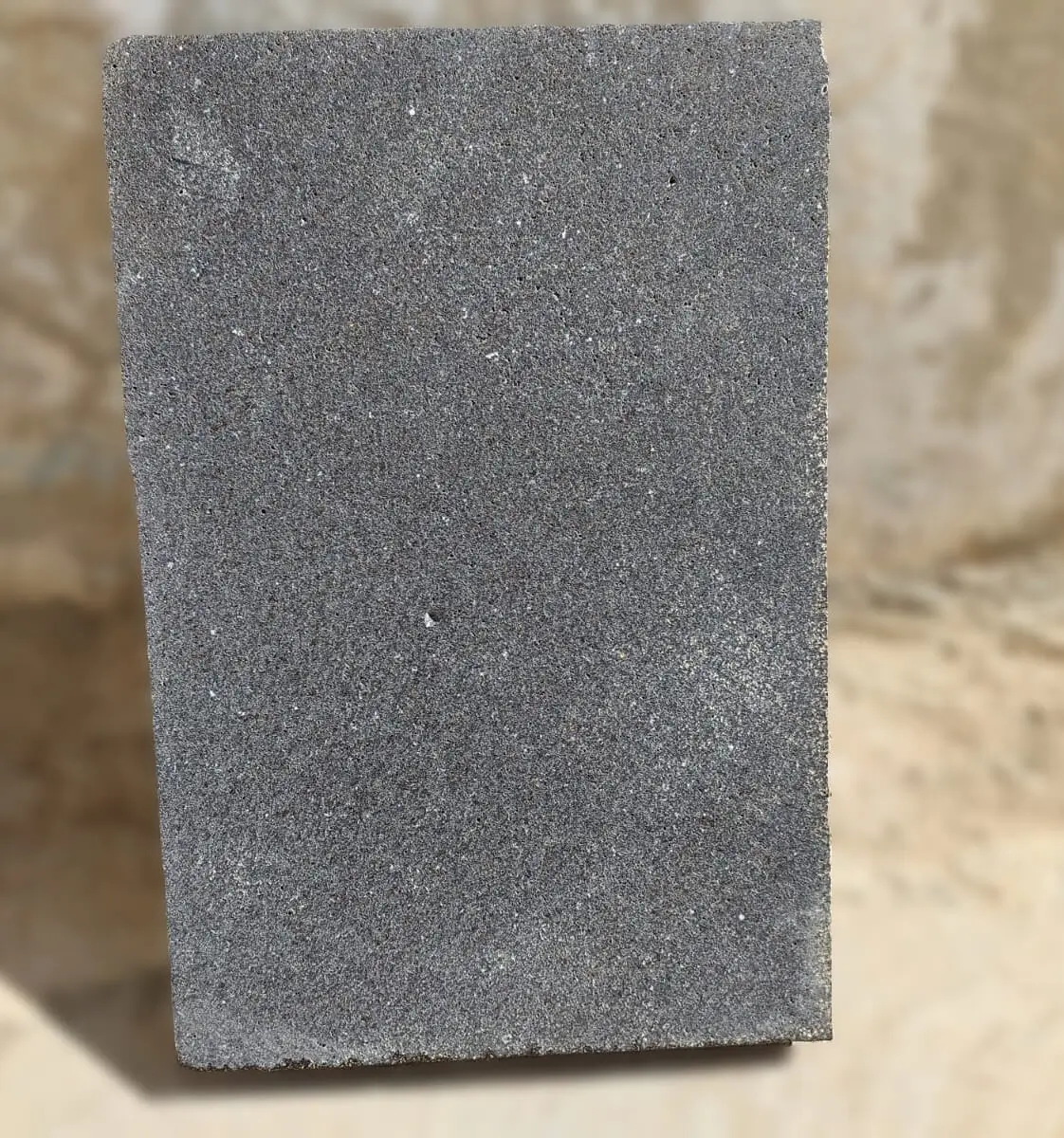
- Vesicular or scoria-influenced basalt: contains visible gas pockets from volcanic outgassing, which limits load-bearing applications but suits decorative cladding and water-feature work where the texture reads as a design element
Picro basalt occupies a separate classification entirely. It is an ultra-mafic volcanic variant with higher magnesium and iron content, producing a darker, heavier matrix than standard basalt. You’ll encounter it less often in commercial supply, but it appears in specialist geological and landscape applications where its density and colour saturation are specified as design features.
Finish Types and What They Actually Change
The finish you select on any basalt rock type alters not just the appearance but the practical behaviour of the surface in service. This is where specifiers sometimes underestimate the decision’s consequence.
- Honed finish: a flat, matte surface produced by abrasive grinding — leaves the stone’s natural mineral colour rich and even, with the pore structure partially open; suited to interior flooring, pool surround coping, and wall tile
- Flamed finish: high-heat torch application spalls the surface to a rough, open texture — the micro-topography this creates is worth understanding from a slip-risk management perspective; the finish is measurable under ANSI A326.3 wet testing, and the test report is available on request
- Bush-hammered finish: a mechanical dimple pattern applied with a textured head — produces consistent surface relief without the colour shift that flaming causes; commonly specified for step treads and ramps
- Sawn finish: the raw cut surface straight from the saw, with visible blade striations — less processed, lower cost, but requires sealing assessment before external use
- Tumbled finish: barrel-tumbled edges and faces produce a softened, aged texture with an open, matte surface character — suits garden paving and casual hardscape settings
Slip resistance across all these finishes should be evaluated using ANSI A326.3, which measures performance wet — the relevant condition for most external applications. If you need a tested value for your specification, request the test report from your supplier. The finish, not the rock type alone, is the variable that drives that result.
Types of Basalt for Paving and Cladding Applications
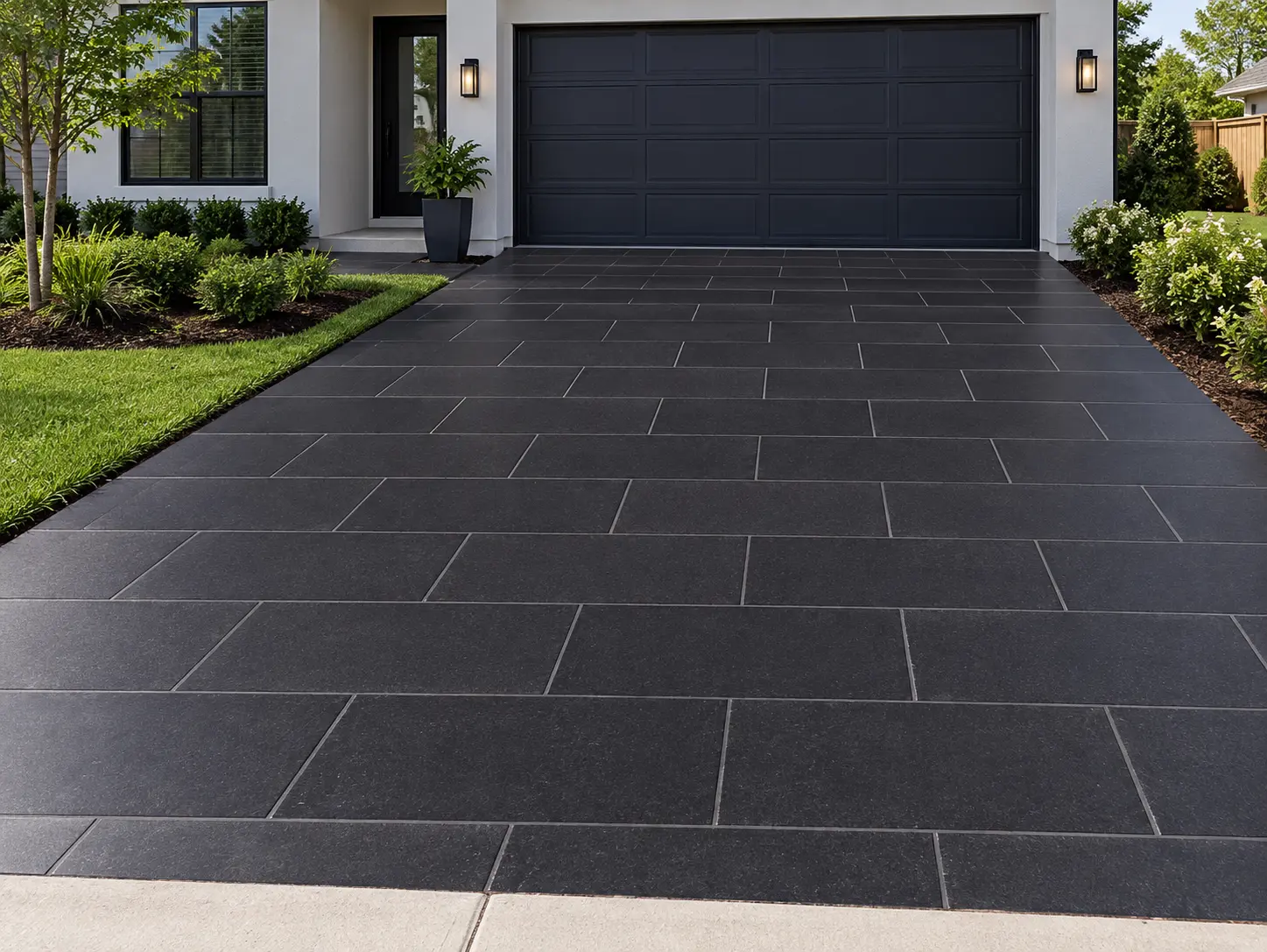
The distinction between basalt paving grades matters most when your application combines point load, thermal cycling, and moisture exposure simultaneously. For basalt pavers and cladding, your thickness specification is the first lever, and it should track the load class of the application, not a default catalogue dimension.
For pedestrian paving applications — courtyards, walkways, residential driveways — dense-grade basalt pavers in a nominal thickness appropriate for the anticipated foot traffic load perform well with a compacted aggregate base. The material’s fine-grained matrix keeps joint-edge chipping low compared to coarser volcanic alternatives. For vehicular applications, the base depth and basalt thickness must both increase to manage dynamic load distribution; specify the thickness against the point load calculation, and request the compressive and flexural test data from the supplier so your structural engineer can sign off properly. Basalt Pavers from Citadel Stone are cut to order at our selected quarries, so thickness and format can be matched to the project specification rather than forced into a catalogue size.
For wall cladding, standard-grade basalt performs reliably where fixing centres are correctly calculated for panel weight and wind load. Vesicular grades work for feature walls and interior applications but should not carry structural fixing loads without engineering review of the void structure’s effect on anchor pull-out values.
Soil Conditions and Subgrade Stability Under Basalt
Here’s the performance factor that gets less attention than it deserves in basalt specifications: the subgrade. The stone itself can be precisely right for the application, and the installation can still fail within a few seasons if the ground beneath it isn’t properly prepared for the soil type you’re working with.
Expansive clay soils are the most challenging substrate for natural-stone paving of any kind. Clay expands when it absorbs moisture and contracts as it dries, and that cyclic movement transfers directly to the paving above it. Even dense basalt pavers with properly compacted aggregate bases can lift, shift, and open joints when the clay beneath is working. Your base specification needs to account for the clay’s plasticity index — a detail that belongs in the geotechnical report, not the paving spec in isolation.
- In expansive clay zones: consider a deeper aggregate base with geotextile separation, and design the joint pattern to accommodate minor differential movement rather than assuming the base will stay rigid
- In caliche-heavy ground: caliche layers can create drainage barriers that saturate the base above them — investigate drainage paths before committing to base depth
- In sandy soils: compaction is achievable but requires attention to moisture during compaction; dry sandy subgrades compact poorly and can migrate laterally under load cycles
- In rocky or decomposed granite subgrades: excellent bearing capacity, but irregular surface profiles require levelling before aggregate placement to avoid thin base sections beneath individual pavers
The relationship between subgrade stability and basalt paving performance is direct. The stone’s own dimensional stability works in your favour only when what it sits on stays stable across seasonal moisture and temperature cycles.
Sealing Basalt Correctly — And Why Grade Matters Here Too
Basalt’s absorption characteristics vary with grade, and that variation determines your sealing protocol. Dense, low-porosity basalt absorbs very little — a penetrating impregnating sealer is typically sufficient, and reapplication intervals follow whatever the sealer manufacturer specifies for the product. Don’t assume a single application is permanent; check the manufacturer’s stated maintenance interval and build it into your handover documentation.
Standard-grade basalt with higher void structure absorbs more aggressively. You’ll often find that an initial sealer application saturates quickly and a second coat is needed after the first has fully cured. Skipping that second coat on a more porous grade leaves the surface underprotected, particularly around joint edges where capillary absorption is highest. Vesicular basalt — with its gas-pocket texture — is the most demanding to seal uniformly because sealer pools in the voids rather than penetrating the surrounding matrix. For decorative cladding applications using this grade, a specialist stone sealer formulated for high-texture surfaces is the right choice.
According to the Natural Stone Institute’s stone variety guidance, igneous stone sealing requirements vary considerably by porosity and surface finish — always reference the stone’s absorption characteristics, not just the generic product category, when selecting a sealer type.
Thermal Behaviour and Specification Precision
Basalt’s thermal mass is higher than lighter sedimentary stones, which has practical consequences for exterior paving in full-sun conditions. Dark basalt surfaces absorb and retain heat, and in high-UV environments, surface temperatures can rise significantly above ambient air temperature during peak sun hours. This is a real comfort and safety consideration for pool surrounds, entry paving, and outdoor entertaining areas.
Your finish selection interacts with this thermal behaviour. A honed dark basalt surface retains more heat than a flamed or bush-hammered surface, because the textured finishes scatter solar radiation rather than absorbing it uniformly. Where heat retention is a design concern, specifying a lighter grade or a more textured finish is the practical mitigation. Britannica’s volcanic rock formation data confirms that basalt’s high iron and magnesium mineral content is directly responsible for its density and dark colouration, both of which drive the thermal absorption behaviour you’re managing in specification. Picro basalt, with its elevated iron and magnesium content relative to standard grades, exhibits particularly pronounced thermal mass — a factor worth flagging when it is specified for sun-exposed external applications.
Joint spacing for external basalt paving should account for thermal expansion. Request the thermal expansion coefficient from the test report — don’t derive it from a generic igneous stone table, because the actual coefficient varies with the specific quarry’s mineral composition. Your setting material and joint width need to accommodate the movement your specific stone will generate across the temperature range at the installation site.
Ordering, Logistics, and Delivery Planning
Natural stone delivered to a project site arrives in quantities that require proper offloading arrangements. Basalt pavers in particular are dense — a pallet carries significant weight — and your site access needs to accommodate that. Whether delivery reaches you via flatbed or standard freight, confirm truck clearance dimensions, turning radius, and offloading equipment availability before the delivery date is set. Lead times are quoted with the order, so build that window into your project programme rather than assuming standard availability timelines.
Citadel Stone quarries and cuts material at our selected quarries, which means your order is matched to your specification at source — format, thickness, and finish are confirmed against the project schedule before cutting begins. That process eliminates the common problem of receiving stock sizes that need to be cut down on site, which wastes material and introduces cut-edge inconsistencies. At Citadel Stone, we recommend confirming your full quantity, including a waste allowance for cuts and breakage, before production starts — mid-run additions can affect colour consistency across batches.
Final Perspective
The basalt rock type decision isn’t just a material-selection step — it’s a cascade of downstream specification choices around base preparation, finish, sealing, joint design, and thermal management. Getting the grade right for the application means your installation performs as engineered rather than requiring early intervention. If your project involves a geologically varied subgrade, address that before finalising paving thickness and base depth; the stone will hold up its end of the specification if the ground beneath it is properly engineered.
For context on the geological processes that produce the grades you’re specifying from, how basalt forms and why that matters for paving provides useful background on the connection between volcanic origin and finished material performance. Knowing which basalt rock type suits your surface helps architects and buyers work more effectively with Citadel Stone when specifying stone for hardscaping projects.