

Basalt stepping stones punish vague specifications quickly — size, finish and spacing interact so closely that getting one wrong reshapes what the path looks and feels like underfoot. The dark, fine-grained surface reads differently at different scales: a compact 400 × 400 mm stone reads as a series of dots across a lawn, while a broader 600 × 900 mm slab reads as a continuous ribbon. Understanding that perceptual shift before you finalise your order saves you from a layout that photographs well on a mood board but feels choppy in real life.
Choosing the Right Size for Your Path
Your stride governs the first constraint. Adult stride length on a relaxed garden path typically falls between 550 mm and 650 mm centre-to-centre, so your stone width and your joint gap together need to land within that band. Stones that are too narrow force a toe-to-heel shuffle; stones spaced too far apart produce the jerky hop that makes a stepping stone path feel awkward to walk. A 500 × 500 mm stone set with a 100 mm gap lands neatly in range for most adults and works as a sensible starting point for residential projects.
Thickness matters for a different reason. Key sizing rules for pedestrian use:
- Minimum 30 mm thickness for stable, settled placement on a compacted gravel bed — anything thinner tends to rock under a loaded footfall because the stone’s own mass is insufficient to hold it flat without an adhesive bed
- Minimum 40 mm thickness for paths crossing soft ground or areas that hold moisture, keeping each stone from tilting as the base material shifts seasonally
- Width and joint gap combined should target 550–650 mm centre-to-centre to match adult stride on a relaxed garden path
Which Finish Works Best for a Stepping Stone Path
Finish is where most specifiers underinvest their attention, and it shows in year two when a polished surface develops the kind of micro-scratch haze that makes dark basalt look grey and tired. The rule is straightforward: the wetter or more exposed the surface, the more texture you need. Polished finishes belong strictly on dry indoor surfaces — countertops, feature walls, vanity tops — and have no place on an outdoor stepping stone path regardless of how striking they look in a showroom sample.
For a basalt stepping stone path in a sheltered courtyard or covered terrace, a Honed 60 Grit or Honed 120 Grit finish gives the smooth, matte reading that works with both minimalist and traditional garden styles without accumulating the gloss that shows every dust particle. For open garden paths, paths crossing lawn or gravel, or any location that sees rain, choose a Brushed 36 Grit for patios and general garden paths or a Brushed 80 Grit for barefoot areas and terraces. For paths near pools, wet steps, or any slope, a Bush-Hammered finish is the appropriate choice — it leaves an open, matte texture that the ASLA natural stone walkway and stepping stone design guidance recognises as a well-established practice for pedestrian surfaces in landscape settings.
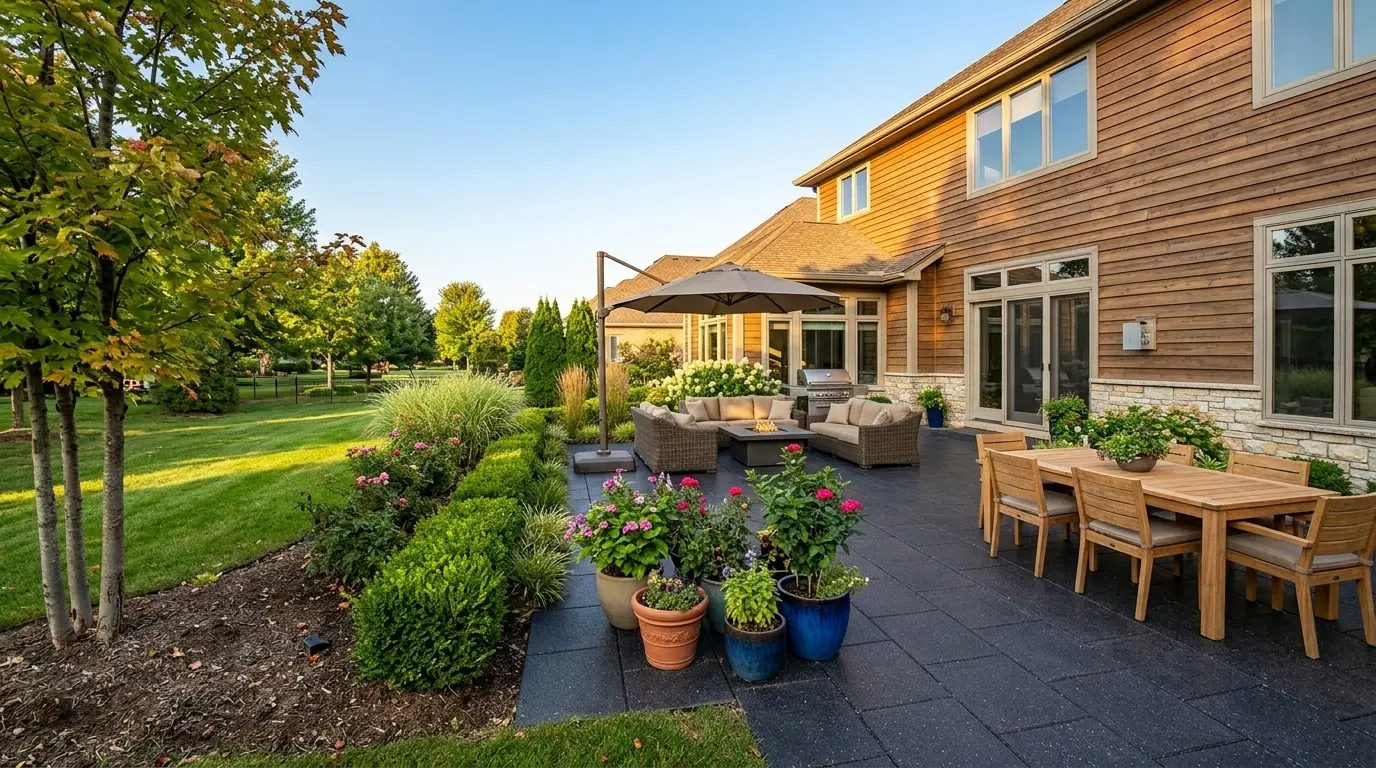
The finish also changes how the stone reads against its surroundings. A honed black basalt stone set into pale limestone gravel is a graphic, high-contrast choice suited to desert xeriscaping and modern minimalist planting. A brushed or bush-hammered surface in the same setting reads as softer — the open texture catches light differently and the surface lightens slightly in tone, which suits mixed herbaceous planting and more naturalistic landscape styles. Both are valid; the choice is a design decision as much as a performance one.
Understanding Slip Performance and Finish Choice
Slip resistance is a topic worth addressing plainly. The current wet-surface standard is ANSI A326.3, tested wet — not the ASTM C1028 static test withdrawn in 2014. The finish is the primary variable: a bush-hammered texture leaves a deeply open, irregular surface, a brushed finish leaves a consistent directional texture, and a honed finish leaves a smooth, tight surface. For any stepping stone path exposed to wet conditions, specify the finish accordingly and ask your supplier whether a test report under ANSI A326.3 is available for that finish on the specific stone. At Citadel Stone, we can make test reports available on request for finished basalt surfaces so your specification is documented.
Layout Patterns and Spacing Decisions
Three layouts cover the majority of residential and commercial stepping stone paths, and each changes both the practical and the visual character of the route.
- Single-file linear: stones placed in a direct line, one per stride. Works well in narrow planting corridors, between raised beds, and in formal modern gardens. Requires precise stride matching — measure your own step before setting centre-to-centre distance.
- Staggered double file: two stones side by side, alternating left and right along the path direction. Reads wider and more relaxed, suits tropical planting and cottage-style borders, and allows two people to walk comfortably side by side on a wider path.
- Irregular scatter: informal placement at varied but walkable intervals, often used with irregular-cut or natural-edge stones in woodland, meadow or naturalistic landscape settings. Spacing discipline still applies — scatter is not random if the path needs to function.
Joint width between stones is not purely aesthetic. Wide joints filled with gravel or planted with low ground cover allow surface water to drain freely between stones rather than pooling on the basalt surface itself. For a path in a freeze-thaw climate, keeping joints open and free-draining reduces the risk of frost heave displacing individual stones over winter.
Base Preparation That Keeps the Path Level
The most common failure mode in stepping stone installations is differential settlement — one stone drops while its neighbour stays put, creating a trip edge. It traces almost always to inconsistent base preparation rather than to the stone itself. A consistent, compacted base of clean crushed aggregate is essential, and the key preparation parameters are:
- 100 mm compacted aggregate depth for pedestrian use on stable ground, set to a flat or gently graded surface before any bedding material is added
- 20–30 mm sharp sand or grit bedding layer to allow individual stone levelling and accommodate minor irregularities in the stone’s own thickness
- Each stone checked with a level and bedded firmly by hand-tamping or careful rubber-mallet work — a stone that rocks at any corner will work itself down on the low corner within one wet season and become a persistent trip hazard
According to USGS basalt volcanic rock properties and composition, basalt’s density makes it well suited to dimensional applications where mass and stability matter; the stone itself will hold its position when the base does its job.
Citadel Stone cuts stepping stones to order at our selected quarries, so you can specify the exact length, width and thickness your layout requires rather than adjusting your design around stock tile sizes. When planning delivery, factor in your site’s access for the delivery vehicle — long or irregular driveways, low overhangs, or soft ground at the property edge all affect offloading logistics, and lead times are quoted with the order.
How Basalt Stepping Stones Work Across Landscape Styles
Basalt’s near-black colour and tight grain make it one of the more versatile stepping stone materials across landscape styles, but the finish and format choice must track the design intent. In modern minimalist settings — clean lines, restrained planting, gravel mulch — a large-format honed stone set flush with the surrounding material with consistent 10 mm joints reads as architectural and deliberate. In a desert xeriscaping scheme, the contrast between dark stone and pale decomposed granite is part of the palette strategy, and the rough texture of a bush-hammered finish integrates better with the loose material than a honed face would.
Traditional colonial and heritage garden settings generally call for a more irregular stepping stone — natural-edge cut stones or slightly varied dimensions that soften the line of the path. A brushed finish in Brushed 36 Grit sits well here: enough texture to read as natural, enough consistency to maintain the material’s quality reading against brick, timber or wrought-iron elements. Tropical planting schemes benefit from larger stones with wider planted joints — creeping thyme, baby’s tears or liriope growing between the stones grounds the path in the planting rather than cutting through it.
The basalt stepping stone path is supported by NSI stone variety specifications for igneous paving materials precisely because basalt’s density and surface consistency make it predictable to cut, finish and lay — a practical quality that translates directly into a path that holds its specification appearance over decades of service life.
Sealing Basalt Stepping Stones
Basalt is a dense igneous stone with low absorption relative to sedimentary alternatives like limestone. For outdoor basalt stepping stones set in open soil or lawn, sealing is still worth doing — not to block water permanently, but to slow the rate at which organic matter, iron deposits and tannins from adjacent planting stain the surface. A penetrating impregnator suited to dense igneous stone is the right product category; surface sealers that form a film on open-air paving tend to peel as moisture migrates from below.
- Apply sealer to clean, dry stone — not to a surface that has been rained on in the previous 48 hours
- Re-seal on the interval stated by the sealer manufacturer — not on a fixed annual schedule, because formulation longevity varies
- On bush-hammered or brushed stones, apply by brush rather than spray to ensure the sealer reaches into the texture’s valleys
- Honed surfaces take sealer more evenly and can be wiped; textured surfaces need worked-in application and a dry-back check before foot traffic resumes
Avoid acid-based cleaners on basalt. Muriatic acid and some concrete-cleaner products etch the surface and permanently alter the colour reading of the path. A neutral-pH cleaner and a stiff brush handle most organic staining. For iron or rust staining — common where adjacent steel edging or fixings corrode — a specialist stone-safe iron stain remover is the correct product, applied according to the manufacturer’s dilution and dwell-time instructions.
Ordering, Sizing Quantities and Project Planning
Calculating quantity for a basalt stepping stone path is simpler than for continuous paving because you are counting units, not covering area. Draw your layout to scale, mark each stone position, and count the total units required in each size. Add a contingency of around 5% to account for any stones that arrive with edge damage or that need to be cut for the path ends — basalt cuts cleanly with a diamond blade, but cutting adds a step and a cost that a small buffer avoids.
If your path uses multiple stone sizes — for example, alternating 600 × 600 mm and 400 × 600 mm stones in a staggered layout — order each size separately and confirm the exact dimensions with your supplier before cutting begins. Our dark basalt pavers are cut to the dimensions you specify, so confirming finished size, tolerance and finish in writing before the order is placed protects both the project timeline and the budget.
Lead times for cut-to-order basalt stepping stones are quoted at the time of order and depend on the size of the run, the finish specified and shipping logistics to your site. Delivery is arranged and managed by Citadel Stone from our selected quarries — your responsibility is to confirm site access for the delivery vehicle, including any weight restrictions, turning radius constraints, or offloading arrangements your property requires. Getting this detail confirmed early avoids rescheduling costs on your end.
Getting Your Basalt Stepping Stone Path Specification Right
The specification decisions that matter most are size relative to stride, finish relative to exposure, and base preparation relative to the site’s drainage and soil conditions. Get those three right and the path will perform and look well for decades of service life. The landscape style and design palette — minimalist, naturalistic, tropical, or formal — shape the format and finish choice but sit downstream of those functional decisions. Your path needs to work first; it can be beautiful second, and with basalt, those two goals rarely conflict.
As your project planning develops, adjacent stone applications may also come into scope. If you are considering a concrete base as part of the path’s foundation or surrounding terrace, basalt pavers over a concrete base covers the technical considerations for that installation approach in useful detail. Dark basalt stepping stones from Citadel Stone stand out against lawn, gravel or planting, sourced from our selected Middle East quarries.
Related reading: Large Format Basalt Pavers: Planning and Layout · basalt fire pit surround · how basalt is formed.