

Basalt landscape steps fail most often not because the stone gives out, but because the ground beneath them moves. Choosing solid basalt block steps is a sound structural decision — basalt’s dense, fine-grained volcanic composition means the stone itself rarely causes the problem. The real variable is what happens below grade: the base material, the soil type, and how you manage drainage across a slope. Get those three right and basalt landscape steps will deliver decades of service life. Get them wrong and you’ll be releveling before the third winter.
Why Basalt Works Well for Landscape Stairs
Basalt is an igneous volcanic stone with a notably tight crystalline structure that makes it exceptionally durable under repeated load and abrasion. For landscape stairs, that density matters because each step takes concentrated point loads every time someone descends — particularly on the nosing edge. Softer sedimentary stones can edge-chip over years of this; basalt holds its profile considerably longer under the same conditions.
The stone’s low absorption rate is another practical advantage outdoors. Water that can’t soak in can’t freeze inside the stone’s structure and cause spalling during freeze-thaw cycling. Specify the ASTM test method for water absorption and request the test report from your supplier to confirm the precise value for the specific material you’re ordering — test reports are available on request from Citadel Stone.
- Dense volcanic composition resists edge chipping on nosings and treads
- Low absorption reduces freeze-thaw spalling risk in cold regions
- Dark, consistent coloration holds its appearance across varying exposures
- Available cut to order in block and slab formats for different stair configurations
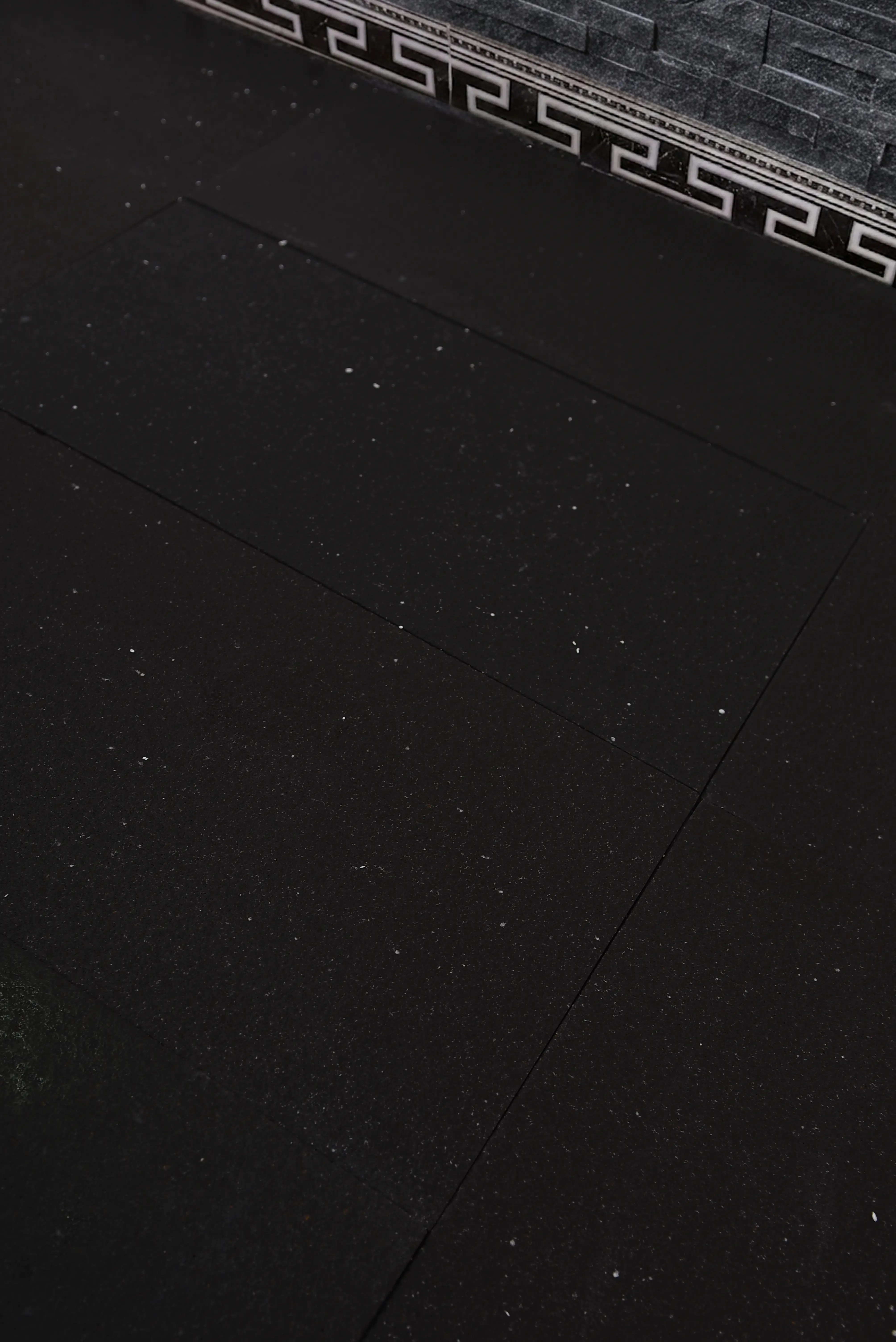
Block or Slab: Choosing Your Stair Configuration
Your first structural decision is format: full-depth basalt blocks versus thinner slab treads on a built substrate. Both are legitimate approaches, but they suit different ground conditions and budgets differently.
Full-depth basalt block steps — typically cut at 6 to 8 inches tall — act as self-supporting monoliths. You set them on a compacted gravel base with no concrete substrate required, and each step is heavy enough to resist frost heave and lateral creep without mechanical fixing. This is the format that performs best on slopes with variable or unpredictable subgrades, because the mass itself is the stability. Blocks cut this way are the more common specification for exposed garden slopes, retaining terraces, and informal pathways through planted areas.
Slab treads bonded to a concrete substrate are thinner — typically around 2 to 3 inches — and depend entirely on the integrity of the substrate below. They’re appropriate for formal entry stairs where a concrete stringer already exists, but they’re a poor choice for open garden slopes where ground movement is expected. A crack in the substrate telegraphs directly through the stone.
- Full-depth basalt blocks: self-supporting, tolerant of subgrade variation, no concrete substrate needed
- Slab treads on concrete: thinner profile, formal appearance, depends on substrate stability
- Block format preferred for outdoor garden slopes and terraced gardens
- Slab format suited to formal entry stairs with engineered concrete base
Getting Dimensions and Proportions Right
The riser-to-tread ratio governs how comfortable and safe a stair feels to use. Outdoors, a shallower pitch suits landscape stairs better than interior proportions — you’re often descending a slope at a relaxed pace, not climbing a compact interior staircase. A common outdoor landscape proportion pairs a riser around 5 to 6 inches with a tread depth of at least 14 to 16 inches, giving a natural stride. This is a design variable your landscape architect or contractor will calculate precisely for your slope geometry; the principle is that outdoor stairs should feel unhurried.
The ADA accessibility standards for outdoor surfaces set minimum tread widths and maximum riser heights for accessible routes, and those figures are worth reviewing even for private residential projects — they represent well-tested ergonomic reasoning, not just compliance targets. Where your stairs will be used by a range of ages and abilities, building to accessible proportions costs nothing extra at the specification stage and matters considerably over the life of the project.
Blocks can be ordered cut to specific tread depths and riser heights. Citadel Stone cuts each order to the dimensions your project requires, so you’re not confined to off-the-shelf proportions. Factor in the nominal width of the flight — wider stairs read as more generous and architectural; narrow stairs feel utilitarian.
Choosing the Right Finish for Outdoor Steps
Finish selection for basalt landscape steps deserves more attention than it usually gets at the specification stage. The finish determines the surface texture, which affects how the stone performs under foot traffic and how it ages visually.
For pool decks, ramps, wet areas, and any step that will regularly be exposed to water — including garden steps in regions with heavy rainfall — a bush-hammered finish is the standard recommendation. Bush-hammering leaves an open, uniformly textured surface with a mechanical roughness that persists through years of foot traffic. According to USGS data on basalt volcanic rock properties, basalt’s tight grain structure makes it particularly responsive to surface texturing processes, holding mechanical finishes well without fracturing or spalling.
For other outdoor landscape steps not regularly wetted — covered terrace entries, sheltered pathway stairs — a brushed finish in a coarser grit works well. The Brushed 16 Grit finish suits driveways and courtyards; Brushed 36 Grit is suited to patios and outdoor-indoor transitions. Check a physical sample in your site’s light and wet conditions before committing — photographs rarely convey what a stone looks like after rain on a shaded slope.
- Bush-hammered: open, matte texture — for pool decks, wet steps, slopes, and all regularly wetted stairs
- Brushed 36 Grit: medium texture — for patios, outdoor stairs with some shelter, pool surrounds
- Brushed 16 Grit: coarser texture — for driveways, courtyards, heavy-traffic garden paths
- Polished: dry indoor surfaces only — never for outdoor stairs
- Always view a sample wetted under your site’s natural light before final selection
Ground Conditions and Base Preparation
Here’s what most stair installations underestimate: the subgrade is doing at least as much structural work as the stone itself. Basalt blocks are dense and heavy, but they can still tilt, settle, or separate if the ground beneath them moves — and many soil types move more than installers expect.
Expansive clay soils are the most common problem. Clay expands when wet and contracts when dry, and that seasonal cycling can shift a stair block by a meaningful margin over a few years. The fix isn’t to pour more concrete — it’s to excavate the clay to a sufficient depth and replace it with a well-compacted granular sub-base (clean crushed stone, compacted in lifts) that drains freely. The drainage is what stops the clay below from repeatedly cycling between wet and dry. On slopes with expansive clay, the base excavation depth for basalt landscape steps is often greater than the block height itself.
Sandy or loose soils present a different problem: they compact unevenly and can wash out under the step if surface drainage runs across rather than away from the stair flight. Geotextile fabric between the natural soil and the granular base layer addresses washout and keeps fines from migrating upward into the drainage layer. For rocky subgrades — caliche pan in arid regions, fractured ledge rock in mountainous areas — your installer needs to assess whether the surface is level enough to set a base layer correctly or whether excavation is needed to create a uniform bearing plane.
- Expansive clay: excavate and replace with compacted granular base; prioritize drainage over mass
- Sandy soils: use geotextile fabric to prevent fine migration; check that surface drainage runs away from the stair
- Caliche or rocky subgrade: establish a level bearing plane before placing granular base
- Freeze-thaw regions: base depth must reach below local frost depth to prevent heave
- Any slope: cross-fall drainage across tread face prevents standing water at riser joints
How to Set Basalt Block Steps on a Slope
Setting each step correctly is a process of working up the slope from the bottom — never from the top down. The bottom step sets the datum; every step above it references back. Start by establishing your base trench for the lowest step, compact the granular base to the specified depth, then set the block with a slight back-tilt: a fraction of an inch of backward lean prevents the step from appearing to tip forward as the ground settles, and it channels any surface water away from the riser face rather than pooling at the joint.
For NSI stone steps and treads design specifications, the bearing width under each step block should be generous — at least two-thirds of the tread depth. Steps set on a narrow bearing strip are inherently less stable than those with broad, even contact across the full base. On compacted granular base without mortar, that bearing contact is the only thing preventing the block from rocking.
You can use our basalt stone blocks as a complementary material where the stair flight meets a retaining edge, a planted border, or a path — the stone family is consistent so the transitions read cleanly. Building steps and adjacent hardscape elements from the same material is a detail that experienced landscape architects use to give a project visual coherence.
Sealing and Long-Term Maintenance
Basalt is a dense stone with relatively low absorption, which means it’s less dependent on sealing than more porous alternatives like limestone or sandstone. That said, sealing an outdoor basalt stair flight has practical benefits: it reduces the absorption of organic material (leaf tannins, soil runoff, algae spores) that would otherwise stain the surface over time, and it makes routine cleaning more straightforward.
For outdoor stairs, use a penetrating impregnator sealer appropriate for dense igneous stone — not a surface coating or topical sealer, which can peel under the foot traffic and UV exposure a stair surface receives. Your sealer manufacturer’s data sheet will specify the reapplication interval; reseal on that schedule rather than waiting for the stone to show staining. In shaded or damp climates, algae and moss growth on outdoor stone stairs is a practical concern. A low-concentration algaecide wash applied periodically addresses it without damaging the stone surface.
- Use a penetrating impregnator sealer for outdoor basalt steps, not a topical coating
- Reseal on the interval your sealer manufacturer specifies — not by appearance alone
- In shaded conditions, periodic algaecide wash prevents biological growth buildup
- Routine cleaning: a stiff brush and water handles most outdoor surface soiling
- Avoid acid-based cleaners — they can etch the basalt surface over time
Planning Your Order and Delivery
Full-depth step blocks are heavy units. Your project’s truck access constraints directly affect how the delivery is staged and where material can be offloaded. Plan this early — a delivery truck needs a clear, firm surface to approach and offload heavy stone blocks, and a garden slope with no vehicle access requires a mechanical lift or a manual carry from the nearest access point. Both scenarios can be accommodated, but they need to be confirmed before the delivery date rather than worked out on site.
Citadel Stone stocks basalt at our selected quarries and cuts each order to the specified dimensions. Lead times are quoted with the order, so build ordering into your project programme well ahead of the installation phase. Coordinate the delivery date with your installer so the material is on site and accessible when the base preparation work is complete — storing heavy basalt blocks on a soft slope while waiting for a base to be excavated creates unnecessary handling risk and potential surface damage to the blocks.
The Natural Stone Institute publishes stone variety guidance worth consulting when writing a material specification for a formal project document.
Moving Forward
Your basalt landscape steps specification comes down to three decisions that compound: block format and dimensions for the slope geometry, finish for the exposure conditions, and base preparation for the soil type beneath. Get the base depth and drainage right for your soil conditions — whether that means excavating expansive clay and replacing it with granular fill, or setting geotextile against sandy subgrade — and the stone above it will perform as expected for decades. Choose bush-hammered finish for any step that gets regularly wet; choose a brushed grit for drier, more sheltered situations and check a sample first. Cut the blocks to the riser-tread proportions your slope geometry requires, not to whatever size is easiest to stock. As you develop your outdoor hardscape further, basalt cobble tree surround applications show how the same material family extends naturally to planting details and garden features throughout the same project. Basalt block steps from Citadel Stone bring a dark, solid line to a garden slope, with each block cut to order from our selected Middle East quarries.
Related reading: basalt cobble drainage channel · basalt cobblestone care · Building a Basalt Block Retaining Wall.