

The layout decision that determines whether a basalt cobble tree surround looks intentional or improvised comes down to one variable most people overlook: the transition from cobble to root-zone mulch. Get that interface wrong and you’ll be resetting stones every other year as seasonal movement works them loose. Basalt cobble tree surrounds, when set correctly, hold their geometry through decades of thermal cycling, root pressure, and landscape crew foot traffic — but the spec work happens before a single stone goes in.
Why Basalt Works So Well Around Trees
Basalt is a dense, fine-grained volcanic stone, and those two properties work in its favour when it sits adjacent to a living root zone. Its low absorption rate means moisture drawn toward the root ball doesn’t wick into the stone body and cause spalling during cold nights. Its mass also means individual cobbles resist the kind of casual displacement that lighter decorative aggregates suffer under a garden hose or a heavy rainfall. According to USGS data on basalt volcanic rock properties, basalt’s crystalline structure produces a material that is exceptionally durable under a wide range of surface conditions.
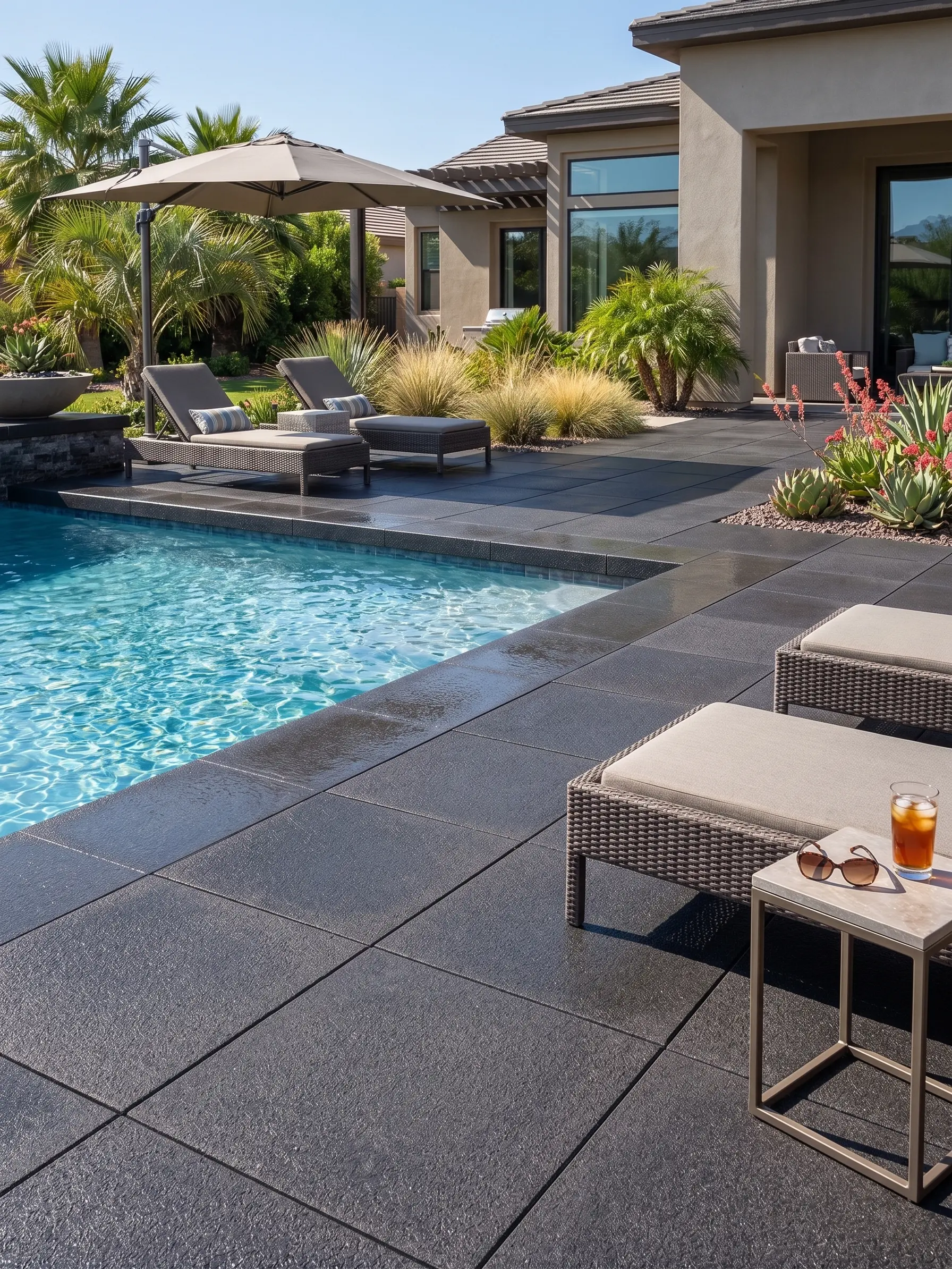
The dark colouration — near-black through deep charcoal, with occasional blue-grey undertones — creates a strong visual contrast against bark mulch, ornamental grasses, and pale paving. That contrast is what makes a cobble surround read as a designed element rather than a functional afterthought. The colour holds without sealing because basalt’s mineral composition resists UV bleaching better than paler sedimentary options such as limestone.
Basalt’s surface texture — particularly in a split face or bush-hammered presentation — complements the natural character of a tree trunk. It bridges the gap between hard landscaping and planted elements without either dominating.
Design Patterns and Layout Geometry
The geometry of your surround shapes the entire character of the planting bed. Three approaches dominate well-executed projects, and each requires a different setting method.
- Concentric ring layouts use cobbles laid tightly in arc rows around the trunk, with each ring offset by half a cobble from the one inside it. This produces the most formal, architectural result and works well in contemporary paving schemes where the surrounding surface is a large-format slab.
- Irregular mosaic settings mimic the randomness of natural riverbed stone. Cobbles vary slightly in size and are set with tighter joints on the inner rings and progressively looser ones toward the perimeter. This suits cottage gardens and woodland planting schemes.
- Radial spoke patterns project straight lines outward from the trunk gap, with cobbles aligned along each spoke and smaller fill pieces closing the wedge-shaped spaces between them. The most labour-intensive of the three, but the most visually striking at larger diameters.
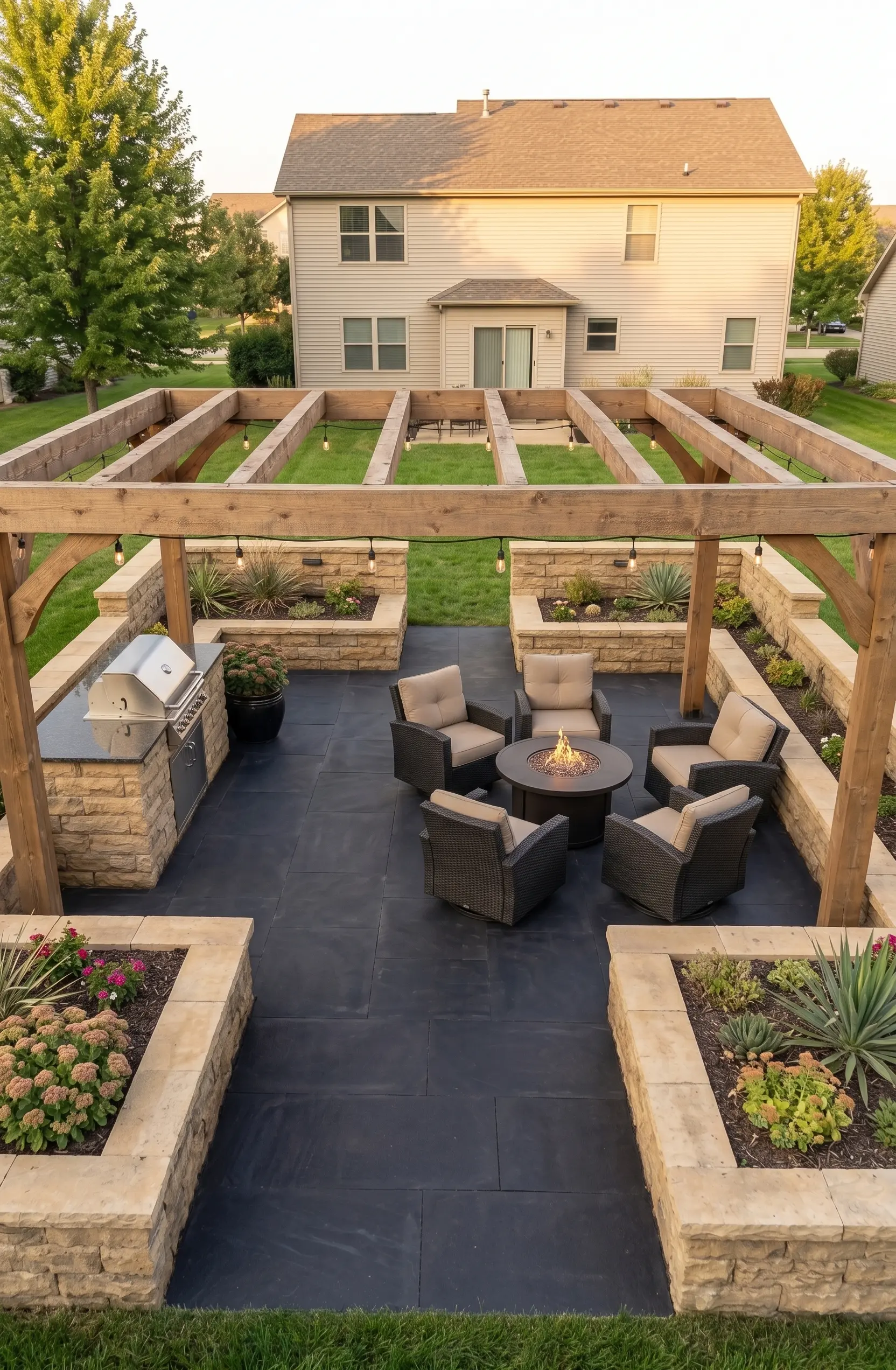
Your choice between these patterns should be driven by the surrounding paving language rather than personal preference alone. A radial pattern set against a brushed basalt terrace looks cohesive; the same pattern against random-coursed flagstone competes for attention. Let the dominant hardscape material set the register, and use the surround to echo it.
Diameter matters more than most designers allow. A surround that’s too tight looks like an afterthought; one that’s too generous swallows the tree visually at the planting stage, even if it makes sense for the mature canopy spread. A practical working range is one-and-a-half to two times the current trunk diameter at setting, with the understanding that you’ll add an outer ring or two as the tree establishes. Plan for that expansion from the start — design the outer edge so stones can be added without re-laying the whole surround.
Selecting Cobble Size and Finish for Your Project
Cobble dimensions directly affect how a basalt cobble tree surround reads from a distance and how it sets in practice. Smaller cobbles — in the 3 to 4 inch range — give you more flexibility on curved layouts and tight ring radii. Larger cobbles, toward 6 inches, anchor the eye more strongly and suit surrounds around mature specimen trees where scale demands it.
Finish selection is worth careful thought for tree surrounds specifically, because these surfaces get foot traffic from maintenance, not from regular pedestrian use. That changes the performance brief. For surrounds set into a lawn or planting bed where they won’t be walked across routinely, a split face finish gives the most naturalistic texture and strongest visual contrast. For surrounds at path junctions or courtyard trees where occasional foot traffic is unavoidable, a bush-hammered finish presents an open, matte texture suited to wet conditions without making a safety claim about its performance.
- Split Face: raw, fractured surface with strong textural relief — best for purely ornamental surrounds in planted beds
- Bush-Hammered: mechanically textured, consistent surface — appropriate for surrounds at path intersections or courtyards
- Brushed 36 Grit: smoother than bush-hammered but with visible surface tooth — suitable for transitional zones between indoor-outdoor paving and planting beds
Polished and honed finishes are intended for dry indoor surfaces only and don’t belong in an outdoor tree surround context. Stick to the textured options and the project will age gracefully.
To explore the full range of sizes and surface options, our basalt cobblestone range covers the product specifications in detail.
Base Preparation and Setting Method
Base preparation separates surrounds that hold their geometry for decades from those that need resetting after the first wet season. The root zone is the complicating factor — you’re preparing a base adjacent to a living system that will push laterally and vertically as it grows.
The standard approach for a pedestrian-load surround uses a compacted aggregate sub-base topped with a bedding layer of coarse sharp sand. Depth depends on your soil type: in well-draining sandy soils, a shallower sub-base is workable; in clay-heavy soils, you need additional depth and ideally a geotextile layer between the native soil and your aggregate to prevent clay migration into the bedding layer over time. That clay migration is what causes the uneven settlement most installers blame on frost — the frost accelerates it, but the real problem is base contamination.
- Excavate to a consistent depth across the full surround footprint, including the transition zone at the outer edge
- Install geotextile fabric over the native soil in clay or expansive-soil sites before placing aggregate
- Compact the aggregate sub-base in lifts — never in one deep pour, which won’t compact evenly
- Bed the cobbles into coarse sharp sand or a dry mortar mix depending on how much root movement you anticipate
- Leave a clear gap around the trunk — never mortar directly against bark, and allow for trunk expansion over the tree’s growing years
For surrounds in freeze-thaw climates, a sand-set approach is generally preferred over full mortar bedding. Sand-set surrounds can absorb the slight vertical movement that freeze-thaw cycling produces without cracking. A fully mortared surround in a region with significant seasonal temperature swing will eventually develop fracture lines at the joints — not because the basalt fails, but because the mortar is stiffer than the ground movement beneath it. The field fix is straightforward: sand-set the cobbles and repack the joints annually after the first melt cycle, which takes less than an hour for a typical residential surround.
How Freeze-Thaw and Thermal Cycling Affect the Surround
Basalt cobble tree surrounds perform well across a wide temperature range, but the specific challenge in temperate and cold climates isn’t the cold itself — it’s the cycling. A surround that drops to freezing and stays there through winter is easier to design for than one that crosses the freeze-thaw threshold repeatedly through a single month. Each cycle that takes water in the joints from liquid to solid and back again exerts movement pressure on the setting bed.
According to Britannica’s coverage of basalt volcanic rock formation and construction properties, basalt’s low porosity relative to other natural stones limits the volume of water that can enter the stone body — which is directly relevant to freeze-thaw performance, because absorbed water that freezes inside the stone is what causes spalling over repeated cycles.
Your joint width decision interacts directly with thermal cycling. Tighter joints leave less room for differential movement between adjacent cobbles; wider joints allow that movement to be absorbed without stone-on-stone contact. In climates with significant diurnal temperature swings — hot days and cold nights even in seasons that don’t produce frost — wider joints filled with polymeric sand or a flexible jointing compound outperform rigid mortared joints over time. The thermal expansion coefficient of basalt means that a large surround, say two metres in diameter, will show measurable dimension change between its coldest and hottest state. Rigid joints don’t accommodate that change; flexible ones do.
The practical recommendation: in regions where day-night temperature differentials regularly exceed 30 to 35 degrees Fahrenheit, specify flexible jointing for any surround over 1.2 metres in diameter and plan annual joint top-up as routine maintenance. This is standard practice for cobblestone and sett installations in those climates and costs very little relative to a full reset.
Integrating the Surround into Your Wider Paving Scheme
The basalt cobble tree surround’s design role extends beyond the immediate planting area. Used well, it becomes a compositional device that connects vertical planting elements to horizontal hard surfaces. Used poorly, it creates a visual interruption in an otherwise coherent scheme.
Three integration principles guide the best projects. First, echo the stone species — if the surrounding terrace or path uses basalt in slab or tile form, the cobble surround reads as a deliberate variation of the same material family rather than a contrasting accent. Second, carry the joint direction — if your surrounding paving runs in a particular orientation, orient the surround’s radial or ring structure so it resolves against that paving without fighting it. Third, manage the edge detail at the surround perimeter — a soldier course of matching basalt setts or a flush-set steel edging strip both give a clean termination that prevents the surround from looking like it just stops.
Basalt cobble tree surrounds work well alongside other basalt products. Citadel Stone cuts cobbles and setts to order at our selected quarries, so you can specify matching stone across the surround, the surrounding path, and the edging border from a single source — which keeps colour and texture variation within the normal range of the material rather than introducing the inconsistencies you get when mixing batches from different origins.
Drainage and Root-Zone Management
The tension between a neat cobble surround and a healthy root zone sits at the heart of every tree surround project. Roots need water and gas exchange; a poorly designed surround can restrict both. A well-designed one protects the root zone, improves drainage, and keeps maintenance equipment away from the trunk.
Sand-set cobble surrounds in themselves are reasonably permeable — water passes through the joints and into the sub-base. The problem arises when the surrounding hard paving directs surface runoff toward the tree but the sub-base under the cobble surround is too compacted to pass it into the root zone at a useful rate. Design your grade so that water runs toward the surround at a shallow pitch rather than away from it, and ensure your sub-base aggregate is coarse enough to remain permeable over time even as fines migrate downward.
- Use angular crushed aggregate, not rounded pea gravel, for the sub-base — angular material compacts more firmly and stays in place under repeated foot traffic loading
- Keep the cobble surface nominally level or with a very shallow pitch toward the tree so that rainfall reaches the root zone rather than sheeting off toward drains
- Leave the trunk gap clear of mortar, membrane, and compacted aggregate — the zone immediately around the root flare needs to breathe
- Revisit the surround every year or two to lift any cobbles that have been displaced by surface root growth and relay them with the root exposure acknowledged in the new setting
The Natural Stone Institute’s guidance on igneous stone paving reinforces the importance of understanding stone porosity and absorption in outdoor settings — properties that directly affect how water moves through and around a stone installation at the root zone interface.
Root barriers are sometimes specified below cobble surrounds to limit root incursion into the sub-base. These are a legitimate tool where aggressive-rooting species are involved, but they need to be permeable to water — an impermeable root barrier that protects the setting bed but starves the root zone of moisture defeats the purpose of the tree in the landscape. Specify a permeable geotextile root barrier rather than a solid membrane.
Ongoing Care and Maintenance
Basalt cobble tree surrounds require less routine maintenance than most landscape stone elements, which is one of the reasons they’re worth specifying. The material itself is highly resistant to weathering, staining from organic debris, and the mechanical wear that paths and terraces face. The maintenance workload is almost entirely about the joints and the interface with the root zone.
Your annual maintenance cycle should include:
- Inspecting joint filling across the full surround and topping up any areas where sand or jointing compound has settled or washed out
- Checking the trunk gap to confirm cobbles haven’t migrated inward as ground movement compresses the inner ring
- Resetting any displaced stones — root pressure from vigorous species can lift individual cobbles, and early correction prevents progressive displacement
- Cleaning the surface with a stiff brush and plain water if organic staining from leaf debris has accumulated over winter
Sealing is optional for basalt cobbles used outdoors. Basalt’s natural absorption characteristics mean it doesn’t urgently require sealing the way a lighter limestone might in the same setting. If you do choose to seal — which can deepen the colour and provide modest stain resistance against organic materials in mulched beds — use a penetrating impregnating sealer specified for dense igneous stone and apply it on the interval your sealer manufacturer states. Never apply sealer to damp stone, and allow the surround to dry fully after any cleaning before resealing.
Delivery of basalt cobbles for large surrounds or multiple tree pits across a site should be planned around access to the planting locations. In established gardens with narrow paths or restricted access points, offloading arrangements need confirming before the delivery date — lead times and logistics are quoted with the order.
Getting Your Basalt Cobble Tree Surround Specification Right
Your specification for a basalt cobble tree surround comes together most effectively when you treat it as a paving decision first and a planting accessory second. The stone needs a proper base, appropriate joint treatment for your climate’s thermal cycling regime, and a clear drainage strategy that serves both the setting bed and the root zone. Get those three things right and the aesthetic result follows naturally from the material’s inherent character.
Choose your finish based on the surround’s functional context — split face for ornamental-only settings, bush-hammered where foot traffic is part of the brief. Match cobble scale to tree scale and to the surrounding paving’s module. Plan the outer edge for future expansion so you’re not rebuilding the whole surround in five years when the canopy justifies a wider footprint. And in climates where temperature swings between day and night or between seasons are significant, default to flexible jointing and sand setting — it’s the detail that separates surrounds that age gracefully from ones that need constant attention.
For further ideas on how basalt cobbles can work across the broader outdoor space, basalt cobble design ideas for patios covers complementary applications worth considering alongside tree surrounds. Dark basalt cobbles from Citadel Stone frame trees and planting pockets with a neat, natural edge, sourced from our selected Middle East quarries.
Related reading: Maintaining Basalt Cobblestone: A Care Guide · basalt block retaining wall · uneven basalt cobbles fix.