

Basalt crazy paving ideas tend to look deceptively simple on the page — irregular pieces laid in a mosaic pattern — but the decisions that determine whether the finished surface holds up over decades happen long before the first stone is set. The organic geometry of crazy paving means joints vary in width, direction and depth, and that variation forces you to think carefully about bedding depth, joint-fill material and what happens when seasonal ground movement works through the slab. Get those variables right, and you end up with a surface that earns its place in the landscape for a very long time.
Why Basalt Works So Well for Crazy Paving
Basalt’s dense, fine-grained structure gives it a low absorption rate that suits outdoor irregular paving well. Moisture works its way into jointing compounds and bedding mortars far more readily than it penetrates the stone face itself, which matters especially in freeze-thaw regions where repeated expansion cycles test every joint in the layout. The stone’s natural colour palette — deep charcoals, warm mid-greys, subtle blue-black tones — stays visually stable as it ages, which is something not every material can claim. According to USGS basalt volcanic rock properties, basalt forms from rapidly cooled lava, producing a uniformly dense matrix that resists surface breakdown far longer than softer sedimentary options.
The irregular shapes in a basalt crazy paving layout also mean you are working with genuine cut edges rather than calibrated sides. Basalt cleaves cleanly, so the broken edges stay relatively tight and don’t crumble at the perimeter the way some softer stones do. That edge integrity directly affects joint width — and narrow, consistent joints are easier to fill, easier to seal and less prone to weed ingress over time.
12 Basalt Crazy Paving Ideas Worth Exploring
Your design direction shapes every material and finish decision that follows, so it pays to lock in the look before you specify thicknesses and base depths.
- Dark charcoal pieces in a full random layout, joints filled with fine dark granite dust — creates a seamless, moody courtyard surface that reads almost monolithic from a distance
- Mid-grey basalt crazy paving set against white rendered walls, joints brushed with a light mortar mix — the contrast highlights the irregular stone geometry without overwhelming the space
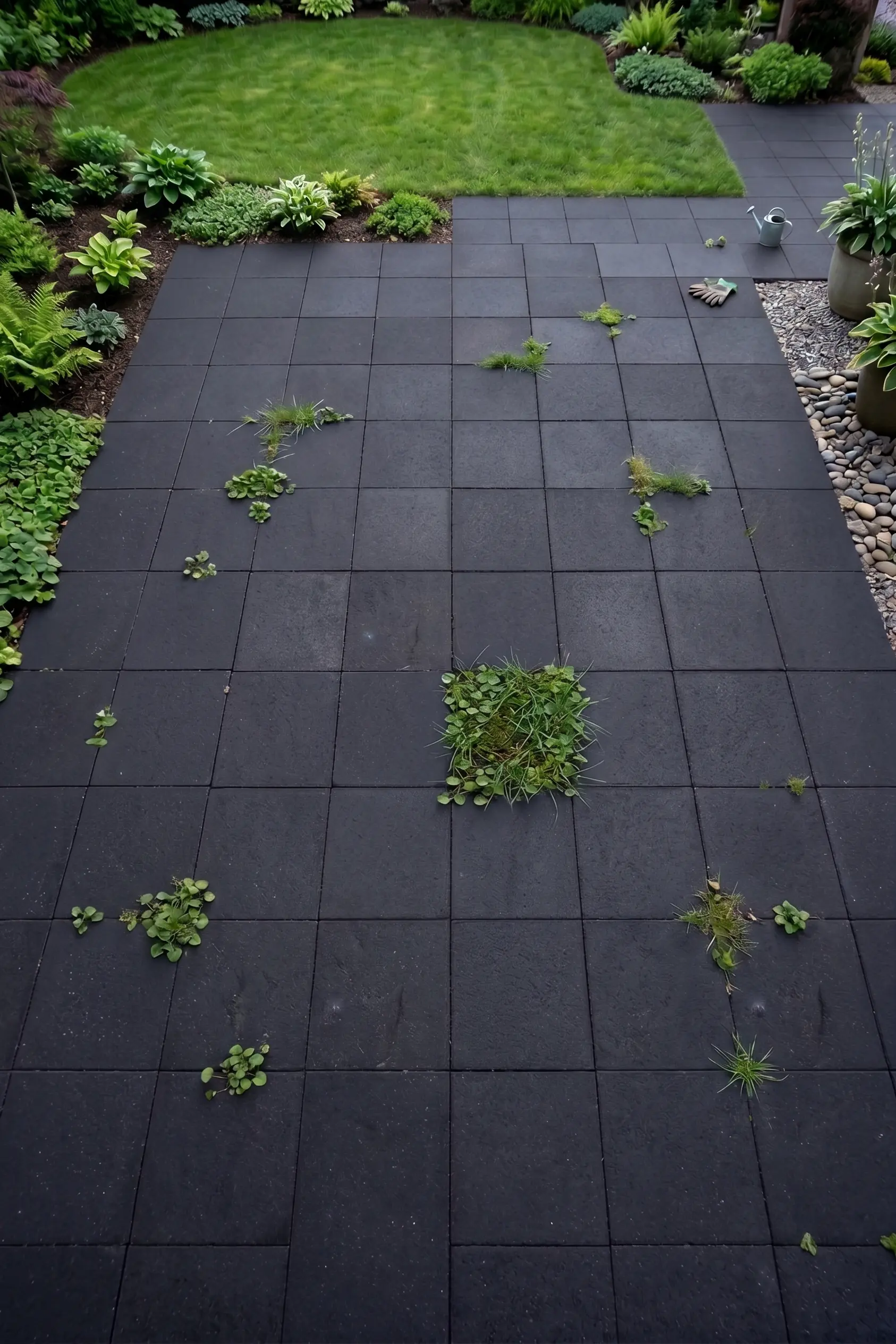
- Large-format irregular pieces with deliberately wide planting joints, allowing creeping thyme or sedum to thread through — works particularly well on gently sloped garden terraces
- Basalt crazy paving used as a border or apron to a rectangular pool surround, framing the clean-cut coping with organic texture
- Mixed-tone basalt — pulling together lighter grey and darker blue-black pieces — for a surface that reads variegated rather than uniform; sourcing consistent basalt colours across a full run is critical here
- Smaller, tighter-jointed pieces in a courtyard entry, creating a dense, urban texture underfoot that suits contemporary architecture
- Crazy paving as a freeform pathway through a planted garden, with irregular pieces set on a compacted aggregate base and gaps filled with decomposed granite
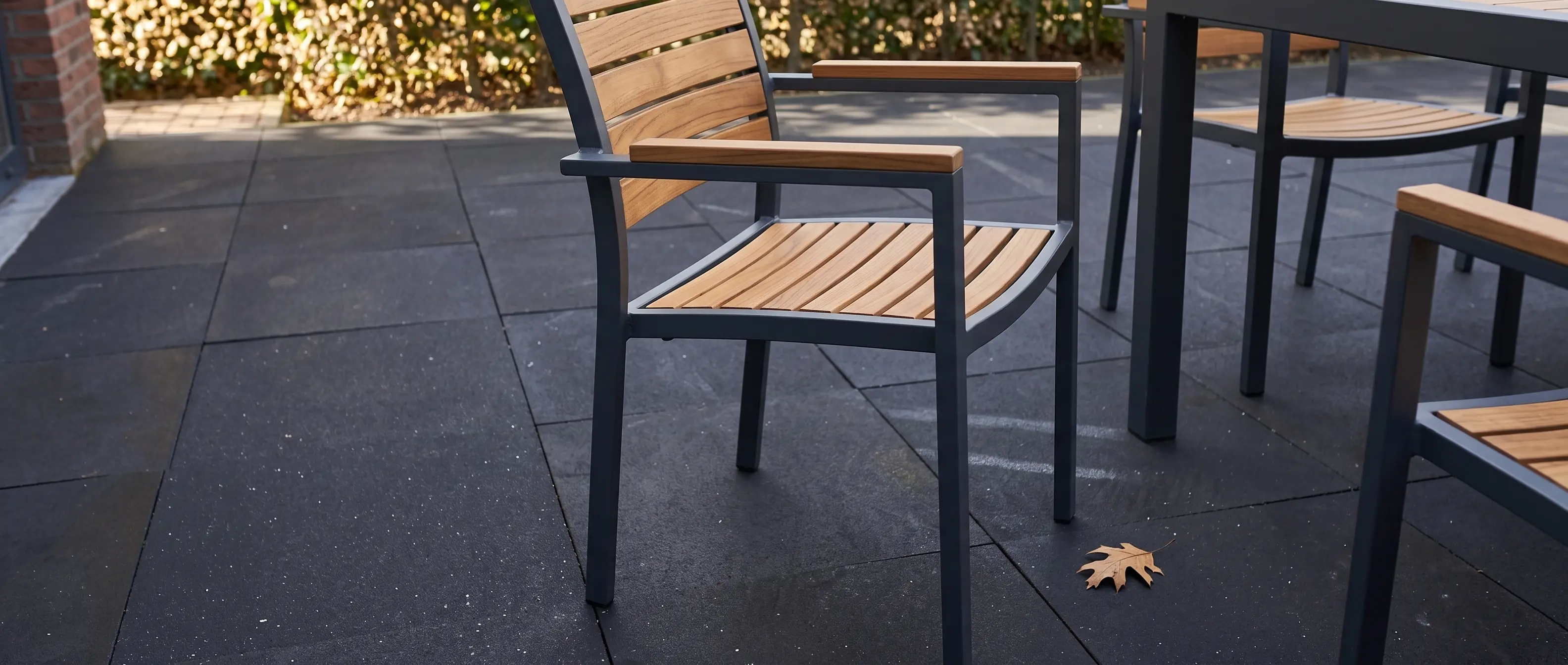
- Basalt irregular paving in a sheltered outdoor dining area, finished with a brushed texture to open the surface slightly for a more casual barefoot feel
- A fire-pit surround built from basalt crazy paving in the outer patio zone — the stone cut to fit the irregular zone around a prefabricated fire-pit unit, with clearances set by the appliance manufacturer’s specification and your local building code
- Basalt crazy paving used as a retaining-wall face cladding, with irregular pieces set in mortar to create a naturalistic textured surface on garden terrace walls
- A formal water-feature surround in crazy paving, where the irregular geometry softens what would otherwise be a hard geometric feature
- Large statement pieces — some pushing 600–800 mm in any dimension — interspersed with smaller fill pieces, creating a more architectural, deliberate-looking random pattern rather than an all-small mosaic
Choosing Basalt Colours for a Coherent Layout
Colour consistency is the specification challenge that catches most basalt crazy paving projects off guard. You’re working with a naturally volcanic stone, and the mineral variation between batches — even from the same deposit — can shift the surface tone noticeably. For a crazy paving run that reads as a unified field rather than a patchwork, you want all your pieces drawn from the same quarry batch and, where possible, from the same extraction lift.
The range of basalt colours runs from near-black blue-basalt through mid-charcoal to warm grey, with some material showing a slight greenish undertone in raking light. That undertone can look rich and considered in a garden setting — or it can feel unexpected if your design intent was a neutral grey. Request a physical sample swatch before committing to a full order, and view it in your project’s actual light conditions, not just indoors under artificial light. Basalt’s formation and mineral composition are well documented, and the colour variation traces directly to the mineral assemblage — olivine, pyroxene, plagioclase feldspar — which shifts with the specific source geology.
Which Finish Works for Each Application
Finish selection for basalt crazy paving ideas is not simply an aesthetic call — the finish determines the texture and, in wet areas, the practical character of the surface underfoot. The finish choice also affects how the stone ages, how readily it shows efflorescence, and how frequently you will need to re-seal.
- Brushed 36 Grit: a mid-range brushed finish that suits patios and pool surrounds — leaves an open, lightly textured surface without the coarseness of a heavier grit; pool surrounds and outdoor terraces are natural applications
- Brushed 80 Grit: finer brushing that works well on barefoot pool decks and terraces where you want a softer texture against skin; the surface remains open but the peaks are less pronounced than coarser grits
- Bush-Hammered: produces a pronounced, dimpled texture; the recommended choice for pool decks, ramps, wet areas and public zones where the surface texture needs to be meaningfully open
- Split Face: a cleaved surface retained for feature walls, cladding, retaining walls and exterior surrounds — not typically used for flat paving where a stable bearing surface is required
- Honed 60 Grit: works for covered patios and indoor-outdoor transition zones where you want a smoother surface than brushed without committing to a polished finish
- Polished: for dry indoor surfaces only — interior floors, feature walls and fireplace surrounds in a controlled interior environment
For pool decks, wet steps and slopes, choose a bush-hammered finish. For other outdoor paths, bush-hammered or brushed in our coarsest grit both work; check a sample. The Natural Stone Institute’s guidance on igneous stone paving technical standards underscores how finish interacts with surface texture and moisture behaviour — not as a safety guarantee, but as a material characteristic worth specifying deliberately.
Base Preparation and Thickness for Basalt Crazy Paving
The base is what the crazy paving surface reports back to, so this is where structural decisions actually get made. For pedestrian patio applications, you’re looking at basalt crazy paving pieces typically 30–50 mm thick, bedded on a compacted aggregate sub-base topped with a mortar or sand-cement bed. The exact sub-base depth is set by your local code and the bearing capacity of the native soil — not by a generic rule of thumb.
For driveways, use setts or cobbles at least 3.5 in (4 in standard) thick on a compacted base, or pavers 2 in (5 cm) or thicker mortar-bonded to a reinforced concrete slab. Crazy paving in thinner dimensions is a pedestrian and patio format — it is not a vehicle-area specification regardless of the stone’s inherent density. Frost line depth is another variable your base calculation must account for: in freeze-thaw regions, sub-base depth typically needs to extend below the frost line to prevent heave cycles from working up through the bedding layer and cracking joints. Your local building code sets the frost depth requirement — check it before specifying base depth.
Seismic zones add a related consideration: in areas with meaningful seismic exposure, rigid mortar-bedded crazy paving can perform differently from a flexible sand-set installation under lateral movement. Consult a structural engineer or the local building authority for projects in active seismic zones. The edge restraint system also needs to be code-compliant — open edges on a mortar-set crazy paving run without adequate restraint will migrate outward over successive seasons.
Jointing Approaches for Irregular Layouts
The joint in a basalt crazy paving layout carries more structural and visual weight than the equivalent joint in a regular grid. Because the pieces are irregular, joint widths vary — sometimes dramatically — and the mortar or jointing compound has to accommodate that variation without developing differential cracking over time.
You can explore our irregular basalt pieces to get a sense of the typical piece geometry before deciding on a jointing system. For a mortar-filled joint in an outdoor setting, a slightly flexible polymer-modified mortar will accommodate seasonal movement better than a straight sand-cement mix, which tends to crack as joints widen and narrow through thermal cycling. Resin-based jointing compounds offer a cleaner finish and good weed resistance but require the base to be fully cured and dry before application — a condition that can be harder to meet on a site that’s juggling multiple trades.
- Polymer-modified mortar: versatile for variable joint widths, some flex under movement, suits outdoor patios and terraces
- Resin jointing compound: cleaner finish, good durability, requires dry base — better suited to controlled installation conditions
- Decomposed granite or fine aggregate: for planting-joint layouts where you want vegetation to establish between pieces — not suitable for wet areas or heavy foot traffic zones
- Sand-cement mix: traditional, low-cost, tends to develop fine cracks in joints exposed to freeze-thaw; needs periodic raking and re-pointing over the surface’s life
Sealing and Ongoing Maintenance
Basalt’s absorption characteristics — which compare favourably to limestone or sandstone, though you should request the test report from your supplier for the specific batch — mean it takes a sealer well and holds protection longer than more porous alternatives. A penetrating impregnator sealer, applied after the installation has fully cured and dried, is the standard approach for outdoor basalt crazy paving in most climate exposures.
Your sealer manufacturer’s stated re-application interval is the one to follow — not a generic industry rule of thumb. In high-UV, low-humidity environments, some sealers degrade faster than their nominal schedule; in cooler, more shaded installations, the interval can extend comfortably. The surface will tell you when it needs attention: water beads cleanly on a properly sealed basalt surface, and when you start to see the water absorbing rather than beading, the sealer has reached the end of its effective life.
- Allow the installation to cure fully before sealing — rushed sealing over green mortar leads to haze and adhesion problems
- Apply sealer to a bone-dry surface — moisture trapped beneath a sealer film causes whitish clouding that is difficult to reverse
- Two thin coats outperform one heavy coat — the first coat soaks in and creates an anchor layer; the second builds the protective film
- Re-seal on the schedule your sealer manufacturer specifies, not on a fixed annual programme
Bringing Your Basalt Crazy Paving Ideas Together
The best basalt crazy paving ideas on paper become great installations in practice when the specification decisions behind them are made deliberately — finish matched to application, joint system matched to climate exposure, base depth matched to local code and soil conditions. Colour consistency across the full order is worth investing time in early: request physical samples, view them on site, and confirm the source batch before the order ships. As you develop your project’s broader hardscape, thinking through how connected elements relate to your crazy paving surface pays off — for layout ideas on a complementary application, basalt stepping stone layouts and sizing covers specification considerations for an adjacent format that often appears in the same landscape project. Citadel Stone cuts basalt pieces to the sizes your project requires, working directly from stock at our selected quarries so that colour and thickness remain consistent across the full order. Stone for nationwide projects ships from our selected quarries in the Middle East, giving designers consistent basalt colours across crazy paving runs.
Related reading: how basalt is formed · basalt rock type explained · Brushed Basalt Pavers: Texture, Look and Best Uses.