
Stone selection for pavers around pool is where most projects either lock in decades of service or set themselves up for early remediation — and the decision point is almost always cost versus performance trade-off, not just the per-square-foot price. The budget conversation needs to account for slab thickness, base preparation depth, finish specification, and sealing interval, because each of those variables shifts your five-year cost picture significantly. What you’ll see quoted online is usually the material-only rate for a standard size; what you actually spend depends on how those four factors interact on your specific site.
What Drives the Cost of Pavers Around Pool?
Your total project number is built from more layers than the stone price alone. Material cost is the most visible line item, but it rarely represents the majority of what gets spent on a well-specified installation. Understanding the cost structure before you request quotes means you won’t be surprised when the base preparation invoice arrives.
- Stone material: priced per square foot and varies by species, finish, and thickness — thicker slabs cut to order carry a higher unit rate than standard tile formats
- Base preparation: excavation depth, compacted crushed-stone base, and setting bed material add substantial labor and material cost that the stone quote never includes
- Finish specification: a bush-hammered surface requires more machining time than a sawn cut, so the finish you specify for wet-zone safety affects the delivered price per square foot
- Sealing: the first application and ongoing resealing at whatever interval your sealer manufacturer states is a recurring line item, not a one-time cost
- Delivery and offloading: lead times and truck access constraints are confirmed at order time — sites with restricted access or long carries from the roadside add to your installation labor
- Waste allowance: cutting around pool edges, curves, and equipment zones typically demands a meaningful overage factor above net area
Stone Species and What Each Costs
Different stone species carry different price bands, and those bands exist for real reasons — porosity behavior near water, the machining required to achieve a safe finish, and the slab yield at the quarry all feed into the delivered price. The three species most commonly specified for pavers around pool each occupy a distinct segment of the cost range.
Black Basalt: Cost and Performance
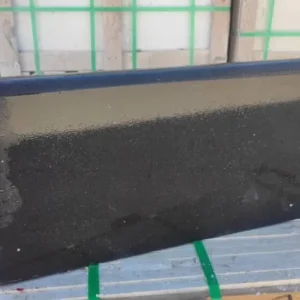
Black basalt is a fine-grained volcanic rock — the USGS overview of igneous rocks explains how rapid surface cooling keeps crystal size small, which is precisely why honed basalt presents such an even, dense face. That density means low absorption, which matters enormously next to a pool where water is constant. Black Basalt Paver Steps and pool-surround formats in basalt sit at a mid-to-upper price point within the natural stone range, reflecting both the machining intensity of a bush-hammered or brushed finish and the slab weight that affects shipping logistics.
Your specification for basalt around a pool should call out finish explicitly. For pool decks and wet areas, choose a bush-hammered finish — it leaves an open, textured surface that suits high-traffic wet zones. A brushed finish in a coarser grit works for covered terraces or transition areas that stay drier. Polished basalt belongs indoors on dry surfaces only and is not appropriate for pool surrounds. For basalt, the governing dimension stone standard is ASTM C615 — though basalt is classified as a volcanic rock rather than a granite, the dense, fine-grained character means it is frequently evaluated against comparable igneous stone benchmarks; specify your required test methods by standard designation when writing your project spec.
White Limestone: Cost and Performance
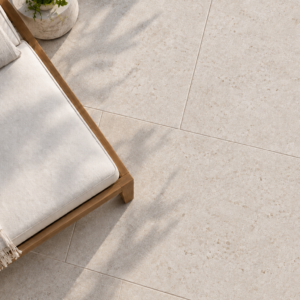
White limestone occupies the most popular price tier for pool surrounds in warm climates, and for understandable reasons — a light-toned surface reflects solar energy rather than absorbing it, which keeps the paving surface cooler underfoot on a bright afternoon than a dark stone in the same exposure would. White Limestone Patio Pavers are priced competitively within the natural stone range, though the governing standard is ASTM C568 (Limestone Dimension Stone), and the absorption characteristics of limestone mean sealing protocol is non-negotiable — an unsealed limestone pool surround will show water marks and biological growth faster than a sealed one. The Natural Stone Institute limestone overview covers the range of limestone grades and their suitability for outdoor applications.
Your sealing interval for white limestone near a pool should follow the sealer manufacturer’s stated schedule, not a generic rule of thumb — high UV exposure and constant splash accelerate the breakdown of penetrating sealers faster than you’d see on a covered interior floor. Budget for resealing as a recurring cost, not an optional extra. A laboratory certificate of test covering density, absorption, compressive and flexural strength, abrasion and modulus of rupture is available on request for white limestone.
Ocean Reef Shell Stone: Cost and Character
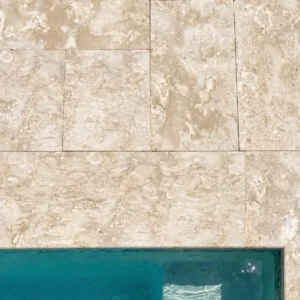
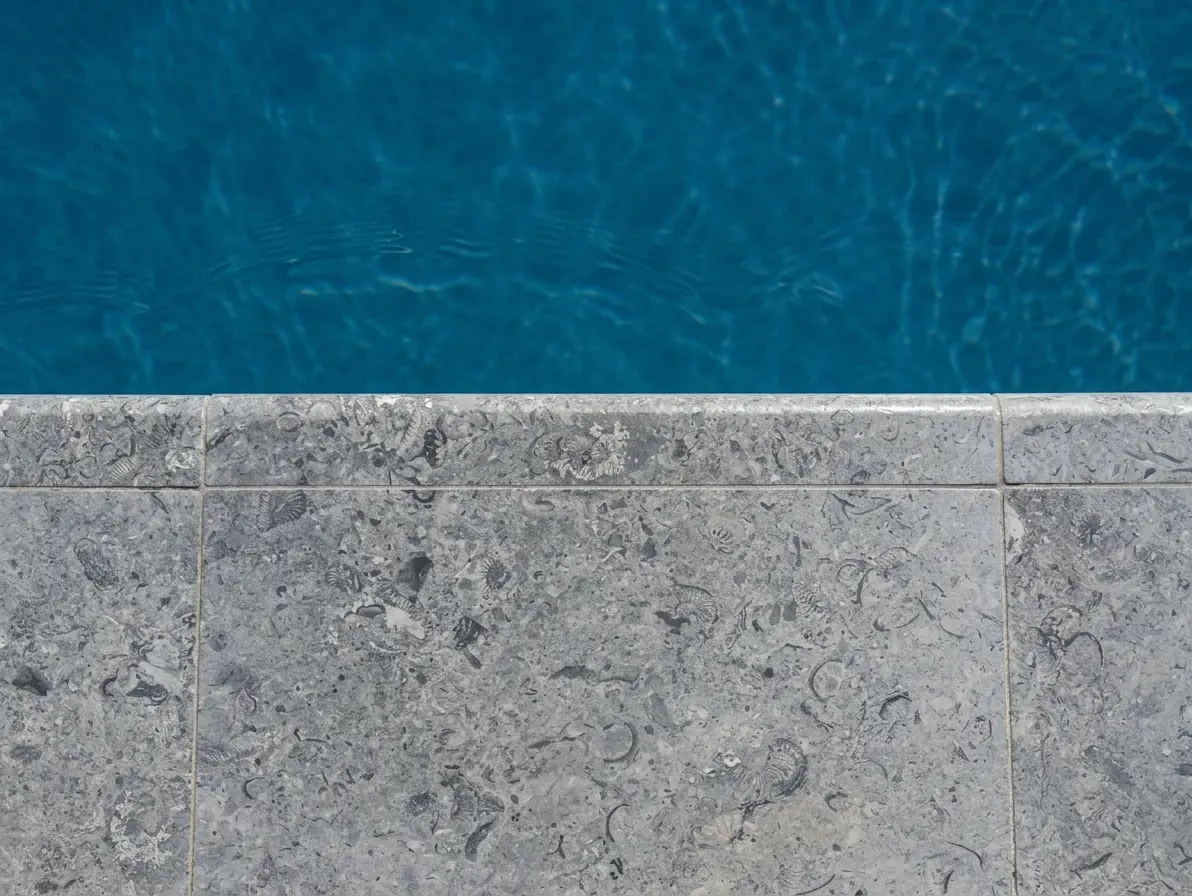
Ocean Reef Leathered Shell Stone Pavers occupy a distinctive niche — a fossilized shell limestone with a naturally open, textured surface that suits pool surrounds in coastal and tropical landscape settings. The leathered finish reinforces the organic texture of the shell matrix without requiring heavy machining, which keeps the finish cost lower than a bush-hammered basalt but still delivers an open matte surface appropriate for wet areas. Shell stone is priced at a premium over standard limestone in most markets, reflecting the selectivity of the quarrying process and the aesthetic uniqueness of each slab. A laboratory certificate of test covering density, absorption, compressive and flexural strength, abrasion and modulus of rupture is available on request for ocean reef shellstone.
The shell fossil structure in this material means you’ll see variation in texture and tone from piece to piece — that’s inherent to the material, not a defect. Specifying a wider acceptable range for color variation in your purchase order prevents disputes at delivery. For pool surrounds in tropical or coastal landscape designs, that natural variation integrates well with organic planting schemes and relaxed hardscape aesthetics.
How Finish Affects Your Cost Per Square Foot
The finish is where most buyers focus last and should focus first. It determines both the surface texture of the wet face and the machining cost built into the per-square-foot price. For pavers around pool, the finish selection is a specification decision, not an aesthetic preference — your pool deck is a wet surface every time the pool is in use.
- Bush-hammered: the standard recommendation for pool decks, wet steps, ramps, and public wet areas — the textured surface left by the bush-hammer tool creates an open matte face; this finish requires more machining time and carries a higher unit cost than sawn or honed
- Brushed 80 Grit: appropriate for barefoot pool decks and terraces where a softer texture underfoot is preferred — finer than the coarser brushed grits but still an open, matte surface; priced between honed and bush-hammered
- Brushed 36 Grit: suited to patios and pool surrounds that see moderate wet exposure — coarser texture, slightly lower machining cost than 80 grit
- Honed: appropriate for interior floors and covered patios where the surface stays dry; not recommended for direct pool deck use where standing water is regular
- Polished: for dry indoor surfaces only — countertops, vanity tops, interior floors, fireplace surrounds — never for pool surrounds or any wet exterior application
The ANSI A326.3 standard, measured wet, is the current slip performance framework for hard surface flooring in the USA, replacing the ASTM C1028 static test withdrawn in 2014. For pool surround specification, the finish is the variable that determines surface texture — no published slip figure is available for any stone in this article, and a specifier should evaluate finish samples on a wet surface before finalizing the selection.
Thickness Specification and What It Costs
Thickness is a structural decision driven by your base plan and the load conditions the paving will carry — pedestrian pool surrounds have different requirements than areas that will also serve as an access route for pool service equipment. Your project drawings should state the nominal thickness, and the stone is cut to order to meet that dimension. Thicker slabs carry a higher material cost per square foot because there is more stone in each piece and more waste generated during sawing.
- Standard paver thickness for pedestrian pool surrounds: 1¼ in (3 cm) mortar-set on a prepared base is the common specification for patios, pool decks, and pedestrian plazas
- Thicker formats: where structural loading or specific base conditions require additional section depth, slabs can be cut thicker — confirm the target thickness with your installer before ordering
- Coping and edge pieces: pool coping at the water’s edge is typically a different thickness and profile than the field pavers — specify these separately and confirm the nosing profile required by your pool shell design
- Steps and treads: Black Basalt Paver Steps are cut to the riser and tread depth the structural drawing specifies — step thickness is not interchangeable with field paver thickness
Citadel Stone cuts pool paving to order at our selected quarries, so the thickness you specify on your drawings is the thickness that ships. Confirm your base plan and nominal dimensions before the order is placed — changes after cutting generate waste and delay delivery.
Design and Landscape Integration: How Stone Choice Affects the Overall Scheme
The cost conversation for pavers around pool is inseparable from the design context — because the material that fits your landscape scheme is usually the one you’ll be least tempted to replace early. A pool surround that reads as an extension of its landscape rather than an afterthought tends to hold its value and your satisfaction with it over a longer horizon.
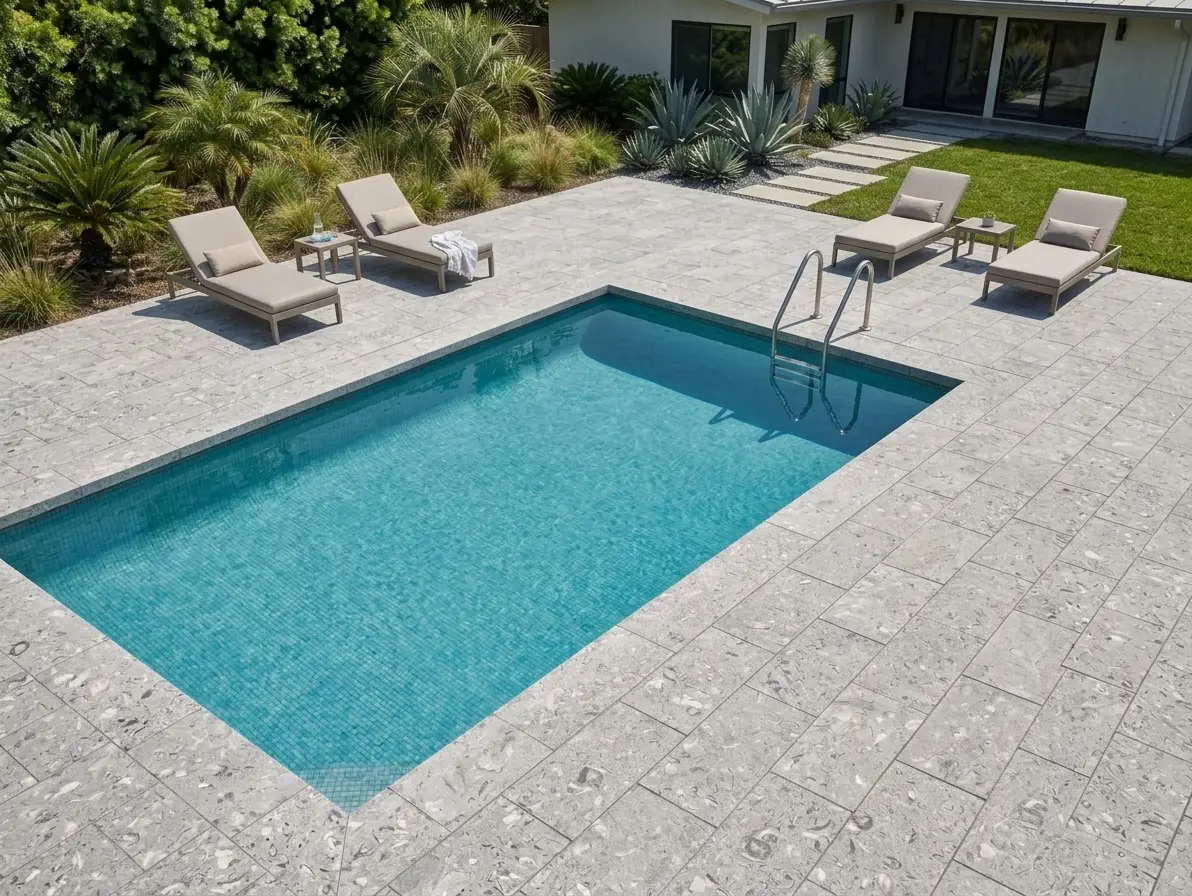
Desert and xeriscaping landscapes, where the planting palette runs to agave, ornamental grasses, and low-water shrubs, pair naturally with the dark, mineral character of black basalt. The clean, almost monolithic face of a honed or bush-hammered basalt reads as deliberate and architectural against an arid planting scheme — and the dark tone absorbs color from sky and water rather than competing with either. Tropical and lush planting designs tend to call for a warmer, more textured stone; Ocean Reef Leathered Shell Stone Pavers sit comfortably in that context, the shell fossil character echoing organic forms in the surrounding planting. Modern minimalist pool designs — clean geometry, restrained palette, strong horizontal planes — align well with white limestone in a large format, where the consistent light tone and fine texture let the pool and the landscape architecture do the visual work.
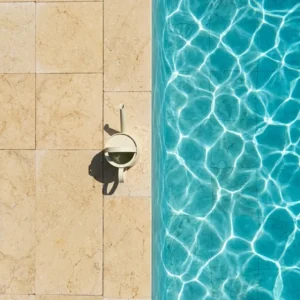
Traditional and colonial landscape styles often specify a stone with a warmer, more varied tone and a slightly rustic texture — tumbled limestone or a double-brushed finish that softens the grid of the joint pattern. For Pool Pavers, the design context shapes the finish and format selection as much as the performance requirement does. Bring a sample of your wall material, coping profile, and primary landscape element into the selection process — the pool surround reads as part of a composition, not in isolation.
Sealing and Ongoing Maintenance Costs
Your total cost of ownership for pavers around pool includes sealing, cleaning, and periodic joint maintenance — none of which appears in a material quote but all of which determine whether the installation holds up or degrades prematurely. Sealing penetrating sealers on limestone and shell stone is non-negotiable in a pool environment; the question is interval and product, not whether to seal.
- Penetrating sealers for limestone and shell stone: applied to a clean, dry surface after installation and reapplied at the interval your sealer manufacturer states — high UV and splash exposure shortens the effective life of most sealers compared to interior applications
- Basalt: lower absorption means the sealing interval can be longer, but the pool chemical environment still argues for sealing — confirm with your sealer manufacturer for chlorinated water exposure
- Joint maintenance: sand-set installations will require periodic joint replenishment after the first wet season as fines migrate; mortar-set joints in a pool environment should be inspected annually for cracking or softening
- Cleaning: algae and biofilm establish quickly on any horizontal surface near water — a pH-neutral cleaner appropriate for natural stone, applied on a regular schedule, keeps the surface clean without attacking the sealer or the stone
The PHTA pool deck and coping standards cover deck surface requirements in the context of pool construction — worth reviewing when you’re aligning your stone specification with your pool contractor’s scope and your local building authority’s requirements.
Ordering, Logistics, and Delivery Planning
Getting the material to site on time and in condition is a planning task that starts before the order, not after. Lead times are quoted with the order and vary by species, finish, and thickness — stone cut to a non-standard dimension takes longer than a standard format from stock. Plan your ordering timeline backward from your installation start date and add contingency for site access coordination.
- Measure net area and apply your waste factor before ordering — pool surrounds with curves, cutouts for equipment, and step-down transitions generate more offcuts than a rectangular patio
- Confirm site access at the time of ordering — the offloading arrangement and any crane or forklift requirement affects delivery scheduling and sometimes delivery cost
- Inspect the delivery against the agreed specification before the vehicle departs — thickness, finish, and color range should match the approved sample; disputes resolved at delivery are simpler than disputes resolved after installation
- Stage material carefully on site — keep slabs flat, fully supported, and protected from foot traffic before installation; edge chips on pool coping pieces are almost always a handling issue, not a manufacturing defect
At Citadel Stone, our technical team can advise on nominal thicknesses, finish options, and format sizes before your order is confirmed — it’s the kind of pre-order conversation that prevents specification errors that only surface at delivery.
Spec Wrap-Up: Getting Your Pool Paver Specification Right
Pavers around pool perform across a full range of demands simultaneously — constant wet exposure, UV load, bare-foot traffic, pool chemical contact, and the aesthetic weight of anchoring an outdoor living space. The cost figure that matters is the one that accounts for all five of those demands, not just the material price per square foot. Specify the finish for the wet condition, the thickness for your base plan, and the sealing protocol for your pool environment — then the material cost and the long-term maintenance cost become predictable numbers rather than surprises. As your project scope develops, planning adjacent hardscape elements alongside the pool surround often saves coordination cost later; stone quantity and budget planning is a useful reference as you work through the broader project numbers. Sourced from our selected Middle East quarries, these stone pavers around a pool are cut to the slab thickness your base plan calls for.
Related reading: best pavers for pool deck · gray pool pavers.