

Drainage geometry is the variable that governs basalt courtyard pavers more than any other — get the fall wrong and you trap water at the base, which accelerates joint failure and lifts flags long before the stone itself shows any sign of wear. Most courtyard projects spend careful attention on material selection and finish choice, then underinvest in the two hours of layout planning that determine whether the floor drains cleanly or puddles at the lowest wall. This article walks through the complete installation sequence: from sub-base compaction through level setting, drainage fall, and joint detailing, so your specification is tight before a single paver is placed.
Why Drainage Fall Governs Everything
An enclosed courtyard has no natural escape path for surface water — you have to engineer one deliberately. The standard target for basalt courtyard pavers is a fall toward a channel or linear drain, expressed as a percentage or as inches per foot. A 2% slope (about ¼ in per foot) moves water efficiently without making the floor feel noticeably tilted underfoot. Below that threshold, water lingers; above about 3%, barefoot use becomes uncomfortable and wheeled furniture rocks.
The fall direction matters as much as the percentage. In a square or rectangular courtyard, a single cross-fall toward one wall drain is the simplest geometry to set and check. A four-way crown toward a central drain works for larger spaces but introduces more setting-out complexity and requires tighter screed control at the apex. Whichever you choose, decide it before templating your stone — the layout grid and the cutting scheme both follow from the drainage plan, not the other way around.
Basalt is a fine-grained volcanic rock formed when lava cooled rapidly at the surface, which is why its crystal structure is so dense and its face so uniform — the USGS overview of igneous rocks explains how fast cooling keeps grain size small. That density is an asset in a courtyard: the stone itself sheds surface water well when the fall is correctly set.
Sub-Base and Bed Preparation
Your drainage fall begins at the sub-base, not at the screed. Setting the sub-base to the finished surface gradient — rather than flat and compensating in the bed — distributes the fall consistently and prevents thin-spot mortar pockets that crack under point loads. A compacted crushed-stone base of at least 4 in (100 mm) is the minimum for a pedestrian courtyard; where clay soils dominate or the site has poor natural drainage, increasing that to 6 in (150 mm) pays dividends over a long service life.
- Compact the sub-base in lifts of no more than 4 in (100 mm) — single thick lifts leave soft pockets you won’t see until the surface drops
- Set a datum peg at the high point of your intended fall and use a spirit level or laser to confirm grade across the full base before laying any screed
- Allow the compacted base to settle for at least 24 hours before screeding, particularly if the ground was recently disturbed or backfilled
- In freeze-thaw climates, extend the base depth further and consider a geotextile separation layer between native soil and aggregate to prevent migration over multiple seasons
Basalt courtyard pavers laid on a mortar bed benefit from a semi-dry mix set to the gradient — the consistency should hold a thumb-print without crumbling. Fully wet mortar on a sloped bed slumps before the stone is down, which makes holding the fall angle unreliable.
Paver Thickness and Format Selection
For pedestrian courtyards, basalt pavers in a 1¼ in (3 cm) thickness mortar-bonded to a prepared base handle standard residential foot traffic comfortably. Larger formats — 24 × 24 in (600 × 600 mm) or 24 × 12 in (600 × 300 mm) planks — make a courtyard feel expansive and reduce visible joint lines, but they demand a flatter, more precisely graded bed because any bow in the sub-base telegraphs through a rigid large-format stone. Smaller formats like 12 × 12 in (300 × 300 mm) are more forgiving on minor grade variation and make cutting around drains and columns straightforward.
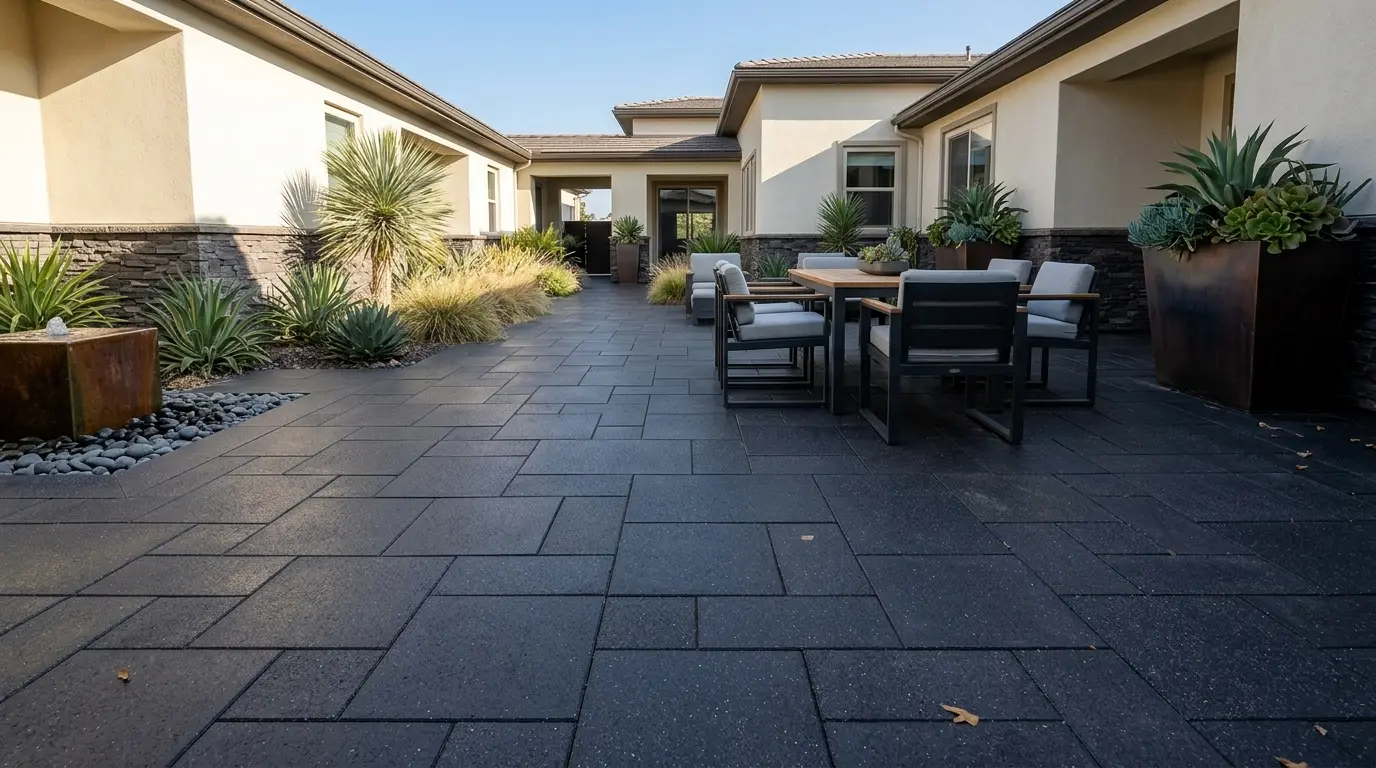
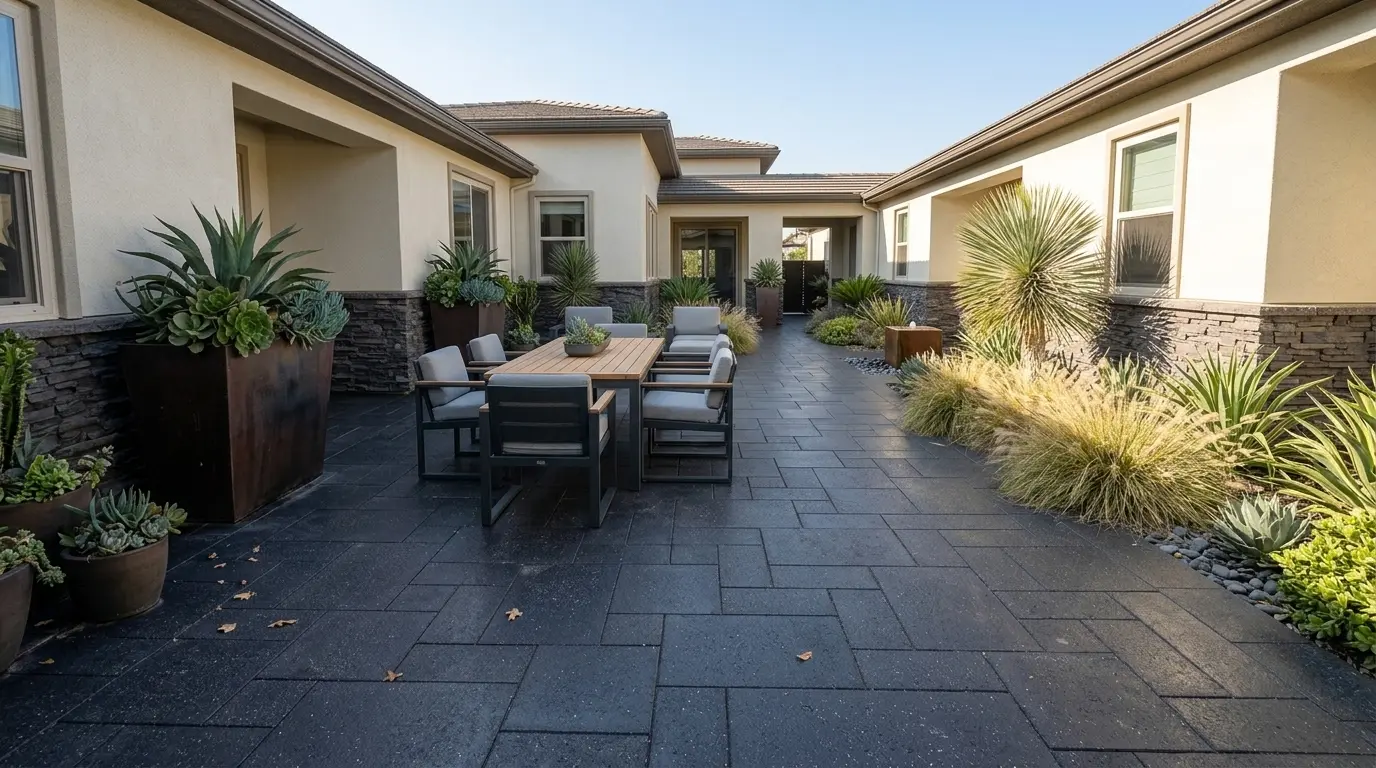
Basalt pavers in an enclosed courtyard read differently depending on format. A running bond with 12 × 24 in (300 × 600 mm) units creates a directional, linear feel that can guide the eye toward a focal point. A square grid with 24 × 24 in units reads quieter — calmer, more contained — which suits walled garden spaces where the stone floor is the feature rather than the path to one. The Britannica entry on basalt volcanic rock notes that the stone’s fine crystalline structure gives it an unusually even, matte face, which reinforces that contained, composed quality in courtyard applications.
Layout, Setting-Out and Joint Planning
Setting-out in an enclosed courtyard is trickier than an open patio because every edge is a fixed wall — there is no soft landscape boundary to absorb a cut. Start by dry-laying a test row along both axes from the centre out to the walls and calculate the cut widths at each edge before any mortar goes down. A cut narrower than half a unit width at the wall looks awkward, so adjust your grid origin until the cuts balance acceptably. Mark your working lines in chalk on the sub-base and snap a grid at the standard joint spacing you intend to hold.
- Use a story pole — a straight length of timber marked at paver width plus joint width — to step out your grid quickly and consistently
- Keep joints at a consistent width throughout; for basalt, 3/16 in to ¼ in (5–6 mm) works well with a sand-cement grout, and 3/8 in to ½ in (10–12 mm) for a resin-based joint compound that accommodates minor movement
- Plan drain positions on your layout grid so the drain falls within a joint or at the centre of a cut unit — a drain that splits an otherwise full unit always looks unresolved
- Factor in any fixed elements — inspection covers, column bases, outdoor lighting conduit — and adjust the grid so these land on joint lines rather than mid-unit
For basalt pavers in an enclosed courtyard with a courtyard drain set into the floor, confirm the drain body depth before laying so the grate finishes flush with the finished paver surface. A drain set even ⅛ in (3 mm) proud or shy of the surrounding stone catches feet and collects debris at the lip.
Finish Selection for Courtyard Use
Your finish choice controls the surface texture, and texture matters in a courtyard that sees year-round outdoor use. For a covered courtyard or a partially sheltered space that stays relatively dry, a Honed 60 Grit or Double-Brushed 60 finish gives a refined, smooth face that reads elegantly in an enclosed setting. For an open courtyard exposed to rain, consider a Brushed 36 Grit for patios and general outdoor areas, or a Brushed 80 Grit finish for barefoot terraces where texture underfoot is a priority.
For pool decks, wet steps and slopes, choose a bush-hammered finish. For other outdoor paths, bush-hammered or brushed in our coarsest grit both work; check a sample. The Natural Stone Institute’s overview of natural stone varieties provides a useful reference for understanding how surface finish interacts with stone type in outdoor environments.
A polished finish is reserved for dry indoor surfaces — walls, countertops, interior floors — and is not appropriate for an open courtyard floor regardless of stone type. Stick to brushed or bush-hammered finishes for any courtyard that receives direct rainfall.
Budgeting and Sourcing Considerations
The material-to-labor cost ratio for basalt courtyard pavers shifts noticeably depending on where you are in the country. In markets where natural stone is less routinely specified — parts of the interior Midwest, for example — labor rates for skilled stone setting can actually narrow the gap between premium and mid-range material choices, because the installation cost is the dominant variable either way. In coastal urban markets, labor is at a premium and the material cost difference between stone grades becomes proportionally smaller.
Freight distance from the point of fabrication to your project site is a real budget variable that is easy to underestimate at the early estimate stage. Basalt is dense and heavy — shipping cost per square foot is meaningful over long hauls — so get a delivered price, not an ex-works price, when you are comparing suppliers. Citadel Stone cuts basalt to order at our selected quarries and arranges delivery to the project site; lead times and delivered pricing are quoted with the order, so your budget number reflects actual landed cost rather than a figure that grows later.
Value engineering on courtyard projects often centres on format size rather than material grade. Dropping from a 24 × 24 in (600 × 600 mm) format to a 12 × 24 in (300 × 600 mm) format reduces the per-unit waste factor and can lower material cost without changing the stone specification — a useful lever when the budget is tight but the finish quality has to hold. Explore our charcoal basalt pavers for format and thickness options that suit courtyard specifications across a range of project budgets.
Sealing and Ongoing Maintenance
Basalt’s density makes it naturally low in absorption relative to limestone or sandstone, but sealing is still worthwhile in a courtyard where organic material — fallen leaves, algae, food — sits on the surface in a confined space. A penetrating impregnator sealer keeps contaminants from working into the pore structure and makes routine cleaning easier. Apply sealer to clean, fully cured stone — typically 28 days after mortar installation — and reapply on the interval your sealer manufacturer states. No sealer is permanent; the reapplication schedule is part of your maintenance plan, not an optional step.
- Clean basalt with a pH-neutral stone cleaner — acidic cleaners etch the surface and leave a haze that becomes obvious in low-angle light
- Pressure washing is effective for general cleaning but keep the lance moving; dwelling in one spot at high pressure can dislodge joint compound over time
- Re-point any joints that show hollowness or cracking before the next winter season — open joints allow water to migrate under the bed and accelerate freeze-thaw movement
- Check the drainage channel and drain grate annually and clear any sediment that has accumulated at the low point of the fall
Joint Filling and Movement Provision
The joint compound you choose affects both the finished appearance and the long-term performance of the floor. A sand-cement grout at ¼ in (6 mm) joints is the traditional approach — it is hard, bonds well to basalt, and reads as a tight, linear joint in the finished floor. The trade-off is rigidity: sand-cement grout does not accommodate thermal movement, so perimeter expansion joints at the wall abutments are essential. Without them, the restrained floor builds stress through summer heat cycles and the joints crack at the weakest point — usually somewhere in the middle of the run, where it is most visible.
Resin-based joint compounds flex slightly more than sand-cement and resist algae growth better in damp enclosed spaces, which makes them a practical choice for courtyard applications. They typically need a slightly wider joint — 3/8 in to ½ in (10–12 mm) — to cure properly. Specify the joint compound and the joint width together; the compound manufacturer’s data sheet states the minimum joint width for its product, and working below that minimum produces a weak, crumbly joint.
Perimeter expansion joints should be a minimum of 3/8 in (10 mm) wide at every wall abutment and at any fixed element — column base, drain frame, step riser — that the paving runs to. Fill these with a flexible polyurethane sealant, not grout, and tool it slightly recessed so it does not catch debris or become a trip point.
Before You Specify
A well-executed basalt courtyard floor comes down to three specification decisions made before a single unit is ordered: drainage geometry, format and joint layout, and finish selection for the exposure conditions. Get those three right and the installation sequence is straightforward. Get any one of them wrong and the field corrections are expensive — resetting a drainage fall after mortar has cured means lifting the entire floor. Your drainage plan, your layout grid, and your finish specification should all be locked before you template or order material.
Basalt is an exceptionally durable choice for the enclosed courtyard environment — its fine grain, consistent color, and dense face hold up well over decades of service in contained, high-use spaces. Citadel Stone’s technical team is available to advise on thickness, format, and finish for your specific project conditions; contact us early in the design stage so the specification can be built around accurate delivered-cost and lead-time information. As you finalise the broader stone package, structural considerations in basalt paving are worth reviewing in depth — understanding what causes basalt pavers to crack helps you build a specification that avoids the most common field failures from the start. The deep, even tone of Citadel Stone basalt gives an enclosed courtyard a calm, unified floor from wall to wall.
Related reading: basalt fire pit surround · basalt pavers over concrete · Basalt Stepping Stones: Choosing Size, Finish and Layout.