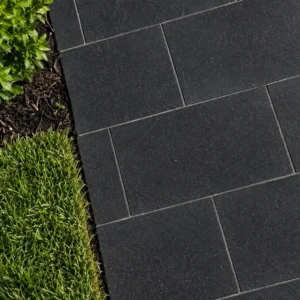
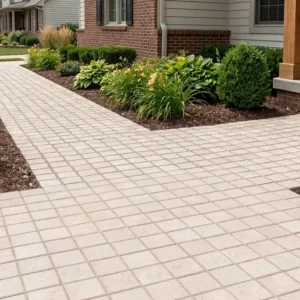
Granite paving for plazas demands a level of specification precision that separates installations lasting decades from those requiring costly early intervention. The variable most specifiers underestimate isn’t the stone itself — it’s the interaction between joint width, substrate movement, and the thermal expansion characteristics of large-format granite in full sun. Get those three elements aligned in your spec, and you’re building something that will outlast the surrounding infrastructure. Miss any one of them, and you’ll be watching joints open and edges lift within a few years of handover.
Why Granite Works in Civic and Commercial Paving
Granite is an intrusive igneous rock — it cooled slowly deep underground, which is why its interlocked crystal structure is so dense and uniform. The Natural Stone Institute granite application overview describes how that crystalline density translates into low absorption and high resistance to surface abrasion, both critical properties for pedestrian plazas with high foot-traffic volumes. For plaza designers and project engineers, that crystalline uniformity also means granite machines cleanly and holds precise dimensional tolerances across large orders — an important practical consideration when you’re specifying thousands of square feet of paving at consistent thickness.
Beyond the structural characteristics, granite carries an inherent longevity that civic projects require. You’re specifying a material that public institutions will maintain for generations, not for a single design cycle. That’s a fundamentally different brief than a residential courtyard, and granite paving for plazas answers it well: the surface endures heavy pedestrian loading, periodic cleaning equipment, and decades of seasonal cycling without the surface degradation that affects softer stones.
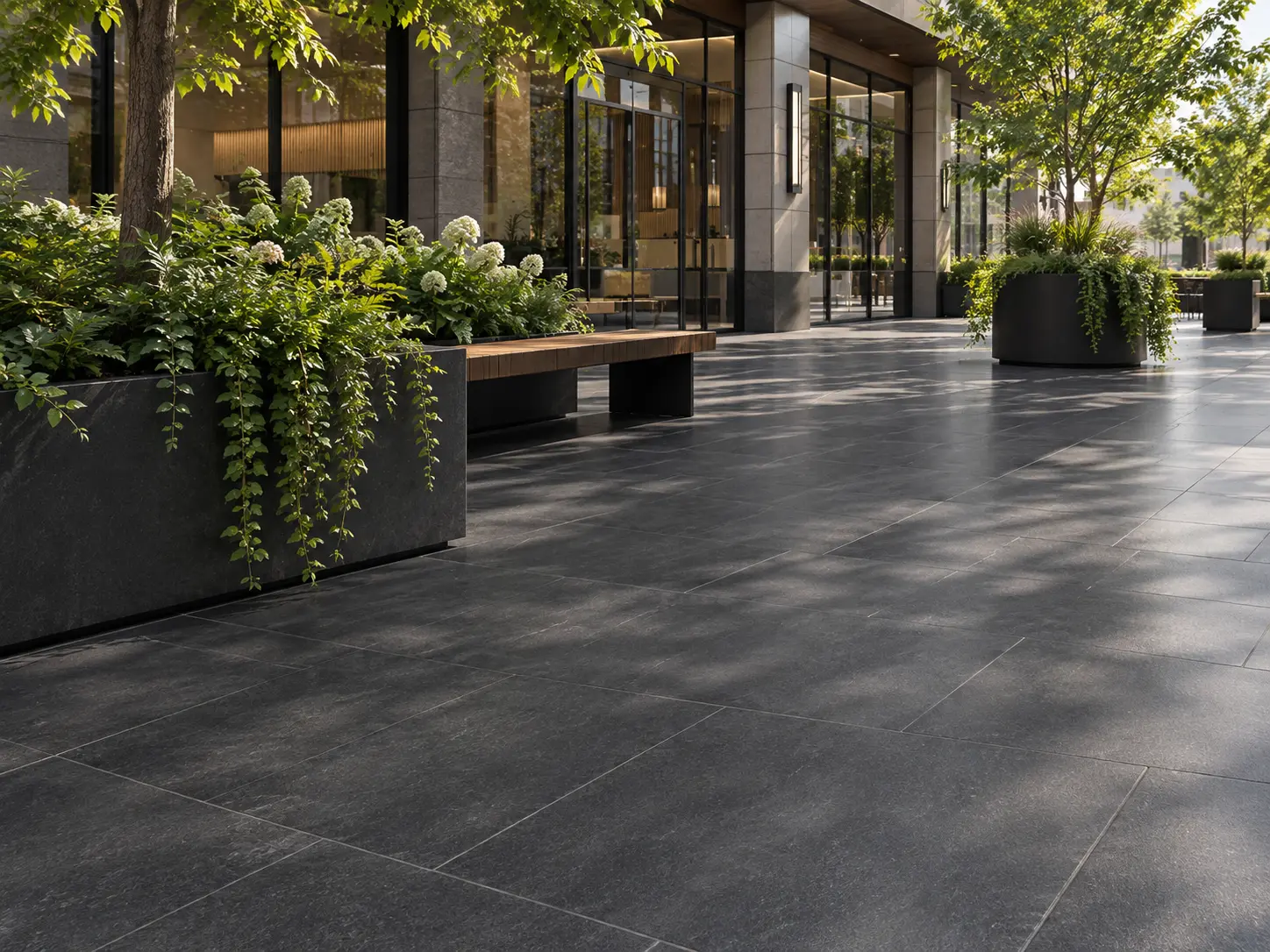
Format and Thickness: Getting the Numbers Right
The format decision for a civic plaza is not purely aesthetic. Larger slabs — say 24 × 24 in (600 × 600 mm) or 24 × 48 in (600 × 1200 mm) — create the clean, contemporary grid that plaza designers often specify, but they also increase the thermal mass per unit and amplify any differential movement between the stone and the mortar bed. Smaller units such as 12 × 24 in (300 × 600 mm) planks or sett-format pieces distribute movement stress across more joints, which is why historic plazas built from sett-format granite have outlasted many of their modern replacements.
- For pedestrian-only plazas on a reinforced concrete slab, 1¼ in (approximately 30 mm) nominal thickness is the standard pedestrian specification — confirm the point-load demand with your structural engineer before finalizing
- Plank formats in widths from 4 in to 12 in (100 mm to 300 mm) suit long, linear plaza grids and transition neatly to coping and step nosing details
- For areas where service vehicles or maintenance equipment will occasionally cross, increase thickness and confirm the base specification with a structural engineer — do not rely on the stone’s compressive strength alone as proof of suitability
- Request the ASTM C615 test report from your supplier to verify the granite meets the dimension stone standard for the application; the ASTM C615 granite specification sets the benchmark for granite dimension stone in construction
Thickness tolerance is a field issue that gets overlooked at the specification stage. If your granite paving for plazas arrives with a thickness tolerance tighter than your bedding mortar can absorb, installers compensate by varying the mortar bed — which introduces inconsistent bonding. Specify the tolerance explicitly and confirm it with your supplier before fabrication begins, not after delivery.
Finish Selection: Matching the Surface to the Setting
The finish you specify for granite paving in a plaza context isn’t just a design decision — it directly affects surface texture, maintenance demands, and the long-term appearance of the installation. A polished finish is appropriate only for dry interior surfaces such as atrium floors or interior lobby paving. For exterior plaza applications, the choice narrows to finishes that maintain their texture under sustained pedestrian use and periodic pressure washing.
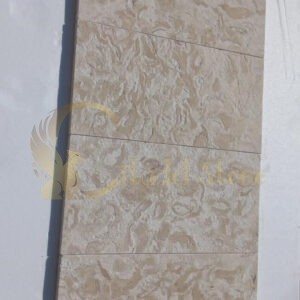
- Bush-hammered: produces a deeply textured, matte surface well suited to plazas, ramps, and any areas where moisture accumulates; the open texture is the result of mechanical percussive dressing
- Flamed: a thermally textured finish that opens the surface grain, creating a rough, consistent texture appropriate for high-traffic exterior areas
- Honed: a smooth, matte surface suitable for covered plazas, transitional interior-exterior zones, and cladding details — not for open exterior areas subject to standing water
- Brushed finishes in coarser grits (16 or 36 grit) suit outdoor paths and courtyards adjacent to the plaza; finer grits move toward the interior end of the range
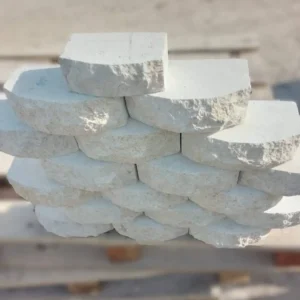
- Split face is appropriate for raised planters, retaining walls, and vertical feature elements within the plaza, not for the primary horizontal paving field
ANSI A326.3, the current wet-tested slip standard, governs how finish affects the surface under wet conditions. The standard is measured wet — the finish is the key variable. Consult your supplier regarding finish options; no slip rating is published here, but finish selection is the primary lever you control at specification stage.
Base Preparation and Substrate: The Detail Most Specs Miss
Here’s what often gets overlooked at the design stage: granite paving for plazas on an elevated deck or podium behaves differently from the same paving at grade. The substrate’s drainage geometry determines whether the stone stays flat or develops differential settlement — and in large civic plazas, even minor differential movement becomes visible because the long sight lines amplify any lippage.
Your substrate specification should address three things simultaneously: structural load capacity, drainage fall, and the accommodation of thermal expansion at the stone-to-substrate interface. For mortar-bonded plaza paving on a reinforced concrete slab, a minimum fall of ¼ in per foot (approximately 2%) toward drainage channels is the practical minimum; shallower falls lead to ponding, which accelerates staining and biological growth in the joints. The slab itself needs to be within a flatness tolerance that your bedding layer can genuinely correct — if the slab is out of plane by more than your mortar bed depth, you’re building unevenness into the finished surface from the start.
Joint Width, Grout, and Thermal Movement
Thermal movement is the specification variable that produces the most avoidable failures in large granite plaza installations. Granite expands and contracts with temperature — the rate depends on the specific stone, and you should request the thermal expansion coefficient from the supplier’s test report rather than applying a generic textbook figure. In a 100 ft (approximately 30 m) unbroken run of paving, even a modest expansion coefficient produces a meaningful cumulative movement that your joint system has to absorb.
- Movement joints must be located at regular intervals across the field and at all interfaces with fixed elements — columns, drainage channels, raised planters, and building perimeters
- Joint width and spacing should be calculated from the actual thermal expansion data for the granite you’re specifying, not from a standard rule of thumb that may not match your stone or your climate region
- Sanded epoxy grout or flexible polyurethane sealant in movement joints handles differential movement better than rigid cement grout, which cracks under thermal cycling and allows water infiltration at the joint base
- In freeze-thaw regions, water that infiltrates a failed movement joint expands at the stone edge — this is the mechanism behind the edge spalling and corner lifting that appears in northern plaza installations after a few winters
The joint specification discussion happens between the architect, the structural engineer, and the stone supplier — not after installation. Bringing it to the table early, with actual thermal data for the granite in question, is what distinguishes a specification that performs from one that’s corrected in the field.
Managing Color Variation Across a Large Plaza Order
Color consistency in granite is a genuinely complex topic that gets underestimated when project teams specify large quantities from multiple production runs. Granite is a natural material, and even within the same quarry, adjacent blocks can show meaningful variation in tone, veining density, and mineral distribution. For a civic plaza where hundreds or thousands of square feet need to read as a coherent surface, that variation matters.
The practical approach is to specify from a single production batch where the project size allows, and to request representative samples from the actual material in stock at the quarry before committing to fabrication. Large format pieces cut from slabs also tend to show more individual character than smaller sett formats, which average out visually when laid at density. Browse our quarried granite selection to understand the range of tones and formats available before you draft the finish and color clause of your specification.
In practice, the installation team’s lay pattern makes a significant difference to perceived consistency. A dry-lay trial across a representative area of the plaza — mixing material from different packs — allows the installer to balance variation before the bedding mortar goes down. It’s a detail that costs little in time and prevents the patchy appearance that comes from running a single pack in sequence.
Sealing and Long-Term Maintenance for Plaza Granite
Granite paving for plazas is specified partly because its maintenance demands are manageable at civic scale. The surface doesn’t require the aggressive sealing schedule that more porous stones demand, but sealing is still the right call for most exterior plaza applications — particularly where the paving adjoins food service areas, planting beds, or high-use gathering zones where organic staining is likely.
- Apply an impregnating sealer appropriate for exterior granite before the plaza opens; this protects the stone from oil-based and organic staining without altering the surface appearance
- Reapply on the interval your sealer manufacturer states — this varies by product and exposure level, so follow the manufacturer’s schedule rather than a generic annual rule
- Efflorescence can appear in the first months after installation as soluble salts migrate through the mortar bed; this is a substrate chemistry issue, not a defect in the granite, and it resolves with normal weathering and proper drainage
- Pressure washing at low to moderate pressure suits routine cleaning; avoid high-pressure lances directed at joint lines, which can erode grout and disturb the bedding at the joint edges
- Record the sealer product, application date, and interval in the project’s maintenance manual — this information is essential for the facilities team who inherit the plaza years after the design and construction team has moved on
Cost Factors and Sourcing Decisions for Plaza-Scale Projects
Budget planning for granite paving at plaza scale requires you to disaggregate the cost components clearly: material unit cost, fabrication, shipping, and installation labor. The ratio between material and labor shifts significantly depending on where your project is located and where the stone originates. Freight distance is a real variable — stone moving from quarry to project site accumulates freight cost that can meaningfully affect the total delivered price per square foot. For very large orders, the efficiency of a direct-quarry supply chain reduces per-unit cost compared to buying from an intermediary stock point.
Labor market conditions in your region affect the total project budget independently of the material cost. In markets where skilled stone installation labor is in short supply, specifying a format that requires precise cutting and tight tolerance bedding can push installation cost up significantly. Sett and plank formats cut to consistent dimensions reduce on-site cutting waste and speed the installation, which is a genuine value engineering consideration worth raising with your contractor at the estimating stage.
The USGS dimension stone production data tracks granite as a significant component of the US construction stone supply, which reflects the enduring market for this material in commercial and civic applications. At Citadel Stone, we quarry and cut granite to order from our selected quarries, which means your project specification drives the dimensions and finish — not an existing stock profile. Lead times and delivery logistics are confirmed at the time of order, so your project schedule should include those lead times in the procurement plan rather than assuming availability on short notice.
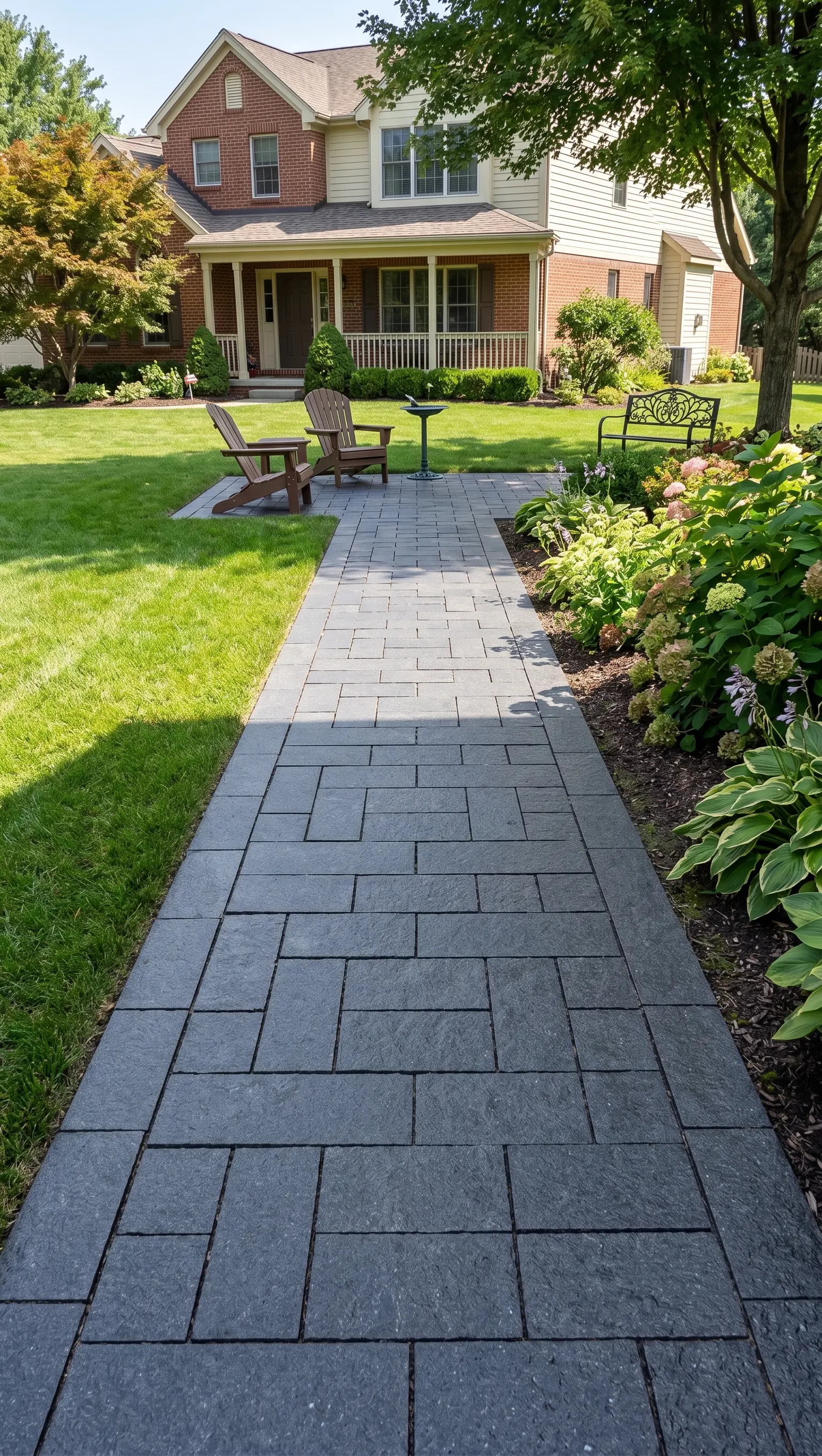
Delivery and Site Logistics for Large Granite Orders
Plaza-scale granite orders arrive on pallets, typically with stone bundled by format and finish. Your site access constraints determine how much pre-planning the delivery coordination requires — a city-center plaza with restricted access windows and no laydown area is a fundamentally different logistics challenge from a suburban civic center with an open staging zone. Offloading arrangements should be confirmed before the delivery date, with the crane or forklift capacity matched to the pallet weights your order produces.
Your project’s access constraints may affect delivery scheduling in ways that feed back into the project program. If deliveries can only arrive during overnight windows or on specific days, that affects the sequence in which the installation team can access material. Getting those constraints into the logistics conversation early — ideally before fabrication begins — prevents the situation where stone arrives and sits on the street because the site isn’t ready to receive it.
Stone arrival inspection is not optional on large plaza orders. Check dimensional conformance and finish consistency on a representative sample from each pallet before the pallets are broken and the installation team starts laying. Flagging a dimensional anomaly before bedding mortar goes down is a straightforward correction; flagging it after a section is installed requires costly rework that no project budget absorbs comfortably.
What Matters Most in Granite Paving for Plazas
Granite paving for plazas rewards the specifications that treat joint design, substrate geometry, and thermal movement as primary engineering inputs rather than afterthoughts. The material itself is exceptionally durable and will deliver decades of service life in civic use — but only if the system surrounding it is specified with the same rigor as the stone selection. Your most important decisions happen before fabrication: format, thickness, finish, movement joint spacing, and base specification. Those choices, documented clearly in the project spec, are what the installation team and the facilities team will work from for the life of the plaza.
For projects that extend beyond the primary paving field into linear features, pathways, or transitional zones, format selection becomes an interesting adjacent question. granite plank sizing and layout options explores how plank-format granite integrates with broader hardscape designs — a useful reference as you develop the full material palette for your project. Granite paving from Citadel Stone gives civic and commercial spaces a natural stone surface, with each order cut to the project’s specification.
Related reading: granite paver thickness · granite stepping stone path · granite vs porcelain pavers.