Specifying granite types for outdoor paving comes down to understanding how the stone’s mineralogy, texture, and formation depth translate into field performance — and the differences between types are more consequential than most project specs acknowledge. Granite rock types vary widely in crystal size, quartz content, and void structure, and those variables determine how a paved surface holds up under real loading conditions, not just how it photographs in a brochure. The type you choose shapes joint behavior, thermal movement tolerance, and long-term surface integrity in ways that generic grade descriptions simply don’t capture.
Related guide: What Type of Rock Is Granite? Geology Explained.
What Actually Makes Granite Granite
Granite is an intrusive igneous rock — it formed deep underground as magma cooled slowly over millions of years, which is precisely why its crystals are visible to the naked eye. That slow cooling process produced a dense, interlocking mineral matrix of quartz, feldspar, and mica that gives the stone its characteristic toughness. The Natural Stone Institute granite durability and application specifications outlines the compositional range you’ll encounter across commercial granite varieties.
What matters to a specifier is that granite’s interlocking crystal structure means it absorbs very little water through its surface — though the degree varies with the specific type and finish. You’ll see this play out in freeze-thaw regions: types with lower absorption rates cycle through winter with minimal surface spalling, while varieties with higher mineral porosity benefit from penetrating sealer applications on a schedule your sealer manufacturer specifies. The geological origin sets the baseline; your finish and maintenance protocol determine how well that baseline performs over decades.
The ASTM C615 standard governs granite as a dimension stone, setting the quality parameters suppliers and fabricators work to — request the test report from your supplier rather than relying on descriptive grade claims alone.
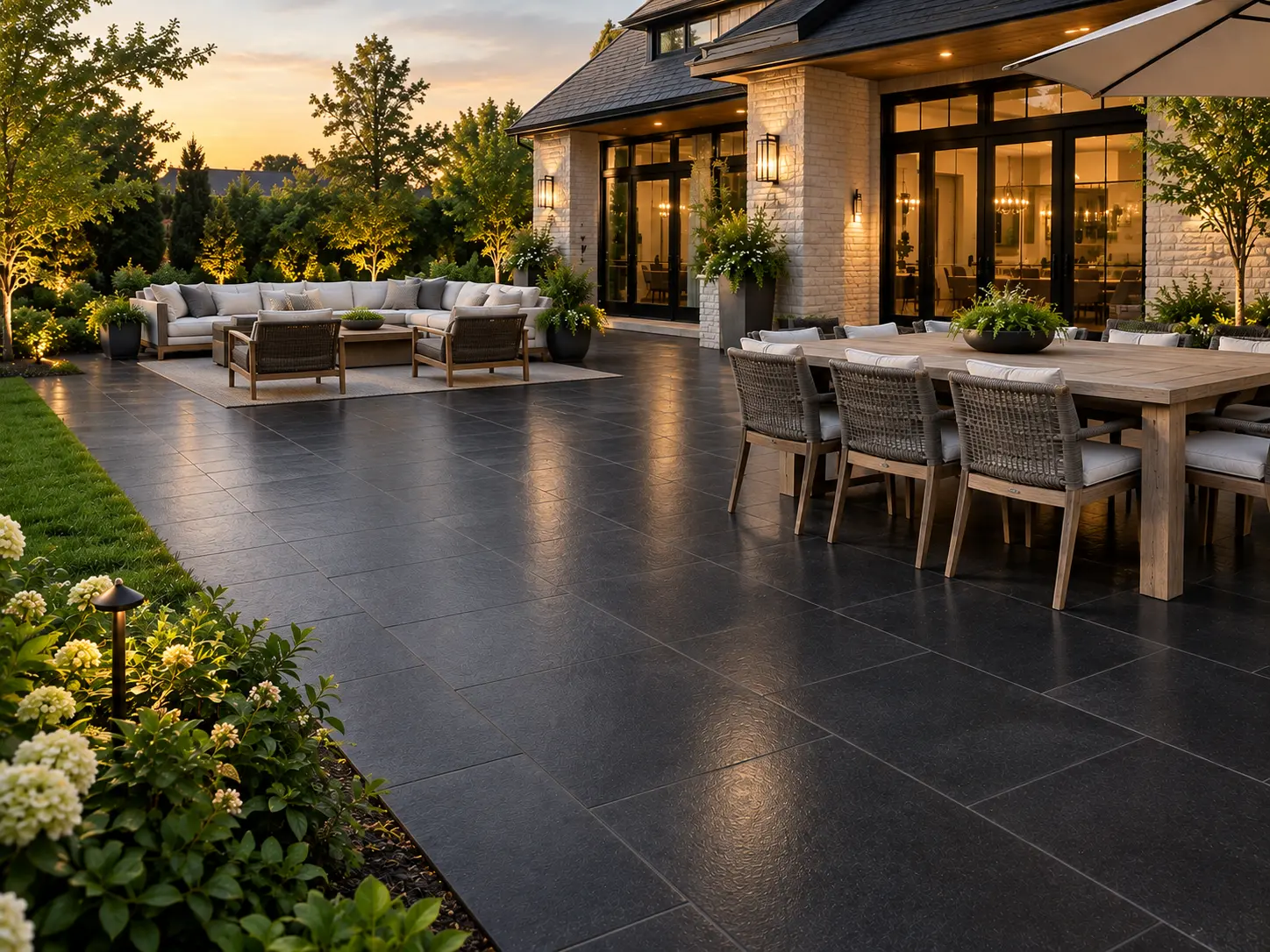
The Main Granite Types You’ll Encounter for Paving
Not every stone labeled granite in a yard is true granite in the geological sense — the trade uses the term broadly to cover granodiorite, gneiss, and similar coarse-crystalline rocks. For paving purposes, that broader category is what matters, because the performance characteristics are close enough to specify similarly. Here are the principal granite types relevant to outdoor projects:
- True granite — high quartz and feldspar content, very dense crystal matrix, excellent for high-traffic paving and structural applications
- Granodiorite — slightly lower quartz ratio, often with more plagioclase feldspar, still highly durable and widely used in setts and cobbles
- Gneiss — a metamorphic rock with a banded appearance sometimes sold as granite; its foliation planes require attention during installation so water doesn’t track along them
- Rapakivi granite — distinctive ovoid feldspar phenocrysts, used more for visual effect in feature paving than in heavy-load applications
- Pegmatite granite — very coarse crystals, often used in landscape feature elements rather than field paving because the large crystal boundaries can widen under cyclic loading
Your specification should name the type and request the relevant ASTM C615 test report. Accepting a broad “granite” label without type confirmation is where mismatches between expected and actual performance typically originate.
How Color Reflects Mineral Composition
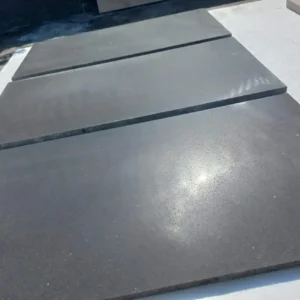
The color of a granite type is a reliable indicator of its feldspar and mica content, which in turn relates to how the stone weathers. Pink and red granites get their color from potassium feldspar — a durable mineral that resists weathering well in most climates. Gray granites are typically rich in plagioclase feldspar and quartz, producing a more uniform surface tone that ages evenly under UV exposure. Black granites — which are almost always gabbro or diorite rather than true granite — contain high percentages of pyroxene and amphibole minerals, giving them their dark color and characteristically fine, dense surface.
The mica content is worth watching. Biotite mica (the dark flake you see in many gray granites) can oxidize to a rusty surface stain when exposed to consistent moisture over years. It’s not a structural concern, but on light-colored slab paving it produces an effect that surprises homeowners who weren’t briefed on it. Muscovite mica (silver-white flakes) is more stable under weather exposure and less prone to surface staining.
When you’re selecting a granite type by color, you’re also making a mineral selection — and that mineral selection has maintenance implications that belong in the project handover notes.
Finishes by Granite Type: Matching Texture to Application
The finish transforms the raw stone surface and largely determines how the paving performs in its specific location. Different granite types respond differently to the same finishing process, so the finish recommendation is always type-specific:
- Polished finish: appropriate only for dry indoor surfaces — interior floors, countertops, vanity tops, fireplace surrounds, and wall cladding. The crystalline surface of true granite takes a high polish that is visually striking and easy to maintain indoors, but unsuitable for any wet or exterior application
- Honed 60 Grit or Honed 120 Grit: works well on interior floors, covered patio applications, and wall cladding, where you want a matte surface without the coarser texture of brushed finishes
- Brushed 36 Grit: suited to patios, pool surrounds, and indoor-outdoor transitional areas; the open matte texture this process leaves makes it appropriate where the polished surface would be unsuitable
- Brushed 80 Grit: for barefoot pool decks, terraces, and interior floors where a smoother brushed surface is preferred over the coarser grits
- Bush-Hammered: the preferred finish for pool decks, ramps, wet areas, and public paving — the mechanical process leaves an open, dimpled texture across the surface
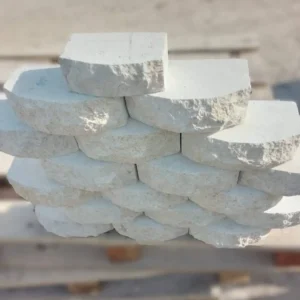
- Split Face: used in feature walls, exterior cladding, cobble setts, and retaining walls; the natural cleft surface reads very differently from a cut face
For pool decks, wet steps, and slopes, choose a bush-hammered finish. For other outdoor paths, bush-hammered or brushed in our coarsest grit both work; check a sample. Confirming the finish with an actual sample from your supplier before committing to a full order is standard practice — finish tone and texture both vary between production runs on the same granite type.
Thickness and Format by Application
The format — slab, tile, sett, cobble, or paver — and its thickness should follow the application’s loading and base conditions. For granite types in paving, these are the formats you’ll be specifying:
- Tiles and pavers for pedestrian areas, patios, pool decks, and paths: 1¼ in (3 cm) thickness is the standard for pedestrian-grade paving mortar-bonded to a concrete base
- Setts and cobbles for driveways and vehicle areas: for driveways, use setts or cobbles at least 3.5 in (4 in standard) thick on a compacted base, or pavers 2 in (5 cm) or thicker mortar-bonded to a reinforced concrete slab
- Cladding panels: thickness varies by panel size and substrate; consult your structural engineer for anchored systems on tall facades
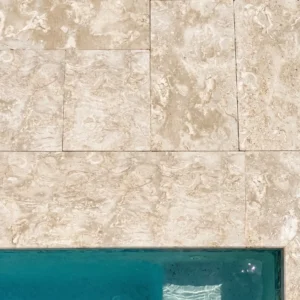
- Pool coping: cut to size from slab with a bullnose or similar edge profile; the edge treatment is as important as the field thickness
You’ll find our granite paving available in multiple thickness options cut to order from stock held at our selected quarries, so you can specify the format your project drawings call for rather than adapting to what’s available off a shelf.
How Granite Types Hold Up in Wind, Storm, and Severe Weather
Mechanical stress from storm events is an underexamined factor in outdoor granite paving specs, and it’s where granite type choice genuinely matters. During high-wind events, the primary failure modes in paved surfaces aren’t the tiles themselves — it’s edge restraint loss, joint washout from wind-driven rain, and surface debris impact. Granite’s crystalline density gives individual units high resistance to impact, but that advantage is lost if the installation substrate or edge detail fails under the mechanical loading a major storm delivers.
Wind-driven rain forces water horizontally into joints at pressure levels that gravity-draining joints aren’t designed to handle. In coarse-jointed granite cobble or sett installations, this is managed by the joint geometry itself — the depth of the joint and the compaction of the filling material. In tight-jointed mortar-bed installations, joint integrity depends on the bond between mortar and the granite unit’s cut face. Finer-grained granite types present a more uniform cut face with consistent absorption, which typically bonds more predictably to cement-based mortars than coarser or more variable types.
Hail impact is worth considering for exposed horizontal surfaces in hail-prone regions. The crystalline hardness of true granite makes surface pitting from hail an unlikely concern under normal hail events, but large-format thin tiles (particularly in the 24 × 24 in (600 × 600 mm) range at 1¼ in (3 cm) thickness) are more vulnerable to fracture from point impact on a poorly compacted base than thicker formats. Full mortar bed support eliminates most of that risk by removing the void under the tile where impact energy would otherwise concentrate.
Reading Granite Grades and Evaluating Sourcing
The granite trade uses grade terms — first choice, standard, commercial, rustic — inconsistently. What counts as first choice from one quarry region may carry more natural fissures and color variation than a commercial grade from another. The only reliable approach is to request samples, specify the visual range you’ll accept, and confirm that the test report for the relevant ASTM standard accompanies the order documentation.
The ASTM C615 granite dimension stone standard sets the reference framework for granite quality in construction; your supplier should be able to reference compliance with it for the specific granite type you’re ordering. The USGS dimension stone production and use data provides useful context on the range of granite types in active commercial production and how they distribute by application — it’s background that helps when you’re evaluating a supplier’s claimed type against what the market actually produces.
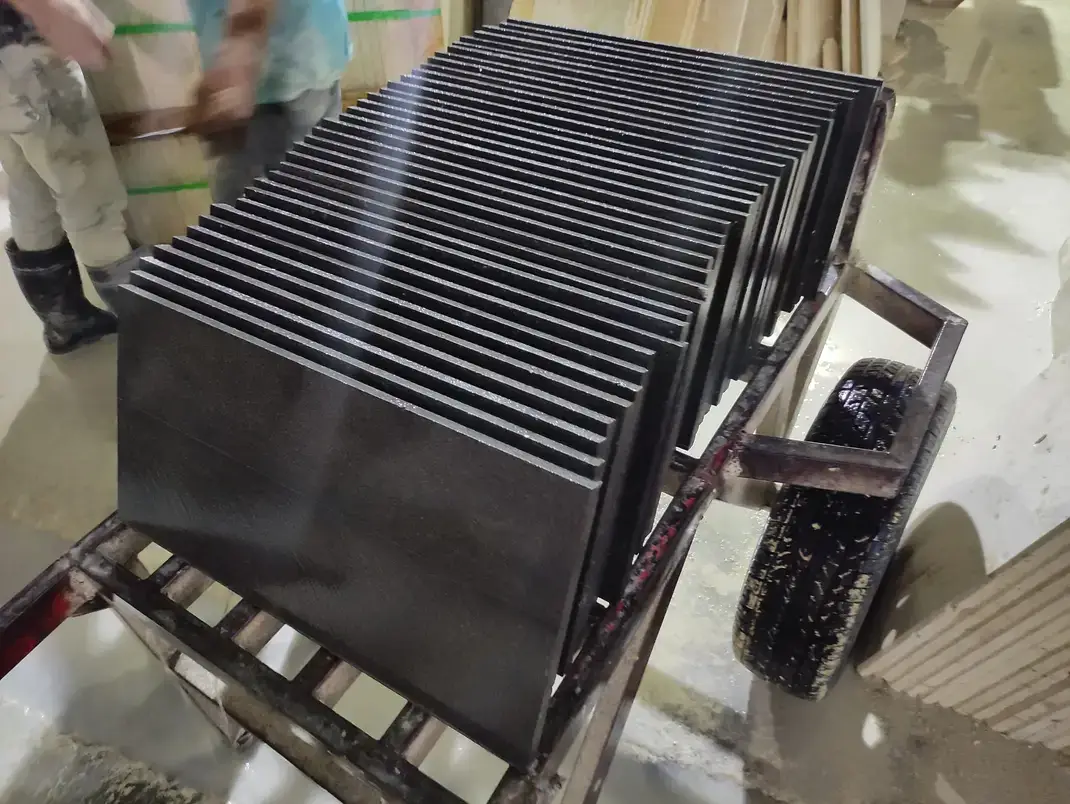
Citadel Stone cuts granite to order at our selected quarries in the Middle East, which means the material you order is cut to your specified dimensions from quarry stock — not a standard-format tile recut in a separate operation. That distinction matters for large-format or non-standard thickness orders where material waste and dimensional tolerance are tightly managed from the block face outward.
Base Preparation and Jointing for Granite Paving
The base is where outdoor paving installations succeed or fail long-term, and granite types don’t compensate for a poorly constructed substrate. The sequence matters more than any individual step:
- Subgrade compaction to the geotechnical specification for your soil type — clay-bearing soils require particular attention because seasonal moisture change causes vertical movement that rigid-bedded granite registers as joint cracking
- Crushed-stone base at the depth your loading condition and soil bearing capacity require — this is a structural calculation, not a rule of thumb
- Mortar bed or sand bed appropriate to the format: full mortar bed for tiles and pavers in pedestrian areas, compacted sand or grit bed for setts and cobbles
- Joint filling material compatible with the movement expected — in freeze-thaw climates, rigid mortar joints in cobble or sett areas often crack and require periodic repointing, while compacted kiln-dried sand in wider joints can be refilled after the first wet season settlement
- Edge restraints set before the field paving, not after — trying to retrofit edge containment into an existing installation is one of the most common and most avoidable field problems
Your project’s site access for delivery should be confirmed early. Offloading arrangements for granite paving — particularly for large slab formats where a crane-lift or telehandler is required — need to be confirmed well before the delivery date, and lead times are quoted with the order so the logistics sequence can be planned accurately.
Sealing, Maintenance, and Service Life
Granite types vary in their absorption rate, and that figure — available on request as a test report — determines whether a penetrating sealer is genuinely necessary or simply precautionary. Dense, low-absorption types in dry climates may perform for years without sealing; the same type in a high-rainfall climate with organic material (leaves, pollen, algae) on the surface benefits from sealer applied on the interval your sealer manufacturer states.
Here’s what often gets left out of the care guidance: sealing doesn’t eliminate maintenance, it extends the interval between more intensive cleaning. A sealed granite surface still accumulates surface grime that requires periodic cleaning, and the sealer itself needs to be reapplied when it no longer beads water effectively. Choosing a breathable penetrating sealer rather than a surface-coating sealer is the standard recommendation for exterior granite paving — it allows vapor movement through the stone rather than trapping moisture that can cause surface spalling in freeze-thaw conditions.
You can expect decades of service from a well-specified and properly installed granite paving installation where drainage functions correctly and maintenance follows the sealer manufacturer’s stated interval. The granite type you started with determines the baseline durability; the base, joint, and maintenance decisions determine whether that baseline is realized in practice.
Your Granite Types Specification Plan
Narrowing down granite types for your outdoor paving project is a sequence of decisions, not a single choice. Start with the application — pedestrian patio, pool deck, feature wall cladding, pathway — because that determines the format, thickness, and finish range before color or type even enters the conversation. Then select the granite type by requesting samples alongside the test report, and confirm that the grade range in the sample represents what you’ll actually receive, not the best-case piece from the quarry face.
Finish selection follows application: polished only for dry indoor surfaces, bush-hammered for pool decks and wet areas, brushed in the appropriate grit for patios and outdoor pedestrian use. Joint design and base specification should come from your structural and civil inputs, not from a finish manufacturer’s generic guide. Plan your delivery logistics — site access and offloading method — before the order is placed, because large granite orders on mortar-bed projects require coordinated site preparation that can’t be improvised on delivery day.
For projects that combine granite field paving with crushed stone infill or border detailing, using crushed granite alongside pavers covers how these two formats work together in a single hardscape layout. Stone for nationwide projects comes from our selected quarries in the Middle East, chosen for density that resists freeze-thaw cracking.
Related reading: granite stepping stone path · Granite vs Porcelain Pavers: Which Suits Your Patio? · square pavers.