Granite paver thickness is the specification decision that separates installations lasting decades from those needing remediation within a few years — and the variable most buyers underestimate is not the load, but the interaction between load, subbase stiffness, and the cumulative movement that temperature cycling imposes on every joint. Thickness alone does not define structural adequacy; the right granite paver thickness for your application is the one calibrated to the combination of point load, span between supports, and the base preparation beneath it. Get that combination wrong and even a well-quarried stone will crack at the edges or tip under traffic.
Why Thickness Matters More Than Stone Strength
Your first instinct when specifying granite pavers might be to ask how strong the stone is. That is a reasonable question, but it points to the wrong variable. Flexural strength — the property that governs whether a paver cracks under a spanning load — is governed by thickness more powerfully than by material grade. A paver supported only at its edges acts as a beam, and beam moment capacity rises with the square of the section depth. Doubling thickness quadruples the bending resistance. That relationship is why thickness selection is the most consequential decision on your specification sheet.
Compressive strength matters for the stone’s long-term wear face, and you can request the ASTM C615 test report from your supplier to confirm the material meets the grade your project requires. The Natural Stone Institute granite specifications overview describes why granite’s interlocking crystal structure makes it well-suited to demanding outdoor paving — but neither the overview nor the test report substitutes for the thickness calculation your application requires.
- Flexural bending capacity scales with the square of thickness — a thicker paver is disproportionately stronger than a thinner one
- Compressive wear resistance matters at the surface; request ASTM C615 test data from your supplier
- Point loads — chair legs, heels, concentrated foot traffic — create local bending that thickness absorbs
- Edge-unsupported spans amplify bending stress and are where under-specified pavers fail first
Standard Granite Paver Thickness Ranges by Application
Granite paver thickness options follow a practical hierarchy that aligns with application load class. Understanding where your project sits in that hierarchy is the starting point for every specification.
- ¾ in to 1¼ in (about 20–30 mm): wall cladding, interior feature floors on continuous substrate, decorative indoor applications where the slab is fully supported
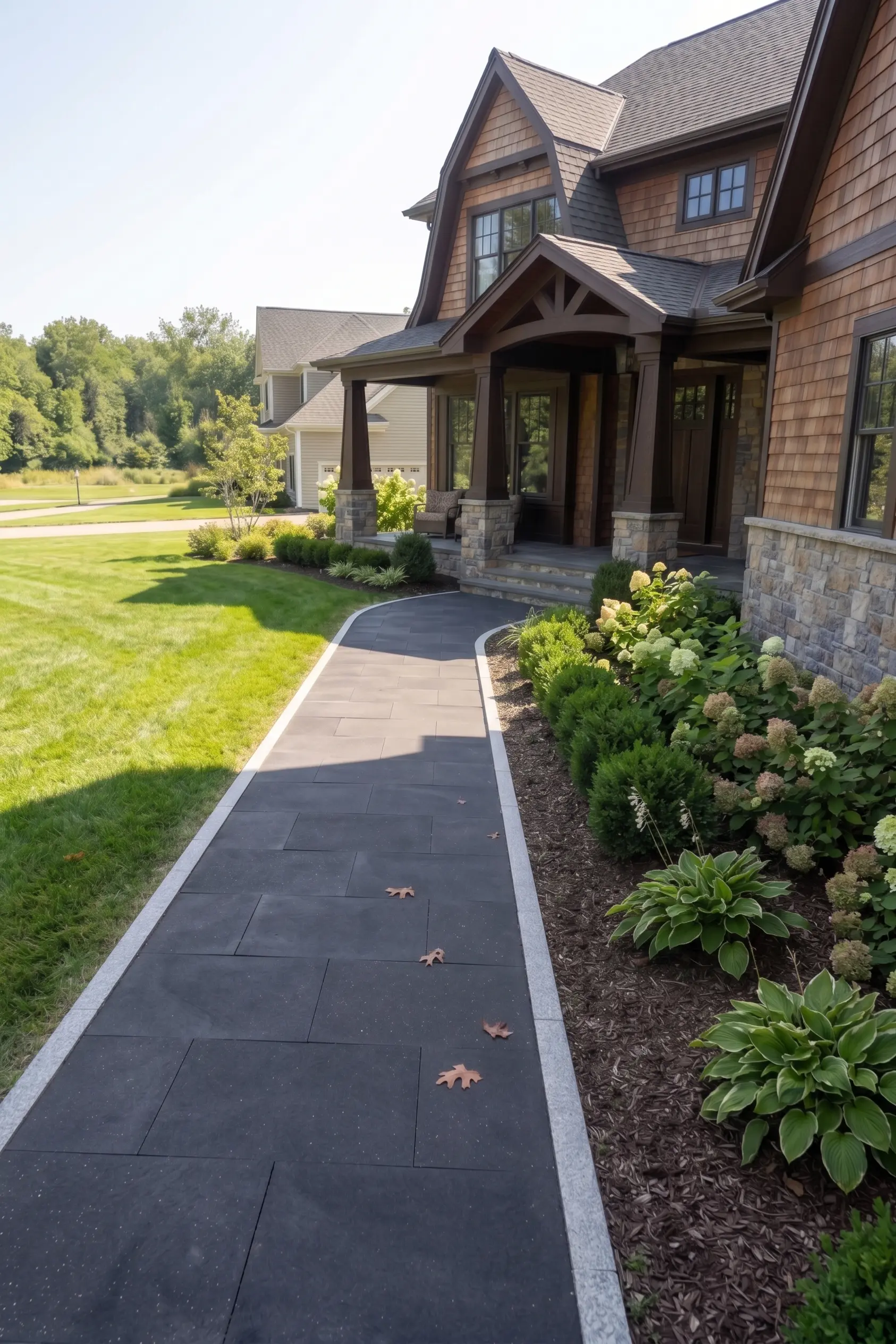
- 1¼ in (about 30 mm): residential patios, garden paths, pool surrounds, and pedestrian-only terraces on a prepared compacted base or mortar bed
- 1½ in to 2 in (about 38–50 mm): commercial pedestrian plazas, rooftop terraces on pedestals, high-footfall public spaces, and pool deck coping
- 2 in (50 mm) or thicker mortar-bonded to a reinforced concrete slab: pavers intended for light vehicle or wheeled equipment access, service paths, and similar demanding uses
- 3.5 in to 4 in (standard) on a compacted crushed-stone base: setts and cobbles for driveway use — for driveways, use setts or cobbles at least 3.5 in (4 in standard) thick on a compacted base, or pavers 2 in (5 cm) or thicker mortar-bonded to a reinforced concrete slab
The ASTM C615 granite dimension stone standard is the benchmark specification for granite in construction; your supplier’s test report against that standard gives you the data for your structural engineer to verify thickness selections against actual load conditions.
Base Preparation and Its Relationship to Thickness
Your paver thickness specification and your base specification are inseparable — each governs the performance of the other. A 1¼ in paver on a poorly compacted base behaves structurally like a much thinner one, because differential settlement creates unsupported spans that were never in the original design. The base absorbs the load and distributes it; the paver bridges local irregularities. Remove base stiffness and you have transferred the entire load to the stone’s bending capacity, which is what fails first.
For residential pedestrian applications, a compacted crushed-stone base of at least 4 in (100 mm) beneath a well-graded bedding layer is the standard starting point in most soil conditions. Clay-heavy soils may require deeper excavation and geotextile separation to prevent subgrade migration into the base over time. The USGS dimension stone production data shows granite consistently accounting for a significant share of US dimension stone output — reflecting the material’s breadth of application and the equally broad range of base conditions it is installed over.
- Compacted crushed-stone base at minimum 4 in (100 mm) depth for residential pedestrian paving
- Mortar bed over a reinforced concrete slab for rooftop, elevated, or vehicle-area applications
- Geotextile separation layer between subgrade and base in clay or expansive soils
- Sand bedding layer screeded to 1 in (25 mm) nominal for set-on-base granite paver thickness options
- Concrete slab minimum 4 in (100 mm) with appropriate reinforcing for any paver in vehicle service
Freeze-Thaw Cycling and Joint Design
Temperature cycling imposes cumulative movement on every granite paving installation — and the damage is rarely from a single freeze event. What wears out an installation is the repeated expansion and contraction that works joint material loose, shifts bedding, and eventually cracks pavers that have lost their bedding support. In regions with significant day-night temperature swings, even without hard freezes, the thermal cycling alone accumulates enough movement across a large paved area to open joints measurably over a few seasons.
Granite’s coefficient of thermal expansion is modest compared to concrete, which is one reason granite paver installations age more gracefully than cast slabs in temperature-extreme environments. That said, your joint design still needs to accommodate the movement that does occur. Rigid mortar joints in a large run without periodic expansion relief joints will eventually crack — not because the stone is weak, but because the joint material cannot absorb the cumulative displacement. Specify expansion joints at intervals your structural or landscape engineer calculates from the installation’s total run length, the temperature range, and the coefficient of thermal expansion from the material’s test data. A rule-of-thumb interval copied from a generic specification without reference to actual temperature range is a reliable way to end up with cracked joints in year three.
- Thermal cycling accumulates cumulative movement that degrades joints progressively, not catastrophically
- Granite’s low thermal expansion coefficient is an advantage, but expansion joints are still required in long runs
- In freeze-thaw regions, water trapped in tight joints expands on freezing and applies outward pressure — open joints and adequate drainage are the mitigation
- Day-night cycling in hot climates with large temperature swings (40°F or more across 24 hours) can approach the total annual movement of a moderate freeze-thaw region
- Specify expansion joint intervals from your calculated movement figure, not from a generic table
Thickness for Pool Decks and Wet Areas
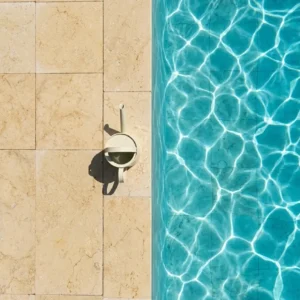
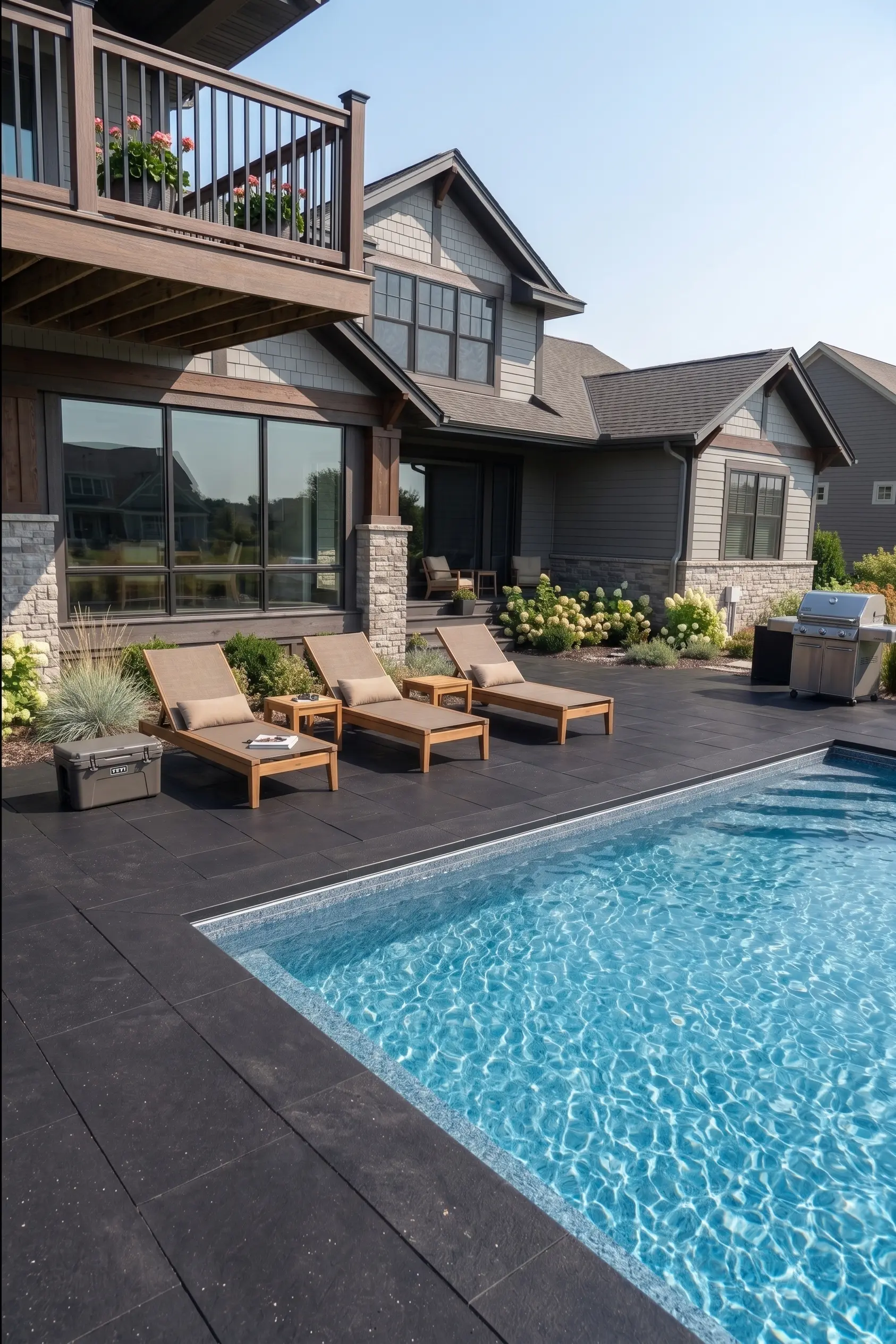
Pool decks and wet-area surrounds have their own thickness logic, driven partly by load and partly by the drainage geometry the finish creates. For pool surrounds, 1¼ in (30 mm) granite paver thickness is the practical minimum for pedestrian areas; 1½ in (38 mm) provides meaningful additional resistance to edge chipping at the pool perimeter and at coping joints, where pavers take concentrated foot traffic from people pushing off the wall. Coping pieces that cantilever over the pool edge should be specified at 2 in (50 mm) or more, and your pool builder’s structural requirements govern what the bond beam can carry.
For pool decks and wet steps, a bush-hammered finish is the appropriate choice — it leaves an open, matte texture that the surface maintains through water contact. For other outdoor paths, bush-hammered or brushed in our coarsest grit both work well; always check a sample in your specific site conditions. Browse our granite paver range to review the finish and thickness options available for pool and outdoor applications. Finish selection and thickness work together — your specification should address both, not one in isolation.
Thickness and Finish Selection for Indoor Applications
Interior granite paving brings a different set of constraints. Your subfloor type — whether concrete slab, timber substrate, or existing tile — determines the minimum build-up depth you can accommodate, and that total depth guides thickness selection as much as load does. A 1¼ in granite paver on a concrete slab with a thin-set bed works well for most residential interior floors. Thinner formats — ¾ in to 1 in (20–25 mm) — are appropriate for wall cladding and for interior feature floors that are fully supported on a flat concrete substrate.
For dry indoor surfaces — floors, walls, countertops, vanity tops, and fireplace surrounds — a polished finish is appropriate and delivers the reflective, refined look granite is chosen for in interior settings. Honed 120 Grit is the practical alternative for interior floors where the visual character calls for a softer sheen without the full mirror finish. At Citadel Stone, we cut granite to the thickness your project specifies, whether that means standard paver formats or custom section depths for bespoke interior applications.
- Concrete substrate: 1¼ in pavers on thin-set or mortar bed is standard for residential interior floors
- Timber substrate: consult your structural engineer on deflection limits before specifying stone thickness — tile and stone are sensitive to subfloor movement
- Polished finish suits dry indoor surfaces; specify Honed 120 Grit for a softer interior look
- Wall cladding: ¾ in to 1 in formats keep weight manageable and reduce the structural demand on the fixing substrate
- Heated floor system beneath stone: confirm the system’s operating temperature range and joint design with the system supplier before specifying adhesive and grout types
Ordering, Logistics, and Project Planning
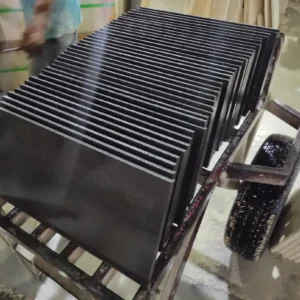
Granite paver thickness affects more than the structural specification — it directly shapes your delivery logistics, your installation schedule, and your waste calculation. Thicker pavers weigh proportionally more, and the cumulative pallet weight for a large project can require confirming access routes before delivery is arranged. Offloading arrangements and site access constraints are confirmed before the delivery date so the material arrives where your crew can handle it efficiently.
Citadel Stone stocks material at our selected quarries and cuts granite paver thickness options to order, which means your specification drives the cut rather than the cut driving your specification. Lead times are quoted with the order — build that window into your project schedule from the planning stage, not after the base is poured and you need pavers on site. Order your sample pieces at the specified thickness so your installer can confirm the bedding depth calculation against the actual material before full delivery.
- Calculate total pallet weight from paver thickness, format size, and total square footage — thicker pavers mean fewer pieces per pallet and more pallets per order
- Confirm site access clearances, turning radii, and offloading equipment before delivery is scheduled
- Allow material to acclimatize on site before installation in extreme temperature conditions — setting material performance depends on temperature at application
- Waste allowance of 10% is standard for straightforward rectangular layouts; allow 15–20% for complex cuts, angles, or irregular shapes
- Request material from a single production run where color consistency across a large installation matters
Getting Granite Paver Thickness Specifications Right
The specification decisions that define granite paver thickness performance come down to three variables working together: application load class, base preparation standard, and joint design relative to the temperature cycling the installation will experience. None of those variables operates in isolation. A correct thickness on a poorly prepared base performs like an undersized paver. A correctly bedded paver with rigid joints and no expansion relief in a high-cycling climate develops cracks that are misread as stone failure but are actually joint design failure. Getting all three right is what separates an installation that ages gracefully from one that needs remediation in year five.
Your specification process should start with a test report request — ASTM C615 for the granite grade, and any additional absorption or flexural data your structural engineer requires. Never accept a supplier’s verbal assurance on material properties where a test certificate exists. Beyond material quality, your base contractor’s work is the variable you can most directly influence on site: inspect compaction, confirm bedding depth, and verify joint material compatibility with your sealer before the installation begins. For a complementary look at how granite performs across a different format, granite cobbles versus concrete cobbles covers durability and long-term performance comparisons worth reading alongside this guide. Granite pavers from Citadel Stone are cut to the thickness your project calls for, so each area can be planned for the load it will carry.
Related reading: granite pavers for driveways guide · granite paver color guide · Reclaimed Granite Pavers: A Buyer’s Inspection Guide.