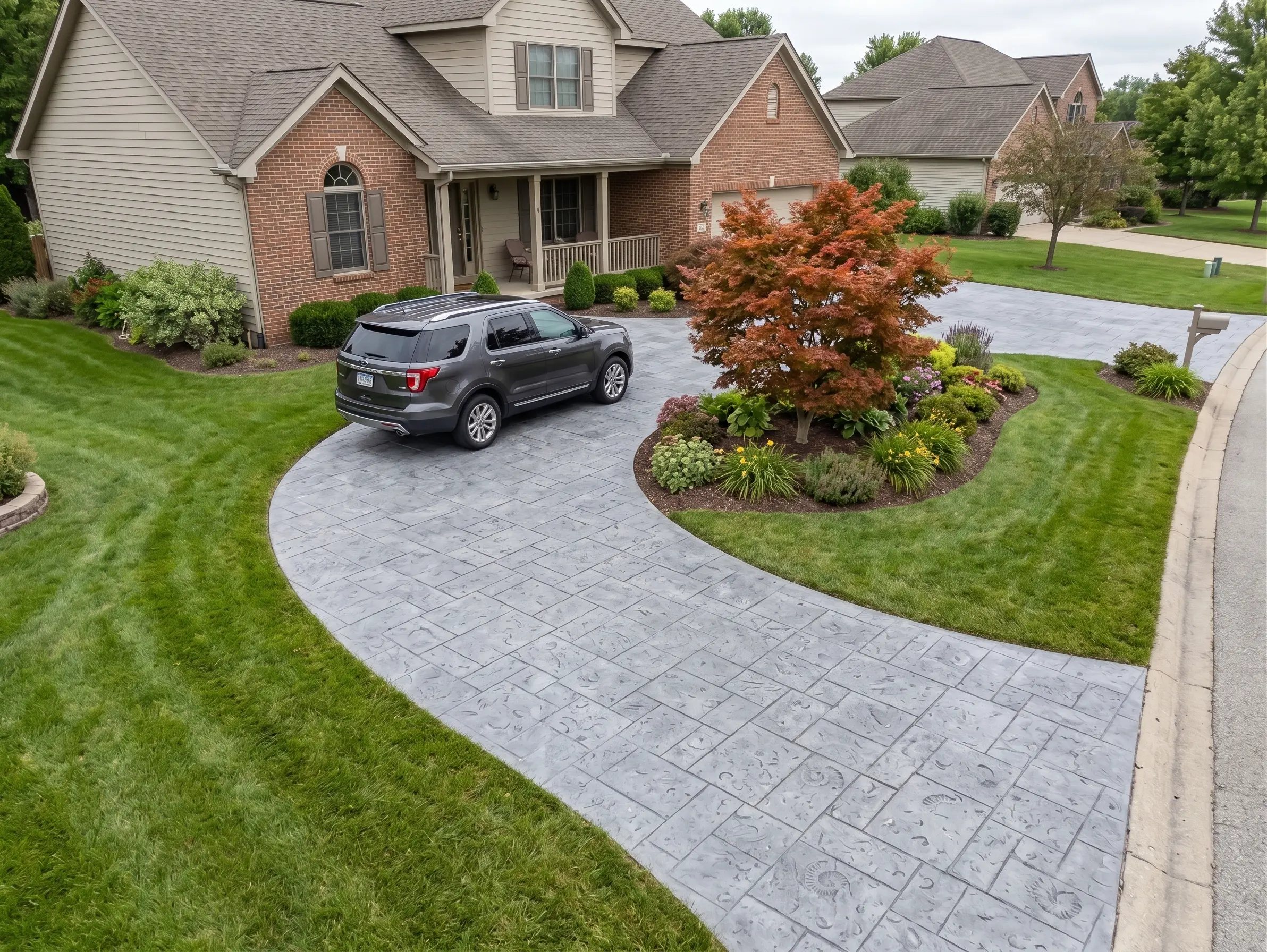
Granite pavers for driveways get specified for one reason above all others: load-bearing performance at the surface level that most paving materials can’t match over a multi-decade service life. This granite pavers for driveways guide walks you through every variable that matters — from subgrade assessment through finish selection — so your granite driveway performs the way the material is capable of performing. The decisions that separate a driveway that holds up from one that rocks, settles, or sheds surface material aren’t made at the showroom; they’re made during base design, thickness selection, and finish specification.
Why Granite Works for Driveways
Granite is an igneous stone — formed under enormous pressure deep in the earth — and that origin story translates directly into field performance. Its dense, interlocking crystalline structure gives it the compressive capacity to carry repeated vehicle loads without crushing or deforming at the surface. According to Natural Stone Institute granite durability and application specifications, granite’s physical properties make it one of the most demanding applications-ready natural stones available for exterior paving. Porosity is low relative to sedimentary stones, which limits water ingress into the body of the paver itself — a meaningful advantage in freeze-thaw regions where water expansion inside a porous paver causes progressive surface spalling.
Granite holds its surface texture and dimensional stability over decades in ways that concrete or clay brick simply don’t replicate. The mineral hardness — quartz, feldspar, and mica in combination — resists abrasion from tire contact and grit tracking without the surface degrading visibly in the first five years. That durability pays off long-term, but it also means installation precision matters more: a poorly built base under granite doesn’t get forgiven the way it might under softer materials that flex and self-adjust.
Thickness Selection and Load-Bearing Reality
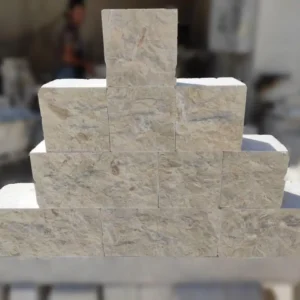
Paver thickness drives the structural conversation more than any other single specification in a granite pavers for driveways project. Residential driveway use — passenger vehicles, the occasional light delivery van — is a very different load case from a property that regularly sees heavier vehicles or equipment. Standard residential driveways are typically specified with pavers in the 30–40 mm nominal thickness range, but confirm the appropriate nominal dimension against the actual load case with your supplier before cutting to order. Granite pavers for driveways with heavier-use demands — a workshop entry, a property that takes regular delivery vehicles — warrant thicker stock, and the base design must be adjusted to match.
The ASTM C615 standard covers granite dimension stone quality specifications, and ASTM C615 granite dimension stone quality standards provide the framework your specifier or structural consultant should reference when project drawings call out a minimum performance threshold. Rather than relying on generic tables, request the test report from Citadel Stone for the specific material you are ordering — that report gives you the compressive and flexural data for that stone, not a category average.
- Residential passenger-vehicle driveways: specify nominal thickness appropriate to the pattern and joint design — confirm with your supplier
- Mixed-use or delivery-vehicle driveways: heavier thickness is warranted; base depth increases proportionally
- Permeable or open-joint designs: thickness selection must account for reduced lateral restraint from the joint system
- Slopes over 1:20: consult a structural engineer; surface geometry affects both drainage and lateral load distribution
Base Preparation and Soil Conditions That Determine Outcome
Here’s what most driveway specifications underweight: the subgrade is the actual foundation. The finest flamed granite pavers available will still produce a rocking, uneven surface in three years if the subgrade wasn’t assessed and addressed before aggregate went down. Soil type is the controlling variable, and it varies significantly across the country in ways that directly change how you build the base.
Expansive clay soils — common across the mid-south, parts of the plains, and coastal regions — swell when wet and shrink during dry periods. That cyclical movement translates into differential settlement under rigid stone paving unless you either stabilize the clay layer or build a compacted aggregate base deep enough to bridge the movement. In practice, this usually means excavating well below frost depth in northern regions and below the active moisture zone in clay-heavy southern soils, then compacting in lifts with quality crushed aggregate before any bedding layer goes down. Sandy subgrades present a different problem: excellent drainage but poor bearing capacity. Sand won’t hold compaction the same way well-graded aggregate does, so a geotextile separation layer may be needed to prevent migration of the aggregate base down into the sandy subgrade over time.
- Expansive clay: increase base depth, consider lime or cement stabilization of the clay layer before aggregate placement
- Sandy or loose subgrade: geotextile separation fabric between subgrade and aggregate base is strongly advisable
- Caliche or rocky subgrade: drainage management becomes critical — caliche is nearly impermeable and water can pool at the interface
- Organic or fill soils: full excavation to undisturbed native material is required before any base construction begins
The compacted aggregate base itself should be well-graded crushed stone, placed and compacted in lifts — typically no more than 100 mm per compacted lift — to achieve consistent bearing throughout the depth. A plate compactor run in two perpendicular directions on each lift is the field standard. Skipping lift compaction is the most common installation shortcut, and it’s where long-term settlement originates.
Finish Options for Granite Driveways
Flamed granite pavers are the most widely specified finish for driveway applications, and the reason is straightforward: the thermal flaming process opens the surface crystal structure, leaving a matte, textured face. Flaming also highlights the mineral variation in the stone, giving the finished driveway a visually rich appearance that ages well. The open texture created by flaming affects how the surface interacts with water — it channels rather than sheets — and your specifier should review the ANSI A326.3 standard, which is the current wet-surface measurement protocol, to understand how finish selection affects slip resistance performance in context. That standard is measured wet, not dry; the finish is the primary variable; and if a tested value is relevant to your project, the test report is available on request.
Beyond flamed, you may encounter sawn, honed, or bush-hammered finishes on granite cobble stone pavers and sett-style units. Sawn faces are smooth and dimensional — better for contemporary aesthetics, but the surface texture discussion above applies. Bush-hammered finishes create a pitted, regular texture through mechanical impact and are used where a more uniform surface profile is specified. Each finish changes both the visual register and the surface-level behavior of the stone, so your choice should be driven by the project’s design intent and the advice of whoever is signing off on the surface specification.
Joint Design and Edge Restraint
Granite’s dimensional stability is an asset, but it also means the paving system needs to be designed to manage thermal movement at the joint level rather than through the stone itself. Concrete and asphalt flex and absorb movement; granite does not. Joint design needs to account for the expansion and contraction that will occur seasonally, and in freeze-thaw regions this is not a marginal consideration — it’s a design requirement.
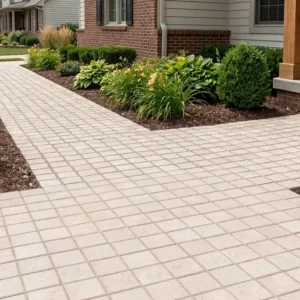
Solid edge restraint — concrete haunching or proprietary mechanical edge restraint systems — is non-negotiable for any granite driveway. Without it, lateral load from vehicle turning movements progressively pushes the perimeter pavers outward, and once the pattern begins to open at the edges, the entire field becomes unstable. The edge restraint must be installed before infill pavers are set, and it should be continuous around the perimeter including any radii or curved sections.
- Butt-joint or near-zero joint patterns require very precise cutting tolerance — confirm with the supplier before specifying
- Sand-filled joints in permeable designs need periodic top-up after the first wet season; this is maintenance, not a defect
- Polymeric jointing compound in narrow joints reduces weed ingress and joint erosion in high-traffic areas
- Expansion joints at abutments — garage aprons, steps, curb transitions — prevent point-loading failure at the interface
Bedding Layer Options for Granite Paver Driveways
The bedding layer — the material directly under the paver — is where a lot of installation decisions get made in the field, sometimes incorrectly. For bound systems (mortar bed over concrete slab), the concrete base must be structurally adequate for the intended load before any stone goes down. For unbound systems (compacted sand or dust bedding over aggregate base), the bedding layer should be screeded to a consistent depth and not disturbed after screeding. Walking on a screeded bedding layer before pavers are set introduces undulation that no amount of tamping corrects properly.
Your Granite Pavers specification should confirm whether the project is bound or unbound, because this affects paver thickness recommendations, base design, and maintenance approach. Citadel Stone cuts granite pavers to order at our selected quarries, so thickness and format can be matched to the structural requirement rather than to a standard stock size that may not fit the project’s load case.
Granite Color Ranges and What They Signal
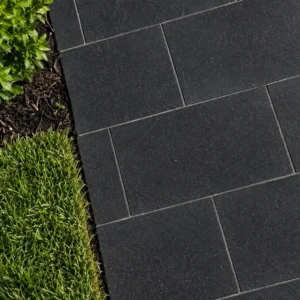
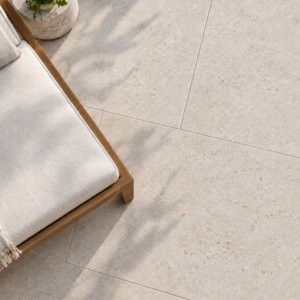
Granite’s color comes from its mineral composition — the ratio of quartz, feldspar, and biotite or hornblende in the crystalline matrix. Grey tones, including the popular silver-grey and salt-and-pepper ranges, reflect high feldspar and quartz content. Darker granites — approaching near-black in some material — have higher proportions of darker minerals and often show a finer grain structure. The color range matters for specification because it signals something about the stone’s internal structure and how it will cut and finish.
At Citadel Stone, we source granite through our selected quarries in the Middle East, and the material is quality-checked against the agreed specification before it is cut to order. The consistency of the mineral composition across a quarry face is what determines how reliably the color matches from pallet to pallet — something worth asking about specifically if you’re specifying a large driveway area where visual uniformity matters. USGS granite production and construction use statistics document the range of granite types used in dimension stone applications across the country, and the material variation between geological formations is significant enough that source matters in color-critical specifications.
Drainage and Slope Design for Granite Driveways
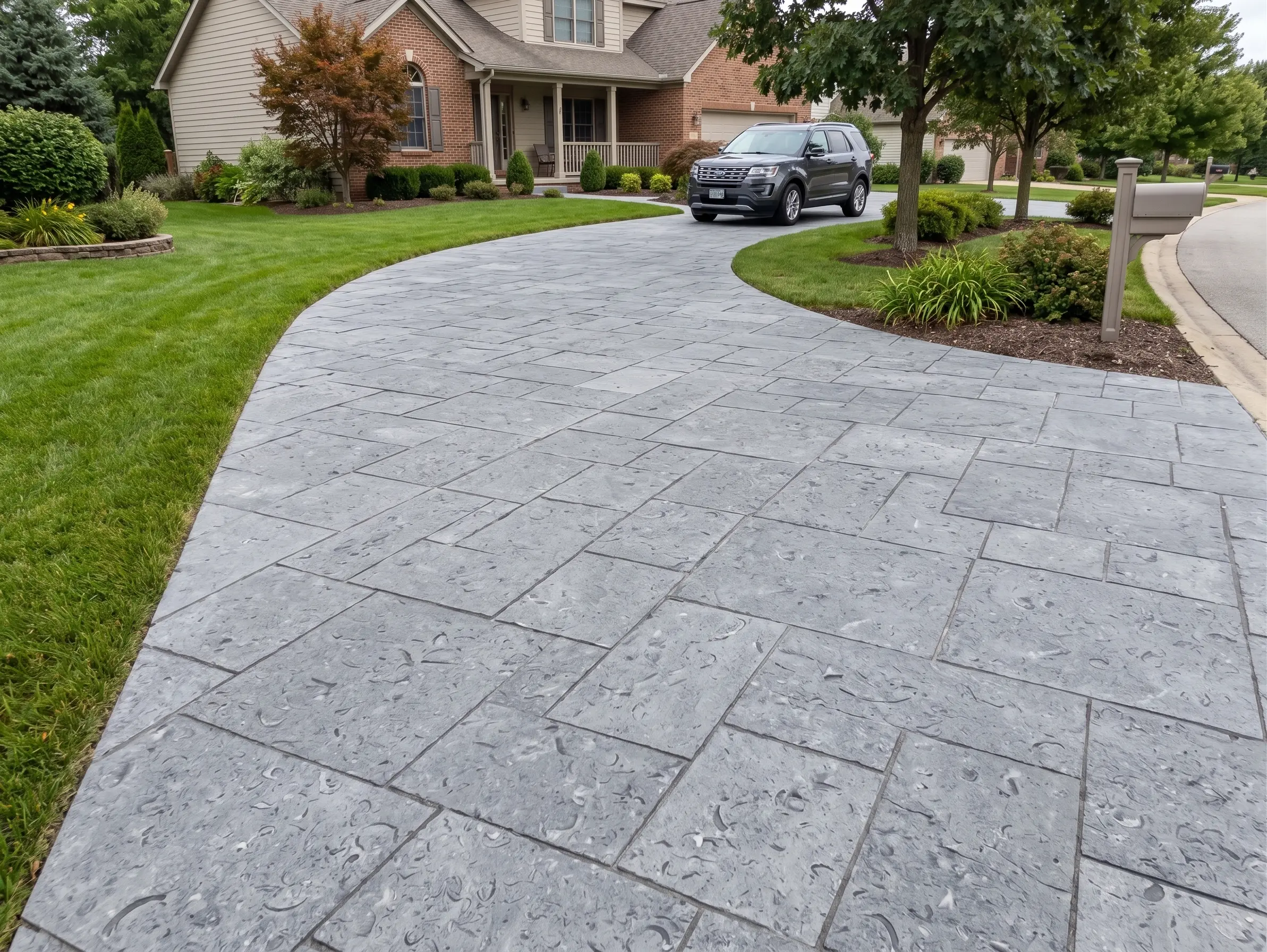
Granite pavers for driveways perform best when the drainage design keeps water moving off the surface and away from the base rather than allowing it to pond or infiltrate laterally into the subgrade. The surface slope specification — typically a minimum cross-fall — should be established on the design drawings before installation, not adjusted in the field. Once the base is compacted and the bedding layer is screeded, correcting a drainage problem requires taking the paving up and starting again.
In regions with heavy rainfall or expansive clay soils, consider integrating linear drainage channels at the low points of the driveway, particularly at the apron where the driveway meets the road or pavement. Channel drains at the apron intercept surface water before it sheets onto adjacent infrastructure and protect the subgrade from saturation at the most vulnerable interface. The drainage specification should be coordinated with the site grading design — drainage is a civil engineering question as much as a paving question, and the paving contractor needs to know where the surface water is going before the first paver is set.
- Minimum cross-fall of 1:50 is a widely used starting point — confirm with your civil engineer for the specific site conditions
- Avoid drainage toward the building foundation; water management must route away from the structure
- Permeable jointing systems require an open-graded aggregate base — do not use dense-graded aggregate under a permeable joint design
- In clay-heavy soils, perimeter drainage at the base of the excavation prevents hydrostatic pressure building up under the slab or aggregate base
Delivery and Project Logistics
Your project’s site access constraints are a practical logistics variable that should be confirmed early in the ordering process. Granite pavers are dense, and a full driveway project involves meaningful tonnage — the delivery arrangement needs to account for access width, turning radius, and whether the site can accept a full pallet drop or requires staged delivery. Offloading arrangements are confirmed before the delivery date, and lead times are quoted with the order. Factor the delivery schedule into your installation sequence so the aggregate base and bedding preparation are complete before material arrives — granite pallets stored on an unprepared site can cause their own ground damage.
Citadel Stone manages the delivery logistics from our selected quarries through to the project site, and we can advise on staging if your site has access limitations. The ASLA provides driveway paving material guidance and environmental performance considerations worth reviewing when your project has environmental or stormwater management requirements attached to the planning approval.
Getting Your Granite Driveway Specification Right
A granite pavers for driveways specification that performs over its full potential service life comes down to decisions made before a single paver is set: subgrade assessment, base depth matched to soil conditions and load case, correct thickness for the vehicle profile, appropriate finish for the project’s surface requirements, and drainage design that keeps water out of the base. The stone itself is exceptionally durable — granite’s geological density and low porosity give it a decades-long service life in driveway conditions — but those inherent properties only express themselves when the installation underneath them is built correctly. If your project involves varied color palettes across multiple stone types, how color interacts with grey basalt tones is a useful complementary reference for coordinating granite with other hardscape elements on the same property.
Choosing the right base build-up and paver thickness from Citadel Stone is essential for driveways that must handle both vehicle weight and freeze-thaw stress.