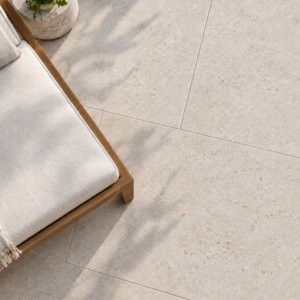
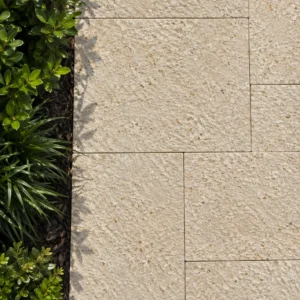
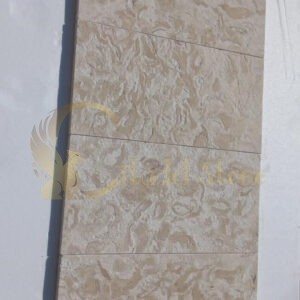
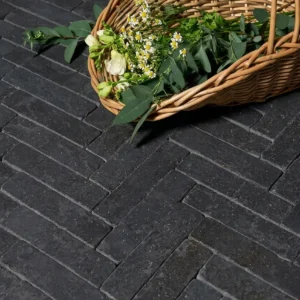
Reclaimed granite pavers carry a structural track record that most new-cut stone can’t match on paper — decades of load cycles, weather exposure, and compaction history are already baked into every piece. What this reclaimed granite pavers guide addresses that most buyers are missing isn’t a history lesson; it’s a methodical inspection protocol that separates stock worth specifying from stock that will fracture, rock, or drain incorrectly once it’s in the ground. The surface patina looks compelling in photos, but the dimensional variation, micro-fractures, and inconsistent thickness hiding underneath that patina are what decide whether the installation ages gracefully or becomes a maintenance liability within a few seasons.
Related guide: Reclaimed Granite Curb Guide: Grading, Sizes, and Uses.
What Reclaimed Granite Actually Means
The term covers a wide range of salvage origins, and origin matters more than most buyers realize. Street-pulled cobbles, decommissioned rail ballast, demolished kerb runs, and reclaimed paving slabs all fall under the reclaimed granite umbrella — but they perform very differently in a new installation. Cobbles and setts from historic street projects were typically rough-split or bush-hammered, sized for tight interlock with sand joints, and laid on compacted rubble without mortar. Slab material from commercial plazas was usually honed or polished, bonded to concrete, and cut to larger formats. You’re reading these differences in the surface texture, joint width tolerance, and thickness range of the stock you’re inspecting.
Understanding sourcing history also tells you about contamination risk. Reclaimed stone from industrial sites can carry embedded oils, salts, or chemical residues that will migrate through a sealer and stain the finished surface. Always ask for the salvage site documentation before buying at volume, and inspect a cross-section sample for discoloration that runs deeper than the surface skin.
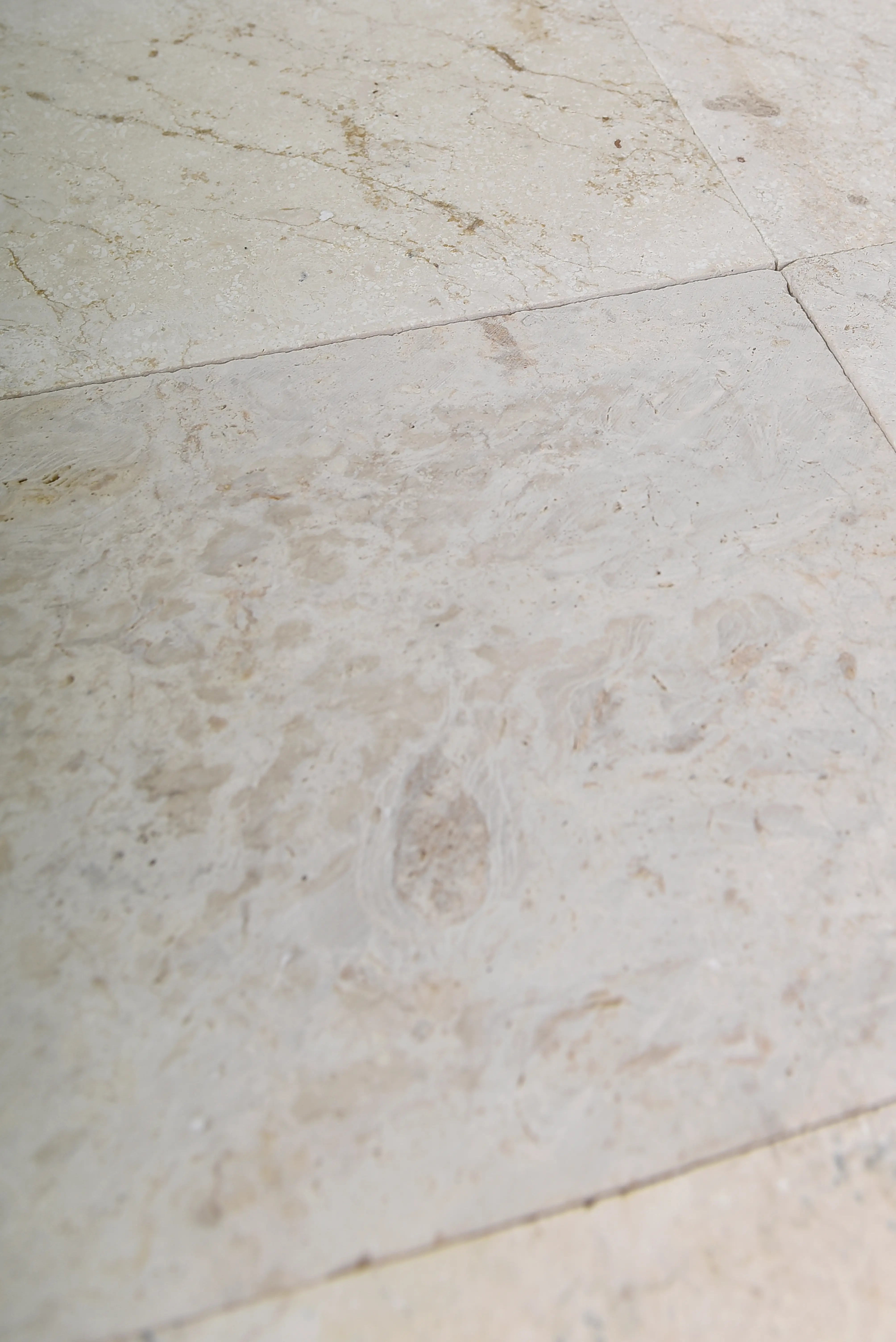
Dimensional Inspection: The First Gate
Reclaimed granite pavers are rarely dimensionally consistent, and that inconsistency cascades through every downstream decision — joint width, bedding mortar depth, finished surface plane. Your inspection starts with thickness measurement across a representative sample. Pull at least twenty pieces from different positions in the pallet stack, not just the top layer. Measure thickness at four corners and the center of each piece and record the spread. A tight specification project tolerates a narrower band; a rustic cobblestone pathway can absorb more variation.
- Thickness variation across a single pallet often exceeds the tolerance most bedding mortars can compensate for — know your acceptable band before you buy
- Edge chipping and spalling reduce the effective joint contact area, which affects how the stone interlocks under load
- Face area dimensions vary significantly in irregular reclaimed stock — confirm whether the supplier’s quoted size is nominal or a measured mean
- Warped or bowed pieces create high-point rocking under foot traffic; lay each sample piece on a flat reference surface and check for movement
- Re-cut edges from secondary processing are a good sign — they indicate the supplier has already done dimensional sorting
For mortar-bed installations, a wide thickness spread means your setting mortar layer has to carry the dimensional compensation. That’s workable up to a point, but beyond it you’re building inconsistent bond strength into the bed. Gauge your tolerance realistically: the finished surface plane matters more for pedestrian paths, and even more for ramp and slope installations where an uneven face can redirect sheet flow in unintended directions.
Reading Fractures and Micro-Cracks
Granite’s interlocking crystalline structure makes it highly resistant to fracture propagation under ordinary compressive loads. However, reclaimed stone has already lived through thermal cycling, freeze-thaw cycles, and mechanical stress from removal equipment. The micro-fractures that develop during that service history aren’t always visible in normal light. Your inspection protocol needs to include a percussion test — tap the face of each sample piece with a steel hammer and listen for the response. A solid piece rings clearly; a cracked piece returns a dull, flat thud. Any piece that thuds on percussion gets set aside, regardless of how good it looks on the surface.
For high-stakes installations — commercial plazas, public access ramps, or any installation where structural failure carries liability — specify that the supplier provides a batch sample for petrographic review. The Natural Stone Institute granite durability and application specifications outline the property categories relevant to structural granite assessment, and requesting a test report for the specific salvage batch gives you documented evidence of the material’s actual condition, not just its appearance.
Surface Finish and What It Tells You
The finish on reclaimed granite pavers is partly original and partly the result of decades of wear — and distinguishing between them informs your application decision. Original finish categories in reclaimed stock include split face, bush-hammered, flame-textured, sawn, and polished. Wear then modifies the high points of textured finishes, rounding off the peaks and reducing the open matte character that made them appropriate for their original application.
- Heavily worn bush-hammered pieces may have surface character closer to a brushed or honed finish than their original specification intended
- Old polished surfaces typically show micro-scratching and a dulled sheen — they are rarely suitable for a polished-look indoor specification without re-polishing
- Split-face cobbles from historic street stock retain their original texture well because the split surface was never the trafficked face
- Flame-textured reclaimed slabs can develop weathering channels in freeze-thaw climates that alter drainage behavior at the surface
Finish assessment also connects directly to the slip performance question buyers always ask. Slip behavior under ANSI A326.3 is evaluated wet, the finish is the governing variable, and the relevant test is performed on a prepared sample — not estimated from visual inspection. For any installation where surface texture under wet conditions is a specification requirement, ask the supplier whether a tested batch sample exists and whether the test report is available on request. Never rely on a visual assessment of a reclaimed finish as a proxy for a tested result.
Base Preparation and Terrain Variables
Terrain and site elevation introduce variables into reclaimed granite installations that a flat-site specification simply doesn’t encounter. On sloped ground, the base preparation geometry changes: you’re not just building a level compacted platform, you’re managing grade, cross-fall, and the hydrostatic forces that develop when water moves downhill through the base layer. Reclaimed granite’s dimensional variation makes this more sensitive, because uneven pieces on a sloped plane redirect sheet drainage in ways that new-cut stone with consistent thickness doesn’t.
For installations on slopes, a step-terraced base with drainage breaks between levels keeps hydrostatic pressure from building behind the paving plane. On hillside sites where cut-and-fill created artificial grade transitions, the compaction quality of the fill zone varies — and that variation shows up as differential settlement under reclaimed granite, which lacks the edge-to-edge consistency that helps new-cut stone bridge minor soft spots. Test the bearing capacity of the compacted base before laying, particularly in fill zones, and add a geotextile separation layer between the subgrade and aggregate base to prevent fines migration over time.
- Cross-fall on a path or terrace should be consistent — reclaimed stone’s thickness variation makes achieving uniform cross-fall harder and requires more skilled bedding work
- At low-lying sites with a high water table, a crushed-stone free-draining base depth matters more than it does on elevated ground — size it to the site’s drainage calculation, not a generic rule
- On elevated terrain with thin topsoil over bedrock, the compacted base can be shallower, but bearing capacity and frost depth still need site-specific assessment
- Grade management at entry points — where a path meets a building or paved apron — requires a positive fall away from the structure regardless of the reclaimed material’s surface variation
Drainage design is the discipline that ties all these terrain variables together. Get the drainage pattern right in the base design, and the reclaimed stone’s surface variation becomes a character feature. Get it wrong, and water pools at the low points that the uneven surface creates.
Thickness Specification by Application
Reclaimed granite pavers for pedestrian applications — paths, terraces, courtyard surfaces, and garden walks — are typically specified in a thickness range that your bedding system can accommodate. For driveways, the specification is fundamentally different: use setts or cobbles at least 3.5 in (4 in standard) thick on a compacted base, or pavers 2 in (5 cm) or thicker mortar-bonded to a reinforced concrete slab. Reclaimed granite setts from historic street paving often meet this thickness requirement, which is part of what makes them well-suited to vehicle-bearing surfaces when properly assessed and laid.
Pedestrian-only applications allow thinner formats, but reclaimed stock in thin sections carries fracture risk from the hidden micro-cracking discussed earlier. For any reclaimed piece under a certain threshold of thickness, the percussion test and visual fracture inspection become more critical, not less. Thinner reclaimed pieces are also more likely to rock on an uneven bedding surface, which creates edge-loading stress concentrations that eventually crack the stone. Your bedding preparation has to be more precise with thinner reclaimed stock than with new-cut material.
The ASTM C615 granite dimension stone quality standards define the property categories used to evaluate granite dimension stone — ask your supplier to confirm which ASTM test methods were applied to the salvage batch and request the test report rather than accepting a verbal assurance of suitability.
Cleaning and Contamination Assessment
Reclaimed granite arrives with a surface history that needs to be removed before installation — old mortar, bituminous residue, efflorescence from prior installation, biological growth, and in some cases, paint or sealers applied during the stone’s previous service life. Your inspection needs to assess what cleaning the stock will require and whether that cleaning is the supplier’s responsibility or yours.
- Old mortar on bed faces must be removed to achieve a proper bond — stone with deep mortar inclusions in the bottom face requires mechanical cleaning that can alter thickness
- Bituminous residue from road applications requires solvent cleaning — confirm the cleaning chemistry is compatible with granite before specifying it
- Biological growth (moss, lichen) is surface-removable, but heavy organic staining can penetrate several millimeters into the stone’s pore structure
- Prior sealers, particularly penetrating sealers, can affect how the cleaned stone absorbs a new sealer — test sealer adhesion on a cleaned sample before committing to a sealing specification
- Salt contamination from road de-icing applications is the most problematic — it requires multiple wet-and-dry treatment cycles to draw the salts out, and affected stock should be quarantined until confirmed clean
Cleaning assessment at the inspection stage also helps you budget realistically. A pallet of heavily contaminated cobbles that looks priced attractively may cost more in preparation labor than the price difference from clean, well-sorted stock justifies.
Matching Reclaimed Stock to New-Cut Pieces
Projects that mix reclaimed granite with new-cut pieces — borders, feature areas, repairs to existing reclaimed installations — face a color and texture matching challenge that you need to address at the specification stage, not after delivery. Reclaimed granite’s aged surface and new-cut granite from the same geological origin rarely match visually without some weathering period. The mineral composition may be essentially identical, but the oxidation patina, surface micro-texture, and joint fill color of reclaimed stock create a visual contrast that takes years to equilibrate.
For repairs to existing reclaimed granite installations, the practical approach is to source reclaimed stock from the same salvage origin where possible. If that’s not possible, a honed or bush-hammered new-cut piece from a compatible granite variety will visually integrate faster than a polished or sawn surface, because the open matte texture of those finishes reads closer to worn reclaimed stone. Our Granite Pavers range includes cut-to-order new granite in formats and finishes that can be specified alongside reclaimed stock where dimensional precision in the new-cut sections matters.
Sealing and Ongoing Maintenance
Sealing reclaimed granite pavers requires a different approach than sealing new-cut stone. The pore structure in reclaimed stone has been partially modified by its prior service history — old sealer residues, mineral migration from prior mortar, and surface carbonation all affect how a new penetrating sealer performs. Always conduct a water-drop absorption test on cleaned sample pieces before committing to a sealer: place a small water droplet on the cleaned surface and time how long it takes to absorb. Pieces with very slow absorption may have a sealer residue that needs additional preparation; pieces with very rapid absorption may need a denser sealer formulation than the supplier’s standard recommendation.
The sealing interval for reclaimed granite in outdoor applications should be set to the sealer manufacturer’s stated schedule for the specific product applied, not to a generic annual rule. High-UV, high-rainfall environments or installations subject to chemical exposure — pool surrounds, outdoor kitchen areas — will exhaust a sealer faster than a sheltered courtyard application. You can expect good service from properly sealed reclaimed granite where drainage works correctly and you reseal on the interval the sealer manufacturer states for the specific conditions.
Ordering, Logistics, and Delivery
Reclaimed granite is a finite resource from a specific salvage event — quantities are fixed at the time of inspection, and the stock that passes your inspection protocol may be considerably less than the supplier’s total advertised volume once you’ve pulled the dimensional rejects and contaminated pieces. Order your confirmed quantity plus a realistic overage for cuts, breakage during installation, and future repair stock. Running out of matching reclaimed material mid-project, or post-installation for a repair, is one of the most common and avoidable problems in reclaimed stone projects.
Delivery logistics for heavy stone pallets require attention to site access before the order is confirmed. Pallet weights for reclaimed granite cobbles or setts are substantial, and scheduling needs to account for your project site’s access constraints — road width, overhead clearances, and off-loading area. Confirm those constraints with the delivery coordinator when you place the order so that the right equipment is arranged. Lead times and delivery arrangements are quoted with the order; plan your project schedule around a confirmed delivery date rather than an estimated window.
Citadel Stone cuts granite to order at our selected quarries, which means the dimensional precision of new-cut stock is held to specification from the first piece to the last — a useful comparison point when you’re evaluating whether reclaimed stock’s character premium justifies its dimensional variability for your specific project. According to USGS granite production and construction use statistics, granite remains among the most specified dimension stone categories in construction precisely because of its combination of hardness, porosity characteristics, and long service life under varied conditions.
Getting Your Reclaimed Granite Pavers Specification Right
A reclaimed granite pavers guide that stops at aesthetic appreciation misses the decisions that actually determine project success. Your inspection protocol — dimensional spread, percussion fracture testing, contamination assessment, finish condition, and cleaning requirement — is the specification work that happens before any order is placed. Terrain and site conditions then shape your base design: slopes, elevation transitions, and drainage geometry all affect how the stone’s inherent dimensional variation performs over time. Match your thickness specification to the application category — vehicle-bearing surfaces require setts or cobbles at the dimensions stated in the driveway section above, while pedestrian terraces allow more flexibility but still demand careful percussion inspection of thinner pieces.
As you finalize your stone selections, related tile and finish decisions across your project can benefit from the same specification discipline. For a different dimension of natural stone specification, basalt hexagon grout selection covers how grout color interacts with a dark stone surface — a topic relevant to any project mixing stone formats and finishes. The specification decisions for reclaimed granite come down to inspection rigor, base engineering, and honest assessment of dimensional tolerance — get those three right and the character of the material works in your favor for decades. Buyers weighing reclaimed character against dimensional precision will find that Citadel Stone cut-to-order granite from our selected Middle East quarries eliminates the sizing uncertainty salvaged stone carries.
Related reading: Granite Pavers for Driveways: A Load-Bearing Guide · Granite Paver Color Guide: Tone, Veining and Finish.