Most granite cobble pavers comparison evaluations focus on surface aesthetics and unit price — and that’s where the analysis breaks down. The performance gap between natural granite cobbles and concrete alternatives doesn’t reveal itself on a showroom floor; it shows up in the field after the first few winters or after a few years of joint cycling from thermal expansion and contraction. Understanding what actually drives long-term performance in a granite cobble pavers comparison means looking at material behavior at the micro-structural level, not just the price-per-square-foot column.
What Sets Granite and Concrete Cobbles Apart at the Material Level
Granite is an igneous rock that cooled slowly deep within the earth, which is why its interlocking crystal structure is so dense and tightly bonded — the Natural Stone Institute granite overview describes this mineralogical structure as a key factor in granite’s dimensional stability. That same crystalline matrix means water has very little pathway to move through the stone body. Concrete, by contrast, is a manufactured composite — cement paste, aggregate and water — and while modern concrete mix designs have improved significantly, the paste matrix remains inherently porous and chemically active in ways that natural granite is not.
- Granite’s crystal structure is essentially non-reactive with common groundwater chemistry and road salts over normal service timelines
- Concrete’s cement paste continues to hydrate and can carbonate over time, making older units more brittle at the surface
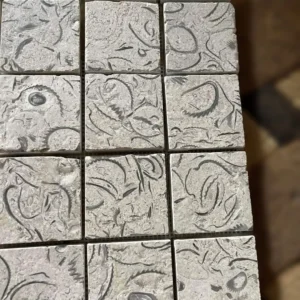
- Granite cobbles are cut or split from a continuous geological formation; concrete cobbles are cast and cured in molds, introducing variable density across the unit face
- Color in granite is mineralogical and extends through the full thickness; concrete cobble color is a surface-applied or surface-concentrated pigment system
Compressive Strength and What the Test Data Actually Tells You
Specifiers often reach for a compressive strength number as the primary performance selector, and it’s a reasonable starting point — but it’s only one dimension of the story. ASTM C615 covers granite dimension stone and sets the framework for how granite compressive and flexural strength are measured. For concrete cobbles, ASTM C936 governs solid concrete interlocking pavement units. The right approach is to specify the relevant test method for each material and request the actual test report from your supplier — never accept an estimated or interpolated value. Citadel Stone cuts granite cobble pavers to order at our selected quarries, so test documentation is tied to specific production batches, not generic product-category averages.
- Request ASTM C615 test data for granite cobbles: test report on request
- Request ASTM C936 data for any concrete alternative under consideration
- Compare absorption results alongside strength — low absorption is a stronger predictor of long-term freeze-thaw performance than strength alone
- Verify that test units match the thickness and finish of what you are actually specifying
How Freeze-Thaw Cycling Separates the Two Materials Over Time
Here’s the variable that most comparison charts understate: it’s not a single freeze event that damages paving — it’s the accumulated mechanical stress of dozens or hundreds of cycles over a decade. Every time absorbed water transitions between liquid and ice, it expands by roughly nine percent volumetrically and generates internal pressure within the material’s pore network. Granite’s naturally low absorption means there is simply less water present to freeze, which is why the material tends to maintain dimensional stability through many cycles. Concrete, even well-made concrete, tends to exhibit progressive surface scaling over repeated freeze-thaw exposure, particularly where road salts accelerate the deterioration.
Thermal cycling compounds this beyond just winter freeze events. In climates with significant day-night temperature swings — where surfaces heat in direct sun and cool rapidly overnight — both the stone units and the jointing material expand and contract at different rates. Granite’s thermal expansion coefficient is well characterized; you can request this figure from your supplier’s test report and use it to calculate joint spacing that accommodates the actual temperature range at your site, rather than relying on a generic rule of thumb. Getting that calculation right from the outset is far cheaper than re-setting joints that open up because the movement wasn’t accounted for.
- Specify freeze-thaw durability testing for your stone selection. when the project is in a region with genuine winter cycling
- Calculate thermal expansion joint requirements from the material’s documented coefficient and the site’s realistic temperature range
- Use a polymeric or flexible jointing material that can accommodate the differential movement between granite units and the sub-base
- Concrete cobbles in freeze-thaw climates benefit from air-entrainment in the mix design — verify this is present in the product specification
Surface Color and Aging Trajectory
The aging trajectory of granite and concrete cobbles diverges noticeably within the first five to ten years of service. Granite’s color lives within the mineralogy of the stone itself — there is no coating or surface layer to wear, fade or chalk. The polished or sawn face weathers to a naturally textured patina that many designers consider an improvement on the fresh-cut surface. Concrete cobbles, regardless of how well-formulated the pigment system is, are subject to UV-driven fade, surface carbonation that mutes tone, and the visual effect of surface scaling where it occurs.
For a detailed look at the granite cobble options available in our current stock range, our granite cobble paver range includes unit dimensions, finish options and sourcing details. The color consistency in granite comes from the quarry block itself — at our selected quarries, batches are assessed for color banding before cutting begins, so what you specify is what arrives on the pallet.
Installation Base Requirements for Each Material
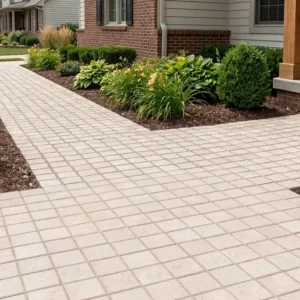
Your base design is not interchangeable between granite cobbles and concrete units of comparable nominal size. Granite cobbles in a traditional sett format carry their load through the mass and the bedding layer below; the unit itself does not flex under point load. Concrete interlocking pavers are engineered to work as a flexible pavement system where load is distributed across the interlock between adjacent units, which means joint integrity is load-critical in a way that it isn’t for set granite cobbles.
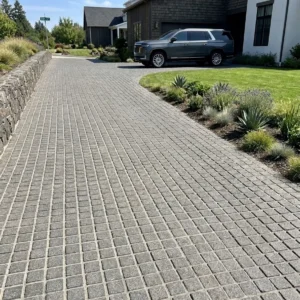
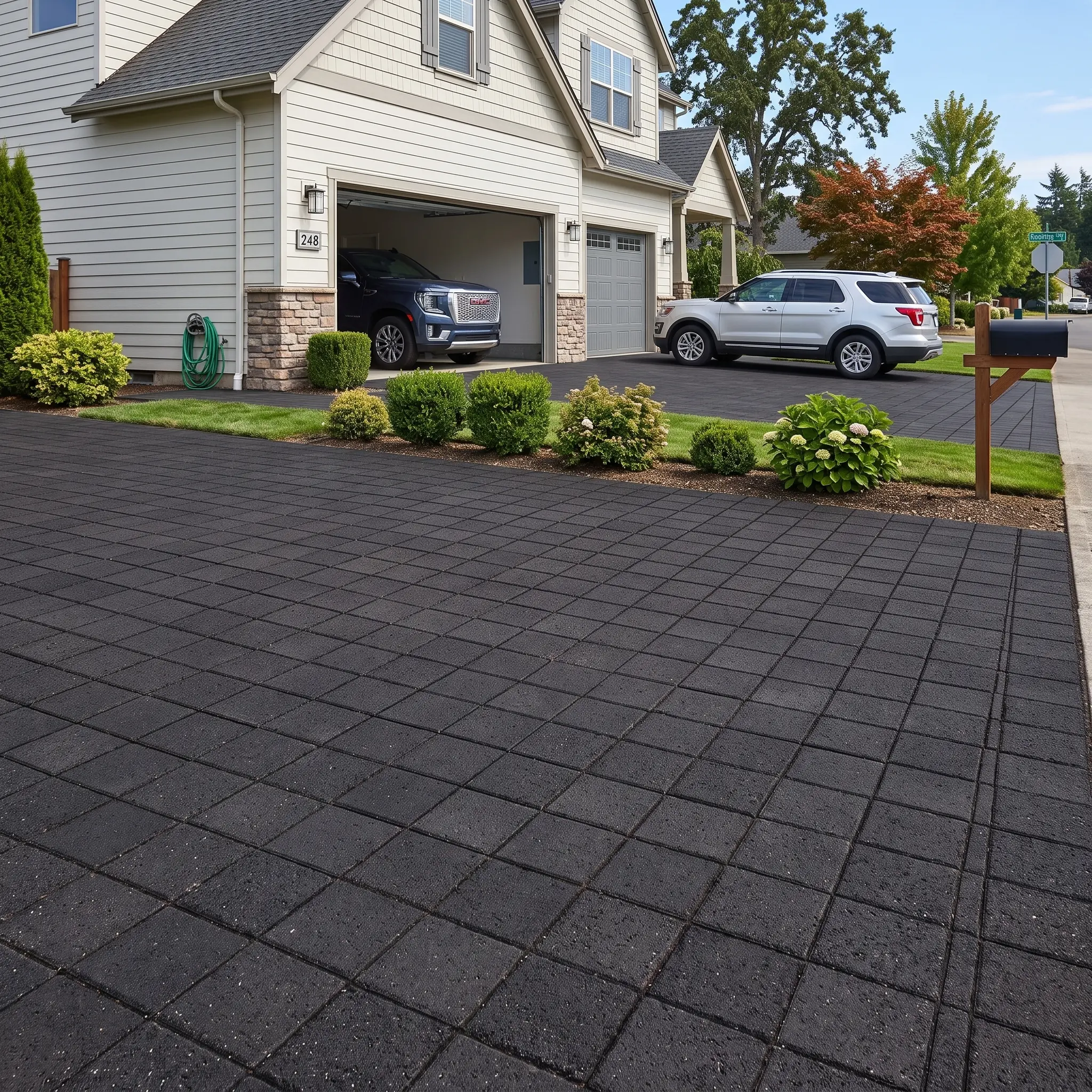
- For driveways, use setts or cobbles at least 3.5 in (4 in standard) thick on a compacted base, or pavers 2 in (5 cm) or thicker mortar-bonded to a reinforced concrete slab
- Pedestrian applications: granite cobble pavers at 2.5–3 in thickness on a compacted crushed-stone base with a bedding course of coarse sand or stone dust typically work well
- Concrete interlocking pavers for pedestrian areas: manufacturer’s published minimum thickness governs — verify against the ASTM C936 specification for the product
- Both materials require adequate sub-base compaction; surface failure nearly always traces back to base movement, not material failure
- Joint sand specifications differ: granite cobbles tolerate polymeric or cement-stabilized joints; concrete interlocking pavers generally require specific kiln-dried or polymeric sand calibrated to the joint width
Maintenance Over the Service Life
The maintenance comparison between the two materials looks fairly similar in year one, but diverges meaningfully by year five to ten. Granite cobble pavers, once properly set, need periodic joint sand replenishment — how often depends on the joint width, the sand specification and whether the surface drains well. Concrete cobbles in the same application share that joint maintenance need, but add the variable of surface degradation management: sealing to limit absorption, monitoring for surface scaling in freeze-thaw climates, and managing the visual effects of uneven weathering if replacement units don’t match the original batch color exactly.
Sealing is genuinely worth discussing for both materials, not as a selling point but as a practical decision. Granite cobble pavers with a sawn or split-face finish generally have low enough absorption that sealing is optional — your decision should be driven by the sealer manufacturer’s data and the stone supplier’s test report on absorption, not by a general recommendation. Concrete cobbles in demanding climates benefit from sealing because it reduces the water entry that drives freeze-thaw damage, but the seal needs to be re-applied on the interval the sealer manufacturer states. Skip that interval and you’ve lost the protection without knowing it.
Cost Comparison Beyond the Unit Price
The unit-price advantage concrete cobbles appear to hold in most granite cobble pavers comparison exercises narrows considerably when you factor in the full lifecycle. Concrete cobbles are typically less expensive per unit at the point of purchase, and for projects with tight initial budgets that’s a real factor. But the USGS dimension stone production data documents that natural stone paving has consistently held its place in high-durability applications where replacement frequency matters to the total cost of ownership. Replacement of damaged concrete units in freeze-thaw climates — matching original color, sourcing from the same manufacturer, and paying for mobilization — is a cost that rarely shows up in the initial comparison but accumulates over time.
- Initial material cost: concrete cobbles typically lower per unit; granite cobbles carry a premium at purchase
- Installation labor: similar for both — neither material is faster to set once the base is properly prepared
- Maintenance over 15–20 years: granite typically requires joint sand management only; concrete may add sealing cycles and surface repair
- Replacement matching: granite from the same geological source is consistent in mineralogy; concrete cobble color matching across production years is variable
- Aesthetic longevity: granite’s color is mineralogical and stable; concrete surface color is subject to weathering-driven change over the same period
Finish Options and How They Affect the Installed Look
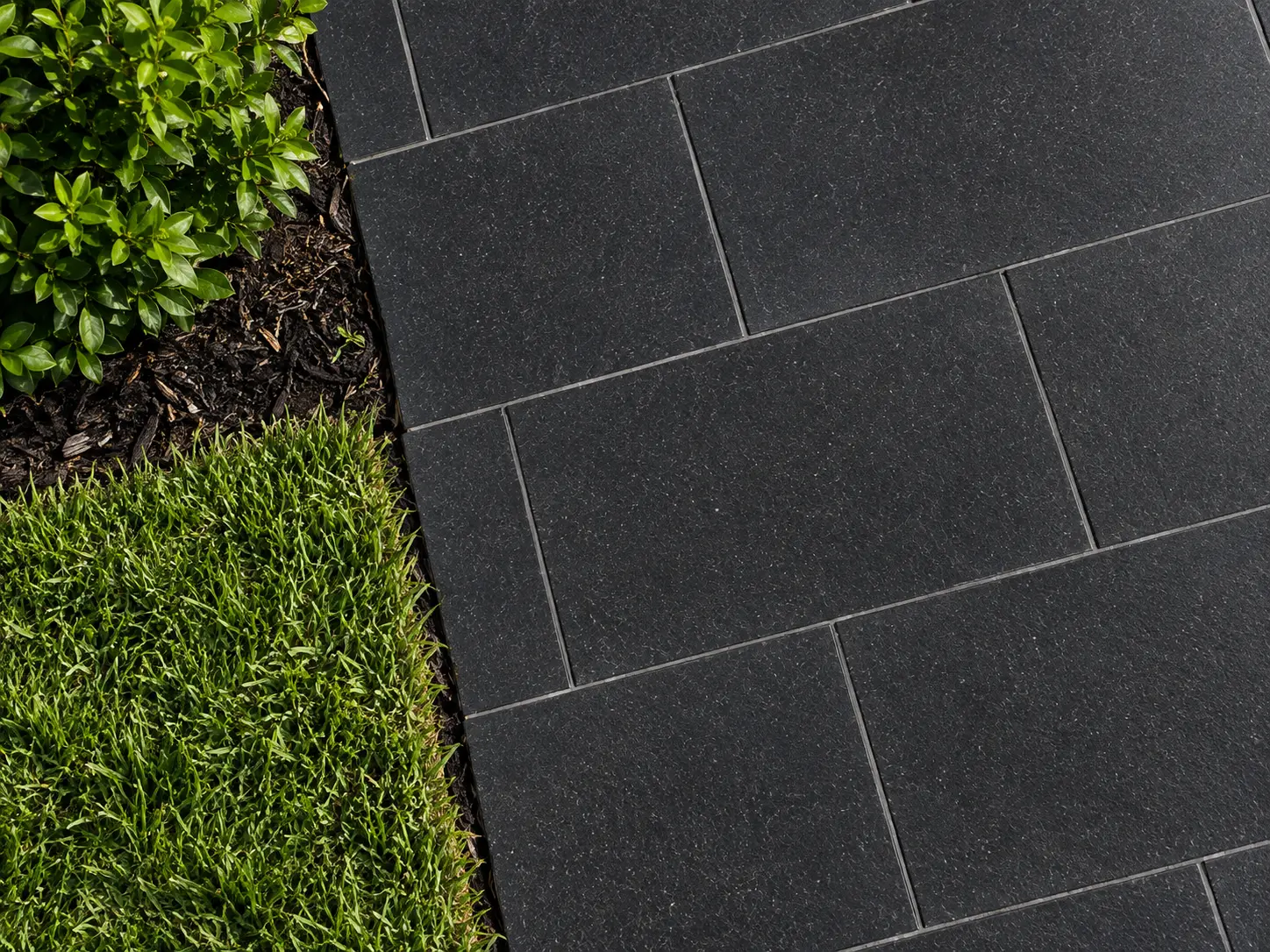
Granite cobble pavers are available in a range of surface finishes that serve different applications. The ASLA guidance on permeable and natural paving materials notes that finish selection affects both surface texture and drainage performance. For outdoor applications — walkways, courtyards, garden paths — a brushed finish at a coarser grit leaves an open, matte texture that suits the application well. A bush-hammered finish leaves a more pronounced, dimpled texture; for pool decks, wet steps and slopes, choose a bush-hammered finish. For other outdoor paths, bush-hammered or brushed in our coarsest grit both work; check a sample.
Concrete cobbles don’t offer the same finish range because the casting process limits surface texture variation to mold geometry. You can get a smooth cast face, a tumbled-edge softened look, or a pressed-aggregate exposed finish — but the depth of choice is narrower than what natural granite delivers. For projects where the visual character of the paving is a design consideration rather than just a utilitarian one, that gap in finish range matters.
Before You Specify
This granite cobble pavers comparison comes down to a few decisions that need to be made honestly before specifying. Your project’s initial budget, expected service life, climate, and maintenance commitment all feed into the right answer — there isn’t a universal winner, only a best fit for your specific conditions. That said, in projects where decades of low-maintenance service is the goal and the site experiences meaningful temperature cycling, granite’s material characteristics are consistently well-suited to the demand. Site access for delivery and offloading arrangements are worth confirming early — lead times and logistics are quoted with the order and confirmed before the delivery date.
As you finalize your specification, related natural stone projects can offer useful parallel insights. For a look at how Citadel Stone materials perform in a complementary application context, a limestone paver project case study illustrates what coordinating a full container delivery from stone selection through to site arrival involves. Over decades of use on driveways and walkways, Citadel Stone granite cobbles typically require far less joint maintenance than concrete alternatives of equivalent size.
Related reading: granite pavers for driveways guide · granite paver color guide · reclaimed granite pavers guide.