

The surface character of brushed basalt pavers is decided before the first paver leaves the quarry — specifically by the grit sequence used during brushing and how many passes the surface receives. That choice shapes everything from how the stone reads visually in different lighting to how the paver behaves under cleaning schedules and seasonal weathering. It is easy to judge basalt on color and size alone, yet two pavers brushed in different grits can look noticeably different under raking afternoon light. Understanding what the brushed finish actually does to the stone’s surface — and what that means for your application — is where a strong specification begins.
What the Brushed Finish Does to Basalt
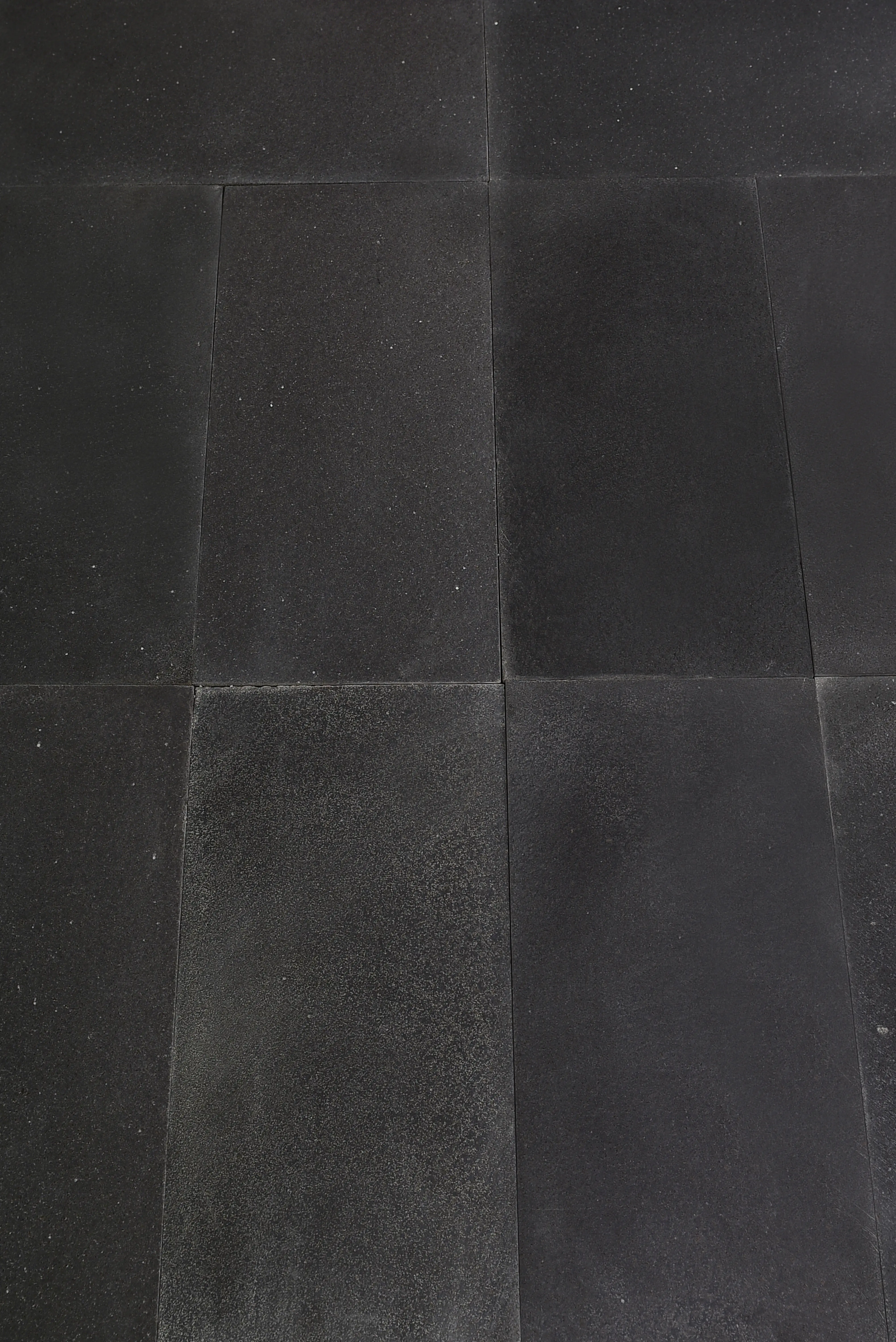
Brushing works the surface of basalt with wire or abrasive rotary tools that scour the crystal matrix without removing a measurable depth of material. The result is a matte, lightly textured face that sits between the glass-smooth plane of a polished finish and the pronounced relief of a bush-hammered surface. You’ll notice the color reads slightly lighter than a honed equivalent — the micro-texture scatters light rather than reflecting it, which softens the stone’s deep charcoal tones and brings forward the natural variation in the mineral grain.
Basalt’s dense, low-absorption structure responds to brushing differently than a sedimentary stone like limestone does. Basalt is a hard, dark volcanic rock (the USGS overview of basalt makes a useful primer), and because its crystal structure is tightly interlocked, the wire brushing raises a gentle tooth without opening pores in a way that significantly changes absorption behavior. The practical implication for your project: brushing changes the look and feel of the surface, not the dense stone beneath it, so the grit you choose is mainly a decision about texture and appearance. If you are weighing how a particular grit will look and wear on your site, our technical team can talk it through.
Coarse vs. Fine Grit: Choosing the Right Surface
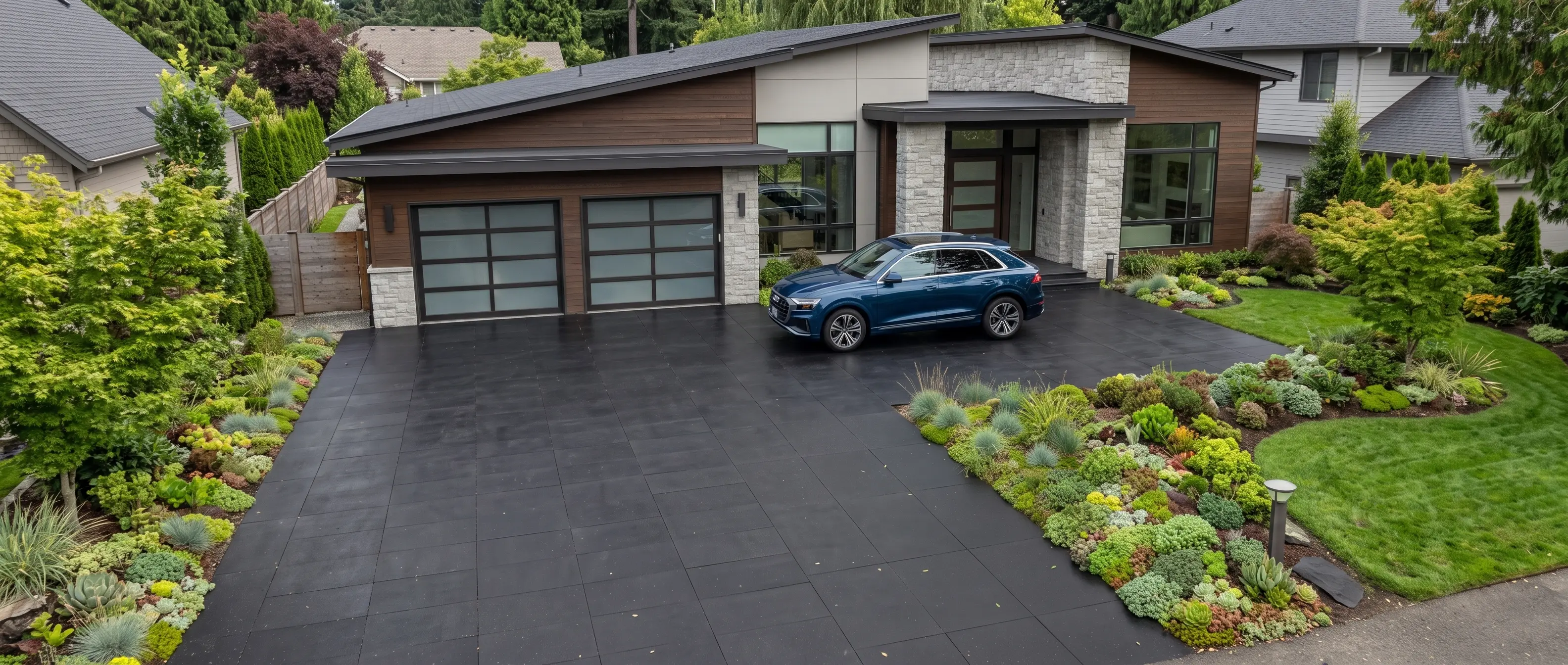
The range between a coarse-grit brushed finish and a fine-grit brushed finish is wider than most project drawings acknowledge. A coarse run leaves an open, matte texture with clearly visible directional striation — you can run a fingertip across it and feel the grain. A fine-grit pass produces a surface that reads almost smooth under diffuse light but still carries enough texture to distinguish it from a honed finish at close inspection. Both are legitimately described as “brushed,” which is why specifying the grit level matters more than the finish label alone. Our brushed family has five grades: Brushed 16 Grit (Rustic & Bold), Brushed 36 Grit (The Balanced Classic) and Brushed 80 Grit (Velvet-Fine), plus two that run the stone through the brushing line twice, Double-Brushed 24 (The Rustic Soft) and Double-Brushed 60 (The Worn-In Soft). 16, 36 and 80 grit are our standard grades, not the only options: the brushes can be set to the grit you specify, including grades finer than 80, and the stone can be brushed twice.
For courtyards, garden paths and driveways (built in the driveway format set out below), 16 grit gives the deepest, most rustic texture we brush. For patios and pool surrounds, 36 grit is the balanced middle grade, clearly antiqued yet comfortable underfoot. For barefoot pool decks and terraces, 80 grit leaves a fine ripple with a soft, suede-like feel, and for contemporary outdoor rooms where the paving is a design feature, 80 grit or finer keeps the clean geometry of the stone’s format in focus while still reading as natural rather than industrial. The double-brushed grades round off the relief: 24 keeps bold texture with a softer touch for terraces and courtyards, and 60 gives our softest brushed feel for interior floors, covered terraces and loggias, pool houses and spas, and bathrooms. To compare every grade with our honed, bush-hammered, split-face and polished finishes, see our full range of finishes. Judge the finish in the actual lighting conditions of the site — a brushed surface that looks warm and rich under indoor lighting can read cool and grey on a north-facing terrace under an overcast sky.
Where Brushed Basalt Pavers Perform Best
Brushed basalt pavers suit outdoor patios, terraces and courtyards, garden paths, pool decks and pool surrounds, sheltered steps, driveways built in the right format, and cladding installations where the matte surface and neutral color palette are design assets. The grit decides which of those jobs a brushed paver does best. The finish works particularly well in contemporary and minimalist landscapes where the stone’s dark, uniform tone anchors the palette without competing with planting or water features.
- Driveways, courtyards and garden paths: Brushed 16 Grit (Rustic & Bold), the boldest brushed texture we make, suits old-world schemes; on a driveway the grit is the surface, not the format, so use setts at least 3.5 in thick on a compacted base, or pavers at least 2 in (5 cm) thick mortar-bonded to a reinforced concrete slab
- Outdoor patios and entertaining areas: Brushed 36 Grit (The Balanced Classic) is the grade most projects land on, and the matte surface reduces glare in full sun, which matters more than specifiers often expect on south-facing spaces
- Garden paths and informal walkways: the brushed texture tolerates leaf debris and organic staining without showing it as obviously as a polished surface would
- Exterior wall cladding and feature panels: the directional texture catches raking light and reads with depth that flat-sawn or honed faces don’t produce
- Pool surrounds: Brushed 36 Grit (The Balanced Classic), the same middle grade we suggest for patios, keeps a clearly antiqued texture that is comfortable underfoot
- Barefoot pool decks and terraces: Brushed 80 Grit (Velvet-Fine), our finest standard grade, leaves a fine ripple with a soft, suede-like feel; where a pool deck needs maximum texture, choose bush-hammered instead
- Terraces, courtyards and covered or interior areas: Double-Brushed 24 (The Rustic Soft) keeps deep relief with softened edges for terraces, courtyards and indoor-outdoor floors, while Double-Brushed 60 (The Worn-In Soft), our softest brushed feel, suits interior floors, covered terraces and loggias, pool houses and spas, and bathrooms
- Exterior steps with covered or sheltered exposure: the texture provides comfortable footing in normal dry conditions; for steps that get wet, a bush-hammered finish is the correct choice
In short: Brushed 16 Grit for driveways, courtyards and garden paths; Brushed 36 Grit for patios and pool surrounds; Brushed 80 Grit for barefoot pool decks and terraces; and Double-Brushed 24 or 60 for terraces, courtyards and covered or interior areas. For pool decks, ramps and wet or public areas where you want maximum texture, and for wet steps and slopes, choose bush-hammered, one of our most textured finishes. Polished belongs on dry indoor surfaces only. Whichever grit you choose, check a sample of it before you order.
Basalt Finish Options Compared
Specifying brushed basalt pavers is easier when you understand where the finish sits in relation to the full finish range. Each option changes the visual weight of the stone, the tactile character of the surface, and the maintenance implications over its service life.
- Polished: reserved for dry indoor surfaces — countertops, vanity tops, fireplace surrounds, and interior floors where a reflective face is the design intent; never appropriate outdoors or in wet applications
- Honed: a flat, matte surface achieved by stopping the grinding process before a reflective sheen develops; smoother than brushed, with a slightly cooler visual tone; Honed 60 Grit (Silky Matte) suits interior floors, cladding and covered patios, and Honed 120 Grit (Silk Matte) suits interiors, bathrooms and wall cladding
- Brushed: wire or abrasive brushing leaves a directional micro-texture and a warm matte face; the working point between honed refinement and the pronounced relief of textured finishes, in Brushed 16, 36 and 80 Grit and Double-Brushed 24 and 60
- Bush-hammered: mechanical or manual peen texturing that produces an open, dimpled surface with high tactile contrast; our pick for pool decks, ramps and wet or public areas where maximum texture is wanted, and for wet steps and sloped outdoor surfaces
- Split face: the stone is split along its natural grain and the fracture itself becomes the face; produced on our black basalt cobblestones for feature walls and cladding, cobble setts and driveways, and garden and retaining walls
The finish choice also affects sealing decisions. A brushed surface sits between honed and bush-hammered in terms of surface openness, so sealer penetration and coverage rates differ from what a polished specification would require. Always confirm sealer compatibility with the actual grit level of your brushed finish, and follow the sealer manufacturer’s reapplication interval.
Thermal Cycling and Freeze-Thaw Performance
Regions with pronounced day-to-night temperature swings — and especially those where the mercury crosses the freeze-thaw threshold repeatedly through a shoulder season — put a specific kind of cumulative stress on paved surfaces that steady-temperature climates don’t generate. Basalt forms when lava cools rapidly at or near the Earth’s surface, which is why it is so fine-grained; for background, see Britannica’s overview of basalt as a volcanic rock. Of the stones we sell, basalt is the one we recommend for freeze-thaw winters: its dense structure takes up less water than more porous stones, and less water in the stone means less water to freeze and expand inside it. In a certified mill test our basalt absorbed 0.59–0.69% water. We do not have a freeze-thaw cycle rating for our stone; we publish its measured absorption instead.
The joints and setting bed, however, are where freeze-thaw damage most commonly originates. A polymeric sand joint or mortar joint that is not fully sealed against water ingress becomes the weak point when temperature cycling is severe. Your specification should call for a joint compound rated for the freeze-thaw conditions expected at your project’s latitude, and the expansion joint spacing should be designed by your installer or structural engineer for the size of the paved area and the temperature range on site. Do not use a generic rule of thumb for joint spacing in a climate where diurnal temperature ranges are wide; the arithmetic matters.
Thermal cycling also affects installation scheduling. Setting materials — mortars and adhesives — have stated working temperature ranges, and pushing an installation when overnight temperatures are forecast to drop sharply compresses the cure window in ways the printed schedule doesn’t account for. Work to the setting material manufacturer’s temperature specifications, not to project deadlines alone. A paver set in marginal conditions and subjected to a hard frost before cure is complete can lose bond integrity that won’t become visible until the following season.
Sizing, Thickness, and Layout for Brushed Basalt Pavers
Standard formats for outdoor brushed basalt paver installations typically run from small modular tiles through to large-format slabs, with thickness determined by load class and base type. For pedestrian-only patios, paths, pool decks and pool surrounds, 3 cm (1¼ in) pavers are the usual choice. Driveways and vehicular access routes need a different build: setts or cobbles at least 3.5 in (4 in standard) thick on a compacted base, or pavers at least 2 in (5 cm) thick mortar-bonded to a reinforced concrete slab. A Brushed 16 Grit face suits a driveway, but the grit is the surface, not the format: the thickness and build above still apply. Ask our technical team about the right thickness for your loads; your installer or engineer designs the base and bedding.
- Confirm nominal thickness against the point-load requirements of the application before ordering
- Specify consistent bed depth across the installation to avoid differential settlement, particularly where large-format brushed basalt pavers span areas with variable sub-base compaction
- Account for grout joint width in your layout calculation — brushed basalt’s crisp-sawn edges allow tight joints, but the joint width still affects the finished module dimension across large areas
- In running-bond or stacked patterns, the directional striation of the brushed finish can emphasize or counteract the joint pattern depending on orientation — lay a few pavers out dry on site to check the effect before committing
- For wall cladding applications, thickness is driven by fixing method and wind-load engineering, not by foot-traffic considerations
You can explore the full range of formats and slab dimensions available from Citadel Stone through Basalt Pavers, where cut-to-size options for outdoor and cladding applications are detailed. Citadel Stone stocks material at its selected quarries from the Middle East and cuts orders to the specified dimensions, so format and thickness can be matched to the project drawing rather than adjusted to fit a fixed stock size.
Specifying Brushed Basalt Correctly
The most useful line in a brushed basalt specification isn’t the finish name — it’s the grit. Finish labels are category descriptors, not precision specifications: a coarse-grit and a fine-grit brushed paver are both “brushed,” yet they look and feel quite different. Naming the grit, the format and the texture range you will accept keeps the order matched to the design intent.
- Match the finish to each area: Brushed 16 Grit for driveways, courtyards and garden paths, Brushed 36 Grit for patios and pool surrounds, Brushed 80 Grit for barefoot pool decks and terraces, Double-Brushed 24 or 60 for terraces and covered or interior areas, bush-hammered for wet steps and slopes and wherever maximum texture is wanted, and polished only for dry indoor surfaces
- Specify the grit by name in the written specification (for example Brushed 36 Grit or Double-Brushed 60), not just the finish name
- Choose the grit with the site’s lighting in mind — north-facing and south-facing elevations read the same stone very differently
- Include a colour and texture range clause in the specification: natural stone will exhibit variation, and the specification should define acceptable limits rather than expecting uniformity
- For measured figures such as density and water absorption, ask us for our basalt test summary
Natural stone properties vary with the quarry and with the way the stone is processed, so it pays to work from figures measured on the stone you are specifying rather than from generic tables; the Natural Stone Institute’s guide to stone varieties is a useful general reference. At Citadel Stone, our technical team can walk through finish and grit options and our basalt’s measured figures with you, so the approval process rests on data rather than assumptions.
Sealing and Maintenance for Brushed Basalt Outdoors
Basalt is among the denser, lower-absorption natural stones used in outdoor paving, which means a surface sealer adds a layer of protection without struggling to penetrate a deeply porous matrix. The brushed surface does have slightly more exposed surface area than a honed equivalent, so sealer coverage rates and penetration depth will differ from what a polished spec would require. Confirm coverage rates with the sealer manufacturer for a brushed igneous surface specifically — not for natural stone generically.
Maintenance intervals depend on sealer type, climate, and use intensity. A trafficked outdoor terrace in a region with strong UV exposure and seasonal rain will deplete sealer protection faster than a lightly used garden path in a temperate climate. Follow the sealer manufacturer’s stated reapplication interval rather than a fixed annual schedule — some penetrating sealers on basalt perform well beyond twelve months; others in high-UV, high-traffic situations require more frequent attention. The test is whether water still beads on the surface; when it starts to absorb, the reapplication window has arrived.
- Clean brushed basalt with pH-neutral stone cleaners — avoid acidic or bleach-based products that can alter the mineral surface over repeated use
- Organic debris (leaves, moss, algae) accumulates more visibly in the brushed texture’s micro-grooves than on a polished surface — a periodic stiff-brush wash prevents buildup from staining
- In freeze-thaw climates, use the least de-icer you need, with joint and bedding materials rated for de-icing salt, and in spring sweep up winter grit and rinse away any salt residue so it does not collect in the joints
- Re-fill polymeric sand joints where settlement or washout has occurred; a shallow joint is the entry point for water that causes freeze-thaw joint damage over successive winters
Delivery and Project Planning
Brushed basalt pavers are a dense material — a pallet of full-size outdoor pavers carries meaningful weight, and your project site’s access conditions directly affect how delivery can be staged. Confirm turning radii, overhead clearances, and unloading-zone proximity to the installation area before finalizing the delivery schedule. Offloading arrangements are confirmed before the delivery date, and lead times are quoted with the order — delivery is arranged and managed by Citadel Stone and will be confirmed at the time of purchase.
Storage on site requires a dry, flat surface and careful stacking to avoid edge chipping on the brushed faces. Basalt’s density means even minor edge contact under a shifting stack can produce visible damage on the finished face. Stack pallets on solid ground, keep them covered if rain is forecast, and plan the delivery sequence so the earliest-needed pavers are accessible without moving others. For large installations, phased delivery aligned to installation progress is often more practical than a single full-delivery drop.
Getting Your Brushed Basalt Paver Specification Right
Your specification for brushed basalt pavers is only as precise as the finish description it contains. Naming the finish category gets you into the right material family; specifying the grit level, matching the format and thickness to each use, and checking the measured figures for our basalt gets you to an installation that performs as designed. The finish is the variable that connects visual intent to field performance — it deserves as much attention in the specification as thickness and base design do. As you plan complementary stone features for interior spaces, basalt fireplace surround options show how the same material reads in a controlled interior setting, which can inform your color and finish decisions across the wider project. Citadel Stone offers its basalt pavers brushed in several grits, from coarse to fine, so the surface texture can be matched to each outdoor scheme.
Related reading: Basalt Rock Type Explained: Which Grade Suits Your Project · How Basalt Is Formed — And Why It Makes Better Pavers.