

A black basalt fireplace surround comes down to three decisions: the finish, the size of each piece, and how the pieces are fixed. All three need settling before a single cut is made. The finish you choose — honed, brushed, or polished — sets how the stone reads in the room and under firelight, and it is hard to change once the slab is cut and set. Specifying your surround before you’ve resolved finish, thickness, and joint detail is the fastest route to a result that looks misaligned on the wall, regardless of how well the stone itself performs.
Why Black Basalt Works for Fireplace Surrounds
Black basalt carries a density and mineralogical uniformity that most sedimentary stones can’t match at the decorative surround level. Its crystalline, fine-grained volcanic structure produces a surface that stays visually consistent across large format pieces — you’re not managing the tonal shifts and markings common in darker limestone. For a black basalt fireplace surround where the wall composition is typically symmetrical, that consistency is a design asset, not a limitation.
The material’s colour depth also responds differently to ambient and focused light than lighter stone options. A honed black basalt fireplace surround in a room with angled spotlighting reads as a near-matte charcoal. Under warm firelight, the same surface takes on a softer, warmer dark grey. Set against pale walls, that change in tone is what gives a dark surround its depth. It’s the kind of material behaviour that photographs don’t fully capture until you see it in place.
- Uniform fine-grained texture reduces the visual noise on large surround panels
- Low water absorption compared to many sedimentary stones reduces the risk of absorbed stains at hearth level
- Consistent colour across the slab face simplifies bookmatching on wider chimneybreasts
- Dense volcanic structure allows clean arrised edges without the micro-chipping risk of softer materials
Finish Options and What They Actually Look Like
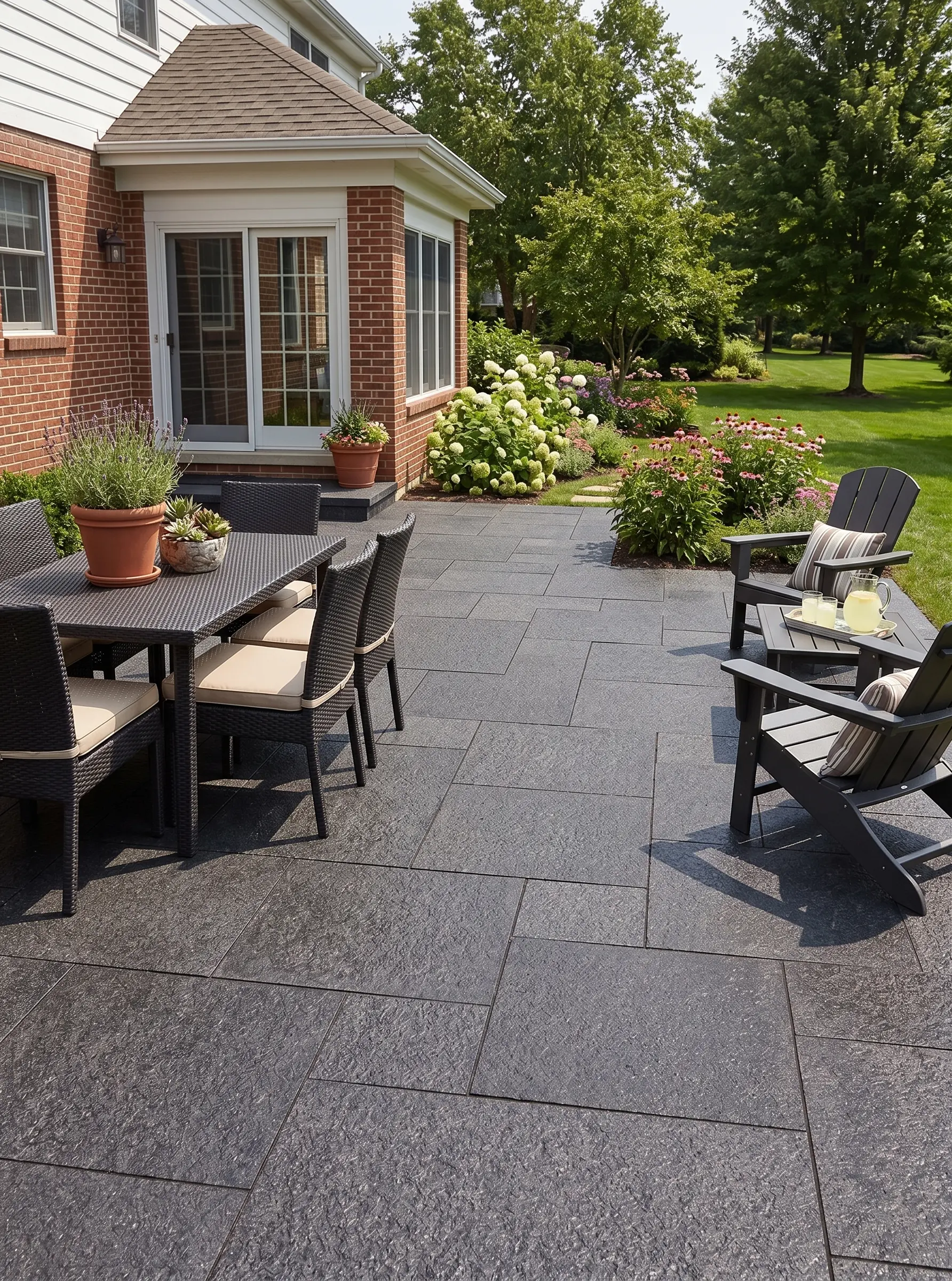
Your finish choice governs the entire visual register of the installation — more than piece size, more than joint width. For a black basalt fireplace surround used indoors on a dry vertical or horizontal surface, three finishes are realistic candidates: honed, double-brushed and polished. Each produces a fundamentally different surface character. An exterior surround is a different brief, covered below.
A honed finish grinds the face flat to an even matte with no gloss. Honed 60 Grit (Silky Matte) is the most popular choice for contemporary and transitional interiors because it reads clean without the formality of a high-gloss surface; Honed 120 Grit (Silk Matte) takes the same flat face one refinement further, to a finer matte that feels smooth under the hand. Honed basalt shows an even, dark charcoal tone without glare. A polished finish is appropriate for dry indoor surfaces like a fireplace surround and hearth; it deepens the colour toward black and adds a reflective sheen. If you want texture indoors, Double-Brushed 60 (The Worn-In Soft) runs the brushing line twice: the second pass rounds off the relief the first pass opened, leaving a gently worn-in face that reads antiqued in raking light yet stays soft to the touch, which suits older architectural styles.
An exterior fireplace surround calls for more texture. Split Face is the finish our range lists for exterior fireplace surrounds: the block is split along its natural grain and the fracture itself becomes the face, so no two pieces repeat and the ridges throw shadow lines as the light moves. Where you would rather have an antiqued texture than a raw rock face, choose a brushed grit — Brushed 16 Grit (Rustic & Bold), Brushed 36 Grit (The Balanced Classic) or Brushed 80 Grit (Velvet-Fine). Those three are our standard grades, not the only options: brushing can be set to the grit you specify and run twice for a softer feel. To compare them side by side, see our full range of finishes.
- Honed 60 Grit (Silky Matte): matte with no gloss and an even charcoal tone, suits contemporary and minimalist interiors
- Honed 120 Grit (Silk Matte): the same flat face taken one refinement further, for a finer, smoother matte
- Polished: for dry indoor surfaces only; deepens the colour and adds a reflective sheen
- Double-Brushed 60 (The Worn-In Soft): a softer, worn-in texture for an indoor surround, suits traditional and rustic settings
- Split Face or a brushed grit (16, 36 or 80): for exterior fireplace surrounds
- Bush-hammered: a uniform pocked texture, best kept for pool decks, ramps and wet outdoor areas rather than an indoor surround
Finish also affects day-to-day care. Smooth honed and polished faces wipe clean with a damp cloth, while a brushed or split face is best cleaned with a soft brush that reaches into its texture.
Sizing the Surround and Hearth Correctly
Your surround dimensions are not independent of the appliance — they’re determined by it. The fireplace or appliance manufacturer’s clearance specifications, combined with local building code, define the minimum return distances from the firebox opening. Those clearance requirements are set by the manufacturer and the authority having jurisdiction: they aren’t a stone specification question, and no stone property overrides them. Get the appliance manual and your local code in front of the tile setter before anything is templated.
What the stone specification does control is thickness and layout geometry. A black basalt fireplace surround on a vertical pilaster run is typically cut from slab — the thickness you specify has to carry the panel width across its span without flex at the fixing points. Your installer needs to account for the substrate flatness, the setting bed depth, and the fixing method before nominal thickness is finalised. For hearth stones cut from black basalt slab, the piece sits in a horizontal plane and takes point loads from foot traffic; thickness here is a structural question specific to the span and substrate, and it belongs in a conversation with your installer, not in a generic spec sheet.
- Always obtain appliance clearance specifications before templating
- Check local building code for minimum hearth extension dimensions from the firebox
- Confirm substrate flatness — basalt’s rigidity means it won’t bridge an unlevel substrate
- Specify thickness by application (vertical surround vs horizontal hearth) with your installer
- Allow full cure before the fireplace or appliance is used — follow the setting material manufacturer’s stated cure period
Design Ideas for Black Basalt Fireplace Surrounds
The design range for a black basalt fireplace surround is wider than most homeowners initially anticipate. The instinct is to pair a dark stone with a dark room, but the material reads most dramatically against pale, warm neutrals — raw linen plaster, white oak millwork, or washed limewash walls. The contrast ratio is what creates visual depth; a black basalt surround on a dark feature wall compresses rather than amplifies the effect.
Large-format panel layouts — fewer joints, wider spans — emphasise the stone’s tonal uniformity and give a monolithic quality that suits statement chimneybreasts. Tighter coursed layouts with deliberate joint lines create a more architectural, structured reading that works well in rooms with a stronger traditional character. You can also use the basalt fireplace hearth as the visual anchor and carry a complementary lighter stone or tile up the breast above the surround, letting the basalt define the lower register without dominating the full wall height.
- Pair with pale or warm-neutral walls for maximum contrast impact
- Large format, minimal-joint layouts suit contemporary and modernist interiors
- Tight coursed layouts with visible joints suit traditional and Arts and Crafts styles
- Consider continuing basalt as the hearth only, with a contrasting material above the lintel
- A black basalt fireplace surround with a brushed finish works particularly well alongside reclaimed timber mantels
When you’re reviewing the design options, our solid basalt stone selection shows the slab and tile formats available, which helps you assess which layout proportions are achievable from stock dimensions before you commit to a cutting plan.
Ordering Cut-to-Size Basalt for Your Project
Black basalt fireplace hearth and surround pieces are cut from slab, not stocked as pre-formed units. That means your order starts with accurate templating — dimensioned drawings that account for the firebox opening, the return distances, the substrate profile, and any recesses or reveals in the chimneybreast. Citadel Stone cuts to order at our selected quarries; the cut plan is confirmed against your dimensions before the order proceeds.
Lead times are quoted with the order and depend on slab availability and cut complexity. Your project’s site access may affect delivery scheduling — confirm offloading arrangements with your contractor before the delivery date is locked in, since slab pieces for fireplace surrounds are heavy and typically require mechanical assistance or at minimum a two-person lift.
- Provide fully dimensioned drawings, not verbal measurements
- Account for appliance clearances in the cut plan — not just aesthetic proportions
- Confirm access for delivery and offloading at the project site before the order is placed
- Order a small test piece or request a sample to confirm finish and colour match in situ
The USGS data on basalt volcanic rock properties and composition gives useful background on why basalt’s density and crystalline structure make it behaviourally different from sedimentary stone options — relevant context when you are comparing materials before committing to a specification.
Sealing and Long-Term Care
Black basalt’s absorption characteristics are lower than most sedimentary stones, but a sealer is still the right call for a fireplace surround and hearth application. The hearth in particular is exposed to soot, ash, and cleaning agents — a penetrating impregnating sealer creates a barrier that makes routine cleaning far more manageable without altering the surface appearance. Apply the sealer to clean, dry stone and follow the manufacturer’s stated cure time before the surface is put back into service.
Resealing interval is determined by the sealer manufacturer’s guidance and your usage pattern, not by a fixed calendar date. A high-use wood-burning hearth needs more frequent attention than a gas fireplace with a decorative basalt fireplace hearth that’s rarely exposed to debris. Run a water-drop test periodically: if water beads on the surface, the sealer is active; if it absorbs quickly, it’s time to reseal. Cleaning between sealing cycles should use a pH-neutral stone cleaner; strong acidic or alkaline products wear the sealer down faster and can leave a honed or polished face looking patchy.
- Apply a penetrating impregnating sealer to clean, dry stone before first use
- Follow the sealer manufacturer’s stated reapplication interval, not a generic schedule
- Use pH-neutral cleaners for routine maintenance
- Test water absorption periodically with a water-drop test to assess sealer performance
Comparing Basalt to Other Fireplace Surround Materials
The comparisons that come up most often are black basalt against black granite and against dark limestone. Granite shares basalt’s igneous origin and dense crystalline structure, but its coarser grain produces a more pronounced mineral pattern — flecks and veining that some designers read as visual noise on a surround panel. Basalt’s finer grain produces a cleaner, more uniform face. The Britannica entry on basalt volcanic rock formation sets out the compositional distinctions clearly: basalt’s rapid-cooling origin produces a finer crystal matrix than the slower-cooling intrusive granites, and that structural difference is directly visible in the finished surface.
Dark limestone is softer than basalt, and because it is a calcareous stone, acidic spills and cleaners can etch it, which adds upkeep on a hearth where scuffs and stains are part of daily use. For a statement surround that frames the fire rather than competing with it, and a hearth that holds up to practical use, black basalt is a well-reasoned choice. The trade-off is that its appeal is a quiet, even tone: if you want bold veining or strong movement across the wall, basalt is not the stone for it. To browse the other stones on your shortlist, the Natural Stone Institute keeps a guide to natural stone varieties.
- Basalt vs granite: basalt has a finer, more uniform grain; granite has more visible mineral variation
- Basalt vs dark limestone: basalt is harder and far less sensitive to acidic spills
- Basalt vs slate: both are dark and fine-grained, but slate’s cleavage planes create a different layered texture
Parting Guidance
A black basalt fireplace surround is a considered, long-term specification — not a purchase you revisit in five years. Getting it right means resolving the appliance clearances and local code requirements before anything is templated, selecting a finish suited to your interior’s light conditions and maintenance expectations, and ordering to accurate dimensions from a supplier who cuts to order rather than to a generic catalogue size. Once it is set correctly, a basalt surround asks for little more than routine cleaning and a fresh coat of sealer whenever the water-drop test calls for it.
As you develop the specification for your fireplace wall, it’s also worth considering how the basalt treatment continues beyond the immediate surround — black basalt used for wall cladding in the broader room can extend the design language without repeating it. For a closer look at how this material performs across interior and exterior wall applications, black basalt wall cladding applications covers the specification considerations for both contexts in useful detail. Natural black basalt from Citadel Stone brings a deep, dark tone to a fireplace wall, cut to order at our selected quarries.
Related reading: choosing a black basalt slab · honed black basalt finish · black basalt slab care.