

Marble pavers cost more than most natural stone alternatives at the outset, but the variable that actually determines your total project spend isn’t the material price — it’s the combination of slab thickness, finish type, layout complexity, and the base preparation your site demands. Specifiers who focus only on the per-square-foot marble pavers cost figure routinely undershoot their budget by a wide margin because they haven’t accounted for the full specification picture. Understanding how each cost driver stacks up gives you a realistic number before you commit to a material or a contractor.
What Drives Marble Paver Pricing
Marble pavers pricing factors fall into two broad categories: material variables and project variables. Both affect your final installed cost, and neither operates in isolation. The material side includes stone variety, finish, thickness, and dimensional tolerance — all of which are set at the quarry and fabrication stage. The project side includes base preparation depth, mortar bed type, joint treatment, drainage engineering, and labor rates for your contractor.
Stone variety is the single largest material variable. White and cream marbles tend to command a higher price than grey or beige options simply because demand for lighter tones in contemporary and transitional design is consistently strong. Veined varieties with tight, even patterning cost more than stones with irregular or cloudy veining because yield rates at the quarry are lower — more stone is cut away to achieve a consistent visual output. You should treat color and veining as specification decisions that have direct pricing consequences, not just aesthetic preferences.
Finish is the other major material cost lever. A honed finish is the baseline — it’s the most common surface treatment for exterior paving applications and carries a standard processing cost. Polished finishes add a step and add cost, though polished marble is less common outdoors because the surface texture becomes a wet-weather management consideration. Brushed and tumbled finishes involve additional mechanical processing that also adds to the per-unit cost. Each finish also changes the stone’s surface texture in ways that matter for maintenance planning, which is a separate but related specification decision.
Marble Paver Thickness and What It Costs You
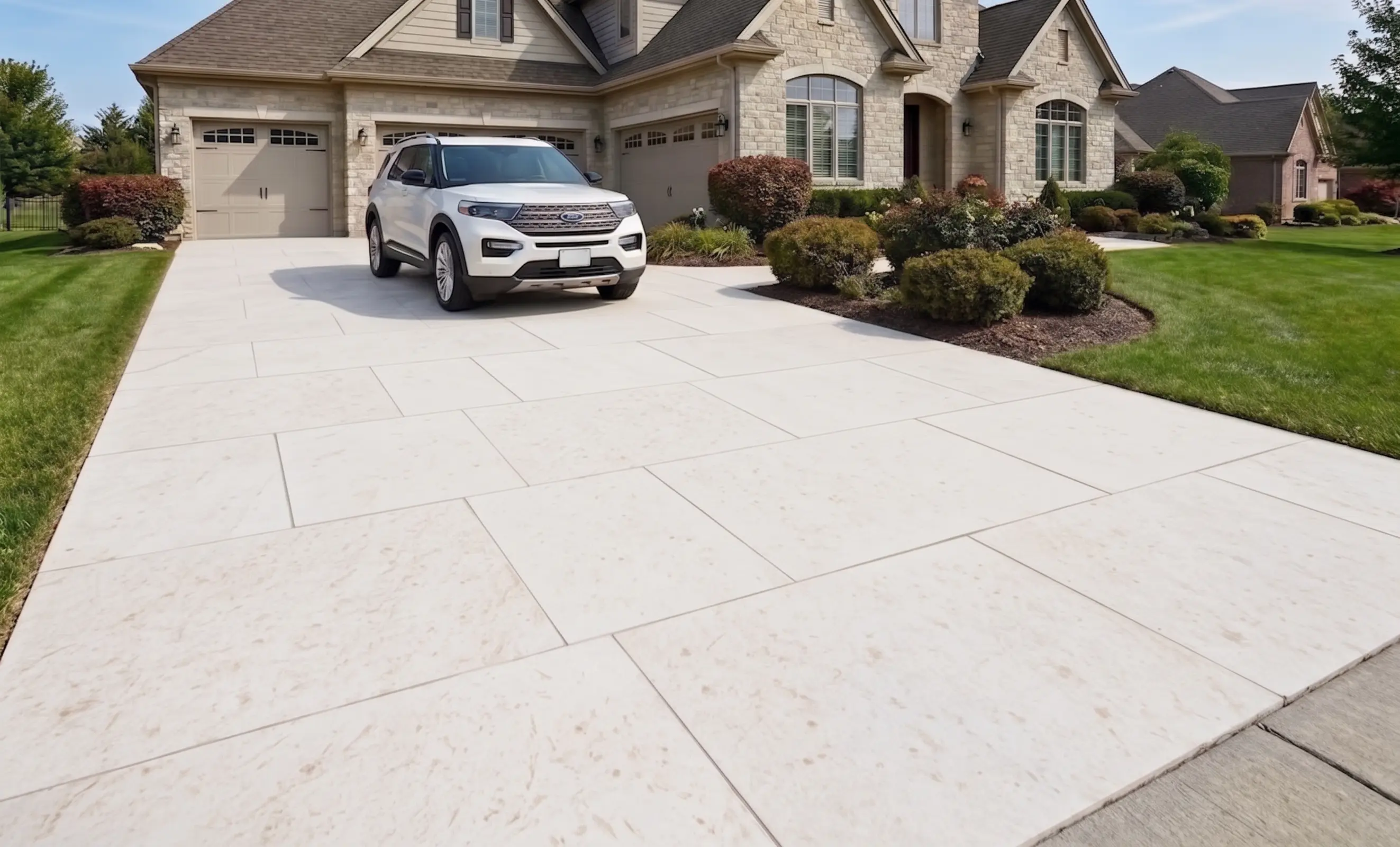
Thickness is a specification decision that affects both material cost and installation labor. Thinner pavers — typically in the 2cm range — suit interior flooring applications over a solid substrate, but exterior paving over a compacted aggregate base almost always calls for a nominal 3cm thickness. The structural logic is straightforward: outdoor installations carry point loads from foot traffic, furniture, and in some cases light vehicle use, and a thinner paver is more vulnerable to flexural stress, particularly across any base movement that occurs through thermal cycling or soil settlement.
- Thicker pavers carry a higher per-unit material cost but reduce the risk of cracking from uneven base support
- A 3cm specification adds weight per pallet, which affects delivery logistics and may require mechanical offloading at your site
- Consistent calibration across a pallet reduces lippage risk during installation and tightens labor time for bedding
- Mixing thickness tolerances from different sources creates installation problems that cost more to fix than the savings justify
Your base preparation depth must be calculated against your paver thickness and the bedding layer specification. A change in nominal thickness ripples through the entire installation stack — it’s not a detail you can adjust late in the process without reworking the subgrade. Lock in your thickness specification before your contractor prices the groundworks.
Material Cost Ranges for Marble Pavers
Marble pavers cost figures vary widely across the market, and price ranges shift depending on origin, variety, and finish. The Natural Stone Institute marble grades and technical specifications distinguish between grades that affect both visual consistency and structural suitability for different applications — and grade directly influences what you pay. Premium-grade material with tight veining and high color consistency sits at the top of the range; commercial-grade material with more variation in tone and veining sits lower.
At the quarry-to-buyer level, marble pavers pricing factors also include the stone’s country of origin and the logistics chain from quarry to project site. Stones from well-established marble-producing regions carry different supply chain structures than stones sourced from emerging quarries, and both affect landed cost. You should request a delivered price that includes all freight and handling to your delivery point — comparing ex-works prices across suppliers without freight comparisons is not a useful exercise.
For marble pavers cost in a realistic project context, you’ll want to see a cost-per-square-foot figure that specifies thickness, finish, and any size premium for large-format cuts. Large-format pavers — anything above 24 inches on the long dimension — carry a yield premium at the fabrication stage and often a freight premium because of packing requirements. Factor those in before comparing prices across suppliers at face value.
Installation Labor Costs and Site Variables
Labor is typically the largest single line item in a marble paver installation budget, and it’s the one most subject to site-specific variation. A straightforward rectangular patio on a flat site with good access will come in at a lower labor rate than a curved pool surround on a sloped lot with restricted access and complex drainage requirements. These aren’t edge cases — most real projects have at least one complicating variable that pushes labor cost above a baseline estimate.
Layout pattern is a major labor variable. A straight-coursed grid is the most efficient pattern to install. A diagonal offset, a herringbone, or a mixed-format layout all require additional cutting time, higher waste allowances, and more skilled positioning at every joint. Your installer’s labor rate should reflect the pattern complexity, and your material order should include a waste factor that accounts for cuts — a figure your installer can calculate from the layout drawing.
- Base preparation labor includes excavation, grading, compacted aggregate placement, and any drainage engineering the site requires
- Mortar bed work adds time over a sand-set installation, but is generally required for exterior marble paving to control differential movement
- Cutting labor increases with pattern complexity and with the number of perimeter cuts around obstacles or curved edges
- Jointing and sealing add a finishing stage that is sometimes quoted separately — confirm with your contractor what is and isn’t included
Delivery logistics also affect installation cost indirectly. Your site’s access constraints determine how pallets are offloaded and how far they need to be moved to the installation area. Sites with limited access may require a smaller delivery vehicle or a crane-assisted offload, which adds cost. Confirm access constraints with your contractor before delivery is scheduled so the offloading plan is settled in advance.
Sealing and Long-Term Maintenance Budgets
Marble is a calcium carbonate stone, which means it is reactive to acidic contact and moderately absorbent depending on its density and finish. Sealing is not optional for exterior installations — it’s a maintenance requirement that belongs in your project budget from day one. According to ASTM C503 marble building stone specification, dimensional marble must meet defined absorption and physical property thresholds, but even compliant stone benefits from sealer protection in outdoor environments where moisture, organic staining, and freeze-thaw cycling are factors.
The sealing interval depends on the sealer product, the finish, and the traffic level of the installation. Polished surfaces typically require re-sealing more frequently than honed or brushed surfaces because the denser finish wears differently. Your sealer manufacturer’s stated interval is the governing figure — not a generic rule of thumb. Budget for re-sealing as a recurring maintenance cost, not a one-time installation expense.
For ongoing maintenance, your cleaning protocol matters as much as your sealer choice. Acidic cleaning agents — including many common household cleaners — will etch marble’s calcium carbonate surface. Use pH-neutral stone cleaners and test any new product in an inconspicuous area before full application. This is a detail that often gets missed in handover documentation between installer and homeowner, and it’s worth putting in writing.
How Landscape Design Influences Your Marble Paver Selection
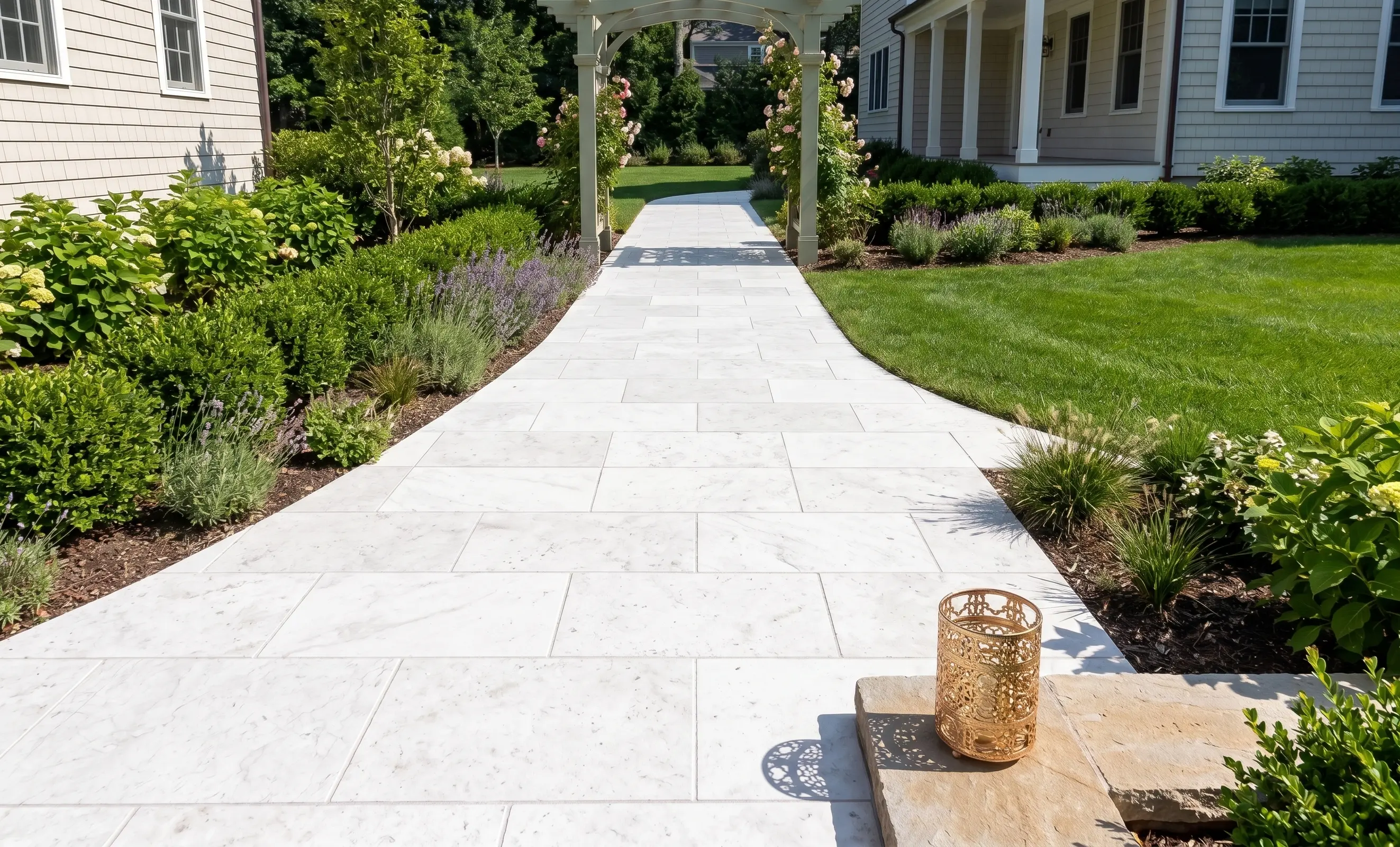
The design context your marble paving sits within shapes both material selection and finish choice — and those choices have direct pricing consequences. A formal garden with clipped hedging and symmetrical planting responds well to a polished or honed marble in a pale, consistent tone, and that specification sits at the upper end of the marble pavers cost range. A looser, naturalistic planting scheme or a desert-influenced xeriscaping layout may call for a more textured finish and a stone with more tonal variation, which can bring the material cost down while still delivering a high-quality result.
Contemporary minimalist exteriors — clean lines, minimal planting, strong geometric forms — typically favor large-format marble pavers in a single consistent tone laid in a straight grid. That format premium pushes unit cost up but reduces the number of joints and cutting operations, which can offset some of the material premium in labor savings. Traditional or colonial landscape settings often work with smaller-format pavers in a wider color range, which lowers the material cost per unit but may increase installation time for pattern work.
- Warm-toned marbles integrate naturally with terracotta, sandstone, and timber landscape elements
- Cool white and grey marbles read well against dark planting and modern architectural finishes
- Veined marble adds visual movement to large flat surfaces, reducing the need for additional landscape features to create interest
- Tumbled or brushed finishes suit informal and traditional garden styles and carry a surface texture that reads as appropriately aged in heritage landscape contexts
The landscape style you are working within should be part of the specification brief from the start, not an afterthought. Choosing a finish for aesthetic reasons alone without understanding the maintenance implications of that finish in an outdoor context is a common specification gap. For a comparison across stone types at different price points, Citadel Stone paver pricing details provides a useful reference across natural stone options.
Comparing Marble to Other Natural Stone Pavers on Cost
Marble pavers cost more per square foot than most limestone and travertine options at comparable thickness and finish grades. The premium reflects marble’s metamorphic density and the processing precision required to achieve consistent dimensional tolerances — particularly for large-format cuts where any variation in calibration becomes visible across the finished surface. Against granite, marble typically sits in a comparable or slightly lower price range depending on variety, though granite’s higher hardness rating means it carries different long-term maintenance characteristics.
Travertine is the most common point of comparison for marble in exterior paving specifications. The Britannica marble geological formation and characteristics resource makes clear that marble and travertine share a calcium carbonate base but differ significantly in formation process, porosity structure, and surface behavior — differences that have practical implications for installation method, sealing requirement, and long-term performance. Travertine’s open-pore structure requires filling before sealing and carries different absorption characteristics than dense marble. Those differences should inform your material choice, not just the price comparison.
For high-visibility applications — pool surrounds, primary entertaining terraces, formal entry courts — marble’s visual premium over limestone and travertine is often a specification justification in itself. For secondary pathways, utility areas, or large-area ground covers where square footage drives cost, a limestone or travertine specification at a lower price point may serve the design intent equally well. Knowing where marble earns its premium in your specific project is the practical cost management question.
Ordering and Logistics: What to Budget For
Your delivered cost for marble pavers includes material, international freight, port handling, and domestic delivery to your project site. Each stage carries its own cost structure, and lead times are quoted with your order — not assumed from a standard schedule. Projects that need material on a tight timeline should confirm lead time as part of the order discussion before committing to an installation date with a contractor.
Citadel Stone stocks marble paving material at our selected quarries and cuts to order, which means your specification — thickness, finish, format, and quantity — is confirmed before production. That process protects dimensional consistency across your order but requires adequate lead time between order placement and delivery date. Building that window into your project program is a basic planning step that avoids the cost and delay of expediting.
- Order quantities should include a waste allowance calculated from your layout drawing — typically between eight and twelve percent depending on pattern complexity
- Pallet weights for 3cm marble pavers are substantial — confirm your site’s offloading capacity before delivery is scheduled
- Delivery is arranged and managed by Citadel Stone and quoted with the order — there is no fixed lead-time promise independent of your specific order configuration
- Any access restrictions at your site that affect delivery vehicle size should be communicated at the order stage
One detail that consistently affects project budgets is the cost of returns or replacements for material ordered in the wrong quantity. Over-ordering creates surplus you can’t use; under-ordering creates a reorder delay that may halt an installation mid-sequence. Your installer’s waste factor calculation, combined with a confirmed site dimension survey, is the foundation of an accurate quantity order.
Professional Summary
Marble pavers cost is a multi-variable figure that only resolves into an accurate project number when you’ve locked in stone variety, finish, thickness, format, waste allowance, base preparation requirements, and your contractor’s labor rate for the specific layout pattern. Treating any one of those variables as an assumption rather than a confirmed figure introduces budget risk. The specification decisions that most commonly drive cost overruns are finish upgrades chosen late, layout pattern changes after material is ordered, and base preparation scope that wasn’t confirmed by a site investigation before the contract was signed.
Your maintenance budget over the installation’s service life is also part of the total cost picture. A marble paver installation that is properly sealed, cleaned with pH-neutral products, and resealed on the interval your sealer manufacturer specifies will provide decades of service in most exterior environments. One that is left unsealed or maintained with the wrong chemistry will show surface degradation much sooner — and remediation costs more than prevention. As you evaluate your overall stone specification, it’s worth exploring how other natural stone materials perform in related applications; our resource on grey basalt tile finishes and pairings covers a complementary hardscape option worth considering alongside marble. Pavers from Citadel Stone are available in calibrated thicknesses, helping installers plan bedding depth and labor budgets accurately.
Related reading: white paver design ideas · Marble Paver Cost Comparison: What Moves the Price? · Snow Stone Pavers vs Marble: Bright Surface Guide.