

Travertine pavers carry a specific structural signature that most material guides gloss over — the pore network running through the stone isn’t a flaw, it’s a direct record of the hot-spring environment where calcium carbonate precipitated rapidly around escaping gas. Understanding what travertine pavers are at a geological level matters for specification because the size, distribution, and connectivity of those voids vary between quarry beds, and those variables directly affect how you finish, fill, and seal the material for your application. Most buyers focus on color and finish before they understand the underlying geology, and that sequencing leads to specification errors that show up six months after installation.
How Travertine Forms: The Geology Behind the Pores
Travertine is a sedimentary limestone, but its formation pathway separates it from reef limestones and other carbonate rocks. It precipitates from hot or warm spring water supersaturated with dissolved calcium bicarbonate. As that water reaches the surface and carbon dioxide degasses, calcium carbonate drops out of solution and accumulates in layered bands. The gas escaping during precipitation leaves behind the characteristic voids — tubular or irregular cavities that run parallel to the bedding planes and, in some beds, through them.
Those voids are the defining structural feature you need to understand before you select a finish. The porosity level, measured through ASTM C97, determines how aggressively the stone absorbs water and sealer — request the test report from your supplier before committing to a pool deck or exterior patio specification. According to USGS geological data on limestone and travertine mineral formation, travertine’s banded structure and variable void content distinguish it from denser carbonate formations, and that distinction carries directly into performance outcomes on site.
The banding also affects how the stone cuts. Vein-cut travertine slices perpendicular to the bedding, exposing the linear striations. Cross-cut travertine slices parallel to the bedding, exposing a cloud-like, swirling face pattern. Both cuts come from the same block — the orientation of the saw blade relative to the deposit determines which face you see. For travertine pavers, the cross-cut face is more common in exterior applications because the open pore pattern fills more predictably and the surface tends to be more consistent across a large installation.
Filled vs. Unfilled: A Decision That Affects Every Subsequent Step
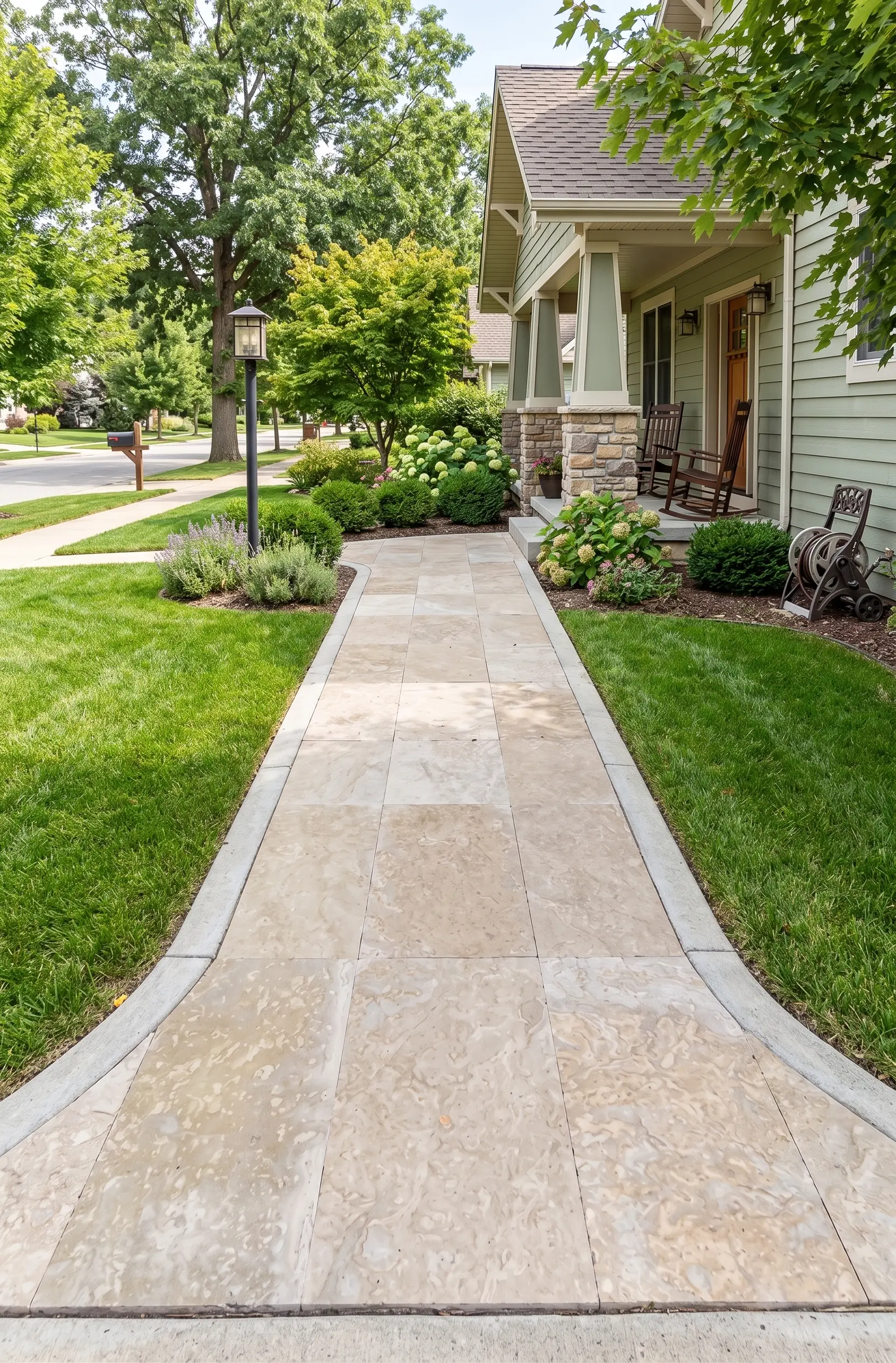
The filled-versus-unfilled distinction is probably the most consequential early decision you make when specifying travertine pavers for a patio or outdoor setting. Unfilled travertine leaves the natural voids open — you get the raw texture of the stone as it came from the quarry bed. Filled travertine has those voids packed with a cementitious or epoxy grout compound before the surface is finished, producing a denser, more closed face.
Here’s what the specification literature often skips: fill compound expansion and contraction behavior differs from the surrounding stone. In freeze-thaw regions, an improperly matched fill can cycle at a different rate than the travertine matrix, and over several winters, you’ll see the fill pop loose or crack at the interface. For projects in climate zones with meaningful temperature swings, specify an epoxy-based fill rather than a cement-based one — the bond is more elastic and tolerates differential movement better.
- Unfilled travertine works well where organic debris accumulation isn’t a concern — open voids can trap leaf matter and fine grit in high-traffic pedestrian areas
- Filled travertine is the practical choice for pool deck and patio applications where consistent maintenance is required
- Fill color selection affects the finished appearance as much as stone color — always review a filled sample in your project’s lighting conditions before ordering
- Epoxy fills resist water intrusion more effectively than cement fills, which matters most in climates with freeze-thaw cycles or high annual rainfall
- For outdoor travertine pavers specifically, confirm that your fill supplier rates their product for exterior exposure — interior fill compounds are not always formulated for UV and thermal cycling
The filled surface also interacts differently with sealer. A cement fill is more porous than the surrounding stone in some products, which means it can draw sealer unevenly and produce a blotchy appearance after the first application. Test a small section before sealing the full field — this is a step that project timelines often sacrifice, and it’s the one that generates the most callbacks.
Surface Finishes: What Each One Actually Means
The finish you apply to travertine pavers changes the surface texture, the apparent color depth, and the maintenance requirements — all simultaneously. Finish selection isn’t purely aesthetic; it’s a performance decision that intersects with your project’s use case, exposure conditions, and cleaning protocols. You can explore our travertine paver finish options to see how each finish presents across the stone varieties we carry.
Honed Finish
A honed travertine surface is ground flat and smooth but not polished to a reflective sheen. The stone reads as matte to satin — color is visible but light doesn’t bounce off the surface in a directional way. For outdoor travertine pavers, honed is one of the most widely specified finishes because it holds its appearance well across changing light conditions and ages gracefully without requiring aggressive maintenance cycles.
The practical consideration with honed travertine outdoors is that the open, slightly porous surface picks up staining from organic matter more readily than a polished surface would. Applying a penetrating sealer rated for exterior limestone and travertine on the interval your sealer manufacturer specifies is essential — skipping resealing cycles on honed stone is the fastest way to see iron staining from leaf tannins work into the surface.
Tumbled Finish
Tumbled travertine goes through a mechanical process — cut pieces are tumbled together to break edges, pit the surface, and create a worn, aged aesthetic. The result is a matte texture with irregular surface relief and softened corners. From a texture standpoint, a tumbled finish leaves an open, matte surface with micro-relief across the face.
- Tumbled travertine pavers are a popular choice for rustic or Mediterranean patio aesthetics where a distressed, aged look is intentional
- The broken edges reduce the visual impact of chipping that occurs over time in high-traffic areas — normal wear blends in rather than standing out
- Surface cleaning requires attention to the texture irregularities — fine grit and organic debris settle into the micro-pits and need periodic pressure washing to clear
- Tumbled finishes are typically unfilled, because the aged aesthetic is partly the open void texture — filling changes the character significantly
Brushed Finish
Brushed travertine sits between honed and tumbled in texture. The surface is mechanically brushed with abrasive wire or nylon brushes to open the grain slightly and create a linear texture that’s visible to the touch but relatively flat in profile. The finish retains more of the stone’s natural pattern than tumbling does, while breaking the smoothness of a honed surface.
For outdoor travertine pavers in sun-exposed settings, a brushed finish reads well because the linear texture catches light differently than a flat honed surface, giving the patio more visual movement across the day. It also tends to show less surface soiling visually than a smooth honed finish — the texture variation masks fine dirt accumulation between cleaning cycles.
Polished Finish
Polished travertine is ground to a high gloss that reflects light directionally. It’s the most dramatic presentation of the stone’s color and veining, and it’s appropriate for indoor flooring in dry environments. For exterior travertine pavers, polished finishes are generally not recommended — surface wear, UV exposure, and freeze-thaw cycling will degrade the polish relatively quickly, and maintaining it outdoors requires effort that most project programs can’t sustain.
The Natural Stone Institute’s guidance on travertine properties, aligned with NSI travertine outdoor performance data, reinforces that finish selection for outdoor travertine should be driven by exposure and maintenance capacity, not aesthetics alone. Specify the finish your maintenance program can realistically support over the life of the installation.
Color Ranges and How Quarry Source Affects Them
Travertine pavers range from near-white through ivory, walnut, and gold tones into deeper russet and silver-grey variants, depending on the mineral content of the spring water at their formation site. Iron compounds drive the warmer tones — the more iron present during precipitation, the deeper the gold and walnut coloring. Silver and grey travertines form where iron content is lower and other trace minerals influence the matrix color.
The color variation within a single quarry bed can be significant, and this is a detail that matters for large patio or pool deck installations. At Citadel Stone, we inspect stone at our selected quarries specifically to assess color consistency across the production run before orders are confirmed. A light ivory travertine paver lot can include pieces ranging from near-white to a noticeably warm cream — whether that range is acceptable depends entirely on your project’s tolerance for variation and the visual effect you’re designing toward.
- Ivory and classic travertine tones are the most widely available and show the broadest quarry-to-quarry variation
- Silver and grey travertines come from a narrower set of quarry beds and typically show tighter color consistency within a lot
- Walnut and noce tones contain higher iron content and can shift slightly in color when sealed — always test the sealer on a sample piece in the actual lot before full application
- Lighter travertine tones in full sun reflect heat more effectively than darker variants — a relevant factor for pool deck and barefoot-use surfaces
Specifying Travertine Pavers for Patio Applications
A patio specification for travertine pavers starts with base preparation, not material selection — but material selection has to inform the base design before you finalize it. Travertine’s nominal thicknesses for pedestrian patio use typically fall in a range suited to a compacted aggregate base with a bedding sand or mortar setting bed above it. The exact base depth your project requires depends on your soil bearing capacity, anticipated load, and local code requirements for frost depth — none of which can be generalized from a product page.
Local building codes increasingly specify minimum base depths for hardscape paving in frost-affected regions, and in some jurisdictions, engineered base specifications are required for patio installations adjacent to structures. The International Building Code and local amendments govern this — check with your local authority having jurisdiction before finalizing base depth, edge restraint, and sub-base compaction specifications. In seismic zones, some codes also require flexible-set mortar systems or specific joint widths to accommodate ground movement without cracking through the field.
- Confirm the frost line depth for your region before specifying base depth — under-specified bases in freeze-thaw zones produce heaving that breaks joints and destabilizes the surface over one to two seasons
- Edge restraint is a code-driven and performance-driven requirement — travertine’s weight alone does not prevent lateral creep on aggregate-set installations
- Specify joint width based on your installer’s and material manufacturer’s recommendations for the setting method — too-tight joints on mortar beds trap moisture and can lead to spalling at edges
- For travertine pavers for patio use near pools, confirm that the setting system is rated for constant moisture exposure — not all mortar and grout products are
- Slope and drainage geometry must be established in the base, not corrected through paver adjustment — travertine does not tolerate standing water well, particularly in filled-paver installations where the fill compound can deteriorate faster than the stone itself
Delivery scheduling for travertine paver orders requires you to confirm site access before order confirmation. Offloading heavy stone pallets demands adequate clearance and a firm surface for equipment maneuvering — project sites with soft ground or restricted access need a detailed logistics plan before the delivery date is set.
Slip Resistance, Wet Conditions, and Finish Considerations
Slipperiness is a genuine concern for any exterior stone surface, and travertine pavers are no exception — the finish variable is what determines how the surface behaves when wet. The current standard for evaluating wet slip resistance is ANSI A326.3, which measures performance under wet conditions; it replaced the ASTM C1028 static test withdrawn in 2014. No specific rating figures are published here — if you need tested performance data for your specification, request the test report from your supplier.
What finish texture does is change the surface geometry at a micro level. A tumbled finish leaves an open, matte surface with micro-relief that provides a different wet-surface texture than a smooth honed finish. A honed surface reads smooth to the touch and presents a closed, flat plane. Neither finish is automatically appropriate for every wet application — your specification should reference ANSI A326.3 and require the supplier to provide documented test results for the specific finish and stone combination you’re specifying.
- Reference ANSI A326.3 wet testing in your specification when slip performance data is required for pool deck or exterior patio applications
- Request the test report from the supplier — do not rely on finish descriptions alone to satisfy a code or liability requirement
- Consider anti-slip treatments as a specified additive for applications where additional surface texture is needed — confirm the treatment is compatible with your sealer program
- Pool deck and exterior stair applications warrant explicit discussion with your installer about finish selection and maintenance schedules
Sealing Travertine: What the Schedule Actually Requires
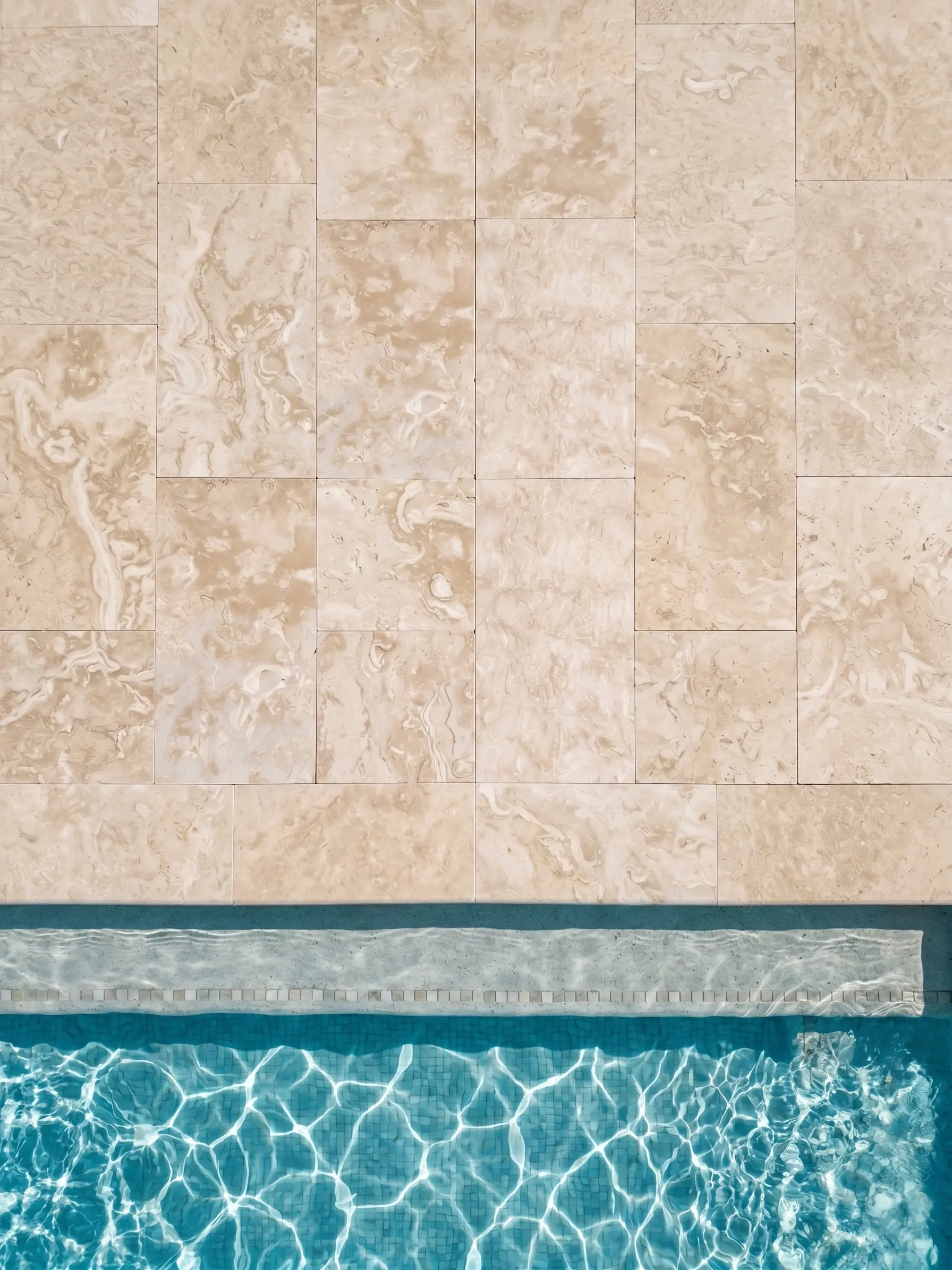
Travertine’s porosity makes sealing a structural maintenance requirement, not an optional enhancement. The stone’s interconnected pore network — the same feature that makes it visually distinctive — allows water, oil, and cleaning chemicals to penetrate the matrix if the surface isn’t protected. For filled travertine pavers, the fill compound also benefits from sealer coverage, which slows deterioration at the fill-to-stone interface.
Penetrating sealers (also called impregnating sealers) are the correct product class for exterior travertine paving. They work below the surface, consolidating the pore structure without forming a film that peels or traps moisture. Topical sealers can be used indoors on polished or honed surfaces but are generally not appropriate outdoors — UV exposure and thermal cycling break down topical coatings faster than the resealing intervals most property owners can realistically maintain.
- Apply sealer to clean, dry stone — moisture trapped under sealer prevents penetration and leads to haze or uneven coverage
- Reseal on the interval your specific sealer manufacturer states — this ranges widely by product, from one year to five or more, and the interval matters for performance, not just appearance
- Test sealer on an off-cut or inconspicuous area first — walnut and noce tones can shift in color under certain sealers, and the change is irreversible
- After a wet season or freeze-thaw cycle, inspect joints and fill for deterioration before resealing — sealing over failed fill compounds the problem
- Acid-based cleaners will etch travertine — pH-neutral stone cleaners are the only safe maintenance product for routine use
According to ASTM C1527 travertine dimension stone standard specifications, dimension travertine is evaluated against defined physical property thresholds that address absorption, density, and flexural strength — the full test report from your supplier gives you the actual values for the specific lot you’re ordering, which is the only reliable basis for a sealing and maintenance protocol.
Ordering Quantities, Lead Times, and Project Logistics
Travertine pavers are a natural material, and lot-to-lot color consistency is a real variable — not a manufacturer defect, but a quarry reality. Your order quantity should include a waste allowance that accounts for cuts, breakage during installation, and future repairs. A standard waste factor for travertine paver installations ranges with the complexity of the layout — simple grid patterns need less allowance than diagonal or pattern-cut designs.
Citadel Stone works with orders cut to specification at our selected quarries, which means lead times depend on production scheduling and export logistics from the point of fabrication. Lead times are quoted with the order — planning your project schedule around confirmed lead time, not an assumed delivery window, is the single most effective way to avoid delays that push installation past your working season.
- Order all material for a project from the same production lot where possible — subsequent orders may not match the color range of the first lot
- Confirm nominal thickness requirements before ordering — travertine pavers specified for vehicular use require a different thickness than pedestrian patio pavers
- Confirm site access dimensions and surface conditions when arranging delivery — inadequate access affects scheduling and offloading logistics
- Request the test report package with your order confirmation — absorption, flexural strength, and density data from ASTM testing gives your installer the specification foundation they need before work begins
Before You Specify Travertine Pavers
Getting the material decision right for travertine pavers means sequencing your specification correctly — geology and void structure first, fill and finish second, base and setting system third. Buyers who start with color and finish and work backward often discover mid-project that their preferred finish requires a setting system or maintenance protocol the project can’t support. The stone’s formation characteristics — the same pore structure that gives travertine its visual warmth — are the variable that every downstream decision responds to.
Thickness is one of those downstream decisions that deserves its own focused review before your specification is finalized. For a closer look at how nominal thickness interacts with base depth, load requirements, and code compliance, travertine paver thickness and specification covers the technical details that inform the right choice for your project type. Understanding the difference between tumbled, brushed, and honed finishes helps buyers choose correctly — and Citadel Stone provides detailed finish comparisons for each paver type.
Related reading: how to cut travertine pavers · travertine paver cost per square foot · how to seal travertine pavers.