Specifying quarry tile 6×6 versus travertine isn’t a straightforward swap — the two materials solve fundamentally different problems, and mixing up their application profiles is one of the most common and costly mismatches in commercial and residential stone work. Quarry tile 6×6 brings a dense, low-absorption body engineered for hard use; travertine brings a calcium carbonate architecture with thermal properties and visual warmth that no kiln-fired tile can replicate. Understanding where each one earns its keep requires looking past the surface finish and into the structural and environmental demands of your specific project.
What Quarry Tile 6×6 Actually Is
Quarry tile is an unglazed ceramic tile extruded from natural clays and shales and fired at high temperatures — typically above 2,000°F. The 6×6 format sits at the smaller end of the commercial range, which is exactly why it became a standard in kitchens, food-service environments, and utility spaces where tight grout lines and dimensional consistency matter more than expansive visual slabs. The vitrification process drives moisture absorption down to levels well below 0.5%, making quarry tile 6×6 highly resistant to staining in the way most natural stones simply aren’t without aggressive sealing programs.
The clay body is dense and uniform — there’s no vein structure, no fossil variation, no open pore network to manage. That uniformity is a technical advantage in wet utility environments and a visual limitation in decorative applications. You’re choosing a workhorse, not a showpiece, and that framing should guide every specification decision you make with this material.
- Typical thickness runs 1/2 inch to 3/4 inch — a thinner section than most natural stone pavers
- The unglazed surface produces a matte, slightly textured face that holds up under foot traffic without polishing over time
- Standard dimensional tolerances are tighter than natural stone, which simplifies thin-set installation in high-run commercial floors
- Color consistency across a production run is high — important for large commercial projects where batch variation would be visible
Travertine’s Structural and Pore Profile
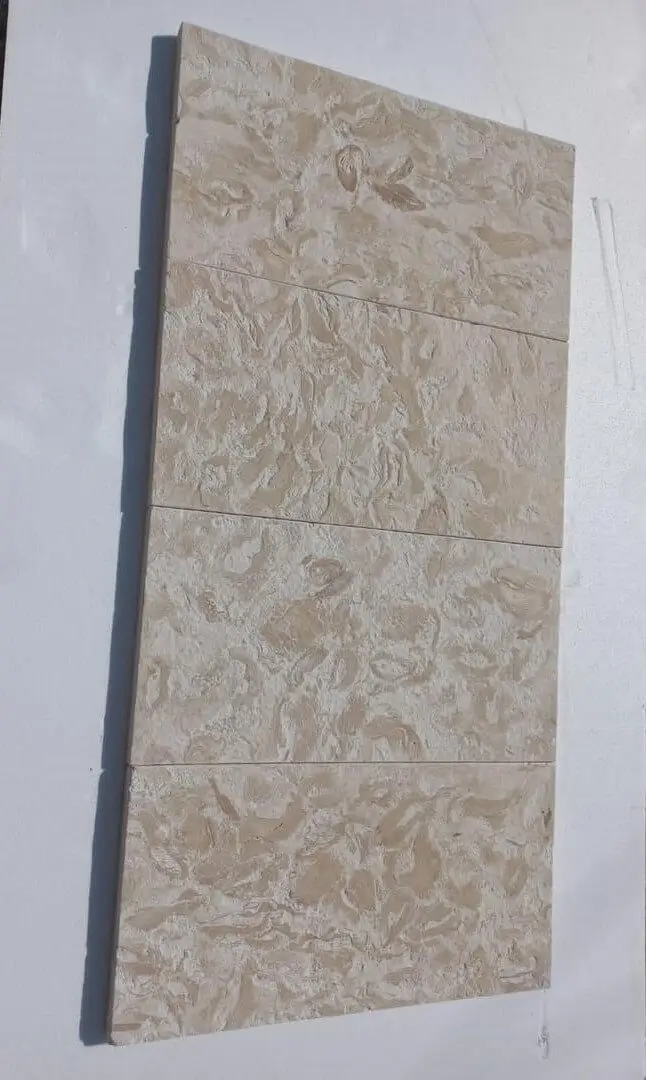
Travertine is a sedimentary limestone formed by the rapid precipitation of calcium carbonate from geothermal or spring water. That formation process creates an interconnected pore and void network throughout the stone body — the characteristic cross-section that separates travertine from dense limestone and from any kiln-fired tile. The voids can be left open (classic tumbled or rustic finish), filled with grout or resin during fabrication, or partially filled. Each approach produces a meaningfully different maintenance and performance profile.
For flooring applications, filled travertine is the practical choice in most environments. Open-face travertine looks striking but allows debris, grease, and cleaning chemistry to lodge in the voids in ways that compound over years. Specifiers who’ve worked through a restaurant remodel with open travertine floors understand the cleaning labor implications immediately. The fill type — whether cementitious or epoxy-based — also affects how the stone responds to thermal cycling, which becomes relevant in environments with significant temperature swings.
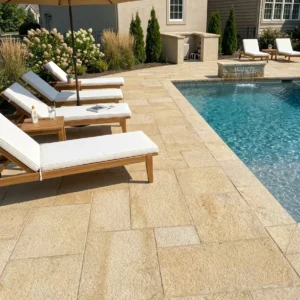
According to Natural Stone Institute travertine properties and outdoor suitability, the open-pore structure and absorption characteristics of travertine actively moderate surface heat in high-UV environments — a physical behavior that kiln-fired tile cannot replicate. That thermal buffering effect is one of the reasons travertine continues to dominate outdoor pool deck and patio specifications in regions with strong solar exposure.
- The pore network provides natural thermal mass — the surface heats and cools more gradually than dense ceramic or porcelain
- Absorption rates vary by finish and fill: honed-filled travertine typically absorbs less than tumbled-unfilled, but test reports should be requested for project-specific verification
- Natural color variation across slabs is a design feature — plan for layout approval before installation on large floors
- The calcium carbonate base makes travertine reactive to acidic cleaners and de-icers — a maintenance consideration that quarry tile 6×6 doesn’t share
Performance Comparison by Application
The choice between quarry tile 6×6 and travertine sharpens considerably when you map each material against its intended use. Both can be specified for floors, but the environments where each performs best are genuinely distinct — not interchangeable. Treating them as equivalent options just because both cover a floor is how projects end up with materials fighting their own specification.
Commercial kitchens, food-prep areas, institutional corridors, and utility spaces are where quarry tile 6×6 earns its dominance. The combination of low absorption, chemical resistance, and dimensional uniformity addresses the actual performance demands of those environments. Travertine in a commercial kitchen would require a sealing program, pH-neutral cleaning discipline, and void maintenance that most facilities management teams can’t sustain.
Residential interiors, outdoor living spaces, bathroom floors, and any application where material character matters — travertine is the more appropriate specification. The ASTM C1527 standard for travertine dimension stone establishes the testing framework relevant to these applications, and according to ASTM C1527 travertine dimension stone standard specifications, classification requirements address thickness, warpage, and breaking strength in ways that directly inform project suitability. Confirming that your travertine meets those classifications before purchase protects the installation long-term.
- Quarry tile 6×6: optimal for commercial kitchens, laundry rooms, mudrooms, exterior utility areas
- Travertine: optimal for residential floors, bathrooms, patios, pool decks, feature walls
- Quarry tile wins on chemical and stain resistance without sealers; travertine wins on thermal performance and visual depth
- Both materials can be used outdoors — but their outdoor performance profiles differ significantly based on freeze-thaw exposure and installation method
Thermal Cycling and Freeze-Thaw Performance
Temperature range — not just peak temperature — is the variable that separates a 20-year installation from one that begins showing joint failure or surface spalling within five years. In climates with significant day-night swings or seasonal freeze-thaw cycles, both quarry tile 6×6 and travertine behave in ways that reward precise specification and punish shortcuts in base preparation or joint design.
Quarry tile’s vitrified body gives it an advantage in freeze-thaw resistance. Its low absorption means water has minimal pathways to penetrate the tile body, saturate it, freeze, expand, and generate internal tensile stress. That’s the mechanism behind freeze-thaw spalling, and quarry tile’s dense structure limits its exposure to that cycle. For exterior applications in freeze-thaw regions, quarry tile specified for exterior use — confirmed through manufacturer freeze-thaw rating — is a defensible choice where the utilitarian aesthetic fits the project.
Travertine’s pore network is the point of vulnerability in the same scenario. Unsealed or inadequately sealed travertine in an environment that cycles below freezing can experience progressive void expansion if water infiltrates and freezes. The mitigation is straightforward: penetrating sealer applied before installation and refreshed on a schedule appropriate to the traffic and climate — typically every two to three years for outdoor applications in regions with significant freeze-thaw exposure. Filled travertine with epoxy-based fill has an additional advantage here, since the fill material limits water ingress into the voids more effectively than cementitious fill.
Thermal expansion also drives joint spacing decisions. Both materials expand and contract with temperature — the coefficient differs between fired ceramic and natural calcium carbonate stone, and specifying the same joint width for both in the same outdoor environment is a mistake. Your installation needs expansion joints sized and positioned to accommodate the actual thermal range of your climate, not a generic printed recommendation.
- In freeze-thaw regions, specify quarry tile with a confirmed exterior freeze-thaw rating — not all quarry tile products carry one
- Travertine outdoors in freeze-thaw zones requires penetrating sealer, correct joint design, and a filled-face finish
- Day-night temperature swings above 40°F are sufficient to produce meaningful cumulative joint stress — expansion joint spacing should reflect that range
- Base preparation matters more in thermal cycling environments: a rigid, well-drained base minimizes differential movement at the tile-mortar interface
Travertine Sample Selection and Batch Consistency
One of the most practical differences between specifying quarry tile 6×6 and natural travertine tile is the sample-to-delivery consistency question. Quarry tile’s manufacturing process produces near-uniform color across a production run — what you see on the sample chip is what arrives on the truck. Natural travertine tile is a natural stone with genuine color and pore variation across slabs and between quarry pulls, and that variation can be significant enough to affect the final installation if you don’t verify batch consistency before committing to a large order.
Ordering a natural travertine tile sample before finalizing a specification isn’t optional on any project where color consistency matters. A physical sample from the actual batch warehouse stock tells you whether the fill color, the vein movement, and the overall tone match your design intent. Digital images — even high-resolution photography — don’t capture the three-dimensional surface character of filled travertine or the way the open pore structure reads under different lighting. Request a Citadel Stone travertine samples before ordering large quantities, and compare the travertine sample against your project’s lighting conditions at the actual installation site.
Batch consistency across a large order is the related specification risk. Travertine sourced from the same quarry pull and processed through the same fabrication run will have a coherent color family. When orders span multiple batches — common when a project phases over several months — tonal shifts can appear between early and late deliveries. Locking in a larger initial order from warehouse stock and staging delivery by truck as phases progress is the professional mitigation strategy for high-visibility floors and feature applications.
Installation Variables and Base Preparation
Quarry tile 6×6 and travertine tile share some installation fundamentals — both require a flat, stable substrate, appropriate mortar selection, and correct joint sizing — but they diverge on tolerance sensitivity and mortar choice in ways that matter in the field. The thinner section of quarry tile means substrate flatness tolerances are tighter; a high spot that wouldn’t affect a 3/4-inch travertine tile can crack a 1/2-inch quarry tile under point loading.
For quarry tile, modified thin-set mortars provide adequate bond for most interior applications. Large-format natural travertine tile — anything above 12 inches on a side — benefits from medium-bed mortar to manage the additional weight and to ensure full back coverage without lippage. The Tile Council of North America installation standards address mortar selection, coverage requirements, and substrate preparation for both ceramic and natural stone tile, and per TCNA installation standards, minimum back coverage thresholds differ between wet and dry environments — a detail that affects both material types but is especially critical for travertine in outdoor or wet-area applications.
Your base preparation also needs to account for drainage geometry in outdoor installations. Travertine pool deck tile and patio applications require positive drainage slope — typically 1/8 inch per foot — and that slope needs to be built into the substrate, not corrected with mortar variation. Trying to adjust drainage slope at the mortar layer introduces inconsistent bed thickness that becomes a source of differential movement over time.
- Substrate flatness for quarry tile 6×6: no more than 1/8 inch variation in a 10-foot run for thin-set applications
- Large-format travertine: medium-bed mortar, minimum 95% back coverage in wet areas
- Outdoor installations: drainage slope built into the substrate, not corrected at the mortar layer
- Grout selection for travertine: sanded grout for joints above 1/8 inch; unsanded for tighter joints against soft stone faces
- Quarry tile grout joints: typically 3/16 to 1/4 inch, reflecting the commercial environments where dimensional variation and thermal cycling interact
Maintenance, Sealing, and Long-Term Care
The maintenance programs for quarry tile 6×6 and travertine are structurally different, and that difference should factor into your specification decision as much as the upfront material cost. Quarry tile’s vitrified, unglazed surface doesn’t require sealing in the way natural stone does — the same low absorption that makes it highly resistant to staining also means penetrating sealers have limited entry pathways. Periodic cleaning with pH-neutral or mildly alkaline chemistry appropriate to the soiling type is the standard maintenance cycle.
Travertine requires a sealing program, and the schedule depends on traffic, exposure, and finish type. A honed-filled travertine floor in a residential living space might need resealing every three to five years under normal conditions. An outdoor travertine patio in a climate with significant seasonal temperature cycling and UV exposure would likely benefit from a two-year sealing interval. The tell for when resealing is due is simple: apply a few drops of water to the surface and time how quickly the stone darkens. If absorption is immediate, the sealer has worn through and the stone is unprotected.
Never use acidic cleaners — vinegar, citrus-based products, or bathroom acid cleaners — on travertine. The calcium carbonate base etches immediately and permanently on contact with acids, and that etching is a physical change to the stone surface, not a stain that sealing can prevent. Quarry tile tolerates a broader range of cleaning chemistry, including dilute acid cleaners for mineral deposit removal — one of the practical reasons it dominates food-service specification.
Ordering, Logistics, and Project Planning
The logistics of sourcing quarry tile 6×6 and natural travertine tile differ in ways that affect project scheduling decisions. Quarry tile is a domestically manufactured ceramic product with relatively predictable lead times and widespread distributor availability. Travertine is a natural stone sourced from quarries across the Mediterranean and Middle East, and lead times from quarry to warehouse reflect that supply chain — typically longer and more variable than manufactured tile.
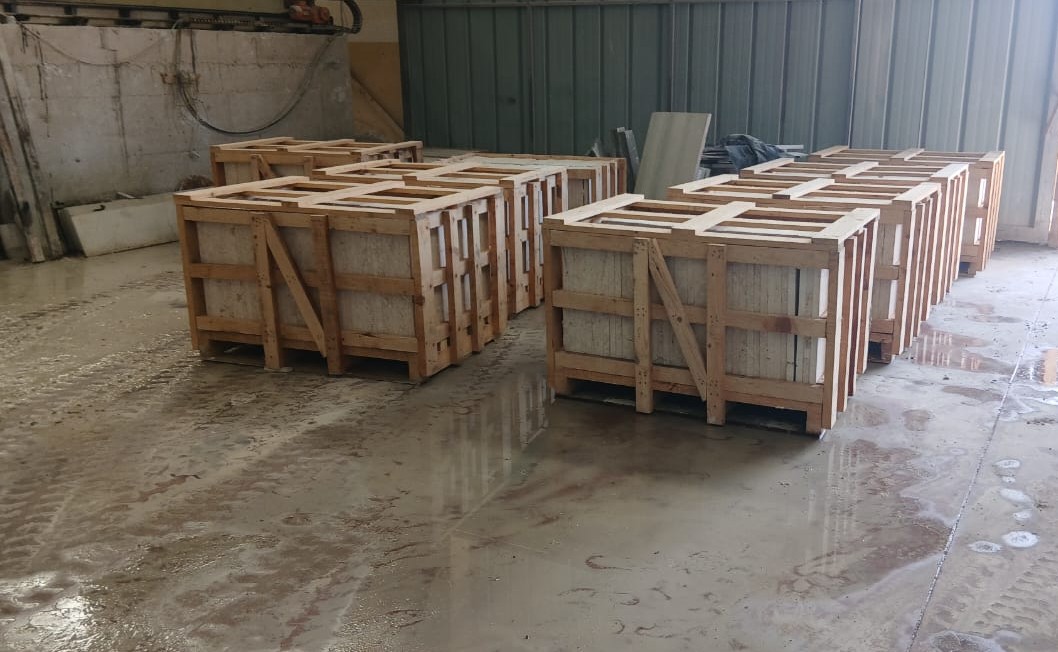
For projects with firm completion schedules, confirm warehouse stock levels before committing to a travertine specification. At Citadel Stone, we maintain warehouse inventory that allows most standard travertine tile orders to ship within one to two weeks for in-stock material, which significantly reduces the project risk that comes with waiting on a quarry pull. However, custom sizing, specialty finishes, or very large quantities may require advance ordering of six to eight weeks to ensure a matched batch arrives in a single truck delivery rather than across multiple shipments with potential tonal variation.
Quarry tile 6×6 orders for commercial projects should still include a waste factor — typically 10 to 15 percent for standard rectangular layouts, more for diagonal or feature cuts. Travertine orders should include the same waste allowance plus a small reserve quantity stored in the same original batch. Natural stone repairs done years later with a different batch pull rarely match perfectly, and having reserve tiles from the original order eliminates that problem entirely.
- Confirm warehouse availability before scheduling installation crews — material delays are the most common cause of installation timeline overruns
- Order reserve stock from the same batch and store it on-site or in your warehouse for future repairs
- For phased projects, lock in the full quantity from one batch and stage truck deliveries by phase to maintain tonal consistency
- Factor sealer and grout lead times into the installation schedule — these are often overlooked until the stone is already on-site
Matching Material to Application: Quarry Tile 6×6 and Travertine
The decision between quarry tile 6×6 and travertine resolves quickly once you define the actual performance demands of the space — not the aesthetic aspirations alone. Quarry tile is the right call in environments where chemical resistance, low maintenance, and dimensional precision matter more than material character. Travertine earns its place in applications where thermal performance, visual depth, and long-term design coherence are the specification priority. The materials don’t compete so much as occupy different territories, and the most effective specification work assigns each one to the territory it was built for.
Thermal cycling and freeze-thaw exposure add a layer of specification discipline that applies to both materials outdoors: the correct base, the correct joint design, and the correct sealing program aren’t optional refinements — they’re the difference between an installation that holds through decades of seasonal cycling and one that begins failing within the first few winters. Get the base preparation and joint spacing right from the start, and both materials will reward the investment. For projects that call for travertine at a more intimate scale, small travertine bathroom design ideas explores how this stone performs in tighter spaces with equally rewarding results. Travertine tile from Citadel Stone is sourced from quarries across the Mediterranean and Middle East, keeping color batches consistent across large orders.
Related reading: travertine border tile ideas · tumbled marble tile 4×4 · small travertine tile patterns.