The detail that separates a well-specified travertine installation from one that disappoints within five years usually isn’t the color or the grade — it’s the surface finish decision made before the first tile is ever ordered. A travertine tile types guide that only covers color families misses the variables that actually govern long-term performance: fill type, cut orientation, finish texture, and how each of those choices interacts with the specific demands of your project. Get those four decisions right and the aesthetic takes care of itself.
What Finish Classification Actually Means in Travertine
Travertine is a sedimentary calcium carbonate stone formed through mineral-rich spring water deposition, which means its internal pore structure is inherent to the material — not a processing artifact. Those voids and channels define how every surface finish performs differently in real use. Understanding the finish is really understanding how much of that pore structure you’re exposing, sealing, or filling before installation. According to Natural Stone Institute travertine properties and outdoor suitability, travertine’s open-pore structure and calcium carbonate composition directly influence absorption rates, finish durability, and appropriate application selection — which is exactly why finish type is a specification variable, not a cosmetic one.
Your finish selection also governs maintenance frequency. A polished travertine floor in a commercial lobby will need resealing every 12 to 18 months under normal foot traffic; the same stone in a tumbled finish on an exterior terrace may only need attention every two to three years. That difference compounds over a decade-long ownership window into a meaningful cost and labor differential worth calculating before you specify.
The Tile Council of North America’s installation standards address this directly — TCNA installation standards distinguish between filled and unfilled travertine installation methods because the substrate preparation and adhesive selection differ significantly between the two. That’s a practical field consideration your installer needs to account for before the first trowel goes down.
Filled vs. Unfilled: The Decision That Drives Everything Else
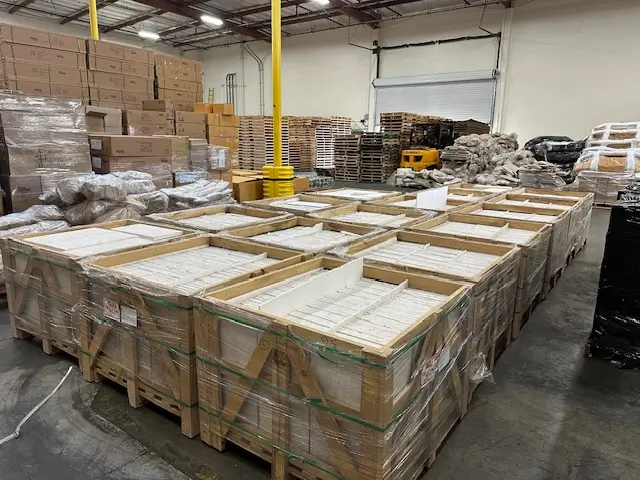
Most discussions of travertine tile types start with surface finish, but the filled-versus-unfilled distinction is the more consequential upstream decision. Filled travertine has its natural voids grouted — typically with a cementitious or epoxy compound — before or after the surface is honed or polished. Unfilled travertine ships with those voids open, giving you the characteristic rustic surface texture that reads as deeply authentic in the right context.
For interior applications where you want a flat, smooth surface that’s straightforward to clean, filled and honed is usually the correct starting point. You get a consistent plane, reduced grout line complexity, and a surface that responds predictably to periodic sealing. The trade-off is that low-quality fill compounds can shrink, crack, or absorb pigment from cleaning products unevenly — something you’ll encounter in economy-grade material, but not in properly sourced, warehouse-inspected stone.
- Filled travertine works better in wet areas, kitchens, and commercial interiors where hygiene and cleanability are primary concerns
- Unfilled travertine suits exterior terraces, feature walls, and rustic residential interiors where character texture is part of the design intent
- Fill compound quality varies substantially across supply chains — inspect cross-sections of samples when possible, not just face surfaces
- Some projects specify filled tiles on field areas and unfilled on accent borders — a legitimate approach that requires careful transition detailing
- Unfilled exterior travertine needs more frequent sealing because exposed voids accumulate debris and allow deeper moisture ingress
Honed Finish: The Specification Workhorse
Honed travertine is ground to a smooth, matte or satin surface without the final buffing that creates a reflective polish. It’s the most broadly specified finish across both residential and commercial projects, and for good reason — it reads as refined without the maintenance sensitivity of a high-gloss surface. Your design retains the warm, organic quality of natural stone while delivering a surface that handles daily use without the scuff and scratch visibility that polished finishes accumulate over time.
The practical field consideration with honed travertine is consistent thickness calibration. Honing removes variable amounts of material depending on the starting surface geometry of each slab, which means that poorly controlled processing can leave you with tiles that vary by 1.5 to 2mm across a batch. That’s manageable with the right adhesive bed depth adjustment, but it adds time and cost to installation. At Citadel Stone, we inspect dimensional consistency at the warehouse before any batch ships — because catching thickness variation before it reaches a job site is far easier than dealing with lippage complaints after the tile is set.
- Honed finishes accept penetrating sealers more evenly than polished surfaces, which tend to resist initial sealer absorption
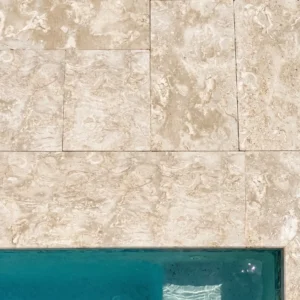
- Suitable for floors, walls, countertops, pool surrounds, and exterior paving — the widest application range of any travertine finish
- Surface temperature under direct sun is measurably lower on honed travertine than on polished stone, which matters for barefoot exterior use
- Color variation reads more naturally in honed form — veining and fossil inclusions don’t compete with a reflective surface sheen
Polished Finish: Where to Use It and Where to Avoid It
Polished travertine creates a high-gloss, reflective surface through successive buffing stages that close the stone’s surface pores mechanically. The result is visually striking — a mirror-quality surface that amplifies color depth, highlights veining, and reads as decidedly formal. It’s the right specification for feature walls, luxury bathroom floors, reception area paving, and interior applications where design impact is the primary driver.
Here’s the honest trade-off: polished travertine is more vulnerable to etching from acidic substances — citrus, wine, vinegar, and most commercial cleaning products — than any other finish type. The polishing process creates a surface that’s optically beautiful but chemically reactive in ways that honed and brushed finishes conceal more forgivingly. For a kitchen floor or an outdoor terrace, polished travertine is a specification you’ll regret. For a master bathroom or an interior feature wall well away from food preparation, it performs exceptionally well with appropriate maintenance.
Slipperiness is also a genuine concern on polished travertine in wet conditions. The finish variable is the determining factor for surface texture — and for wet areas, the ANSI A326.3 standard (minimum wet DCOF 0.42) should guide your finish selection rather than aesthetic preference. Your project’s wet-area requirements may rule out polished travertine entirely, particularly in commercial applications where code compliance is non-negotiable.
Brushed and Tumbled Finishes: Exterior Performance and Character
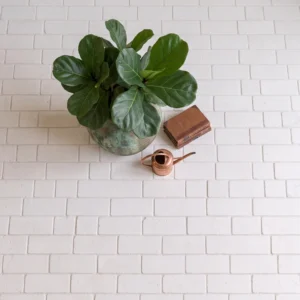
Brushed travertine is mechanically textured with wire or abrasive brushes to open the surface slightly and create a softly aged appearance. It retains the dimensional precision of a machine-processed tile while delivering more surface texture than honed — making it an excellent middle-ground for exterior terraces, pool decks, and covered outdoor dining areas where some grip is needed without the heavily rustic character of tumbled stone.
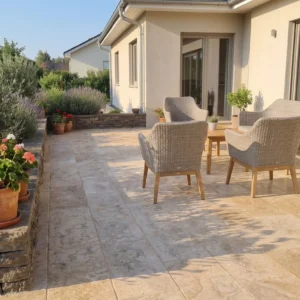
Tumbled travertine goes further, with tiles or pavers processed in a rotating drum to simulate the worn edges and surface variations of aged material. The result is distinctly artisanal — irregular edges, softly pitted surfaces, rounded corners — and it works beautifully in Mediterranean-style residential settings, courtyard pavers, and garden pathways. The surface texture in wet conditions is worth factoring into pool surround and terrace specifications when choosing among the different types of travertine available. For projects specifying travertine in smaller formats, Small Travertine Tiles in tumbled and brushed finishes are available through the Citadel Stone range in sizes that work particularly well for detailed pattern work and mosaic borders.
One field detail that catches specifiers off guard with tumbled material: because edges are irregular by design, grout joint widths need to be wider than you’d use with calibrated tiles — typically 3/8 inch to 1/2 inch minimum. That affects both the visual rhythm of the installation and the total grout quantity your budget needs to account for.
Split-Face Travertine: The Texture Statement
Split-face travertine, sometimes called ledger or stacked stone panel, is produced by mechanically splitting the stone perpendicular to its natural bedding planes to expose the raw, fractured interior surface. The result is dramatically textural — jagged, dimensional, and intensely natural in appearance. Split face travertine is almost exclusively a wall cladding material, used on feature walls, fireplace surrounds, exterior facades, and retaining wall faces where visual depth and natural ruggedness are the design goal.
Among the various types of travertine, split face is where sourcing consistency matters most. Because the split surface is inherently variable, material from different quarry sections can read very differently in color, void size, and surface texture — sometimes dramatically so within the same nominal product. Material from our selected quarries undergoes visual consistency checks at the warehouse before shipping, which reduces the on-site color matching issues that plague projects using split-face stone sourced from multiple supply points.
- Split-face panels are typically mounted with adhesive mortar on a prepared substrate — not set like floor tiles, which is a common installation error
- The fractured surface holds dust and airborne debris, making exterior split-face wall applications in urban environments harder to maintain than interior use
- Sealing split-face travertine requires a penetrating impregnator, not a surface sealer — the geometry of the fractured surface makes film-forming sealers impractical
- Light reflectance on split-face is dramatically lower than on polished or honed travertine, which affects both artificial and natural lighting design calculations
- Panel formats vary — measure your wall area carefully and account for edge piece requirements at corners before placing your order
Vein-Cut vs. Cross-Cut: The Orientation Variable Most Specs Miss
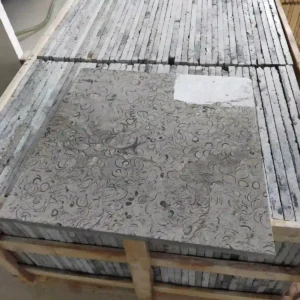
The cut orientation of travertine — how the stone is sliced relative to its natural bedding — produces two fundamentally different visual results from the same block of material. Cross-cut travertine (also called fleuri cut) is sliced perpendicular to the stone’s natural growth layers, revealing the characteristic cloud-like, circular patterning that most people associate with travertine’s classic look. Vein-cut travertine is sliced parallel to those growth layers, producing a dramatically different linear, striated pattern with strong directional veining reminiscent of wood grain.
The specification decision between these two isn’t purely aesthetic. Vein-cut travertine tends to show more structural consistency through the tile because the cut aligns with the stone’s natural density gradients — but it also exposes linear void channels that can require more fill compound to achieve a flat honed surface. Cross-cut material typically has more dispersed, smaller voids and the familiar cloud pattern that reads well in most residential and hospitality settings. Understanding this distinction before specifying is part of what makes an ASTM C1527 travertine dimension stone specification review worthwhile — the standard clarifies how dimensional tolerances and classification apply differently to cut orientation variables.
For large-format applications — 24×24 inch tiles and above — vein-cut material is worth specifying carefully because the directional veining, when laid consistently, creates a formal, striated appearance that suits contemporary interiors. In herringbone or random-set patterns, cross-cut tends to read more naturally because the cloud patterning doesn’t fight the layout geometry.
Budgeting Across Travertine Tile Types: What Drives Real Project Cost
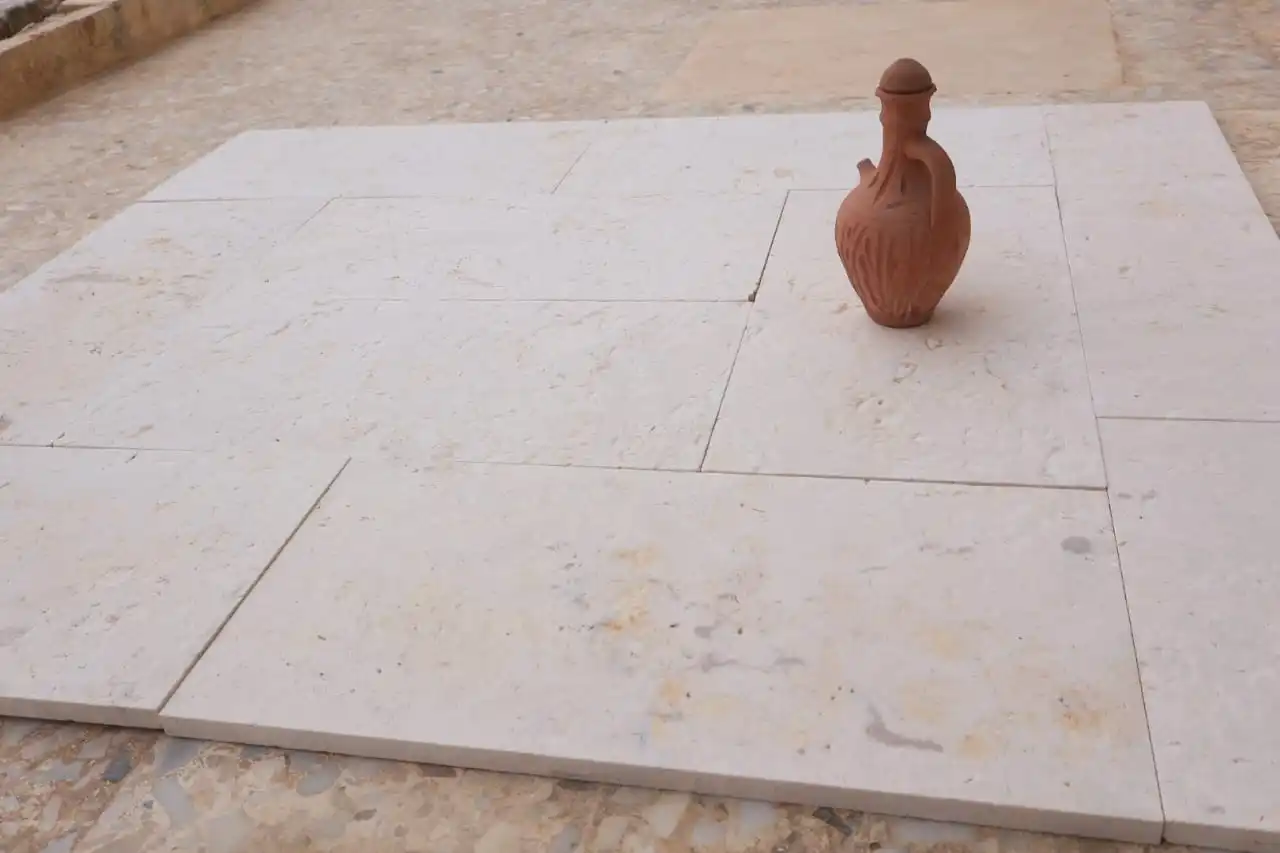
Surface finish and cut orientation aren’t just specification decisions — they’re significant cost variables that affect your total project budget in ways that aren’t always obvious from per-tile pricing. Polished material typically runs 15 to 25 percent more per square foot than honed equivalents of the same grade because of the additional processing stages involved. Split-face panels carry a premium for the manual quality sorting required to produce consistent-looking cladding products. And tumbled or brushed finishes, while often priced similarly to honed, require wider grout joints that increase your installation labor time and consumables cost.
Freight distance is a real budget variable that your square-foot pricing doesn’t capture. Travertine is heavy — a standard 18×18 inch tile at 3/4 inch thickness runs approximately 6 to 7 pounds per square foot — and truck delivery costs from a central warehouse to a job site on the opposite coast can add meaningfully to the landed cost of your order. Consolidating your order for all finish types from a single supplier with national warehouse inventory, rather than sourcing split-face from one supplier and honed field tile from another, typically reduces per-project freight cost and eliminates the scheduling complexity of coordinating multiple delivery windows.
Material-to-labor cost ratios also shift across finish types. Polished travertine on an interior floor commands a higher material cost but requires less joint grouting complexity than tumbled exterior pavers — where the wider joints, irregular edges, and sealing requirements push labor hours higher relative to the material cost. In markets where skilled stone installation labor is tight, that ratio matters as much as the tile price itself. Value engineering a project from polished interior finishes to honed equivalents can free up budget for higher-quality tumbled paving on the exterior, where texture performance under weather is the more important specification variable anyway.
Sealing Protocols by Finish Type: Frequency and Product Selection
Every travertine finish requires sealing — the question is which sealer type, how often, and what maintenance interval your client or facilities manager can realistically sustain. Penetrating impregnating sealers are the correct choice for virtually all travertine finish types because they work below the surface without altering the stone’s natural appearance. Film-forming topical sealers can trap moisture beneath the surface in exterior applications, leading to spalling and delamination in freeze-thaw regions — a failure mode that’s entirely avoidable with correct product selection.
Polished travertine in interior settings typically needs resealing every 12 to 18 months in residential use, and every 6 to 12 months in commercial applications with high foot traffic. Honed and brushed finishes are somewhat more forgiving — every 18 to 24 months is a reasonable residential maintenance interval. Tumbled exterior pavers in exposed conditions may need annual attention simply because the textured surface accumulates contaminants that degrade sealer effectiveness over time. Split-face wall cladding should be sealed on installation and re-assessed every two to three years depending on exposure.
- Water-based penetrating sealers are lower VOC and suitable for interior use; solvent-based penetrating sealers penetrate more deeply and are preferred for dense outdoor applications
- Always test sealer on an inconspicuous area — some formulations darken lighter travertine varieties more than the specification intends
- Sealer application on unfilled travertine requires additional product volume because the open voids absorb more sealer than a filled surface
- Travertine near pool environments needs a sealer rated for chlorine and salt exposure — standard residential sealers degrade faster in chemically treated water environments
- Re-sealing timing should be triggered by a water bead test, not a fixed calendar interval — pour a small amount of water on the surface and observe; if it absorbs rather than beading, the sealer needs renewal
Finalizing Your Travertine Tile Types Specification
Choosing among travertine tile types isn’t a single decision — it’s a sequence of interconnected specification choices where each one narrows the options downstream. Your fill type commitment comes first because it affects installation method, substrate preparation, and long-term maintenance. Surface finish follows, governed by your application context, wet-area requirements, and design register. Cut orientation comes next, shaping the visual language of the finished surface. And sealing protocol rounds out the specification, anchoring the long-term performance expectations you set with your client from day one. As you finalize your material selections, Citadel Stone’s technical team can help you cross-reference finish availability with current warehouse stock to align your specification with realistic lead times before your project schedule locks in. Your broader hardscape scheme may also benefit from complementary stone selections beyond travertine — cobblestone paver pattern options offer another dimension of natural stone specification worth reviewing as you develop your outdoor material palette. Split-face and vein-cut options in the Citadel Stone range differ meaningfully in light reflectance and sealing frequency, two factors worth understanding before any tile purchase.
Related reading: tumbled marble vs travertine tile · small travertine tile patterns.