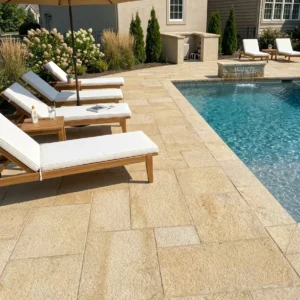
Travertine paver sizes determine more than aesthetics — they directly control material yield, waste percentages, and the structural performance of your finished installation. The dimensional decision you make before a single piece is set affects grout joint behavior, thermal movement across the field, and how forgiving the sub-base tolerance needs to be. Get the sizing logic right early, and the rest of the specification process becomes significantly more straightforward.
Understanding Travertine Paver Size Families
Travertine pavers fall into three broad dimensional families: small-format (up to 12×12 inches), mid-format (16×16 to 18×18 inches), and large-format (24×24 inches and above). Each family performs differently under load, handles thermal expansion differently, and creates a distinct visual rhythm in the finished surface. Your project’s square footage, traffic type, and base tolerance all influence which family makes practical sense.
Small-format pieces give you the tightest pattern control. They’re easier to handle on sloped surfaces and around curved edges, and they allow tighter cutting without excessive waste. Mid-format is the workhorse of residential and light commercial work — travertine paver sizes like 16×16 and 18×18 strike a balance between installation speed and manageable handling weight per piece. Large-format pieces read as more contemporary, but they demand a flatter, more precisely prepared base to avoid lippage and point-load stress at unsupported corners.
- Small-format (up to 12×12 inches): best for irregular layouts, curved edges, and mosaic-style patterns
- Mid-format (16×16 to 18×18 inches): optimal for most residential patios, pool decks, and walkways
- Large-format (24×24 inches and above): suited to contemporary designs with precision-leveled bases
- Plank formats (4×24, 6×24, 8×24 inches): increasingly popular for linear or wood-look installations
Standard vs. Versailles Pattern Sizing
The Versailles pattern — also called the French pattern — combines four nominal sizes in a repeating mosaic: typically 16×16, 8×16, 8×8, and 4×8 inches (or metric equivalents). It’s one of the most commonly specified travertine paver sizes for residential pool decks and patio surrounds, partly because it uses material efficiently and partly because the visual complexity disguises minor base imperfections better than a uniform grid.
Your material order for a Versailles layout typically breaks down as approximately 25% of each size component. In practice, you’ll want to add 12–15% overage rather than the standard 10%, because the four-piece coordination creates more cutting constraints than a single-size field. Any leftover cuts from one component size rarely substitute cleanly for another, so waste compounds faster when you run short mid-project.
- Standard grid layouts (single size): 10% overage is generally sufficient
- Versailles and French patterns (four sizes): 12–15% overage recommended due to multi-piece coordination
- Running bond or herringbone with a single format: 10–12% depending on diagonal cut frequency
- Custom or irregular layouts: assess waste per design — some complex patterns require 15–20% overage
According to Natural Stone Institute travertine properties and outdoor suitability, travertine’s characteristic pore structure and calcium carbonate composition make it well suited to outdoor paving applications — a relevant consideration when choosing a pattern that maximizes exposed surface area and pore visibility.
Thickness and Its Relationship to Format Size
Travertine paver sizes and thickness aren’t independent variables — they’re linked by structural logic. Larger format pieces need greater thickness to resist flexural stress across unsupported spans in the sub-base. A 12×12 piece at 20mm nominal can perform reliably over a well-compacted aggregate base. A 24×24 piece at the same thickness is asking for trouble, particularly under point loads from furniture legs, vehicle overhangs, or foot traffic concentrated at slab edges.
The practical field threshold most specifiers use is: any piece exceeding 18 inches in either dimension should be specified at 30mm nominal or thicker for outdoor pedestrian applications. For vehicular or heavy-use areas, 40mm becomes the working minimum regardless of format size. These thresholds account for the bending moment across the unsupported span — not just the compressive load — which is what most standard calculators underestimate. Explore the specification options for 30mm travertine pavers when your format size pushes past the 18-inch threshold.
How Stone Grade Affects Size Selection
Travertine grading directly limits which travertine paver sizes are practical to produce and hold to dimensional tolerance. Premium or select grade material — with tighter fill consistency and fewer large natural voids — is available across most format sizes because the base stone is dense enough to be cut to larger dimensions without fracture risk during fabrication. Commercial or standard grade, which carries more open pore structure and natural variation, is typically better suited to smaller and mid formats where the void patterning reads as a feature rather than a structural liability.
Here’s what most buyers miss: higher void density in commercial-grade material doesn’t make it inferior — it makes it format-sensitive. A 12×12 commercial-grade piece with open travertine veining looks deliberately rustic and performs solidly. The same material cut to 24×24 introduces a probability of hidden voids near slab edges that can cause chipping during delivery, installation, or early service. Your grade selection should inform your format decision from the start, not be treated as a separate variable.
- Premium/select grade: suitable for all format sizes including large-format 24×24 and above
- Commercial/standard grade: optimal in formats up to 18×18 for outdoor paving applications
- Filled vs. unfilled travertine: filled surface is preferred for large-format pieces where open voids near edges increase chipping risk
- Honed and brushed finishes: both available across most grade and format combinations — finish choice is largely aesthetic in the context of size selection
Joint Spacing, Thermal Movement, and Format Size
Travertine’s thermal expansion coefficient sits in the range of natural calcium carbonate stone — meaning it expands and contracts with temperature shifts in a predictable pattern. What changes with format size is the cumulative expansion across a field. A 20×20-foot patio laid with 12×12 pieces has many more joints to absorb movement than the same area laid with 24×24 pieces. Fewer joints means each joint must absorb more movement, and that means your joint width and sand or mortar type need to be specified with the format size in mind.
For large-format travertine paver installations, expansion joints every 10–12 feet (rather than the 15–20 feet typical in smaller formats) protect against compressive buckling during high-heat cycles. In freeze-thaw regions, this spacing becomes even more critical because the thermal delta between winter lows and summer highs is wider, and the cumulative movement across a large-format field can exceed what a standard polymeric sand joint can absorb without cracking.
- Small-format fields (12×12 and under): more inherent joint flexibility — expansion joints at 15–20 feet are generally adequate
- Mid-format fields (16×16 to 18×18): expansion joints at 12–15 feet recommended
- Large-format fields (24×24 and above): expansion joints at 10–12 feet, with careful attention to perimeter relief joints
- Freeze-thaw regions: reduce expansion joint spacing by 15–20% from the above baseline
The ASTM C1527 standard for travertine dimension stone outlines the dimensional tolerances and physical property requirements that govern fabricated travertine pavers, providing a useful benchmark when comparing format-specific performance claims from different suppliers.
Cost Factors, Format Size, and Project Budgeting
Travertine paver sizes have a direct and often underestimated effect on total project cost — not just material unit price, but freight, labor, and waste combined. Larger format pieces are generally priced higher per square foot at the material level, but they can reduce installation labor hours because fewer pieces are handled, positioned, and cut per square foot of finished surface. The net cost comparison depends heavily on your labor market rate relative to material cost.
Freight distance compounds the format-size cost equation in a way that catches many buyers off guard. Larger format pieces are heavier per unit and require more careful palletization to prevent edge chipping in transit. That means higher freight weight per pallet and sometimes more pallets for the same square footage if pieces can’t be stacked as densely. Projects at greater distances from warehouse stock will feel this more acutely — a size decision that looks cost-neutral on a material quote can shift meaningfully when full freight is calculated. Citadel Stone maintains warehouse inventory that allows shipment across the country, which compresses lead times and reduces the freight variability that plagues imported-on-demand orders.
- Large-format pieces: higher material unit cost, but potential labor savings of 15–25% per square foot in straightforward rectangular layouts
- Versailles pattern kits: can reduce per-piece sourcing complexity but require careful freight coordination across four component sizes
- Freight weight per square foot increases with thickness — a 40mm large-format piece ships at roughly double the weight of a 20mm small-format piece covering the same area
- Labor markets vary significantly — in high-wage markets, labor savings from large-format installation can offset premium material pricing; in lower-wage markets, the calculus often reverses
- Value engineering option: select a mid-format size (18×18) rather than large-format where the design permits — this often delivers 80% of the visual impact at meaningfully lower combined freight and material cost
You’ll also want to account for truck access at your delivery site before finalizing your size and quantity order. Large-format paver pallets are heavy and require level, stable truck access for safe unloading. Constrained access can add handling costs or force smaller delivery increments, which increases per-trip freight charges.
Application-Specific Size Recommendations
Your application context should drive size selection as much as aesthetic preference. Pool decks have specific demands: pieces need to be small enough to follow curved coping transitions without excessive cutting, but large enough to read cleanly as a surface rather than a mosaic. The 12×24 plank format has become particularly popular for pool surrounds because it reads as a proportional tile, handles the curve-to-straight transition well at coping edges, and allows drainage channels to be integrated cleanly into the joint pattern.
For driveways and vehicular areas, smaller formats in greater thickness are preferable to large formats at moderate thickness. A 12×12 at 40mm handles vehicle load distribution across multiple pieces, so no single piece bears the full concentrated load from a tire. A 24×24 at 30mm under the same vehicle creates a single-piece span that relies entirely on sub-base uniformity — and sub-base uniformity under real-world installation conditions is rarely perfect. USGS data on dimension stone use confirms that format size recommendations vary by application load class, a distinction worth carrying into your specification language.
- Pool decks and spa surrounds: 12×24 plank, 16×16, or Versailles pattern in 20–30mm thickness
- Residential pedestrian patios: 16×16, 18×18, or 24×24 in 30mm — all perform well with proper base preparation
- Walkways and garden paths: 12×12 or 12×24 in 20–30mm for flexibility around curves and plantings
- Driveways and heavy-use surfaces: 12×12 or 16×16 in 40mm minimum — avoid large-format over 20×20 in vehicular areas
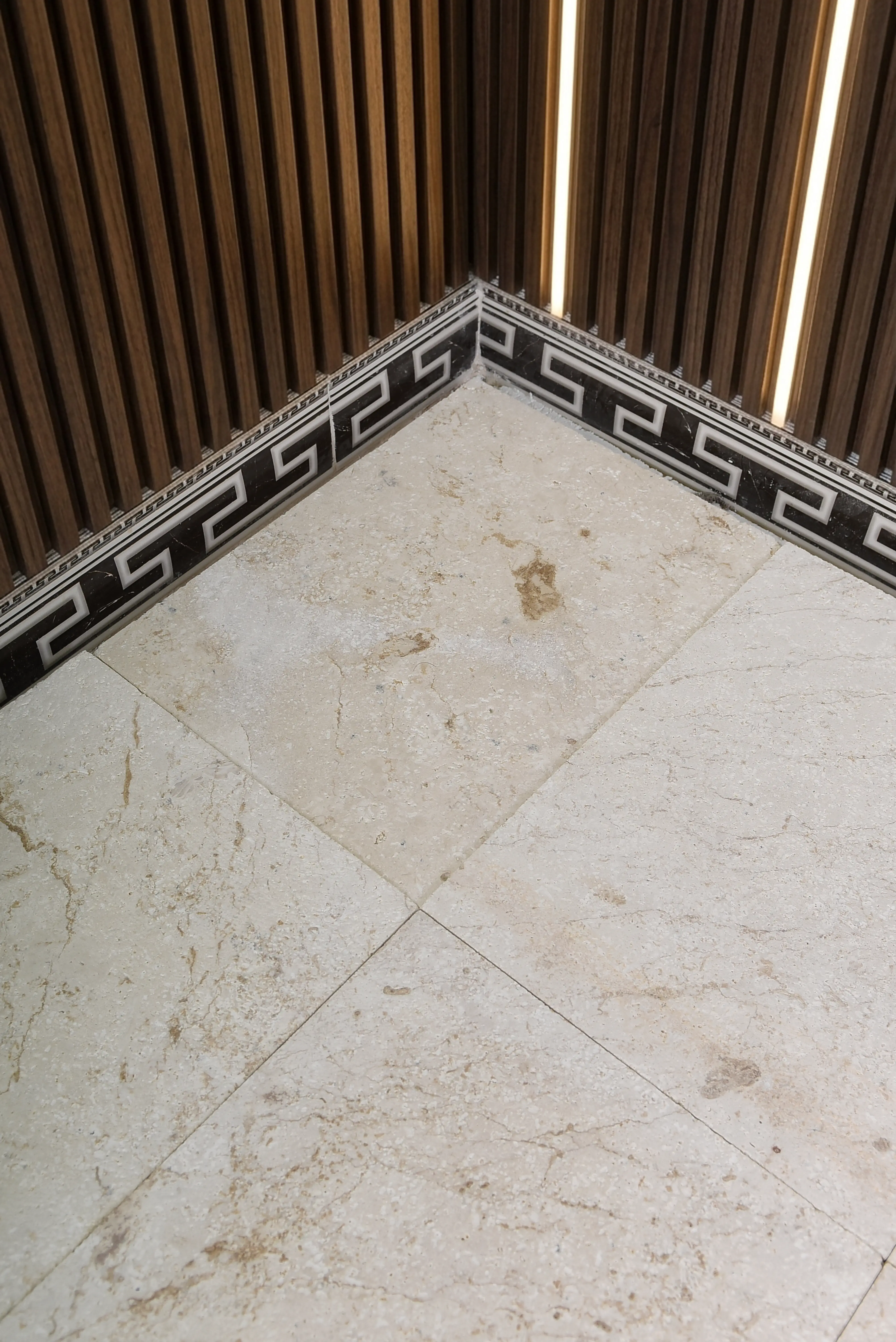
- Interior-to-exterior transitions: match interior tile format where possible for visual continuity — 24×24 format often aligns cleanly with large-format interior tile grids
Ordering, Lead Times, and Format Availability
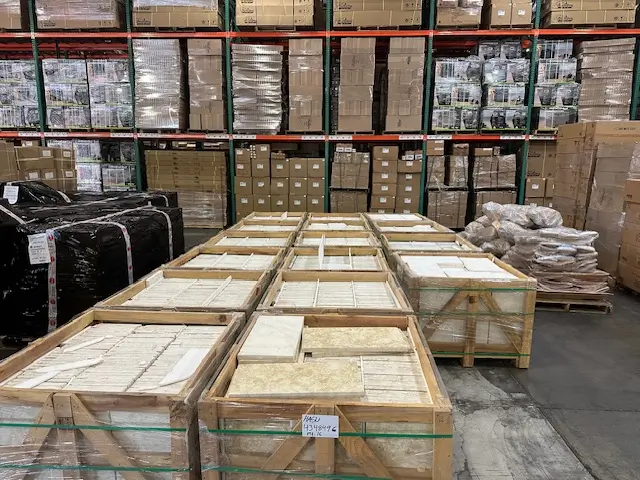
Not every travertine paver size is available in continuous warehouse stock. Standard mid-format sizes — 16×16, 18×18, and 12×24 — typically carry the deepest inventory because they represent the highest-volume demand across residential and commercial projects. Large-format pieces (24×24 and above) and specialty plank widths (4×24, 6×24) may carry lighter stock levels and occasionally require production lead times of four to eight weeks if the warehouse is between shipment cycles.
The practical implication for your project timeline: confirm stock levels and expected availability before locking in a construction schedule. A size substitution late in the planning process — moving from 24×24 to 18×18, for example — isn’t just an aesthetic adjustment. It changes your grout joint count, your overage calculation, your cutting waste profile, and potentially your base tolerance requirements. It’s a specification change, not a product swap, and it warrants a full re-review of adjacent decisions. At Citadel Stone, our technical team can confirm current stock levels and realistic lead times across the full range of travertine paver sizes before you finalize your order quantities.
- Confirm warehouse availability before finalizing your construction schedule — do not assume a size is in stock
- Standard mid-format sizes typically ship within one to two weeks from warehouse inventory
- Large-format and specialty sizes may carry four to eight week lead times if production is required
- Order quantity minimums vary by format size — verify pallet minimums against your calculated square footage plus overage
- If your project requires phased delivery, confirm that the warehouse can hold reserved stock between truck deliveries without repricing
Getting Travertine Paver Specifications Right
Choosing travertine paver sizes is a specification decision with downstream consequences across base preparation, thermal joint design, freight cost, labor hours, and material waste. The format families described here aren’t arbitrary categories — they reflect real performance thresholds that show up in the field as either smooth, long-lasting installations or premature repairs. Your project context, traffic loads, and budget structure should all feed into the size decision before a single square foot is ordered.
As you refine your specification, thickness is the variable that intersects most directly with format size — and it’s where many otherwise well-planned projects introduce unnecessary risk. For additional technical detail on how paver depth interacts with format dimensions and load performance, travertine thickness and format considerations covers the depth decisions that complete your specification. When format choice directly affects material yield, Citadel Stone’s selection of standard and oversized pavers gives buyers practical flexibility from the start.