What Actually Drives 6×12 Tile Cost
Most specifiers look at the per-square-foot price on a quote sheet and think they understand their 6×12 tile cost — but that number rarely tells the full story. The real cost spread on a 6×12 travertine tile project spans material grade, finish selection, fill treatment, and the freight component between your project site and the nearest warehouse stocking the format. Missing any of these variables when building your budget can shift your cost-per-square-foot figure by 30% or more before the first tile is set.
What makes the 6×12 format interesting from a pricing standpoint is its position in the market. It’s large enough to reduce labor time versus mosaic formats, but small enough to avoid the fragility surcharge you’ll sometimes see on large-format slabs. That mid-range efficiency tends to keep the 6×12 tile cost competitive, provided you’re comparing the same grade and finish across quotes.
Grade and Finish Selection: Where the Price Splits First
Travertine grading is the first cost lever you’ll hit. Premium or Select grade material — tight grain, minimal voids, uniform color distribution — carries a meaningfully higher price than Standard or Commercial grade, which tolerates more variation in tone, pitting, and veining. For interior flooring projects where aesthetics are the priority, Premium grade is worth the premium. For a rear courtyard or utility path, Commercial grade performs reliably at lower cost.
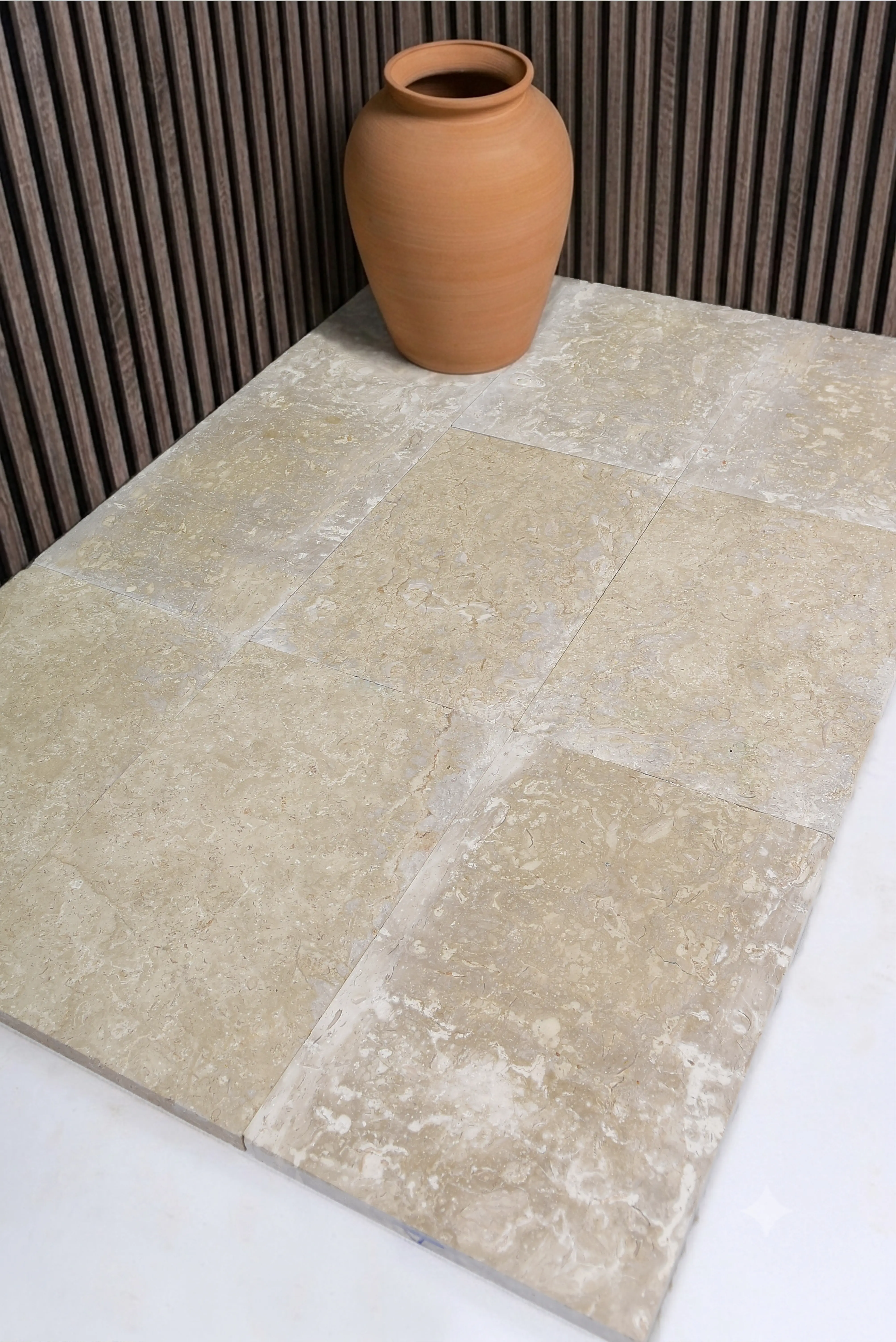
Finish selection compounds the grade cost in ways that aren’t always obvious. Polished travertine requires additional factory processing time, which adds to the base price. Honed and brushed finishes are generally closer in cost to raw unfilled material, while tumbled surfaces — which simulate centuries of wear — require mechanical processing that adds modest cost but often saves on installation labor because edge irregularities mask minor grout inconsistencies.
- Polished fill-and-grout: typically highest unit cost, best suited for indoor applications
- Honed unfilled: mid-range cost, popular for both indoor and outdoor use
- Brushed or antiqued: similar cost to honed, adds texture and slip resistance
- Tumbled: mechanical finish processing adds modest cost, but installation labor often runs lower
The fill treatment decision — whether your tile arrives pre-filled or unfilled — also affects your overall 6×12 tile cost when you factor in on-site materials and labor. Unfilled travertine installed with exposed voids creates a natural aesthetic but requires a different grout approach; pre-filled tile costs more per unit but typically reduces finishing time by an amount that nearly offsets the price difference on mid-to-large projects.
How the 600 x 1200 Tile Format Compares on Price
Specifiers sometimes ask whether scaling up to a 600 x 1200 tile format saves money through faster installation. The honest answer is: it depends heavily on substrate quality and labor market conditions in your region. Larger format tile is highly efficient on a perfectly flat, moisture-stable slab but demands tighter tolerances — and any unevenness in your subfloor that a smaller tile would bridge becomes a costly correction point on large-format material.
The 6×12 format — equivalent to 150 x 300 mm — sits at a practical sweet spot for most residential and commercial applications. It covers ground faster than a 4×4 or 4×12, but doesn’t carry the substrate preparation demands of the 600 x 1200 tile format. For projects where your slab is already prepped and certified flat, the large format can be cost-effective. For renovations or outdoor applications where substrate conditions are less controlled, the 6×12 format typically delivers the better value-per-installed-square-foot outcome.
Adoquin Stone Tile, Rock Finish Tiles, and Texture Pricing
Textured natural stone surfaces deserve attention when discussing tile cost comparisons because finish type significantly affects the per-unit price. Adoquin stone tile — a volcanic basalt material quarried primarily in Mexico — is priced differently from travertine because of its density, sourcing distance, and fabrication requirements. Its rock finish leaves a deeply textured, open surface; where wet-area performance matters, specify against ANSI A326.3 on the finish actually supplied; the standard sets wet DCOF minimums by use classification — 0.55 exterior wet for pool decks and patios, 0.50 interior wet plus for commercial kitchens, showers and wet entries, and 0.42 interior wet. Product classifications are manufacturer-declared.
Rock finish tiles more broadly — whether applied to travertine, basalt, or limestone — carry a fabrication cost that reflects the controlled splitting or mechanical texturing process used to create the surface. You’ll generally find that rock finish tiles cost 10–20% more than equivalent honed material from the same source, but the finish often reduces ongoing maintenance costs and extends the interval between resealing applications in outdoor environments. According to Natural Stone Institute ASTM stone tile specifications, finish type directly influences absorption rate and surface durability — factors that carry long-term cost implications beyond the initial purchase price.
- Rock split or cleft finish: natural texture, higher unit cost, lower maintenance frequency
- Adoquin stone tile: volcanic density gives a coarse, open texture, sourcing distance affects freight cost
- Polished travertine: highest unit cost, highest maintenance requirement
- Tumbled travertine: mid-range cost with excellent outdoor performance profile
Freight Distance and Regional Pricing Dynamics
Your project’s geographic location plays a meaningful but often underappreciated role in total 6×12 tile cost. Natural stone is a dense, heavy material — travertine typically runs 160–180 lbs per cubic foot depending on fill density — and freight costs scale directly with distance from the originating warehouse. A project within 200 miles of a major stone distribution center can see freight add $0.30–$0.60 per square foot. A project requiring cross-country truck delivery can push that figure to $1.00–$1.50 per square foot or more depending on order volume.
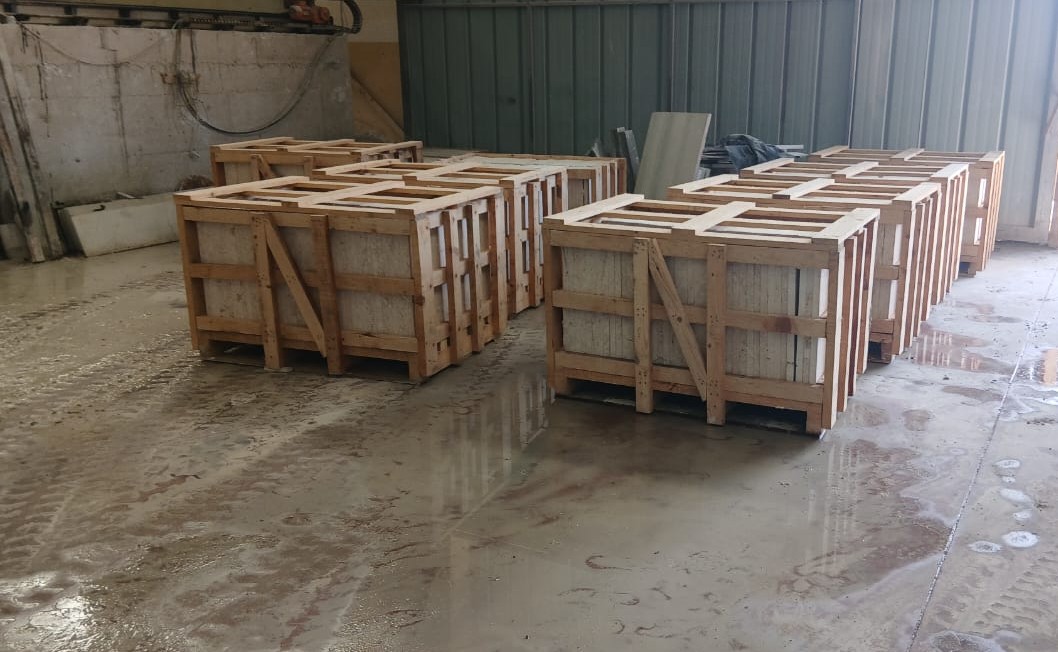
Order size is the strongest lever you have on freight cost. Full pallet quantities — typically 150 to 200 square feet per pallet depending on thickness — ship at meaningfully lower per-unit freight rates than partial pallet orders. Whenever your project allows it, rounding up to full pallet quantities will reduce your effective 6×12 tile cost per square foot, even accounting for modest overage. The overage also provides replacement tile insurance, which has real value over the life of a multi-decade installation.
Labor market conditions add another regional variable that affects total installed cost. In markets where stone installation labor is scarce or highly specialized, the material-to-labor cost ratio shifts — labor can represent 40–60% of your total installed cost rather than the 25–35% typical in more competitive markets. Understanding this ratio matters because it changes which format decisions make economic sense: in high-labor markets, spending more on a pre-filled, pre-sorted tile that installs faster often delivers better total project economics than saving on the unit price and absorbing extra setting time.
Thickness, Structural Specifications, and Their Cost Impact
Travertine 6×12 tiles are available in several thickness profiles, and the cost difference between them is more significant than most buyers expect. Standard 3/8-inch (10mm) material suits most interior flooring applications and is typically the lowest-cost option in the format. Three-quarter-inch (18–20mm) material — appropriate for exterior applications, driveways with light vehicle access, or high-traffic commercial floors — costs 25–35% more per unit and adds freight weight that amplifies shipping costs.
The ASTM C1527 travertine dimension stone standard establishes minimum breaking strength requirements based on thickness and end use — specifications your architect or specifier should reference when writing a project spec. Selecting material that meets or exceeds these benchmarks protects your installation, but it also means you should cross-check quotes to ensure comparable thickness, since suppliers occasionally quote thinner material to appear price-competitive.
- 3/8 inch (10mm): standard interior flooring, lowest cost per unit
- 1/2 inch (12mm): heavier-duty interior or light exterior, mid-range cost
- 3/4 inch (18–20mm): exterior, commercial, or vehicle-bearing surfaces — highest unit and freight cost
- Verify thickness in writing on quotes — this is the most common apples-to-oranges comparison error
Sourcing Origin and How It Affects Material Cost
Travertine originates primarily from quarries in Turkey, Italy, and selected quarries from the Middle East. The sourcing origin affects both the aesthetic character of the material and its pricing. Turkish travertine — the most widely available in the US market — offers consistent cream and walnut tones at accessible price points, partly because high quarry volume and established shipping infrastructure keep costs manageable. Italian travertine from the Tivoli region commands a premium due to its distinctive veining character and historical prestige, while material from the Middle East often offers excellent density and tonal consistency at mid-range price points.
Understanding sourcing origin also helps you evaluate lead times accurately. Material arriving by ocean freight typically runs a 6–8 week lead time from order to warehouse arrival, plus an additional 1–2 weeks to your job site depending on domestic truck distance. At Citadel Stone, we source directly from quarry partners in Turkey and from selected quarries across the Middle East, which gives our technical team direct visibility into material quality before it ever reaches the warehouse floor. That sourcing relationship matters when you need consistent grade and color matching across a multi-phase project.
For budget planning, allow for the full 8–10 week import cycle when your project relies on non-stocked material. If your timeline is tighter, check our travertine tile pricing for warehouse-stocked material, which can dramatically reduce lead times and improve your scheduling reliability.
Installation Cost Factors That Affect Your Total Budget
The installed cost of 6×12 travertine tile goes well beyond the material line item on your quote. Base preparation — whether that’s a mud-set mortar bed for outdoor applications or a bonded screed for interior floors — can add $3–$7 per square foot before a single tile is placed. Outdoor settings require a properly compacted aggregate base, typically 4–6 inches of compacted gravel, to prevent differential settlement that cracks stone over time.
Setting material selection also carries cost implications. Large-format tiles — and even the 6×12 format in exterior settings — benefit from a full-coverage thinset application rather than a spot-and-back approach. Full-coverage thinset uses 15–20% more material and slightly more labor time, but dramatically reduces the risk of hollow spots that cause cracking under point loads. The TCNA installation standards for natural stone tile specify full-coverage mortar bed coverage minimums that your installer should be following regardless of tile format.
- Substrate preparation: $3–$7 per sq ft depending on site conditions
- Full-coverage thinset: modest material upcharge, significant long-term protection
- Grout and sealant: add $0.50–$1.50 per sq ft depending on joint width and sealer type
- Expansion joints: required every 8–12 feet in exterior applications — factor into layout planning early
Value Engineering Your 6×12 Tile Project
Value engineering on a stone tile project doesn’t mean buying cheaper material — it means optimizing the decisions that affect total installed cost without compromising performance or aesthetics. The most impactful single decision is typically format consistency: using the 6×12 tile throughout a space rather than mixing multiple sizes keeps setting patterns simpler, reduces cut waste, and allows your installer to maintain a faster pace.
Layout orientation is a cost factor that rarely appears on any quote. A running bond pattern — the most common for a 6×12 tile — is straightforward and minimizes cuts. A herringbone layout with the same material requires 15–25% more cutting time and typically generates 10–15% more material waste, both of which add cost. If herringbone is the design intent, factor those additions into your material order and your labor estimate from the start. The USGS geological data on travertine and limestone formation underscores why consistent slab thickness from a single quarry source matters — thickness variation across batches from different quarry runs is a primary cause of lippage and setting corrections that drive labor costs up.
Rather than quoting a standard shipping window, Citadel Stone cuts each order at its selected quarries and confirms the lead time once the specification is agreed. Coordinating your delivery schedule to align with your installation crew’s readiness — rather than taking early delivery and paying for on-site storage and handling — is another practical cost management step that experienced project managers consistently implement.
Final Recommendations for 6×12 Tile Cost Planning
Getting your 6×12 tile cost right means treating the budget as a system, not a line item. Your material grade, finish selection, thickness, sourcing origin, freight distance, and installation approach are all connected — a decision in one area creates ripple effects in the others. The specifiers who consistently deliver projects on budget are the ones who nail down all of these variables before the first order is placed, rather than discovering the interdependencies mid-project when changes are expensive.
Verify thickness and grade specifications in writing on every quote. Round up to full pallet quantities whenever your project volume is close to a pallet threshold. Lock in your layout pattern before finalizing your material order so your waste allowance is accurate. And check your lead times against your installation schedule before committing — a truck delivery that arrives three weeks before your crew is ready adds handling cost and breakage risk that erodes your material savings. As you plan your stone project, related installation considerations can also inform your design decisions — travertine herringbone and pattern layouts covers how format and orientation choices interact with material cost and labor efficiency. Sourced from quarries across the Mediterranean and Middle East, Citadel Stone offers 6×12 tile with predictable lead times for larger orders.
Related reading: Small Travertine Tile Installation Problems Solved · rectangular travertine tile sizes compared · quarry tile thickness.