Travertine and marble share a chemical kinship that trips up even seasoned specifiers — both are calcium carbonate stones, and that single fact is responsible for most of the confusion. But knowing whether is travertine marble a valid classification or a geological misnomer matters practically, not just academically. The differences in formation, porosity, finish behavior, and long-term field performance are significant enough to change your specification decisions, your sealing schedule, and your expectations for how the material will age in service.
What Is Travertine? Formation and Geological Identity
Travertine is a sedimentary limestone — specifically a freshwater variety deposited by mineral-rich hot spring and river water as it releases carbon dioxide. What is travertine at its core? It’s calcium carbonate that precipitated rapidly out of solution, trapping gas bubbles and organic material in the process. Those voids are the defining structural characteristic: the interconnected pore network you see in every cross-section of the stone. Understanding travertine rock formation explains everything about how it behaves in service — its absorption rate, its sensitivity to acidic cleaners, and why filled versus unfilled finishes perform so differently in exterior applications.
The hot spring environment that creates travertine is also responsible for its color banding. As mineral content and temperature fluctuate in the source water, layers deposit at different densities, producing the tan, ivory, walnut, and gold striations characteristic of the material. This is formation chemistry, not quarrying variation — and it means no two slabs will ever match exactly, which is a feature in design terms but a challenge when you’re matching across multiple warehouse batches.
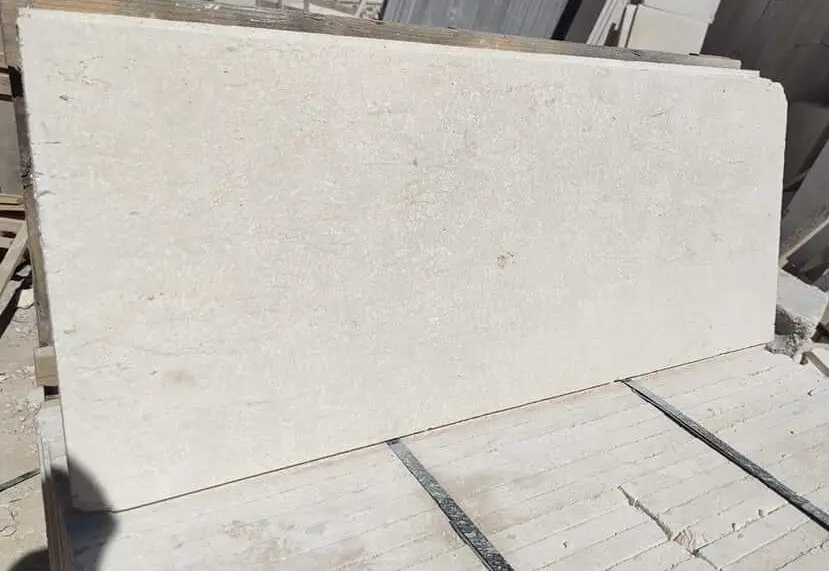
How Marble Forms — and Why It’s Fundamentally Different
Marble begins as limestone or dolomite that gets subjected to intense heat and pressure deep in the earth’s crust — a metamorphic process that recrystallizes the calcium carbonate into interlocking calcite crystals. The result is a dense, low-porosity stone with compressive strength values that typically range between 15,000 and 25,000 PSI, depending on variety. According to Natural Stone Institute travertine properties and outdoor suitability, the distinction between sedimentary and metamorphic calcium carbonate stones is critical for specifying correct maintenance regimes and finish systems.
The recrystallization process closes most of marble’s original pore structure. That’s why marble accepts a high-gloss polish that travertine simply cannot achieve without extensive void-filling and surface grinding. It also means marble’s absorption rate is dramatically lower — typically 0.1–0.4% by weight versus travertine’s 1–3% range for filled material and considerably higher for unfilled. That porosity gap is what separates the two materials in real-world performance, not their chemical composition.
Is Travertine Marble? The Definitive Technical Answer
Travertine is not marble. Both are calcium carbonate stones, but the classification diverges at the geological process level. Travertine is sedimentary — it forms at the earth’s surface through precipitation. Marble is metamorphic — it forms under heat and pressure below the surface. The ASTM classification system treats them separately: ASTM C1527 governs travertine as a dimension stone category distinct from marble under ASTM C503.
Here’s where the industry muddies the water: the commercial stone trade has historically grouped travertine under a broad “marble” category for sales and specification purposes — particularly in tile showrooms. You’ll still encounter pricing sheets that list “travertine marble tile” as a product category. That’s a trade convention, not a geological reality. For specification writing, maintenance planning, and performance assessment, always treat travertine as the sedimentary limestone it is. The practical consequences of misclassifying it — using polishing compounds designed for true marble on unfilled travertine, for instance — range from disappointing results to surface damage.
Reviewing the ASTM C1527 travertine dimension stone standard confirms the independent classification: travertine has its own absorption, compressive strength, and modulus-of-rupture benchmarks that differ from marble’s ASTM C503 limits. Minimum compressive strength for travertine under C1527 is 1,800 PSI, while marble under C503 requires a minimum of 7,500 PSI — a gap that explains why travertine is not typically specified for high-point-load commercial applications without thickness upgrades.
Porosity, Absorption, and Field Performance
The pore network in travertine creates performance characteristics that diverge sharply from marble in three areas you need to plan for:
- Water absorption: Travertine absorbs moisture more readily — filled and honed travertine tiles typically test at 1–3% absorption; true marble rarely exceeds 0.5% in the same finish
- Stain penetration: Open-cell travertine without a penetrating sealer will absorb cooking oil, wine, and pool chemicals faster than marble of comparable thickness
- Freeze-thaw vulnerability: Moisture trapped in travertine’s pores expands when it freezes — in climates with repeated freeze-thaw cycles, this mechanical stress can fracture unfilled voids over time if the stone isn’t properly sealed before winter
- Finish range: Travertine can be honed, brushed, tumbled, or polished (when filled), but will not achieve the mirror clarity of Carrara or Calacatta marble — the pore structure disrupts reflectivity at depth
- Acid sensitivity: Both stones etch with acidic contact, but travertine’s open pores mean acids penetrate faster — a critical consideration for outdoor installations near pools with pH fluctuations
The freeze-thaw point deserves more attention than it typically receives. Temperature cycling between day and night — even in regions that don’t experience deep winter freezes — creates micro-expansion and contraction in the stone matrix. For travertine tiles set in exterior applications, this thermal cycling means your grout joints need to be sized for movement, not just aesthetics. A 1/8-inch joint that looks refined when installed will begin telegraphing stress cracks within a few seasons if the setting bed doesn’t allow for thermal expansion. Specifying a joint width of 3/16 to 1/4 inch with a flexible sanded grout or epoxy grout gives the installation the relief it needs across seasonal temperature ranges.
Travertine Hot Spring Origins and What They Mean for Design
The travertine hot spring connection isn’t just geological trivia — it directly informs how you use the material. Travertine deposits form around thermal springs where water temperatures range from 40°C to over 90°C, producing stone with a thermal mass profile that performs differently than dense igneous or metamorphic alternatives. The relatively open pore structure that defines travertine rock moderates surface temperature, which is why travertine pool decks stay noticeably cooler underfoot than comparably colored granite or bluestone in high-UV conditions.
This thermal behavior also matters for installation timing and setting material selection. In hot, dry climates with significant day-to-night temperature swings — where ambient temperatures may drop 30–40°F between midday and early morning — travertine’s coefficient of thermal expansion (approximately 4.4 × 10⁻⁶ per °F) creates measurable dimensional change across a full slab. For a 24-inch tile, that translates to roughly 0.002 inches of movement per 10°F swing — small at the individual tile level, but cumulative across a large installation. Failing to account for this with correctly sized expansion joints every 10–12 linear feet in exterior applications is one of the most consistent field errors in travertine paver installations.
Specifying Travertine Tile: Filled, Unfilled, and Finish Selection
Your specification decisions start at the fill question, not the color selection. Filled travertine — where the natural voids have been injected with grout or epoxy at the quarry — creates a more uniform surface suitable for interior floors, counters, and formal exterior terraces. Unfilled travertine preserves the original pocket texture, which adds grip and visual character but demands more aggressive sealing protocols and excludes the material from food-prep surface applications.
The ASTM C1527 travertine dimension stone standard does not specify fill requirements — that’s left to the project specification. You need to call it out explicitly in your spec document, including the fill material type (cementitious vs. epoxy), the acceptable void coverage percentage, and the allowable variation in surface flatness. Leaving this ambiguous in the specification invites substitutions and disputes at delivery.
For exterior travertine tile selections, the Citadel Stone stone guide covers grading criteria and finish options that directly affect outdoor performance and installation planning. Travertine thickness for exterior paving typically starts at 3/4 inch nominal for pedestrian applications, stepping up to 1.25 inches for areas with vehicular access or heavy foot traffic concentrated on point loads. At Citadel Stone, we inspect warehouse stock for void distribution and fill consistency before shipment — because a batch with high void density in unfilled product can behave very differently on site than the sample tile you approved.
Maintenance Differences: What Each Stone Actually Needs
The maintenance gap between travertine and marble is meaningful, and conflating the two because they share calcium carbonate chemistry leads to real installation failures. Here’s how the regimes differ in practice:
- Sealing frequency: Travertine in exterior applications typically requires resealing every 1–2 years with a penetrating silane or siloxane sealer; marble in comparable conditions may extend to 3–5 years between treatments
- Cleaning chemistry: Both stones require pH-neutral cleaners — but travertine’s porosity means acid exposure (including mild household cleaners like vinegar or citrus-based products) penetrates faster and etches more aggressively than on dense marble
- Re-polishing: True marble can be mechanically re-honed and re-polished on-site to restore finish; travertine with significant pore exposure cannot be brought to the same reflective quality without re-filling and grinding, which is a specialist operation
- Joint maintenance: Travertine’s thermal movement means grout joints in exterior settings need inspection annually — replaced when cracked to prevent water ingress and the freeze-thaw damage cycle it initiates
- Efflorescence risk: Travertine’s open pore structure makes it more susceptible to efflorescence from moisture migrating through the setting bed — proper waterproofing membrane installation beneath exterior travertine is non-negotiable
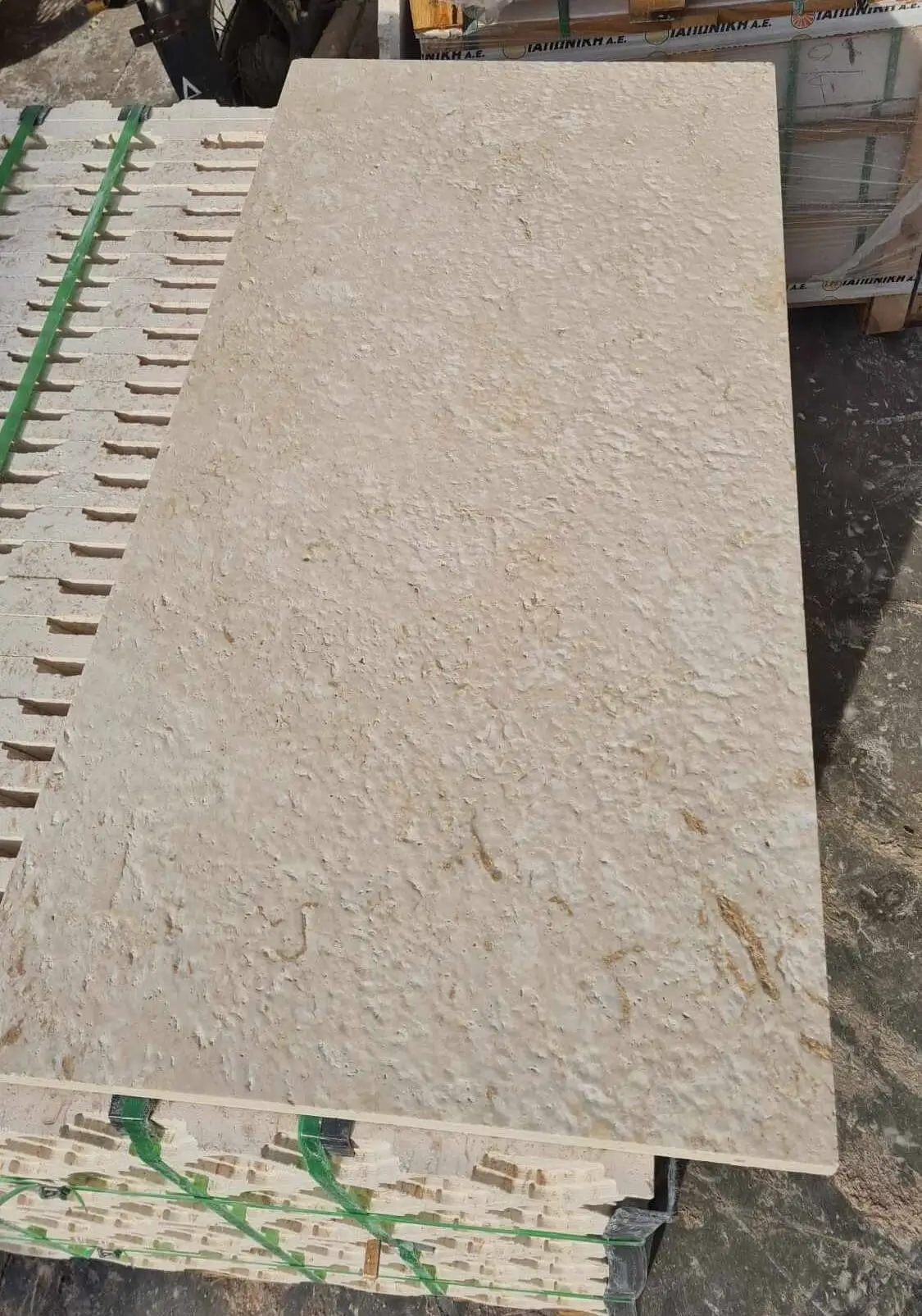
Travertine Rock in Exterior Applications: Where It Excels and Where It Needs Help
Travertine rock performs exceptionally well in exterior paving, pool surrounds, and covered outdoor living areas — but the applications where it genuinely excels are different from where marble thrives. Understanding the distinction saves you from specifying the wrong material for the wrong context.
Travertine is highly resistant to UV-induced color shift in lighter varieties (ivory, classic, silver) because its color originates from mineral deposition rather than dye or resin. Marble’s color stability varies significantly by variety — some veined marbles with iron-bearing minerals will develop surface oxidation under prolonged UV and moisture exposure. For outdoor applications where long-term color consistency matters, travertine’s sedimentary origin works in its favor.
Where travertine needs support is in freeze-thaw environments. According to USGS limestone and travertine natural mineral formation data, calcium carbonate sedimentary stones with higher absorption rates are more susceptible to freeze-thaw spalling than low-absorption metamorphic equivalents. In climates where temperatures cycle repeatedly across the freezing threshold — particularly in regions where winter brings multiple freeze-thaw events per week rather than a sustained cold period — exterior travertine requires a penetrating sealer applied before the first frost season and renewed annually. The mechanical action of water expanding approximately 9% in volume as it freezes inside travertine pores is what causes surface delamination and edge chipping over time. Sealed pores resist water ingress; unsealed pores accumulate it.
Sourcing, Grading, and Project Logistics
Travertine sourced from Middle East quarries and Mediterranean basin deposits represents the dominant supply stream in the North American market. The material’s quality varies significantly by deposit — vein-cut versus cross-cut orientation, void density, and fill quality all differ between quarry sources and even between different extraction levels within the same deposit. Specifying a travertine tile by color name alone gives you insufficient quality control; your specification should also call out the fill type, finish standard, allowable variation in calibration thickness, and minimum batch size per warehouse stock lot.
Project logistics for travertine deserve more planning than most designers allocate. Lead times from warehouse stock are typically 1–2 weeks for standard formats; specialty sizes or custom finishes sourced directly from quarry can run 10–14 weeks. Build that window into your project schedule before committing to an installation date. For large exterior projects — pool decks exceeding 2,000 square feet, for instance — confirm warehouse availability for the full quantity before ordering a sample, not after, since travertine dye lots and vein patterns shift between quarry runs and matching additional material six months later can be genuinely difficult.
Truck delivery logistics matter more than most clients anticipate. A full pallet of 18×18 travertine tiles at 3/4 inch thickness weighs approximately 2,200 lbs. Your site needs to accommodate a flatbed or curtain-side truck with adequate turning radius, and the unloading area needs to be within reasonable proximity to the installation zone — travertine pallets don’t hand-bomb easily. Clarify truck access constraints with your delivery coordinator before scheduling, particularly for residential sites with narrow driveways or low-clearance overhead obstructions.
Final Recommendations for Travertine and Marble Specification
The distinction between travertine and marble isn’t semantic — it drives every practical decision from sealing schedule to joint sizing to exterior suitability. Travertine is a sedimentary limestone formed through hot spring precipitation; marble is a metamorphic stone formed under heat and pressure. They share chemistry but diverge on porosity, compressive strength, finish capability, and freeze-thaw performance in ways that matter every time you put either material in service. Your specification documents should reflect that distinction explicitly, because the installation and maintenance implications are fundamentally different even if the showroom brochure groups them together.
For projects where travertine’s natural texture and thermal moderation are a design asset, the material delivers decades of service life when you seal it correctly, size your joints for thermal movement, and protect it from freeze-thaw cycling with annual maintenance. Where dense, low-absorption stone is the performance requirement — high-load floors, polished formal interiors, or environments with frequent acid exposure — true marble or another metamorphic alternative will serve better. As you develop your natural stone specification beyond travertine, French pattern travertine layouts and design covers another dimension of travertine application worth reviewing for large-format exterior projects, complementing the specification guidance in this article. Sourced direct from quarries in the Mediterranean and beyond, Citadel Stone stocks travertine graded for its characteristic porous surface texture.
Related reading: 12×24 floor tile patterns · travertine countertops · floor tile sizes compared.