Gray travertine tile ideas tend to cluster around two or three predictable applications — and that’s exactly where most designers stop. The real design leverage comes from understanding how the stone’s tonal range actually shifts across finishes and formats, and then exploiting those shifts deliberately across rooms and outdoor surfaces. Whether you’re specifying grey travertine tile for a minimalist bathroom or a layered living space, the material rewards specificity: the right finish, the right grout joint, the right lighting condition all interact in ways that generic mood boards never capture.
What Makes Gray Travertine a Distinct Design Material
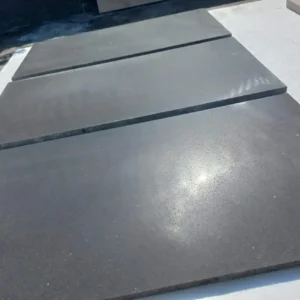
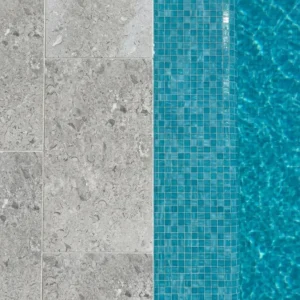
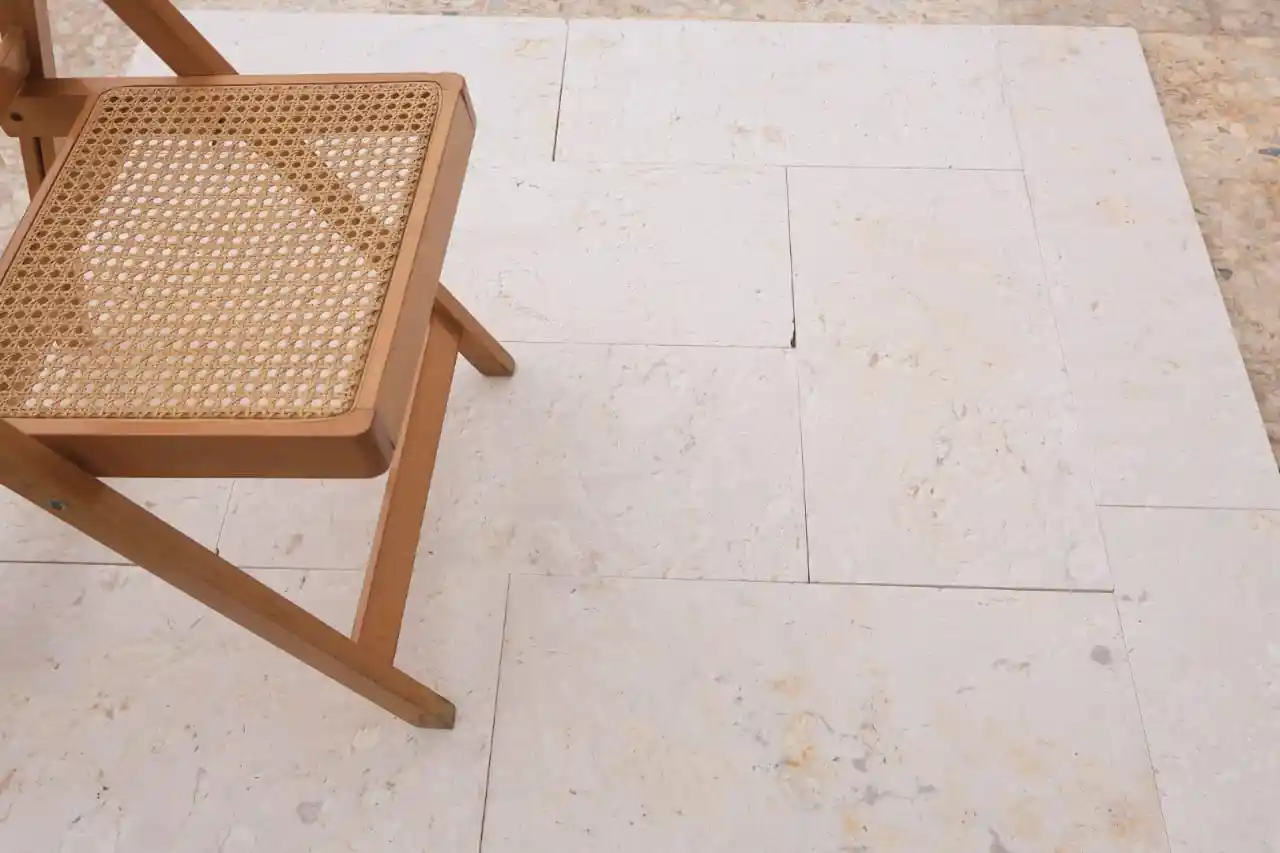
The grey in travertine isn’t flat — it moves from warm ash tones to cooler silver registers depending on the quarry vein, the finish, and the light source. That tonal complexity is what separates it from porcelain alternatives, which tend toward uniform grey that reads clean but lifeless at scale. Gray travertine tile carries natural voids, cross-cut veining, and density variation that create visual texture without added pattern, making it particularly effective in large-format applications where a single-tone surface would feel monotonous.
The stone’s calcium carbonate structure also means surface temperature stays measurably lower than dense igneous alternatives under direct sun exposure — a practical advantage for outdoor flooring that often influences material selection in high-UV environments. According to Natural Stone Institute travertine performance data, the open-pore structure characteristic of travertine actively moderates surface heat, which directly informs finish selection for outdoor applications.
Density within the grey travertine category varies by origin. Material sourced from Middle East quarries typically exhibits tighter vein structure and higher compressive values than equivalent material from some European sources, which tends toward more open voids. Knowing which you’re working with before specifying grout fill treatment is essential — unfilled travertine needs different sealing protocols than filled and honed product.
Interior Gray Travertine Tile Ideas Worth Specifying
Your strongest interior application for gray travertine tile is large-format flooring in open-plan living areas. A 24×24 or 18×24 honed slab reads as sophisticated restraint — the natural veining provides enough movement that the floor doesn’t need competing elements to hold visual interest. Pair it with matte-finish wall plaster and warm brass fixtures, and the stone’s cooler undertones anchor the palette without pulling cold.
Bathrooms are where the silver travertine tile category really performs. The reflective quality of a polished or honed grey surface bounces natural light efficiently in smaller rooms, and the organic veining prevents the sterile quality that large-format porcelain can produce. For wet areas, specify filled and honed rather than unfilled — the reduced void structure limits moisture infiltration and simplifies long-term maintenance significantly.
- Large-format honed flooring in living areas: 24×24 minimum for maximum visual impact
- Feature walls using cross-cut grey travertine tile in 12×24 or book-matched configurations
- Bathroom floors with filled and honed finish for moisture resistance and easier cleaning
- Kitchen backsplash using stacked horizontal formats to frame cabinetry lines
- Fireplace surrounds where the stone’s thermal mass and neutral tone complement heat-producing focal points
One application that consistently surprises clients: grey travertine tile used as a shower wall material with a brushed or tumbled finish. The textured surface reads warmer and more spa-like than polished alternatives, and the coefficient of friction is meaningfully higher — an important safety consideration per ASTM C1527 travertine dimension stone standards, which governs surface finish and absorption specifications for dimension stone tile in wet applications.
Outdoor Gray Travertine Tile Ideas for Patios and Pool Decks
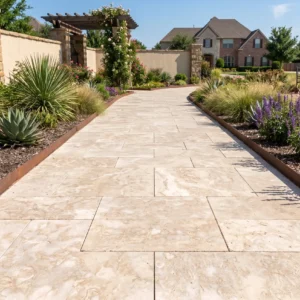
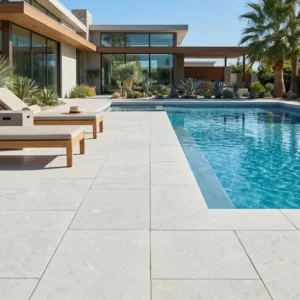
For exterior use, your finish selection shifts the performance profile significantly. Tumbled grey travertine tile delivers a naturally textured surface that handles wet conditions with a dynamic coefficient of friction well above 0.6 — the generally accepted threshold for exterior wet surfaces. Honed and filled works in covered outdoor areas or shaded patios; for pool surrounds and open terraces, tumbled or brushed finishes are the professionally defensible choice.
Thickness matters outdoors in ways it doesn’t indoors. Specify 2-cm (nominal ¾-inch) travertine gray tile for ground-level installations where vehicle or heavy equipment access is possible, and 3-cm for any application where point-load stress concentrates — raised terraces with limited substrate depth, for example. Thinner tile works fine in interior flooring scenarios but carries real deflection risk outdoors unless the substrate is essentially rigid.
- Pool deck: tumbled grey travertine, 2-cm minimum, unfilled for natural drainage
- Covered patio: filled and honed grey, 2-cm, with polymeric sand joints for weed suppression
- Exposed terrace: brushed finish at 2-3 cm, thermal expansion joints every 10-12 linear feet
- Outdoor kitchen surround: honed and filled 12×24 with epoxy grout at food-preparation surfaces
Subgrade Stability and Soil Conditions That Affect Installation
Here’s what frequently gets missed in gray travertine tile specifications: the subgrade under your installation determines long-term performance as much as the stone itself. Natural stone is rigid and unforgiving — any differential movement in the base transfers directly to grout joints, and eventually to the tile body. Expansive clay soils are particularly problematic because moisture cycling causes volumetric changes that standard concrete slabs don’t fully absorb.
In regions with high clay content, your base preparation needs to account for swelling coefficients that can reach 10-15% volumetric expansion in untreated expansive soils. The practical response is a compacted aggregate base of at least 6 inches over the native clay, with a geotextile separation layer preventing clay migration into the aggregate over time. Sandy or rocky subgrades are more forgiving — they drain freely and exhibit minimal movement — but caliche layers common in arid subgrades require mechanical breaking before any base aggregate is placed, otherwise differential drainage creates isolated low spots that concentrate stress on tile joints.
For interior slab-on-grade installations, a crack isolation membrane between the concrete and the tile setting bed is standard practice when expansive soil conditions exist below. The membrane absorbs minor differential movement before it reaches the tile plane. The TCNA installation standards for natural stone tile address this directly, with specific recommendations for crack isolation in slab-on-grade applications over problematic subgrades.
At Citadel Stone, we consistently advise clients to obtain a basic soil report before finalizing tile thickness and substrate specifications — particularly for large outdoor installations. The cost of a soil assessment is trivial compared to the remediation cost of a lifted or cracked installation two seasons in.
Choosing the Right Format and Size for Your Space
Format selection for gray travertine tile ideas follows a straightforward principle: larger rooms can absorb larger tiles without the proportional distortion that makes overscaled tile feel aggressive in tighter spaces. A 24×24 format works well in spaces above 200 square feet; for powder rooms or narrow corridors, a 12×12 or 12×24 reads more naturally and reduces awkward cut ratios at perimeter walls.
The 12×12 format occupies a practical middle ground that suits both interior and exterior uses. For clients exploring silver travertine through Citadel Stone, the 12×12 format offers the flexibility to install in a standard grid, offset brick pattern, or diagonal layout — each of which changes the perceived scale and movement of the floor. Diagonal installation in particular makes grey travertine tile feel wider in rectangular rooms, an effect that’s especially useful in hallways and long kitchen layouts.
- 12×12: versatile for both interior floors and exterior patios, easiest to handle on site
- 12×24: creates a contemporary linear effect, particularly effective on bathroom walls
- 18×18 or 24×24: best for large open-plan living areas and outdoor terraces
- 3×12 or 4×12 subway formats: backsplash and feature wall applications
Honed, Polished, Tumbled, and Brushed: Finish Options Compared
The finish you specify changes the grey travertine tile’s performance profile, maintenance requirements, and design register simultaneously. Polished finishes deliver maximum reflectivity and a smoother surface that shows etching from acidic cleaners — not a weakness you want in a kitchen floor or outdoor surface where wine, citrus, or cleaning products might contact the stone regularly.
Honed finishes are the most broadly applicable. They provide a flat, non-reflective surface with good stain resistance when sealed, without the maintenance sensitivity of polished stone. Honed grey travertine reads sophisticated in contemporary interiors and holds up well in moderate-traffic commercial applications. Tumbled finishes age the appearance intentionally — the rounded edges and textured surface suit Mediterranean or transitional design contexts and deliver the highest friction coefficients of any finish option.
- Polished: highest visual impact, requires pH-neutral cleaners only, avoid in exterior wet zones
- Honed: most versatile, suitable for floors, walls, and covered outdoor areas
- Tumbled: highest slip resistance, best for pool surrounds and rustic design schemes
- Brushed: mid-point between honed and tumbled, retains some texture without fully rounded edges
Sealing and Ongoing Maintenance for Gray Travertine
Gray travertine tile requires penetrating impregnator sealers rather than topical coatings. The distinction matters: topical coatings sit on the surface and degrade with traffic, eventually requiring stripping and reapplication. Penetrating impregnators enter the pore structure and repel moisture from within, leaving the surface appearance unchanged. For honed and polished finishes, you’ll typically need resealing every two to three years under residential traffic; for tumbled and brushed finishes with higher surface porosity, annual sealing is more defensible.
Grout joint maintenance is often where long-term performance breaks down. Travertine gray tile’s natural movement and the thermal cycling of exterior applications gradually degrade flexible sealants at perimeter joints. Inspect perimeter and field expansion joints annually and replace any cracked or deteriorated sealant before the following freeze-thaw season. Catching this early prevents water infiltration that reaches the substrate — once moisture cycles under stone tile repeatedly, bond failure is a matter of time, not possibility.
- Use penetrating impregnator sealers — not topical wax or acrylic coatings
- Allow new installations to cure a minimum of 28 days before initial sealing
- Clean with pH-neutral stone soap — never vinegar, citrus cleaners, or standard household tile cleaners
- Inspect and replace expansion joint sealant annually for all exterior applications
Ordering, Lead Times, and Project Planning Notes
Your material order should account for a 10-12% overage on all gray travertine tile projects — 15% for diagonal layouts or complex cut patterns. Natural stone exhibits batch-to-batch variation in vein density and background tone, so ordering all material from the same production run is essential for visual consistency. Citadel Stone maintains warehouse inventory of core grey travertine tile formats, which typically reduces lead times to one to two weeks compared to the extended timelines that custom import orders require.
Verify truck access to your project site before finalizing delivery scheduling. Gray travertine tile ships on palletized crates that require either a loading dock or a truck with a liftgate — a detail that consistently creates last-minute logistics issues when overlooked. For sites with restricted access or weight limits on private drives, coordinate delivery method with the warehouse team early in the project timeline to avoid delays that affect setting crews.
Gray Travertine Tile: Getting the Specification Right
Gray travertine tile ideas succeed or fail at the specification level — finish, format, subgrade preparation, and sealing protocol are the variables that separate an installation you’re proud of from one that requires remediation. The design range of grey travertine is genuinely broad: it works in contemporary minimalist interiors, transitional outdoor spaces, and warm Mediterranean schemes with equal confidence. The stone’s natural tonal variation does design work that fabricated materials simply can’t replicate. As you plan related travertine applications for your project, travertine backsplash design ideas covers another dimension of how this material performs in vertical and accent applications. Gray travertine selected from Citadel Stone’s range tends to photograph with greater tonal contrast under warm LED lighting than beige or ivory alternatives.
Related reading: ph neutral cleaner for travertine tile · how to repair travertine tile · travertine tile shower installation.