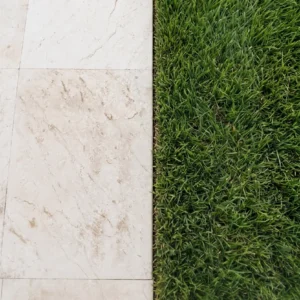
French pattern limestone pavers demand more precision at the layout stage than most specifiers anticipate — not because the geometry is complicated, but because any drift in your reference lines compounds across a large field and becomes nearly impossible to correct after the third or fourth band is set. The pattern itself uses four slab sizes in a repeating module, and the ratio between those sizes is what drives both the visual rhythm and the structural load distribution. Getting that module nailed down before you cut a single stone saves you from the costly correction work that derails schedules on large exterior projects.
Understanding the French Pattern Module
The classic French pattern — sometimes called a Versailles pattern — combines four limestone paver sizes in a single repeating unit: a large square, a medium square, a small square, and a rectangle. The standard module is built around a base unit, typically 6 inches, which means your four pieces are nominally 12×12, 6×6, 6×12, and 18×18 inches. In practice, most fabricators work to metric equivalents with tight tolerances, so you’ll want to confirm your calibrated stone thicknesses and face dimensions before your base is poured. A 2mm variation in face size across a full pallet reads as a visible jitter in the grout lines.
The module’s proportions are what create that distinctly European, non-repetitive feel. Because no two adjacent slabs share the same size, the eye doesn’t lock onto a grid — it reads the surface as organic, even though every tile is precisely cut. That optical effect depends entirely on you maintaining consistent joint widths, typically 10–12mm for exterior limestone work, throughout the field. Wider joints interrupt the rhythm; narrower joints create stress concentrations at corners.
According to NSI limestone technical specifications, limestone’s compressive strength typically ranges from 4,000 to over 20,000 PSI depending on density and formation, which means your slab sizing choices have a direct bearing on point-load performance — not just aesthetics.
Base Preparation for French Pattern Installations
Your base preparation carries more weight here than with uniform-format paving, because the four different slab sizes in a French pattern transfer loads differently at their corners and edges. The 18×18 slabs span wider distances between support points, while the 6×6 pieces carry concentrated pedestrian loads in a much smaller footprint. A consistent 4-inch compacted aggregate base handles both scenarios for residential and light commercial work, but step that up to 6 inches in any zone that will see vehicular overrun or heavy equipment access.
- Compact aggregate base to 95% modified Proctor density — not the 90% figure used for concrete subbase work
- Use a leveling bed of coarse bedding sand between 25mm and 40mm uncompacted depth, screeded to ±3mm across the field
- Verify drainage slope at 1–2% before setting any stone — French pattern fields hold water at grout joints if the fall is insufficient
- In freeze-thaw regions, extend your aggregate depth to 8–10 inches and consider a geotextile membrane at the subgrade interface to prevent frost heave from migrating fine particles upward
Field performance data on French pattern limestone pavers consistently shows that installations failing within the first five years trace back to inadequate base compaction rather than material defects. The pattern’s joint geometry creates dozens of small corner intersections, and any differential settlement at those points telegraphs immediately to the surface as lippage.
Limestone vs Travertine for French Pattern Work
The comparison of limestone pavers vs travertine pavers comes up on almost every French pattern project, and the honest answer is that both materials execute the pattern well — but they behave differently under the same installation conditions. Travertine’s open vein structure gives it a naturally varied surface that some designers prefer for a rustic Versailles aesthetic. Limestone, particularly a dense oolitic or shell variety, delivers a more uniform tone that keeps wide French pattern fields visually cohesive from edge to edge.
From a technical standpoint, the differences that matter most for exterior French pattern work are water absorption and surface hardness:
- Dense limestone typically exhibits absorption rates between 2% and 5% by weight, which supports highly resistant performance through wet-dry cycling
- Travertine absorption can reach 7–10% in unfilled versions, requiring you to seal more frequently in wet climates to maintain joint integrity
- Limestone’s Mohs hardness of 3–4 means it will show pedestrian wear on high-traffic paths over a decade or more — factor this into finish selection
- Travertine’s voids, if left unfilled in exterior work, collect debris and biological growth at grout joint intersections
For large-format French pattern fields — those exceeding 500 square feet — limestone’s dimensional consistency gives you tighter joint alignment across the module repeat. That matters because the pattern relies on straight grout lines between dissimilar slab sizes to read correctly at distance. When evaluating limestone pavers vs travertine pavers for high-traffic applications, the absorption differential is often the deciding factor for long-term maintenance planning.
Layout Sequencing and Reference Line Strategy
Here’s what most specifiers miss when they see the French pattern drawn on a plan: the layout starts from the center of the field, not from a wall or edge. Starting from an edge means your cut pieces accumulate on one side, and if the field dimension doesn’t divide neatly by the module width, your border cuts will be mismatched — large on one side, slivers on the other. Starting from center distributes any remainder equally to opposing edges, which reads symmetrically even when the viewer doesn’t consciously register why.
Your layout sequence should follow this order:
- Establish a true centerline in both axes using a laser level — string lines shift under foot traffic during large installations
- Dry-lay one full module (all four slab sizes) at the center intersection before committing to mortar
- Photograph the dry-laid module and compare it to your design drawing — scale errors appear immediately at this stage
- Set battens at your module repeat intervals so setters can work outward without re-measuring
- Cut border pieces only after the field is fully set and the mortar has cured — cutting too early risks modules shifting before cure
The TCNA installation standards for natural stone tile provide clear guidance on substrate deflection limits and setting bed requirements — both of which directly affect how a French pattern field performs over time on a flexible substrate like a timber deck or lightweight concrete.
Joint Integrity and Storm Weather Performance
French pattern limestone pavers installed in areas subject to storm events face a specific vulnerability that single-format paving doesn’t share: the multiple corner intersections where four different slab sizes meet create more joint nodes per square foot, and each of those nodes is a potential entry point for wind-driven rain. Your jointing material selection and application method directly determine whether those intersections remain tight after a severe weather event.
Polymer-modified joint sand performs significantly better than traditional dry-pack cement at these multi-corner intersections. The polymer binder maintains flexibility through the thermal cycling that follows freeze events, while rigid cement grout can fracture at the corner nodes and allow water infiltration. For installations in regions prone to heavy hail or high-wind events, you should also consider recess-pointing — setting the jointing material 2–3mm below the slab face — which reduces the surface area exposed to direct impact.
- Specify ASTM C270 Type S mortar for wet-bed installations in storm-exposure zones — it provides adequate bond strength with controlled rigidity
- Install perimeter edge restraints with a minimum embedment of 150mm in compacted aggregate — wind-driven lateral loading on patio slabs is underestimated in most residential specs
- Avoid epoxy grout in exterior French pattern work — thermal expansion differentials between stone and epoxy cause surface staining that’s extremely difficult to remediate
- Seal joints annually if the installation is in a high-wind-rain exposure zone; every two years is adequate for sheltered applications
The edge restraint detail deserves particular attention. On a French pattern field, the 18×18 slabs adjacent to the border are the most vulnerable to rocking under lateral load from wind-driven water pressure accumulating along the edge joint. A robust steel or composite edge restraint system, mechanically staked at 300mm centers, keeps the field perimeter locked even during sustained storm events.
Finish Selection for Exterior Limestone Pavers
Your finish choice affects more than appearance — it determines slip resistance, maintenance frequency, and long-term colorfastness. For French pattern limestone pavers in exterior applications, honed and brushed finishes consistently outperform polished surfaces on every practical metric. A polished finish reads beautifully in interior showrooms but opens up the surface to accelerated wear from grit abrasion and reduces the coefficient of friction below safe thresholds for wet conditions.
The brushed finish — sometimes called antiqued or aged — is the traditional choice for Versailles pattern work because it echoes the worn character of historic European paving. It also increases the surface’s dynamic coefficient of friction (DCOF) meaningfully compared to honed, which matters for pool surround applications or any surface that will be wet regularly. Honed finishes hit a middle ground: smoother than brushed, matte rather than reflective, and highly resistant to surface crazing from freeze-thaw cycling.
For large outdoor fields, consider specifying a calibrated stone thickness of at least 30mm (nominal 1.25 inches). Thinner pavers in the 20mm range are adequate for foot traffic but show greater deflection variance between the 6×6 and 18×18 module pieces under point loading, which can cause lippage to develop over time even on a well-prepared base. The USGS limestone composition data confirms that denser limestone formations exhibit lower absorption and higher modulus of rupture values — both factors that support the thinner 20mm specification in low-traffic contexts.
Honeycomb Pavers and Pattern Variation
Honeycomb pavers represent an entirely different geometry — hexagonal rather than rectilinear — but they’re worth understanding alongside the French pattern because designers frequently ask about combining them or using one as a border accent for the other. Hexagonal limestone pavers work well as a transition element between a French pattern field and a planted border, particularly where the rectilinear grid of the main field would create an awkward cut against a curved landscape bed.
The structural principles for honeycomb limestone are different from rectilinear French pattern work. The six-sided geometry distributes point loads more evenly than a square slab of equivalent face area, but the edge-to-edge joints are longer relative to the slab perimeter, which increases the total joint length per square foot. That means more jointing material, more maintenance surface, and — in storm-exposed locations — more total joint length for wind-driven rain to penetrate. Specify honeycomb pavers as accent or transition elements, not as primary field paving in high-exposure zones.
Ordering, Logistics, and Material Quantities
Calculating material quantities for a French pattern field requires you to account for each of the four slab sizes separately, then add a waste allowance that reflects the field geometry and the number of border cuts. A standard waste factor of 10% is appropriate for a simple rectangular field. Step that up to 15% for an irregular outline, L-shaped terraces, or any field with multiple internal obstacles like post bases or drains.
For projects requiring large-format 24×24 Limestone Pavers, confirm warehouse stock levels before locking your construction schedule — large-format calibrated stone can have lead times that differ from standard French pattern piece sizes, and mixing batches from different quarry pulls can introduce color variation across a field that’s visible at completion.
- Order all four module sizes from the same quarry batch — this is non-negotiable for color consistency across a French pattern field
- Specify palletized delivery with banded strapping — loose stone loaded by forklift sustains significantly more corner chipping during truck transit than factory-palletized material
- Verify truck access to your delivery point before ordering — 30-ton deliveries require a hardstand pad or existing paved surface to avoid rutting
- At Citadel Stone, we source French pattern limestone sets from selected quarries in the Middle East and maintain warehouse inventory that allows standard lead times of 1–2 weeks for most stocked colorways
One detail that often gets overlooked in the ordering phase: request a sample panel — a minimum of four module repeats — before committing to full quantity. Color photography of stone rarely captures the true tonal variation across a pallet, and the French pattern’s mix of slab sizes means variation that would be invisible in a uniform format can appear as a patchy field when the sizes are combined.
Your Action Plan for French Pattern Limestone Pavers
French pattern limestone pavers reward methodical specification work. The layout geometry is forgiving once you’ve established your center reference correctly, but it’s unforgiving of rushed base preparation or mismatched stone batches. Your checklist before breaking ground should confirm: base compaction to 95% Proctor, a verified 1–2% drainage fall across the full field, and confirmed module sizes against your calibrated stone delivery. Set one full dry-laid module at center before any mortar is touched — it costs 30 minutes and can save an entire project from misalignment.
As you finalize your stone specification, consider how other natural stone elements on the same property can complement or contrast your French pattern field. For adjacent vertical surfaces, natural stone exterior cladding options offer compatible material choices that carry the limestone palette from the ground plane to the building face — a detail that elevates the overall design coherence considerably.
The detail that determines whether a French pattern installation reads as professional or amateurish is consistent joint width through every module corner intersection. Invest in a quality joint spacer system calibrated to your specified grout width and don’t allow setters to eyeball the corners — the eye is far less accurate than a 10mm plastic spacer at those critical multi-piece intersections. The repeating logic of a French pattern works especially well with the consistent coloring of Citadel Stone limestone, keeping the design cohesive across wide surfaces.
Related reading: how limestone is made · limestone slab vs pavers.