Natural stone paving slab cost splits into two distinct categories that most buyers conflate until the invoice arrives — material cost and total project cost. The gap between those two numbers can run anywhere from 40% to over 200% depending on stone type, thickness, finish, and logistics. Understanding what actually drives natural stone paving slab cost puts you in a position to evaluate quotes accurately and avoid the budget overruns that catch unprepared buyers off guard.
What Drives Natural Stone Paving Slab Cost
Stone type is the starting point, but it’s rarely the dominant cost variable on large commercial or high-end residential projects. Thickness, finish, and format size interact with stone type in ways that can push a mid-range material into premium pricing territory — or bring a premium stone into competitive range through efficient sizing. You’ll want to evaluate all four together before comparing supplier quotes side by side.
- Stone species (limestone, granite, travertine, basalt, sandstone) determines base quarry cost and regional availability
- Slab thickness directly affects both material cost and freight weight — thicker slabs cost more per unit and more to ship
- Surface finish (honed, polished, bush-hammered, flamed) adds processing cost ranging from minor to significant depending on the finish type
- Format size affects yield: larger slabs generate more waste during cut-to-size work, which raises effective cost per installed square foot
- Origin and logistics chain — quarry location, import cycle, and warehouse proximity all influence final delivered price
Stone Type Price Ranges Explained
Limestone sits in the most accessible price band for natural stone paving slabs — typically in the range of $8 to $22 per square foot for standard thicknesses and honed finishes sourced from established quarries. That range reflects real variation in density, color consistency, and quarry of origin. A dense, tight-grained limestone from carefully selected Middle East quarries commands a meaningfully different price than a domestic stone with higher porosity and less color uniformity.
Granite paving slabs occupy a higher mid-range band — roughly $14 to $35 per square foot depending on color, thickness, and finish. The durability case for granite is strong: compressive strengths typically exceeding 20,000 PSI make it the right call for high-traffic commercial paving and driveway applications. According to Natural Stone Institute granite durability specifications, granite’s low absorption rate and abrasion resistance make it one of the most specification-reliable natural stones for exterior use. The cost premium reflects those performance credentials.
Travertine falls in a similar band to limestone, with filled and honed travertine running $10 to $25 per square foot for paving applications. Unfilled travertine with natural voids costs less to process but requires more careful installation and ongoing maintenance — factor that into your total cost calculation. Basalt commands a slight premium over standard limestone, typically $12 to $28 per square foot, largely because of the additional processing required to achieve smooth honed surfaces from this dense volcanic material.
- Limestone: $8–$22 per sq ft — accessible entry point with wide variation by density and origin
- Travertine: $10–$25 per sq ft — value-competitive, but maintenance costs vary by fill status
- Granite: $14–$35 per sq ft — premium durability justifies cost for high-traffic and driveway applications
- Basalt: $12–$28 per sq ft — processing-intensive but exceptionally stable in outdoor conditions
- Sandstone/flagstone: $7–$18 per sq ft — cost-effective but requires careful species-level specification
Thickness and Format: The Cost Multiplier Most Buyers Miss
Slab thickness is the cost driver that catches specifiers off guard more consistently than any other single variable. A 1.25-inch (30mm) paving slab might cost 35–50% more than a 0.75-inch (20mm) equivalent in the same stone, not just because of raw material volume but because thicker slabs require more quarrying depth, generate more waste during extraction, and add significantly to freight weight per pallet. Your project’s structural requirements — foot traffic, vehicle loads, freeze-thaw exposure — determine the minimum thickness, but you should be precise about that minimum rather than defaulting to the thickest available option.
Large-format slabs (24×24 inches and above) carry a cost premium that many buyers don’t anticipate. The premium comes from lower production yield per quarried block, higher breakage risk during processing and transport, and the additional handling complexity at the installation site. For high-aesthetic projects where large format is non-negotiable, that premium is justified. For functional paving applications where a 16×16 or 18×18 achieves the same result, the format selection can reduce material cost by 15–25% without compromising performance.
- 20mm thickness: standard for pedestrian paving, most cost-effective per square foot
- 30mm thickness: recommended for mixed pedestrian and light vehicle use, adds 35–50% to material cost
- 40mm+ thickness: required for driveway and heavy vehicle applications, significant cost step-up
- Large format (24×24 and above): expect 20–35% premium over equivalent smaller tiles
- Irregular flagstone: lower material cost but higher installation labor — total cost often balances out
Finish Selection and Its Cost Implications
Surface finish affects natural stone paving slab cost in two ways — processing cost and long-term maintenance cost. Polished finishes require more factory time and specialized equipment, adding $2–$6 per square foot to base stone cost depending on species. Flamed and bush-hammered finishes, which are common for outdoor slip-resistance, require specialized thermal or mechanical treatment that also adds cost, typically $1–$4 per square foot above honed pricing. Understanding which finish your project actually requires — rather than which finish looks best in a showroom — is where experienced specifiers save money without sacrificing performance.
For sun-exposed outdoor paving, finish selection also has a direct impact on UV performance and long-term appearance. Polished surfaces on light-colored stones are more susceptible to visible oxidation and UV-driven color shift over time — you’ll see it as a subtle yellowing or surface dullness within 3–5 years of unprotected exposure in high-UV installations. Honed and bush-hammered finishes maintain their visual consistency more reliably outdoors because they don’t have a reflective surface layer that UV exposure degrades. According to USGS basalt formation and surface properties, dense igneous materials like basalt show greater UV color stability than calcareous stones precisely because their mineral composition is less reactive to oxidation. Factor finish UV performance into your specification — a finish that looks premium on day one but requires resealing every 18 months costs more over a 10-year horizon than a honed finish resealed every 3 years.
- Honed finish: lowest processing premium, best all-round outdoor durability, resealing every 2–4 years typical
- Polished finish: highest processing premium, not recommended for exterior paving where UV and moisture exposure are constant
- Bush-hammered: mid-range processing cost, pronounced surface texture, very stable appearance under UV exposure
- Flamed: thermal process adds cost, creates a highly textured surface, preferred for pool decks and commercial walkways
- Tumbled/antiqued: minimal processing premium, rustic aesthetic, surface irregularities require more care in jointing
Logistics, Delivery, and Total Project Cost
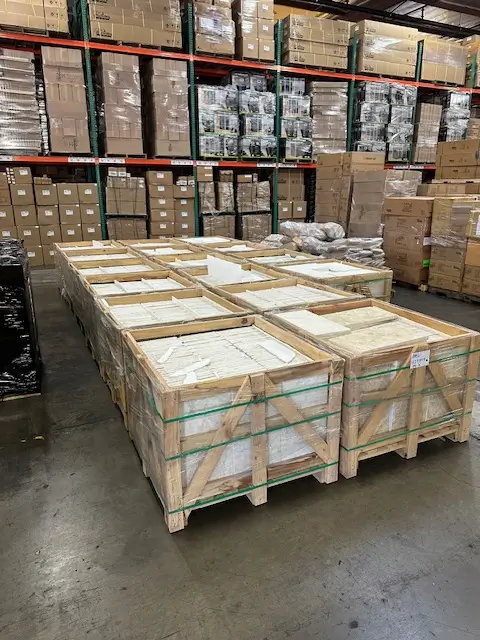
Your delivered price for natural stone paving slabs includes freight from the warehouse to your site, and that number deserves careful attention when you’re comparing supplier quotes. A quote that looks competitive per square foot can become uncompetitive once you add freight from a distant warehouse — or becomes premium once you factor in the lead time savings from a supplier with closer inventory. Pallet weight for 30mm limestone at scale runs 2,200–2,800 lbs per pallet, meaning a 2,000-square-foot project generates significant freight volume that must be priced accurately at quoting stage.
Truck access at your site is a detail that creates real cost surprises. Standard delivery requires full articulated truck access for efficient pallet drops — if your site has restricted access, gate height limits, or poor surface conditions for truck movement, you may incur additional handling charges of $200–$600 per delivery, and potentially multiple smaller truck trips that add cumulatively to the logistics budget. Flag site access constraints explicitly when requesting delivery quotes rather than discovering the issue on delivery day. Citadel Stone ships natural stone paving slabs nationwide, and our logistics team regularly assists buyers in calculating accurate delivery costs before orders are placed — that pre-order cost calculation prevents the post-delivery surprises that distort project budgets. Explore Citadel Stone paving slab options to review available stone types and begin your project cost assessment.
- Freight cost should be calculated as part of per-square-foot cost — not as a separate line item you assess later
- Warehouse lead times typically run 1–2 weeks for stocked materials versus 6–8 weeks for custom import orders
- Pallet delivery requires confirmed truck access — flagging restrictions at quote stage prevents costly redelivery charges
- Oversized or custom-sized slabs may require specialized transport with additional handling fees
- Phased delivery scheduling, where the warehouse stages material for multiple deliveries, can reduce on-site storage requirements and theft risk
Sealing and Maintenance: What Drives Long-Term Cost
Natural stone paving slab cost doesn’t end at purchase — sealing and maintenance create an ongoing cost structure that varies significantly by stone type and installation environment. Limestone and travertine are calcareous stones with open pore structures that require sealing before first use and resealing on a schedule that depends on UV exposure, moisture cycling, and traffic intensity. A quality penetrating sealer runs $0.50–$1.20 per square foot applied, and application cycles for heavily sun-exposed outdoor paving typically run every 18–24 months for limestone and every 24–36 months for denser stones like granite or basalt.
UV-driven color shift is a maintenance concern that affects sealing frequency and cost more than most buyers realize. In high-UV outdoor environments, unsealed or under-sealed calcareous stones develop surface oxidation that presents as a bronzing or yellowing — particularly visible on white and cream-colored stones sourced from selected quarries from the Middle East, where the stone’s light base color makes UV-driven color change highly visible. Pre-treating with a UV-stabilizing penetrating sealer before first exposure, then maintaining a consistent resealing schedule, is the most cost-effective way to preserve both appearance and structural integrity. Skipping or delaying sealing cycles in high-UV installations accelerates surface degradation and can result in remediation costs that far exceed the cost of the sealing schedule you skipped. As ASLA outdoor paving material guidance notes, long-term material performance in exposed exterior applications depends substantially on protective treatment selection and maintenance consistency.
- Penetrating sealers: $0.50–$1.20 per sq ft applied — necessary for all calcareous stones in outdoor use
- Resealing cycle: 18–24 months for limestone in high-UV applications, 30–48 months for granite and basalt
- UV-stabilizing sealers add 20–35% to sealer cost but extend resealing intervals meaningfully — net cost often neutral or lower
- Surface remediation for oxidation-damaged stone: $3–$8 per sq ft, far exceeding proactive sealing costs
- Color-enhancing sealers can restore UV-faded appearance but add ongoing cost to the maintenance cycle
Comparing White Marble and Premium Stone Pricing
White marble slab options command pricing well above most other natural stone categories — typically $25–$65 per square foot for exterior-grade paving slabs, depending on vein pattern clarity, slab size, and source. The visual premium is undeniable, but the specification requirements for white marble in outdoor paving are considerably more demanding than for limestone or granite. Marble’s calcium carbonate composition makes it susceptible to acid etching from organic matter (leaf tannins, bird droppings, fertilizers), and its polished surface shows UV-related dulling more quickly than denser igneous alternatives.
For projects where the aesthetic of a white marble slab is the design mandate, the correct approach is to specify exterior-grade marble with a honed rather than polished finish, apply a penetrating UV-stabilizing sealer before installation, and plan for resealing every 12–18 months in high-UV exposed installations. The cost of that maintenance regime needs to be part of your total cost of ownership calculation — not an afterthought. A white limestone alternative from selected quarries from the Middle East can often deliver a comparable aesthetic at 40–60% of white marble pricing, with better outdoor durability characteristics and a more forgiving maintenance schedule. Buyers seeking natural stone paving slabs on sale should note that white limestone alternatives frequently appear in warehouse overstock lots at further reduced pricing, making the value case even stronger versus white marble.
- White marble paving slabs: $25–$65 per sq ft — premium aesthetics, demanding outdoor maintenance requirements
- White limestone alternatives: $10–$22 per sq ft — comparable light aesthetic, better acid and UV resistance for exterior use
- Honed finish mandatory for exterior marble — polished finish accelerates UV surface degradation
- Acid etching risk requires careful site assessment — avoid marble in areas with overhead tree cover or fertilizer runoff
- Resealing cycle for exterior white marble: 12–18 months — higher frequency than comparable limestone specifications
Sourcing and Sale Pricing: What to Look For
Natural stone paving slabs on sale are a genuine market reality — warehouse overstock, end-of-batch lots, and seasonal purchasing cycles create real pricing opportunities for buyers who plan with lead time. The critical question when evaluating sale pricing is whether the material on offer meets your project’s specification requirements. Discounted stone from a previous large project run may have excellent quality, but the available quantity may not be sufficient for your full installation plus the 10–15% waste overage that proper installation requires.
Batch consistency is the variable that matters most in sale purchasing. Natural stone varies by quarry run — two pallets of the same stone from different extraction dates can show meaningful color and texture variation. At Citadel Stone, we grade warehouse inventory by quarry batch and flag any material that comes from mixed extraction runs, so you can make an informed decision about whether mixed-batch material works for your project or not. For feature paving applications where visual consistency is paramount, same-batch procurement is worth a small premium over mixed-batch sale pricing. According to USGS dimension stone production data, natural stone’s inherent variability by quarry origin is a recognized industry characteristic that specification writers must account for in procurement planning.
- Confirm available quantity covers full installation plus 10–15% waste overage before committing to sale pricing
- Verify batch consistency — request batch documentation from the supplier for any sale material
- Check that sale material meets the thickness and finish specification your project requires
- Understand the warehouse lead time for sale material versus standard stock — some sale lots ship faster, some require consolidation time
- Factor in any non-returnable conditions on sale material — overage risk sits with the buyer on most sale lots
Expert Summary
Natural stone paving slab cost is best understood as a multi-variable calculation — stone species, thickness, finish, format, logistics, and maintenance schedule all feed into the true cost of ownership over a project’s life. The buyers who get this right treat the material quote as a starting point, not the final number, and build a complete cost model before committing to a specification. Stone type is often the variable with the smallest swing once you normalize for performance requirements — thickness, format, and logistics frequently move the needle more in practice.
Specification decisions on finish and sealing schedule have long-term cost consequences that are easy to undervalue at procurement stage. Choosing a honed finish over polished for exterior paving, selecting a UV-stabilizing sealer from the first installation, and locking in a realistic resealing schedule in your maintenance plan all reduce total lifetime cost more meaningfully than negotiating the last dollar off the material rate. For projects involving slate and related metamorphic paving options, choosing slate for flooring and paving provides useful comparative specification guidance worth reviewing alongside your natural stone paving slab selection process.
The natural stone paving slab cost decisions that matter most are made before the order is placed — in the specification stage, when you’re defining thickness, finish, batch requirements, and logistics constraints. Getting those decisions right the first time is what separates projects that perform on budget and timeline from the ones that don’t. Climate exposure in open paving applications affects sealing frequency, which buyers should factor into total ownership cost when comparing stone types.
Related reading: black granite slabs for sale · black marble slabs for sale · Carrara vs Calacatta Marble Slabs: Key Differences.