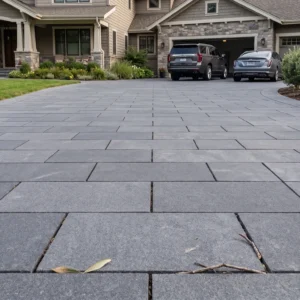
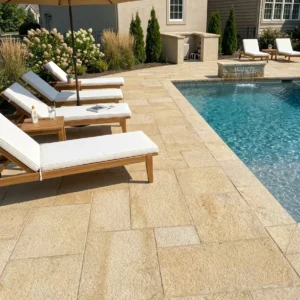
Permeable pavers cost more upfront than standard concrete, and that gap is real — but the figure on your quote sheet rarely tells the complete story. The performance breakdown that actually matters involves four separate cost layers: material, base construction, installation labor, and long-term storm drainage value. Getting that breakdown right before you commit determines whether the budget you set is realistic or whether you’ll be revisiting numbers mid-project.
What Drives Permeable Pavers Cost
The material itself accounts for roughly 30–40% of total project cost for most permeable paving installations. That percentage shifts depending on whether you’re specifying natural stone, concrete-based permeable units, or a hybrid system. Natural stone permeable pavers — particularly open-jointed flagstone layouts — typically run $15–$35 per square foot for the material alone, while manufactured concrete permeable units fall in the $8–$18 range. The performance gap between those categories is significant and worth unpacking before you focus on the unit price.
Base construction is where the real cost differential lives. A properly engineered permeable base — gravel reservoir layer, choker course, and bedding aggregate — typically adds $6–$14 per square foot depending on soil conditions and required infiltration rate. On compacted clay soil, that number climbs. On sandy loam, it compresses. Your geotechnical report, if you have one, will tell you what you’re working with. Without that data, the base estimate is a guess.
- Material cost: $8–$35 per square foot depending on stone type and origin
- Base construction: $6–$14 per square foot for engineered aggregate reservoir
- Installation labor: $6–$12 per square foot for experienced crews familiar with open-joint systems
- Edge restraint systems: $3–$7 per linear foot for mechanical restraints rated for storm load conditions
- Total installed cost range: $20–$65 per square foot, with natural stone at the higher end
Natural Stone vs. Manufactured Units: A Cost Comparison
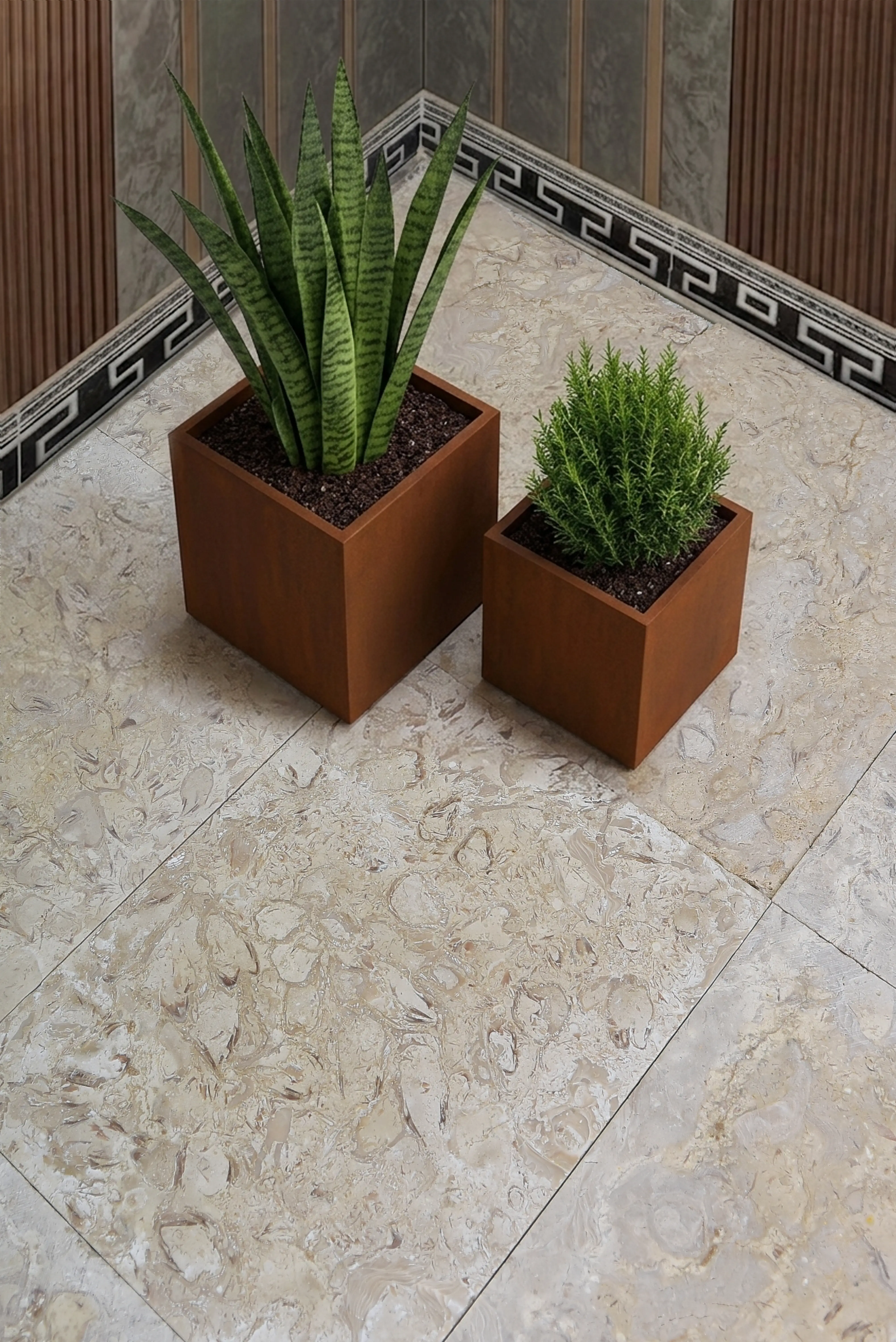
Manufactured permeable concrete units have dominated the commercial permeable paving market for a decade, largely because their cost appears lower on paper. At $8–$18 per square foot for the unit itself, they look compelling. The problem surfaces when you evaluate lifecycle cost across a 20-year window rather than a 5-year budget cycle. Concrete permeable units exhibit progressive joint clogging, surface spalling in freeze-thaw cycles, and color fade that accelerates maintenance frequency. By year 12–15, a significant percentage of installations require partial or full replacement of the surface course.
Natural stone open-jointed permeable layouts behave differently. The material doesn’t depend on factory-molded void channels — the open joint geometry is created at installation and maintained by the bedding aggregate beneath. That structural separation means individual units can be pulled and reset without disturbing adjacent stone, and the natural surface doesn’t degrade the same way engineered concrete does under UV and freeze-thaw cycling. According to Natural Stone Institute technical stone specifications, properly specified and installed natural stone paving consistently demonstrates 40–60 year service life under typical outdoor loading conditions — a lifecycle figure manufactured concrete units rarely approach.
- Manufactured concrete permeable units: lower initial cost, higher 15-year maintenance cost
- Natural stone open-jointed systems: higher initial investment, lower long-term cost per year of service
- Stone’s dimensional stability reduces joint re-sanding frequency compared to concrete systems
- Individual stone units can be relaid without sourcing matching replacement batches when ordered from consistent quarry programs
Base Engineering: The Cost You Cannot Skip
The aggregate reservoir beneath a permeable paver system isn’t optional — it’s the functional infrastructure that makes the surface work. Specifiers who value-engineer the base to reduce cost almost always face post-installation problems: surface settlement, joint sand displacement, and reduced infiltration rates that negate the stormwater management benefit entirely. A properly engineered base for most residential applications requires a minimum 6-inch clean crushed stone reservoir (ASTM No. 57 or equivalent), a 2-inch choker course of No. 8 stone, and a bedding layer of chip stone sized to allow free drainage while supporting the paver’s dead and live loads.
For commercial or driveway applications, that reservoir depth commonly increases to 8–12 inches, particularly in regions with high annual rainfall or heavy clay subsoil. Each inch of additional reservoir depth adds approximately $0.80–$1.40 per square foot in material and compaction costs. That’s not a place to cut — it’s a place to specify correctly from the start. The ASLA guidance on permeable paving surfaces consistently emphasizes that base depth relative to local infiltration demand is the single most influential factor in long-term system performance.
- Minimum residential base: 6-inch No. 57 crushed stone reservoir
- Commercial and driveway base: 8–12 inch reservoir with geotextile separation layer below
- Choker course: 2 inches of No. 8 stone bridging reservoir and bedding layer
- Bedding aggregate: 1-inch minimum chip stone — never sand in open-joint systems
- Subgrade prep: scarify and compact to 95% Proctor before placing any aggregate
Storm Load Performance and Edge Restraint Costs
Edge restraint is where permeable paver systems lose performance under storm event conditions — and it’s also where budget cuts create disproportionate long-term problems. Wind-driven rain during intense storm events applies lateral hydrostatic pressure to open-joint paving systems in a way that standard mortared paving never experiences. The joint openings that enable infiltration also create pathways for hydraulic pressure to push individual units laterally over time. Without mechanical edge restraint rated for that load, joint geometry migrates, infiltration rates drop, and surface trip hazards develop.
The cost of proper edge restraint for permeable stone systems runs $3–$7 per linear foot for heavy-duty plastic or aluminum restraints spiked at 12-inch intervals into the compacted base. Steel pin depth matters — 8 inches minimum in competent gravel base, 10–12 inches in softer soil conditions. That specification doesn’t flex in areas with regular severe weather. The edge restraint is the mechanical anchor that keeps your entire surface geometry intact after a 3-inch rainfall event drives water across the paving at velocity.
- Heavy-duty permeable paver edge restraint: $3–$7 per linear foot installed
- Spike interval: 12 inches on center — never exceed 16 inches for open-joint systems
- Spike depth minimum: 8 inches into compacted aggregate base
- Corner and curve points require double spiking regardless of soil condition
- Hail impact resistance is a secondary benefit of thicker natural stone — specify 2.5-inch minimum for driveway applications in severe weather zones
How Stone Sourcing Affects Your Permeable Pavers Cost
Material sourcing is a cost variable that rarely appears on spec sheets but consistently shows up in project outcomes. Flagstone and dimensional stone drawn from quarries with tight thickness control — typically ±1/8 inch calibration tolerance — dramatically reduces installation labor because units seat consistently in the bedding aggregate without hand-trimming or shimming. Loosely calibrated stone, which is common in cost-compressed supply chains, can add 15–25% to installation labor as crews compensate for thickness variation unit by unit.
At Citadel Stone, we source open-jointed permeable stone from quarry programs with documented calibration tolerances, which is something we verify through warehouse thickness checks before material ships on truck. That quality gate matters more for permeable systems than for mortared installations, because bedding aggregate depth consistency is what maintains your joint geometry across the entire surface. You can explore our permeable paving selection to see the material categories and calibration standards we maintain for open-joint applications.
Material sourced from Middle East quarries — particularly lighter-toned limestone and basalt — has become a dominant category in the open-joint permeable market. These materials combine high compressive strength (typically 8,000–14,000 PSI) with low absorption rates that resist freeze-thaw degradation without surface sealing. The density that makes them durable also gives them the mass to resist wind-driven displacement when jointed correctly. Quarry origin matters because the geological consistency of the formation directly affects how predictably the stone performs across a large project area.
Integrating Vertical Stone Elements with Permeable Paving Budgets
Projects that combine horizontal permeable paving with vertical stone elements — retaining walls, planters, or columns — require a unified material budget that accounts for both applications. Installing manufactured stone veneer on adjacent vertical surfaces follows a completely different cost model than open-joint paving: mortar-set systems with scratch coat preparation typically add $12–$22 per square foot for the veneer work alone, separate from the permeable pavers cost line item. Treating those budgets independently prevents the common problem of discovering that the vertical stone finish exceeds contingency after the paving budget is committed.
The specification alignment between horizontal and vertical stone elements also affects visual coherence. Sourcing the veneer and paving stone from the same material family — even if the finish differs — creates a unified aesthetic that reinforces design intent. That coordination decision is easier to make before purchase orders are placed than after stone from two different programs arrives on truck and the color variation is obvious in place. When installing manufactured stone veneer on walls adjacent to a permeable field, confirm that the mortar system used on the vertical face is compatible with the open-joint drainage plane below — bleed water from the scratch coat should never discharge onto the permeable surface at volume.
Maintenance Costs and Long-Term Budget Planning
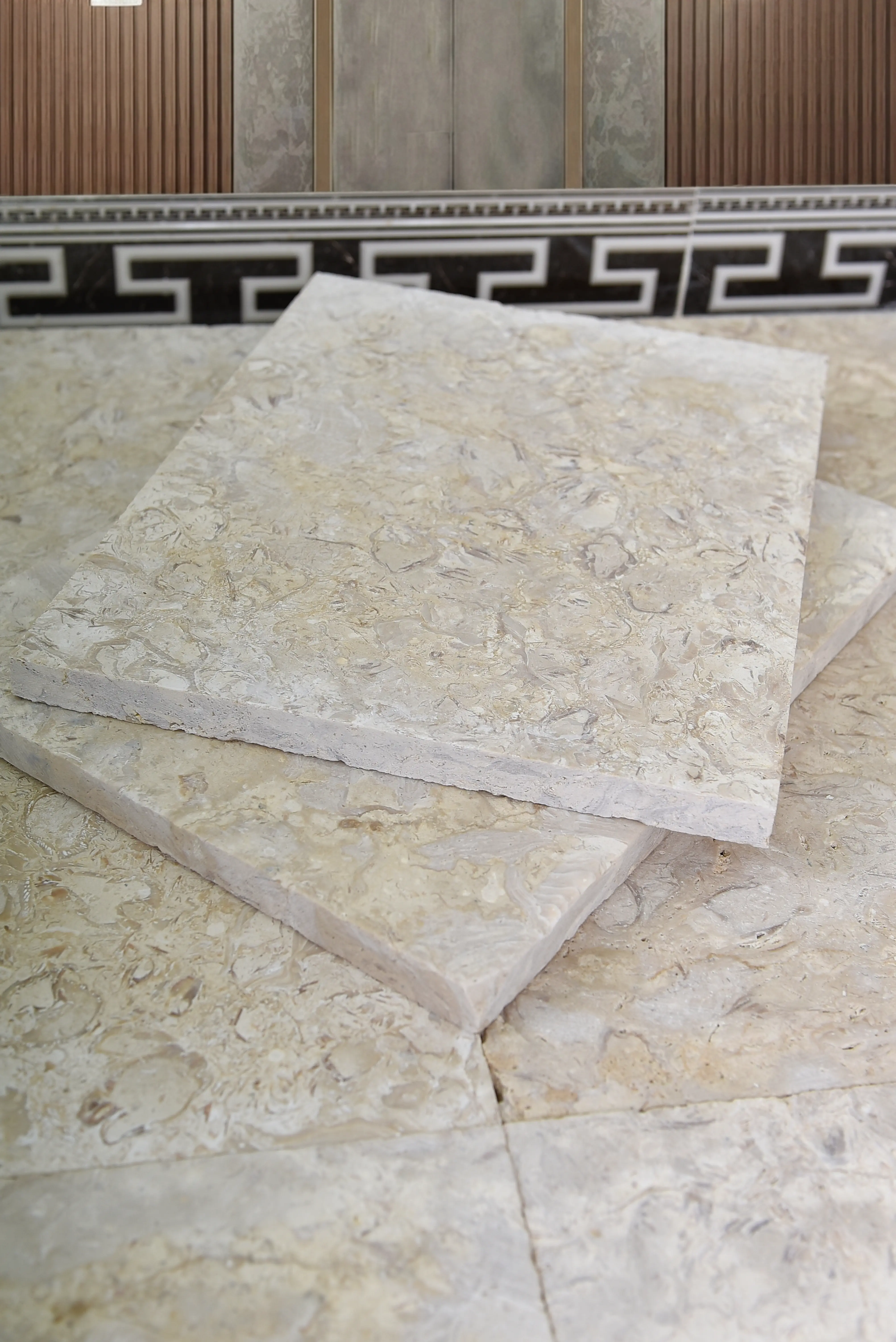
Permeable pavers cost analysis is incomplete without a 10-year maintenance projection. Joint aggregate replenishment is the primary recurring cost — open-joint systems require top-dressing with chip stone every 3–5 years as surface traffic and storm events gradually displace bedding material from the upper joint zone. Budget $0.50–$1.20 per square foot for joint replenishment material and labor, applied on a 4-year cycle for residential applications and a 3-year cycle for commercial and driveway surfaces.
Sediment accumulation in the aggregate reservoir is the other long-term consideration. In areas with significant fine particle runoff — from mulched planting beds or decomposed granite borders — the lower aggregate layers can experience gradual clogging that reduces infiltration rate over time. Vacuum sweeping the surface annually removes the majority of fine particles before they migrate into the base. According to USGS dimension stone production and use data, natural stone dimension products consistently demonstrate the lowest surface degradation rates among paving materials under outdoor exposure — a factor that directly reduces surface replacement frequency in your 10-year cost model.
- Joint aggregate replenishment: $0.50–$1.20 per square foot every 3–5 years
- Annual vacuum sweeping: $0.15–$0.35 per square foot for commercial-grade equipment
- Edge restraint inspection: annually after any major storm event — re-spike displaced sections immediately
- Natural stone surface sealing: optional on most open-joint systems — evaluate based on stone porosity, not aesthetics
- Full base rehabilitation: rarely required before year 20 in properly specified systems
Ordering Logistics and Lead Times for Permeable Stone
Your project timeline is directly affected by where the material sits in the supply chain when you commit to the purchase. Stone currently held in warehouse inventory ships on a 1–2 week lead time for most destinations — a schedule that aligns with typical contractor mobilization windows. Material that requires an import order typically involves a 6–10 week lead time from quarry to job site, and that gap creates real project risk if your contractor schedules are already set.
Pallet weight and truck configuration also affect permeable pavers cost on large projects. Open-joint permeable stone ships on standard 48-inch pallets at 3,000–4,500 lbs per pallet depending on stone density. A 2,000 square foot project at 2-inch thickness in basalt or dense limestone will require careful freight planning — the material weight per truck load limits how much you can move in a single delivery, and that constraint affects both scheduling and final delivered cost. Confirm truck access to the installation area before material is dispatched, particularly on residential projects with restrictive driveway approaches or overhead clearance limitations.
Getting Your Permeable Pavers Cost Estimate Right
The total permeable pavers cost for any project is a function of material quality, base engineering depth, installation skill level, edge restraint specification, and the maintenance cycle you commit to after completion. Projects that underbid the base and edge restraint to compress the initial cost consistently underperform — not dramatically at first, but progressively as storm events and traffic loads expose the gap between what was specified and what the installation actually needed. Getting the budget right from the beginning means accounting for all four cost layers, not just the material price on the quote.
For projects where you’re evaluating complementary hardscape options alongside permeable paving, material comparisons can sharpen your specification decisions. How rubber compares to natural stone for outdoor paving covers a useful contrast that many project teams overlook when evaluating surface material categories. Stone for nationwide projects ships in calibrated thicknesses that suit open-jointed permeable layouts across varied climates.
Related reading: patio paver sealer · Paver Joint Filler Problems and How to Fix Them · plastic edging for pavers guide.