The hardest worked square yard
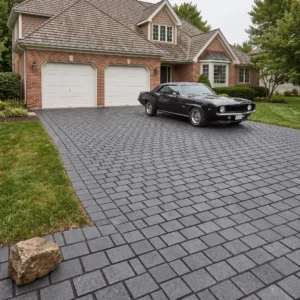
The strip between the lane and the gate takes more punishment than the rest of a Bermuda driveway put together. Vehicles arrive at an angle, brake, steer while nearly stationary and drag their weight sideways across the surface. That scrubbing action, not the static load, is what rotates and lifts paving units out of line. Anything laid on an apron has to be picked for that particular duty, and the decisions that matter are made below the surface long before the stone is chosen. It is also the point where the property meets the lane, so the finished levels have to work with the road as it actually sits rather than as a drawing shows it.
Depth comes before appearance
Thickness conventions on the island are simple enough to hold in your head: around 2 cm under cover, 3 cm for general exterior paving, and 5 cm and above wherever vehicles run. An apron sits firmly in that last group. Going thinner to trim the order is a false economy repaid in cracked units within a season of turning traffic, and depth also buys tolerance, because a deeper unit sits in more bedding and resists rocking when a wheel loads one corner of it. Depth on its own is not the answer either. A heavy unit over a thin base fails as reliably as a thin unit over a good one, so treat sub-base, bedding and unit as a single build-up decided together rather than three separate choices made by three different people.
The edge decides how long it lasts
Aprons rarely fail in the middle. They fail at the perimeter, where the outermost course has nothing holding it and traffic pushes outward with every turn of the wheel.
- Restrain every free edge with a haunched curb or a bedded edging course.
- Take the restraint down below the bedding layer, not just against the sett faces.
- Give the lane-side edge the strongest detail anywhere on the job.
- Keep joints full and topped up, because empty joints let units rotate.
Why small units suit turning traffic
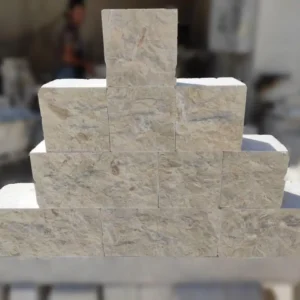
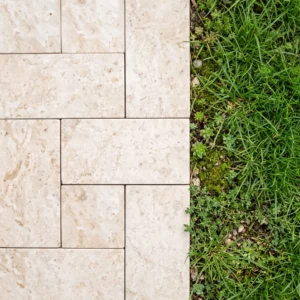
A slab carries a wheel load across one plate, so a lifted corner takes the whole piece with it. Small units share that load between neighbors through their joints, and a single damaged piece is replaced instead of a whole panel. Specify cobble setts at apron thickness and the surface behaves as a flexible field rather than a set of brittle plates.
- Interlock improves as the unit gets smaller against the tire contact patch.
- Joints absorb small movements instead of passing them into a fracture line.
- Repairs stay local, quick and cheap in materials.
- Falls and crossfalls are easier to build into a small-unit surface.
Narrow lanes shape the apron
Road widths and vehicle-size limits here mean deliveries arrive on smaller trucks and turning may have to happen inside the property rather than out on the lane. That pushes the whole maneuver onto the apron. It is worth drawing the swept path of the largest vehicle you actually expect, including the delivery truck, before you fix the paved area, because an apron a few feet short is the reason wheels end up on the planting bed and the edge course goes first. Check the boundary condition while you are there. A crown, a gutter line or a step where the property meets the lane changes the falls you can work with, and it is far easier to design around at the start than to correct once levels are set.
Runoff at the gate
Bermuda has no rivers, streams or freshwater lakes, and roof-caught rain held in regulated tanks is the domestic supply. A driveway is the dirtiest surface on the property, so where its runoff travels is a specification question rather than an afterthought.
- Grade the apron so drive runoff is kept clear of anything feeding a tank.
- Check every sealer, cleaner and degreaser against that drainage route first.
- Give the fall somewhere to go: a channel, a soakaway or a planted margin.
- Stop joint sand washing into a collection route during heavy rain.
Storm exposure and standing water
Fabian in 2003, Nicole in 2016 and Humberto in 2019 are reminders that this island takes serious storms, and the rainfall arriving with them is what finds a weak edge. Standing water at an apron softens bedding and scours joints, and once the joints are empty the units start to move under traffic. Falls, restraint and a working drainage route do more for survival than the choice of stone ever will.
- Keep falls positive so water leaves the apron instead of sitting on it.
- Check joint material after heavy rain and refill before units begin to move.
- Give the low point an outlet sized for a downpour, not for a drizzle.
- Inspect the restraint after a storm, since scour starts at the perimeter.
Pricing an apron properly
Aprons are small in area and heavy in detail, so the material line is rarely the whole story. Excavation depth, base build-up, restraint and drainage usually carry more of the cost than the paving does. Send the dimensions, the vehicle you need to accommodate and the drainage constraint, then price an apron in setts against the real build-up instead of a square-foot guess. An apron is a structure with a stone surface, and it should be priced that way.