Why Frost Ratings Miss the Point
Paving specifications are often written for climates that freeze, and they lean on freeze-thaw cycle counts as shorthand for durability. Bonaire sits at roughly 12 degrees north. Nothing on the island freezes, so a cycle count is a number with no local meaning, and a stone that passes it can still fail badly here.
What the island does have is salt, wind and very little rainfall. Annual rain runs at roughly 14 to 18 inches, arriving in a wet season from October to January that peaks in November and December. The northeast trade wind blows year round at an average close to 15 mph, carrying salt onto every horizontal surface, and there is little rain to rinse it away again.
What an Absorption Figure Tells You
Water absorption by weight is the share of its own mass a dry stone takes up when soaked. A low figure means a tight pore network with less room for liquid to sit. That single number stands in for several practical things: how fast a terrace dries after a wash-down, how much dissolved salt travels inward, and how deeply sunscreen penetrates before anyone can lift it.
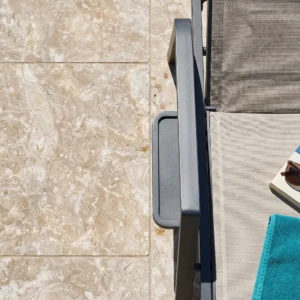
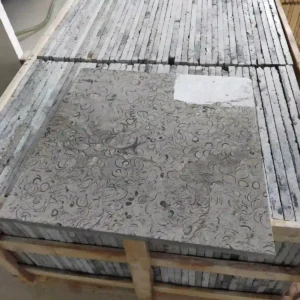
Density is the companion figure. Two limestones can look almost identical on a sample board and behave differently after years of trade wind, because one has the tighter grain and the higher bulk density. Neither property is visible in a photograph; both come off a test report.
Salt Crystallization Is the Mechanism
Salt here is a permanent condition, not a seasonal event. The Pekelmeer saltpans lie at the south end of the island, the sea is never far, and the wind is steady. When salt-bearing water enters an open pore and evaporates, the salt left behind crystallizes and expands against the pore wall. Repeat that daily for years and an absorptive unit begins to fret at its face.
The countermeasures are unglamorous, and they work:
- Put the lowest-absorption units in splash zones and on wind-facing frontage.
- Keep bedding and jointing free of chloride, and never bed on beach sand.
- Fall the surface so water leaves rather than ponding and concentrating.
- Rinse exposed paving with fresh water wherever a supply allows it.
- Increase unit thickness where salt exposure and wheel loads land together.
Matching the Figure to the Zone
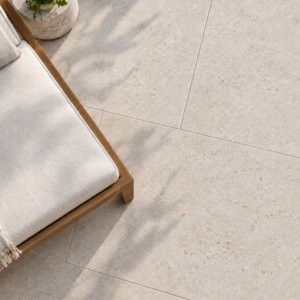
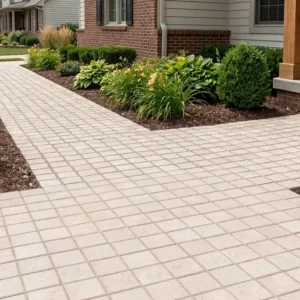
No property faces one set of conditions across its whole footprint. An interior floor, a courtyard behind a wall, an open terrace and a splash zone each ask for something different, and one specification for all of them wastes money at one end and invites trouble at the other. The tightest stone earns its keep where wind and water arrive together, which is why low-porosity limestone units for Bonaire are worth reserving for the exposed edges.
- Interior floors: comfort, cleaning and tone lead the decision.
- Sheltered courtyards: moderate absorption is easier to live with.
- Open terraces: wind-driven salt reaches every part of the surface.
- Pool and shore edges: the tightest units, with the deepest texture.
What Sits Under the Paving
A dense wearing surface laid over a base that traps water will still disappoint. Bedding, sub-base and drainage decide how long salt-bearing moisture stays against the underside of a unit, and in a dry climate the instinct to skip drainage detail is strong precisely because heavy rain is rare. When it does rain in November it arrives quickly.
- Fall the finished surface so water is shed rather than held in low spots.
- Use permeable jointing where the build-up and the detailing allow it.
- Keep bedding depth consistent so units bear evenly across the area.
- Control sediment during the works, because runoff does not stop at the boundary.
The Marine Park Begins at the High-Water Mark
Bonaire National Marine Park covers all the water around Bonaire and Klein Bonaire, from the high-water mark down to sixty meters, and is managed by STINAPA Bonaire under the marine environment ordinance. A shoreline terrace is being built at the park boundary, not merely near it. Four Ramsar wetland sites, Washington Slagbaai, Klein Bonaire, Lac Baai and Pekelmeer, were each extended with a 500-meter buffer zone in 2021.
Building work is consented separately. A bouwvergunning is issued by the bestuurscollege, which must decide within sixteen weeks and may extend that once by up to eight weeks, and the BES Bouwbesluit sets general standards for structural safety, user safety, fire safety and accessibility.
Landing the Stone in Kralendijk
Getting tested stone to the island is not the hard part. The King Ocean ABC service leaves Port Everglades on a Saturday and reaches Kralendijk on the Thursday, a five-day direct sailing with no transshipment, and it has run since 1982. The paperwork side is short enough to set out in a list.
- Import tax on goods entering Bonaire is set at nil, zero rated across the board.
- ABB, the general expenditure tax, applies at eight percent on goods at import.
- ABB is calculated on customs value: goods plus insurance plus transport.
- An import declaration is filed with Douane Caribisch Nederland.
- The US dollar has been the official currency since 1 January 2011.
Those figures sit alongside freight and paperwork in the wider Bonaire supply notes, which is where to start when budgeting a landed cost.
Test a Piece Before You Commit
Numbers on a report are only the beginning. Put a hand sample outside on the site, leave it through a windy week, wet it, walk it barefoot at midday, and clean it the way the household actually will. Compare what you felt against the report you were given.
Absorption is the one figure worth arguing about before the container is booked.