Wet Grip Is a Finish Decision
The body of a stone sets absorption, density and strength. The face sets what happens when a wet foot lands on it. Around a pool that distinction is the entire specification, because the surface is wet by design for most of the hours anyone uses it. Two units sawn from the same block can grip very differently once one has been flamed and the other honed, so a decision made from a photograph of a dry sample is not really a decision at all. The body still matters, but it answers a question about service life rather than about the next five minutes on a wet deck.
The Faces and What Each One Does
Every face is a trade-off between bite, comfort and how easily the surface rinses clean. None of these terms is a guarantee of performance on its own, so treat the list below as a shortlist to test rather than as a ranking to buy from.
- Bush-hammered gives a pitted, open face that keeps bite while the deck is streaming
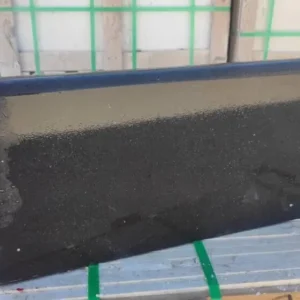
- Flamed produces a thermally textured profile that breaks water quickly
- Brushed offers a softened texture that holds grip and stays kind to bare feet
- Tumbled eases the edges and reads as worn, which suits an open court
- Honed and polished faces belong indoors here rather than on a wet deck
Two Kinds of Water Land on the Same Deck
Treated pool water and sea salt are different problems, and a coastal deck on Curacao gets both. Pool chemistry leaves its own residue. On the east and north sides of the island the trade winds carry a standing salt aerosol onto anything in their path, running at roughly 15 to 25 knots for most of the year. Washdown water leaves whatever it dissolved wherever it happens to dry. A face that traps residue deep in its texture will look tired long before the stone is anywhere near worn, so open textures that rinse clean tend to age better than closed ones that hold a film. Aspect decides how hard that pressure is: a west-facing deck sits in far calmer air than one on the windward side. Start from wet-area limestone paving we stock and work outward to the coping and the surrounds.
Falls, Drainage and the Puddle Problem
Standing water is where salt does its damage, so the drainage design matters as much as the finish sitting above it.
- Set falls away from the coping and toward a run that genuinely discharges
- Size the run-off for a cloudburst; Hurricane Tomas put 265 mm on the island in one day in 2010
- Avoid dished units and flat spots where salted water can sit and dry out
- Keep joint material salt-tolerant and inspect it after the October to December wet months
- Give the deck a rinse point so residue leaves the surface instead of building up
Grip and Comfort Pull in Opposite Directions
The roughest face is not automatically the right one. A texture that grips a running child also scrapes an adult lying on it, and on a sun-struck deck an aggressive profile can feel harsh at midday. The workable method is to find the roughest face the users will accept, then confirm it wet rather than dry. Pale tones help here too, since a cooler surface makes a slightly more open texture comfortable to stand on for longer. It is also worth splitting the deck: the wet ring around the water and the dry lounging area are two different jobs, and specifying them separately usually gives a better result than forcing one compromise across both.
Coping and the Wet Edge
The coping takes more water, more traffic and more hands than any other part of the deck, and it decides how the whole edge reads.
- Choose a coping face that stays sure underfoot when it is thoroughly soaked
- Keep the edge comfortable to grip from the water and to sit on for a while
- Detail the joint so salted water cannot stand against the stone behind it
- Order coping and field together so tone and texture match on delivery
Splitting the coping into a later order is where tone mismatches tend to appear, because a second batch is a second selection. Agreeing the profile, the overhang and the joint width at the same time as the field also removes a round of questions on site.
Test It Wet, Not Dry
Comparing faces worked for wet footing on paper only narrows the shortlist. The last step happens on site with a bucket, and it is worth doing properly.
- Wet each sample thoroughly and step on it barefoot, not in deck shoes
- Tilt the piece slightly to imitate the fall the deck will actually carry
- Leave one sample in full sun and check the surface temperature at two in the afternoon
- Rinse a piece after a salty week and see whether the texture releases the residue
- Check how each face looks once it has dried, since that is its resting appearance
Do the test with the people who will use the deck rather than alone, because opinions about texture differ far more than opinions about tone. Once the face is settled, thickness, format and jointing are straightforward decisions to make.
Choose the face with a wet foot on it, and the rest of the pool deck specification follows easily.